
Accelerators Riverside Health Cardiology RPM Program
Out of the vitals firehose, one patient actually needs you right now.
Meridian turns a continuous stream of remote weight, blood pressure, SpO₂, and symptom data into a ranked, explainable worklist — so a five-person cardiology panel can tell the difference between a patient trending toward decompensation and one whose numbers just moved a little.
Schedule a Demo
Play Video
Watch Platform Flow
Live on Riverside HealthCardiologyBuilt by Bitcot

44
/100
EXPLAINABLE RISK SCORE weighted against configured care-plan thresholds
50
%
ESCALATIONS acknowledged or resolved, tracked to the minute
0
SAFETY-BYPASS FIRINGS missed every Level 2 alert reached on-call
356
Min
CLINICAL TIME LOGGED automatically, ready for CPT claim

The Case For a Native
The web portal proved the model. The app is how it reaches someone in time.
Meridian’s clinician portal already does the hard clinical work: it scores risk, holds an escalation ladder, and gives Riverside’s team something they never had a ranked, explainable answer to “who needs me right now.” The open question isn’t whether the model works. It’s whether that answer actually reaches a nurse’s pocket, a patient’s kitchen counter, or an on-call physician’s nightstand at 2 a.m. reliably, every time. That’s a mobile platform decision, not a clinical one, and it’s worth making deliberately.
Where a browser tab runs out of road
The Escalations module already distinguishes a routine Level 1 note to the care team from a Level 2 safety-bypass page to on-call, but a ladder only works if the rung actually rings. A patient’s daily check-in (“harder I get winded walking”) needs to reach someone even when their phone is locked and the app hasn’t been opened in hours. A web portal, even installed to a home screen, depends on the browser’s notification stack being open, permissioned, and awake, and on iOS in particular, that stack is the least reliable link in an escalation chain that Meridian was built specifically to make dependable.
Where the vitals actually come from.
Today, Maria Gonzalez’s weight and systolic BP land in Meridian because someone enters or syncs them. The CHF, COPD, and hypertension protocols already defined in Care Plans daily weigh-ins, weekly BP checks, SpO₂ floors are built to run on a steady drip of real device data: Bluetooth scales, BP cuffs, pulse oximeters, CGMs. Getting that data in automatically, with no manual step for a 68-year-old CHF patient to forget, is a native Bluetooth and HealthKit/Health Connect problem, not a browser one.
01
Escalations that can’t wait for a tab
Native push (APNs/FCM) can wake a locked device, sound an alarm tone, and hold a persistent lock-screen alert for a Level 2 safety bypass, the exact case Meridian’s escalation ladder exists to handle.
02
Vitals that arrive without being typed
Direct Bluetooth pairing with BP cuffs, scales, and pulse oximeters and HealthKit/Health Connect sync feed the care-plan thresholds automatically, closing the adherence gaps a manual check-in can’t.
03
Reminders that survive a locked phone
Background execution keeps daily check-in reminders and offline data queuing running for homebound CHF and COPD patients, independent of whether the app or a browser tab is open.
04
A faster, more private way in
Face ID/biometric unlock backed by the secure enclave gets a clinician or patient into PHI in under a second without re-typing a password on a shared or locked-down device.
05
Trust that shows up before the first tap
An App Store / Play Store listing carries weight with patients deciding whether to trust a health app, and with a health system’s IT and security review during procurement.
06
Room to grow with the roadmap
The physician role is already reserved in the schema. Native device APIs leave room for future work, wearable integration, video visits, and on-device symptom capture without renegotiating platform limits later.
PWA vs. Native measured against Meridian’s own use case
Criteria
Progressive Web App
Native (iOS / Android)
Escalation push delivery
Web push exists, but on iOS it requires the site to be installed and is historically inconsistent when the device is locked the exact moment a Level 2 alert matters most.
APNs / FCM deliver to a locked screen with sound and priority, matching the urgency of a safety-bypass escalation.
Background execution
Service workers are throttled or suspended in the background, especially on iOS Safari unreliable for check-in reminders or offline queuing.
True background tasks keep reminders and offline sync running independent of whether the app is foregrounded.
Device & wearable integration
Little to no Bluetooth (BLE) support and no HealthKit / Health Connect access vitals still need manual entry.
Direct BLE pairing with BP cuffs, scales, and pulse oximeters, plus HealthKit / Health Connect sync.
Biometric / secure PHI access
Relies on browser session and OS-level Face ID gating for the browser itself, not the app experience.
Face ID / Touch ID tied directly to the app via the secure enclave, gating PHI at the screen level.
Distribution & institutional trust
Shared as a link or home-screen bookmark lighter weight, but easy to overlook and harder for hospital IT to vet or manage via MDM.
App Store / Play Store listing plus MDM enrollment support, which health-system procurement and security review expect.
Engineering cost & time to ship
One codebase, no store review, and instant updates meaningfully cheaper and faster to get a first version live.
Native (or native-shell) builds per platform, plus store review cycles, add real cost and calendar time.
Update & maintenance cadence
Ship a fix and every user has it on next load no review queue, no forced update prompts.
Store review adds a delay before a fix reaches every device; critical patches still need expedited review requests.
Reach across older / low-end devices
Runs in any modern browser regardless of OS version useful for a broad, mixed-device patient population.
Best experience assumes a reasonably current OS version; older devices may lag on feature support.
Recommendation
PWA genuinely wins on cost and shipping speed; that’s a real, not a token, advantage. But Meridian’s core value is getting the right alert to the right person before it’s too late, and that promise lives or dies on push reliability, background execution, and direct device integration, the three rows where native pulls clearly ahead. A pragmatic middle path is a native-shell build (e.g., React Native / Expo) that reuses the existing product logic and design system while gaining true push, Bluetooth, and biometric access natively where it counts, without rebuilding from zero.
The Product, Module By Module
One workspace, seven modules, a single source of truth.
Every screen below is the real, working product deployed for Riverside Health’s cardiology panel, built on Next.js, Supabase, and the Vercel AI SDK. No mockups.
AI-Powered Clinical Triage
Triage Queue
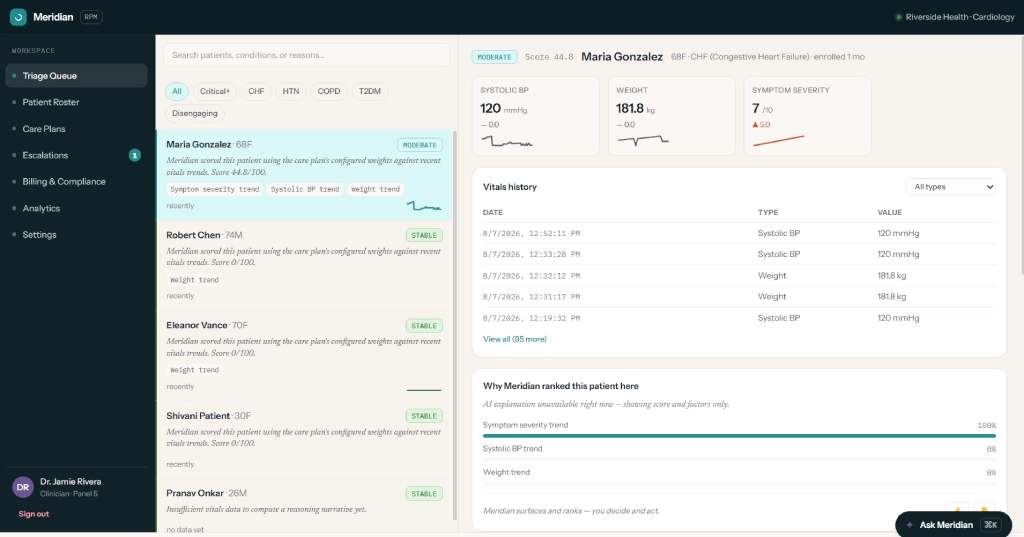
Every patient on the panel is ranked by an explainable score computed against the care plan’s own configured weights: symptom severity, BP trend, weight trend — not a black box. Maria Gonzalez surfaces above stable patients because her symptom-severity trend spiked, and the reasoning is shown, not hidden.
Patient Roster Management
Patient Roster
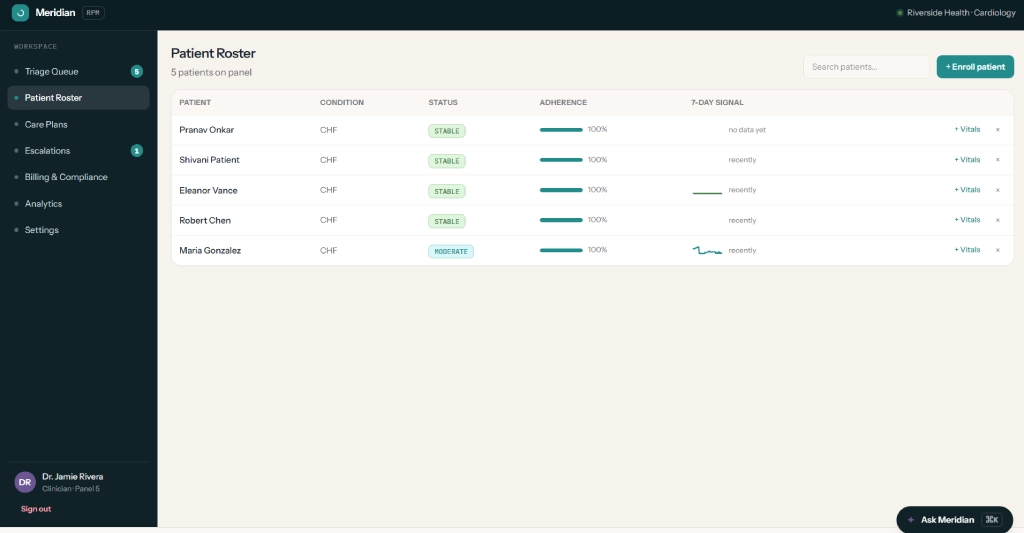
The full panel at a glance condition, status, adherence percentage, and a 7-day signal sparkline per patient so a coordinator can spot a flattening trend line before it becomes an escalation.
Care Plan Management
Care Plans
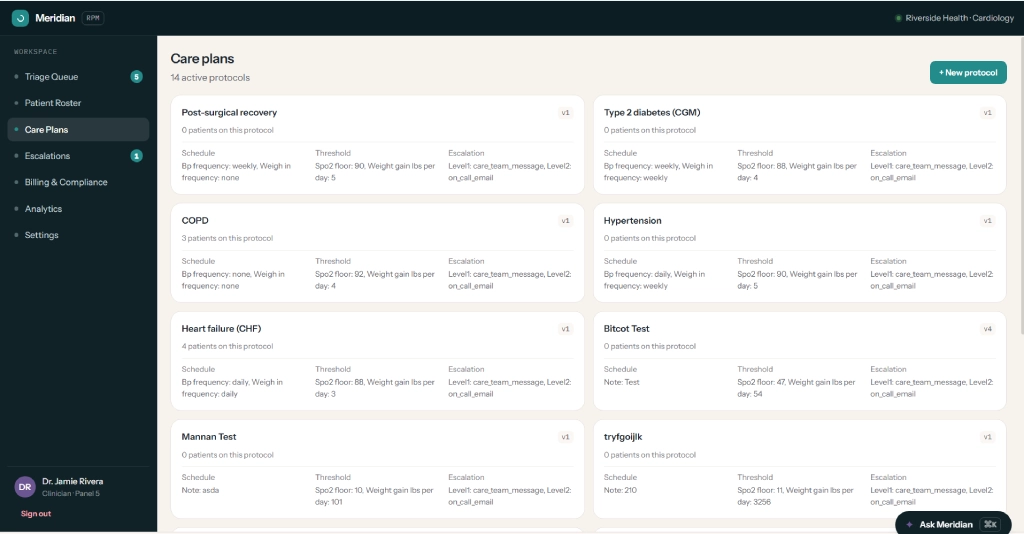
Condition-specific protocols for CHF, COPD, hypertension, and Type 2 diabetes each governing its own check-in schedule, safety thresholds, and two-level escalation pathway, versioned and editable without touching code.
Patient Actions & Escalation
Escalations
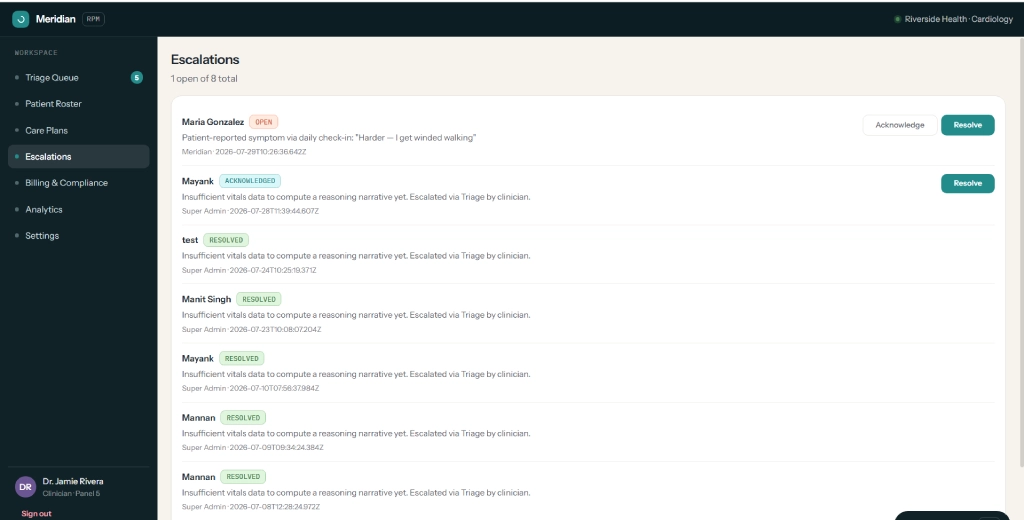
Every alert the system has ever raised is in one auditable log, open, acknowledged, or resolved with a one-click path to acknowledge or close the loop, and a permanent record of who did it and when.
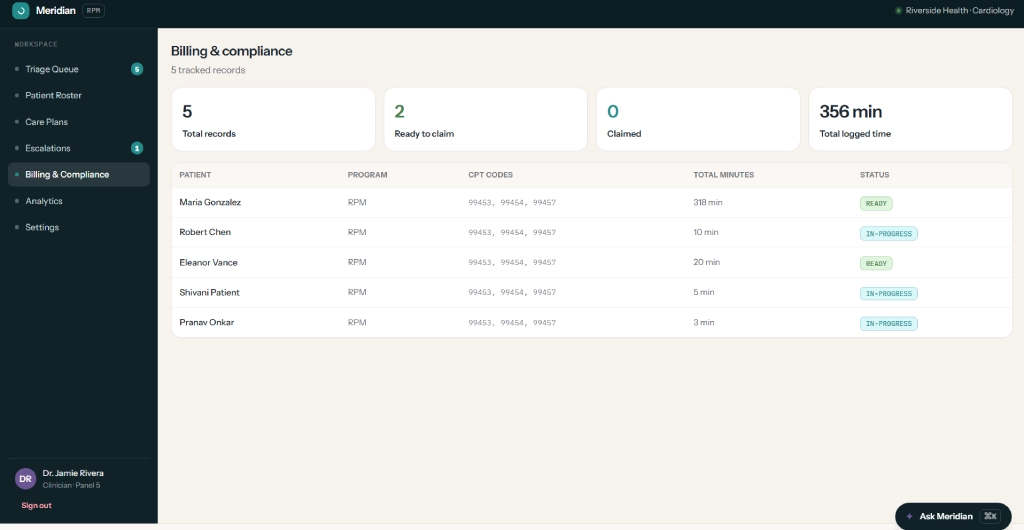
Billing & Compliance
Billing & Compliance
Clinical time is tracked automatically against the CPT codes. RPM billing requires 99453, 99454, and 99457 with a live status per patient, so nothing sits unsubmitted at month-end.
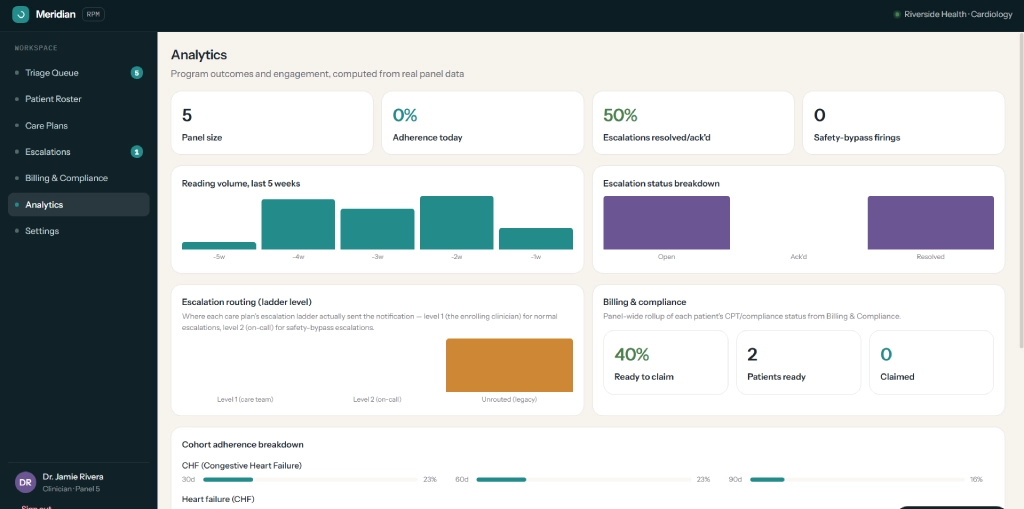
Clinical Analytics
Analytics
Panel-wide outcomes computed from real vital-reading volume trends, escalation routing by ladder level, and cohort adherence by condition, turning five weeks of monitoring into a picture the whole team can act on.
Secure Access & Role Management
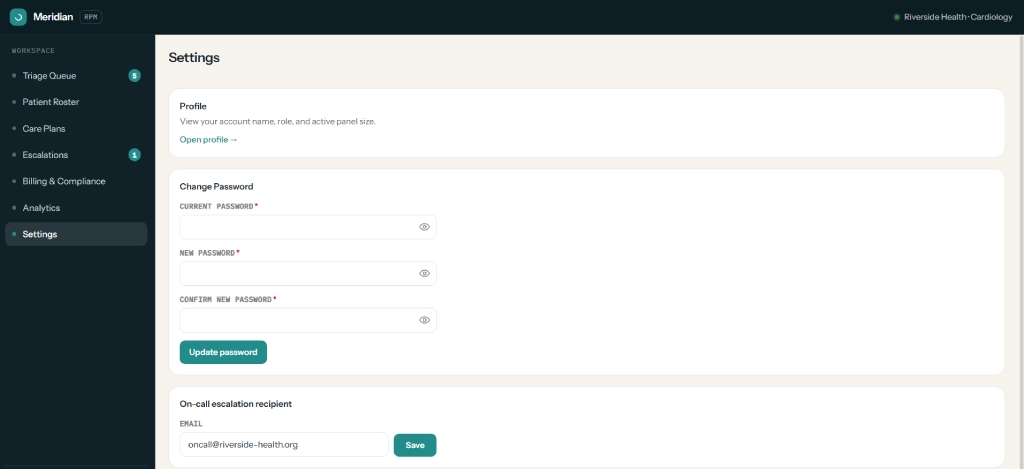
Settings
Account, password, and role management alongside the one setting that matters most operationally, where a Level 2 escalation actually gets routed when no one’s watching the queue.
A guided walkthrough of the live product.
From triage queue to escalation to a closed billing record, the full loop, in one recording.
Built on
Next.js (App Router)VercelSupabase · PostgresSupabase Auth + RLSTypeScriptTailwind CSS + shadcn/uiVercel AI SDK · GPT-4.1
Roles today, room tomorrow
clinicianpatientphysician reserved
Get in Touch
Ready to see it in action?
The platform is live and demo-ready. Reach out to schedule a walkthrough with the Bitcot team.
Let’s go from 0 to 1+
Tell us how you dream it. We’ll show you how to ship it.
A 30-minute discovery call with a senior engineer, not a sales rep. Walk away with a build plan, a timeline, and a clear next step.
✓Reply within 1 business day
✓NDA on request, no obligation
✓Talk to engineers who’ve shipped in your industry
✓HIPAA and SOC 2-aware engineering
Prefer to talk now? +1 858 683 3692
Start the conversation
Takes about 30 seconds.