
The Amazon Seller MCP Data Pipeline gives a multi-brand platform one authenticated way to answer seller questions from an AI client such as Claude. Sellers connect their Amazon account once, and the platform collects, archives, validates, and stores their orders, inventory, financials, and catalog data in an isolated per-brand database. Claude then reads that data through 22 read-only Model Context Protocol (MCP) tools, so “what sold last week?” no longer starts with a manual report download. Our engineering team built and verified the full path in about four weeks.
From seller authorization to scheduled collection, validated storage, and AI answers in Claude, all in one pipeline
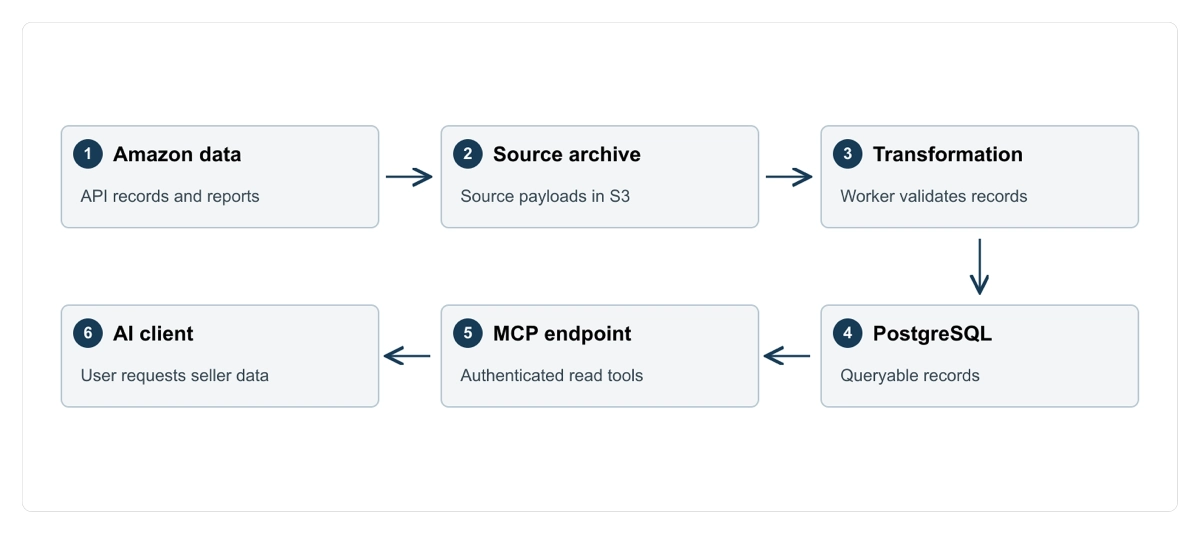
Amazon Seller Data Pipeline
Project Goal — One Trusted AI Question Interface Over Every Seller’s Amazon Data
Brand operators were answering every business question with a manual export or a one-off script, and no AI assistant could answer reliably without known, validated sources. The goal was a modular platform where a user signs up, connects their Amazon seller account once, and then simply asks their AI client. We combined generative AI integration over MCP with a cloud-native application backend on AWS, so the platform collects, validates, and stores the data behind the scenes for every brand.
Overcoming the Challenge — Fragmented Formats, Overlapping Data, Shared Risk
Amazon delivers seller data through document reports, API operations, and push notifications, each with its own format, schedule, marketplace, and permission rules. The same order can arrive from two sources, and a report can be delivered twice, so careless ingestion produces duplicates and conflicting numbers. Many brands share one platform, where a shared-table design sits one missing filter away from a cross-brand leak. Amazon calls are also rate limited and fail from time to time, so collection had to be retryable and resumable from the first day.
👏🏽Transformative Solution — Archive First, Isolate Every Brand, Read Only
The worker stores every raw payload and report document in S3 before transformation, so a wrong rule means a replay instead of a re-fetch from Amazon. A separate job normalizes money to decimals, timestamps to UTC, and country and currency codes, then upserts into the brand's own PostgreSQL schema. Progress markers and backoff retries let each run continue where the last one ended. Claude reaches that data only through read-only MCP tools checked against a hashed bearer key, so it can ask questions but never change seller data.
The Outcome
A recorded end-to-end run covered signup, login, brand creation, seller authorization, collection, transformation, MCP reads, and the readiness email in a single session, with database queries confirming the stored records afterwards. Sellers now connect Claude with one endpoint and one key, and Claude picks the right read-only tool for each question on its own. Every answer comes from validated records in the brand’s own schema, and the original payload in S3 lets anyone trace a number back to its source.
ONE AI QUESTION INTERFACE
REPLAYABLE RAW DATA
SAFE, REPEATABLE WRITES
PER-BRAND DATA ISOLATION
Tech Stack
Some technologies used for this project

NestJS

TypeScript

Python

PostgreSQL

Redis + BullMQ

AWS S3 + Cognito