
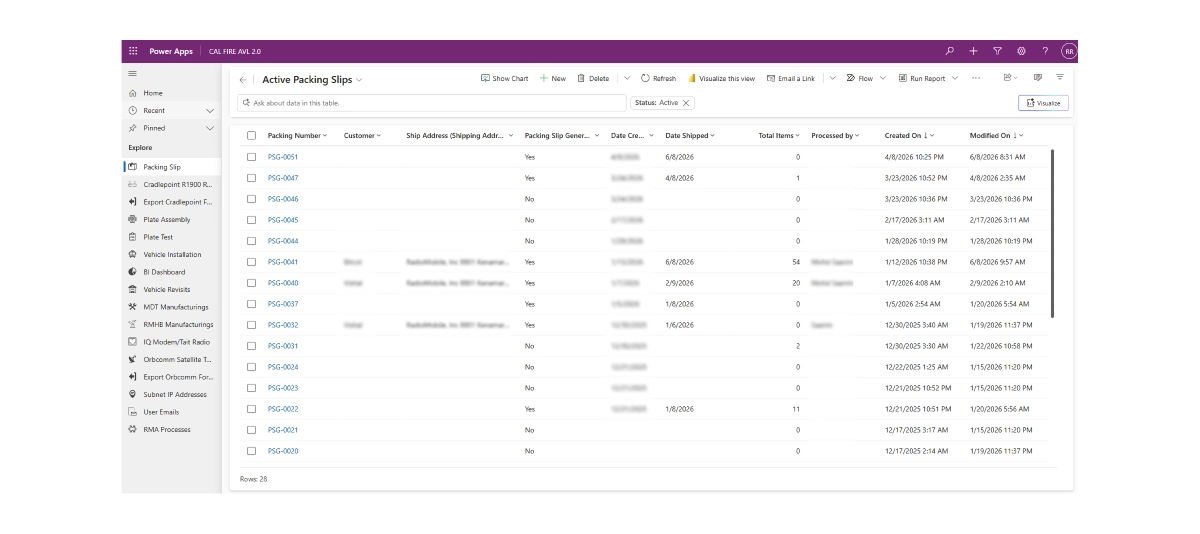
CAL FIRE AVL 2.0 is a mission-critical, model-driven portal purpose-built for a leading Fire & EMS mobile data solutions provider operating across California. The platform unifies every stage of the hardware lifecycle from assembly and quality testing through fleet installation and device activation giving distributed hardware teams, field technicians, and operations managers a single, real-time system of record.
From hardware assembly and QA testing to fleet installation and device activation, all in one portal
Hardware Manufacturing & QA Checklist

Vehicle Fleet Installation & Revisit Tracking
Project Goal — One System of Record for the Entire Hardware Lifecycle
Fire & EMS agencies depend on mobile data systems to dispatch resources and coordinate with command without a single failure. Yet the hardware supply chain behind those systems was managed on disconnected spreadsheets, with no structured QA, no centralized activation tracking, and no fleet-level visibility into what was installed, tested, or activated. The goal was to build a Microsoft Power Apps model-driven portal that replaced every manual process from assembly bench to fire apparatus with a single, auditable, real-time system of record across 16 integrated modules.
Overcoming the Challenge — Fragmented Data, No QA Standard, No Fleet Visibility
Stock levels, assembly status, and device serial numbers lived in disconnected spreadsheets. Cellular router and satellite terminal activations required manual extraction, vendor coordination, and error-prone re-import. Hardware testing lacked a structured checklist, making it impossible to audit quality or trace defects post-installation. Vehicle technicians had no unified system to log installations or flag revisit requirements. And with 1,500+ subnet IP assignments to maintain, network configuration errors were a constant risk.
👏🏽 Transformative Solution — 16-Module Hardware Lifecycle Portal
CAL FIRE AVL 2.0 was engineered as a complete hardware operations platform from packing slips and plate assembly to MDT manufacturing, satellite terminal activation, and fleet-level IP management. Built on Microsoft Power Apps with Power Automate RPA automation, the portal gave the entire team assemblers, QA technicians, field installers, and operations managers a single real-time view of every device at every stage. Every checklist step is logged, every serial number is traceable, and every activation is automated.
The Outcome
CAL FIRE AVL 2.0 eliminated manual hardware tracking chaos and delivered measurable impact across the entire supply chain and field operation. From zero IP conflicts to fully automated activations, the portal transformed how the client’s team assembles, tests, ships, and installs mission-critical communications hardware all through a single, scalable platform built for long-term reliability in public safety operations.
OPERATIONAL EFFICIENCY
QA TRACEABILITY
FLEET VISIBILITY
NETWORK RELIABILITY
Tech Stack
Some technologies used for this project

Power Apps

Power Automate

Dataverse

Microsoft 365