Key Takeaways
- Custom ecommerce builds your store around your business – not around a vendor’s defaults.
- Template platforms work well early on but become bottlenecks the moment you try to scale.
- A 1-second improvement in page load time increases conversions by up to 7% – custom development gives you full control over performance.
- The right development process covers 8 phases – from discovery and design through to launch and ongoing optimization.
- AI personalization, headless commerce, and PWAs are active competitive advantages in 2026 – not future trends.
- Vetting your software development company is as important as the decision to build custom – always check references, QA process, and post-launch support before signing.
- B2B, healthcare, fashion, and DTC brands gain the most from custom ecommerce because their workflows exceed what any template platform can handle natively.
Most online stores are not losing customers because of bad products. They are losing them because of bad platforms.
You already know the signs. Pages that load just slow enough to make people leave. A checkout flow you cannot fully control because the platform will not let you. A mobile experience that feels like an afterthought. Integrations that half-work. A design that looks like fifty other stores in your niche.
Every one of those friction points is a paying customer walking out the door. Quietly. Every single day.
Here is what most businesses do not realize: those are not problems you fix with another plugin or a better theme. They are architectural problems. And the only real fix is a platform built from the ground up around how your business actually operates.
That is exactly what custom ecommerce development delivers.
Bitcot has helped businesses across the US move from platform limitations to purpose-built commerce engines that convert better, scale faster, and cost less to operate long term.
This guide gives you everything you need to make a confident decision: what custom ecommerce development is, what it actually costs in 2026, how it gets built, how to choose the right software development company, and whether it is the right move for your business right now.
What Is Custom Ecommerce Development?
Custom ecommerce development is the process of designing and building an online store from scratch, engineered specifically around your business model, brand identity, customer experience goals, and existing technical ecosystem. Unlike template-based platforms, every feature, integration, and design element is built to your exact specifications – not adapted from defaults designed for someone else’s business.
The analogy most business leaders find useful: a template store is like renting a furnished apartment. You can rearrange the furniture and hang your own artwork, but the layout, the plumbing, and the load-bearing walls are fixed. Custom ecommerce development is like building your own property from the foundation up. Every room, every system, every detail is designed for exactly how you operate.
When a business invests in a custom ecommerce platform, they are choosing:
- A storefront that reflects their specific brand – not a vendor’s default template
- Features that match exactly how their business operates, not how a SaaS platform assumes it should
- Architecture that scales from 10,000 to 10 million SKUs without a disruptive platform migration
- Full code and data ownership – no dependency on a third party’s roadmap, pricing, or uptime
- Deep, native integrations with ERP, CRM, WMS, and logistics systems without plugin fragility
- Complete control over SEO architecture, Core Web Vitals, and technical performance
Custom development serves every ecommerce model: B2C retail, B2B wholesale portals, D2C brand stores, multi-vendor marketplaces, and subscription commerce.
Custom vs. Template Ecommerce: Which Is Right for You?
The choice between custom and template-based development depends on where your business is and where it is going. Here is the comparison business leaders actually need:
| Factor | Custom Ecommerce | Template Platforms (Shopify, WooCommerce) |
| Design Flexibility | 100% unique – built to brand specifications | Limited to available themes; overrides need developer workarounds |
| Feature Customization | Any feature can be built – no ceiling | Constrained to plugins and marketplace extensions |
| Scalability | Scales to millions of SKUs, users, and transactions | Can hit hard limits with large catalogs or traffic spikes |
| Performance Control | Fully optimized for your specific load profile | Shared infrastructure; speed varies by plan and app load |
| System Integrations | Deep, native ERP/CRM/WMS/logistics sync | Plugin-dependent; often shallow or brittle under load |
| SEO Control | Full technical SEO – schema, URLs, Core Web Vitals | Limited by platform structure and theme constraints |
| Data Ownership | 100% – your code, your servers, your data | Platform owns the infrastructure; data portability varies |
| Recurring Costs | Low (hosting and maintenance only) | Monthly sub + app fees + transaction fees (can reach $5K+/month) |
| Time to Launch | 8 to 30+ weeks | 4 to 12 weeks |
| Upfront Investment | $30,000 – $350,000+ | $5,000 – $50,000 |
| Best For | Growth-focused businesses with complex or high-volume needs | Early-stage brands with standard, simpler workflows |
A practical decision framework: if your business generates under $500K per year and your workflows are standard, a template platform is the right starting point. Once you are hitting platform limits – in features, performance, or integrations – the ROI case for custom development becomes clear. Most businesses that make the switch wish they had evaluated it sooner.
Why Growing Businesses Choose Custom Ecommerce Solutions
The global ecommerce market is projected to surpass $9 trillion by 2027. In a market that competitive, differentiation is not a nice-to-have – it is a compounding strategic advantage. Here is why established businesses are investing in custom ecommerce platforms instead of accepting the constraints of off-the-shelf tools.
When Template Platforms Cap Your Growth
Shopify, BigCommerce, and WooCommerce are excellent starting points. But they are not built for where serious ecommerce businesses need to go. The limitations compound over time:
- Checkout customization is restricted – and every restriction is a potential point of cart abandonment
- Product catalog logic requires expensive, fragile plugins that break on platform updates
- API rate limits throttle integrations at scale, creating data sync failures at the worst possible moments
- You are always at the mercy of the platform’s roadmap, pricing changes, and app ecosystem decisions
When those limits begin costing you revenue – and they will – the ROI case for custom development becomes undeniable.
The Revenue Impact of UX and Performance
Every second of additional page load time costs you money. Research from Portent consistently shows that a 1-second improvement in load time can increase conversions by up to 7%. For a store generating $5 million in annual revenue, that is $350,000 in recoverable revenue from a single performance improvement.
Custom ecommerce development gives you full, granular control over every performance variable: CDN configuration, image optimization strategies, JavaScript bundle architecture, server-side rendering, edge caching. Template platforms do not.
Unique Workflows Demand Custom Architecture
No two businesses operate identically. A wholesale B2B distributor with tiered pricing, net-30 terms, and purchase order approval workflows has nothing in common with a luxury D2C apparel brand. Both are ecommerce businesses. Neither can be fully served by the same template.
Custom development builds the exact workflow your business runs on – natively, without workarounds or duct-taped integrations.
Long-Term ROI vs. Recurring Platform Fees
Template platforms appear affordable until you calculate the true total cost of ownership:
- Shopify Plus: $2,500+/month platform fee (and rising)
- Transaction fees: 0.15-0.25% of revenue unless using Shopify Payments
- App stack: typically $500-$2,000+/month for a feature set a growth-stage business needs
- Developer fees for workarounds that a custom platform would handle natively
A custom-built store eliminates most of those ongoing costs. The upfront investment is higher, but most businesses that make the transition reach break-even within 18 to 36 months – and then continue saving and scaling on a platform they fully own.
Core Features of a Custom Ecommerce Website
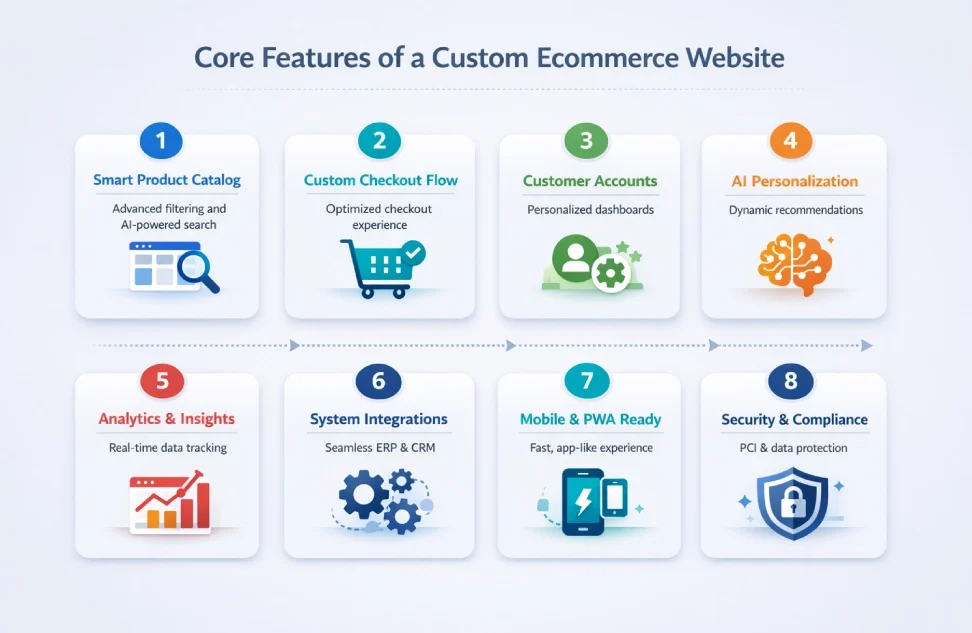
A well-built custom ecommerce platform is far more than a product catalog with a shopping cart. These are the capabilities that business leaders consistently prioritize when partnering with a software development company:
1. Advanced Product Catalog and Intelligent Search
Faceted filtering, AI-powered search with query understanding, custom variant logic, product comparison tools, visual merchandising controls, and catalog architecture that mirrors how your customers actually browse and buy – not how a template expects them to.
2. Custom Checkout and Payment Architecture
Single-page or multi-step checkout, guest checkout, saved payment methods, multi-currency support, and native connections to Stripe, PayPal, Adyen, ACH transfers, Buy Now Pay Later providers, and cryptocurrency rails. Every checkout step optimized to reduce abandonment.
3. Personalized Customer Accounts
Order history with reorder workflows, wishlist management, loyalty program balances, subscription management, saved address books, personalized dashboards – all designed around your specific customer retention strategy.
4. AI-Driven Marketing and Personalization Engine
Machine learning-powered product recommendations, dynamic pricing rules, personalized homepage content by customer segment, behavioral email triggers, abandoned cart recovery, and A/B testing infrastructure – all built natively into your platform.
5. Analytics and Business Intelligence Layer
Real-time dashboards for sales performance, conversion funnels, customer lifetime value, inventory turnover, and marketing attribution. Connect to Google Analytics 4, Mixpanel, Looker, or build a proprietary BI layer. Your data, your rules, your models.
6. Deep System Integrations
Native API connections to Salesforce, HubSpot, NetSuite, SAP, QuickBooks, ShipBob, FedEx, UPS, and hundreds of other systems. No plugin fragility – integrations built directly into the architecture and tested to handle production volume.
7. Mobile-First and PWA Architecture
Progressive Web App (PWA) design delivers near-native mobile performance in the browser: sub-second loads, offline browsing capability, push notifications, and home screen installation – without requiring users to download anything from an app store.
8. Enterprise-Grade Security and Compliance
SSL/TLS encryption, Web Application Firewall, PCI DSS compliance, multi-factor authentication, role-based access control, automated vulnerability scanning, WCAG 2.1 accessibility, and scheduled penetration testing. Built to your specific risk profile, whether that includes HIPAA, GDPR, or CCPA requirements.
How a Custom Ecommerce Website Is Built: The 8-Phase Process
Understanding the development process lets you evaluate proposals accurately, set realistic expectations, and protect your investment. This is how a professional software development company executes a custom ecommerce project from first call to ongoing optimization.
Phase 1: Discovery and Requirements
Your development team maps business goals, revenue model, user personas, technical requirements, and existing system dependencies. The output is a detailed Product Requirements Document (PRD) and a project roadmap with milestones, risks, and dependencies identified before a single line of code is written. A PRD that identifies ambiguity at this stage costs $0 to resolve; the same ambiguity discovered in Phase 4 costs $10,000+.
Phase 2: UX Research and Wireframing
UX designers create wireframes for every critical user flow: homepage, category pages, product detail pages, cart, checkout, and account management. User testing at the wireframe stage prevents expensive redesigns later. Validating flows before visual design is one of the highest-ROI investments in any ecommerce project.
Phase 3: UI Design
High-fidelity mockups are produced for every screen, including responsive breakpoints for desktop, tablet, and mobile. This includes your complete design system: typography scale, color palette, component library, micro-interaction specifications, and brand application guidelines that your development team then builds from.
Phase 4: Frontend and Backend Development
Frontend engineers build the customer-facing interface using modern frameworks such as React, Next.js, or Vue. Backend developers build the API layer, business logic, database architecture, admin systems, and core commerce functionality. These workstreams run in parallel on a shared sprint cadence to maximize efficiency and maintain integration quality.
Phase 5: System Integrations
Payment gateways, ERP, CRM, warehouse management, tax software, shipping carriers, email platforms, and analytics tools are connected via REST or GraphQL APIs. Every integration is tested in sandbox environments before touching production systems, and integration tests are added to the automated test suite.
Phase 6: Quality Assurance and Testing
Comprehensive QA includes functional testing of all user flows, cross-browser and cross-device testing, performance and load testing simulating peak traffic conditions, security penetration testing, and WCAG 2.1 accessibility audits. Budget 15-20% of total project cost for QA. This phase consistently delivers the highest ROI of any project investment.
Phase 7: Launch and Deployment
Production deployment includes DNS migration, SSL configuration, CDN setup, monitoring and alerting infrastructure, and a pre-launch security review. For large stores, a phased rollout or soft launch with a subset of traffic reduces risk before full cutover to the new platform.
Phase 8: Post-Launch Optimization and Support
The best software development companies are partners, not project vendors. Ongoing monitoring, performance optimization, feature development, security patching, and A/B testing keep your store improving long after go-live. Structure post-launch support as a retainer or dedicated sprint cadence – and establish SLAs for critical production issues before signing.
How to Choose the Right Software Development Company
Choosing the wrong partner is the most expensive mistake you can make in a custom ecommerce project. Technical debt, missed deadlines, and cost overruns from a misaligned agency can exceed the original project cost. Here is how to evaluate partners with the rigor the investment deserves.
8 Questions to Ask Before You Sign a Contract
- Can you show me three ecommerce projects similar in complexity to mine – and can I speak directly with those clients? (No reference calls = no verification of anything they have told you.)
- What does your discovery process produce before development begins? Can I see an example PRD from a previous project? (Vague scoping is the leading cause of budget overruns.)
- How do you handle scope changes mid-project? What is your change order process, and is it documented in the contract?
- Who specifically will work on my project – not job titles, but the actual team members? Will they be dedicated to my project or split across multiple clients simultaneously?
- What is your QA process? Do you have a dedicated QA team, or does the developer who wrote the code test their own work?
- What is your post-launch support model? What is the SLA for a critical production issue – and what does that cost?
- Who owns the intellectual property and source code at project completion? Is that explicitly stated in the contract?
- What does your communication cadence look like during development? Weekly demos, shared project board access, dedicated project manager?
How Much Does Custom Ecommerce Development Cost in 2026?
Cost is the most-searched question in this category – and the honest answer requires project context. Here is a realistic breakdown based on scope and complexity.
| Project Type | Estimated Investment | Timeline | Best For |
| Basic Custom Store | $30,000 – $50,000 | 8-12 weeks | Small to mid-size retail with standard workflows |
| Mid-Size Custom Platform (Shopify Plus Headless / Custom) | $50,000 – $80,000 | 12-18 weeks | Growing DTC brands needing custom checkout and deep integrations |
| Full Custom Platform (Next.js Commerce / Magento) | $80,000 – $150,000 | 18-24 weeks | Multi-brand, multi-region, or high-volume retailers |
| Enterprise Marketplace / B2B Portal | $150,000 – $350,000+ | 24-52 weeks | Enterprise brands, wholesale portals, complex marketplace builds |
What Drives the Cost?
- Design complexity: Standard UI systems cost less than fully custom UX with animations, personalization overlays, and proprietary component libraries.
- Number and complexity of integrations: Each ERP, CRM, or logistics connection adds development time. Native integrations cost more upfront but deliver far better long-term reliability than webhook-based connections.
- Feature depth: Standard checkout versus custom pricing rules, quote management, tiered discount logic, and net-terms billing represents a significant cost differential.
- Developer rates: US-based senior engineers average $130-$220/hour. Nearshore teams in Latin America or Eastern Europe range $50-$100/hour. Offshore teams vary widely in quality and communication overhead.
- QA investment: Budget 15-20% of total development cost for QA. Skipping it creates problems that cost multiples more to fix post-launch.
- Ongoing maintenance: Expect $500-$5,000/month depending on complexity, feature velocity, and support SLA requirements.
ROI Framework: Most businesses that invest in a well-scoped custom ecommerce platform reach break-even within 18 to 36 months through eliminated platform subscription fees, improved conversion rates, and operational efficiency gains. For businesses currently paying $3,000+ per month in combined platform and app fees, the math often favors custom development sooner than expected.
The Technology Stack Behind Modern Custom Ecommerce
The technology choices your development partner makes will determine the long-term maintainability, scalability, and performance of your platform. Here is what well-architected custom ecommerce looks like in 2026:
| Layer | Technology Options | Why It Matters |
| Frontend | React, Next.js, Vue, Nuxt | Determines UX performance, SEO-friendliness, and developer maintainability |
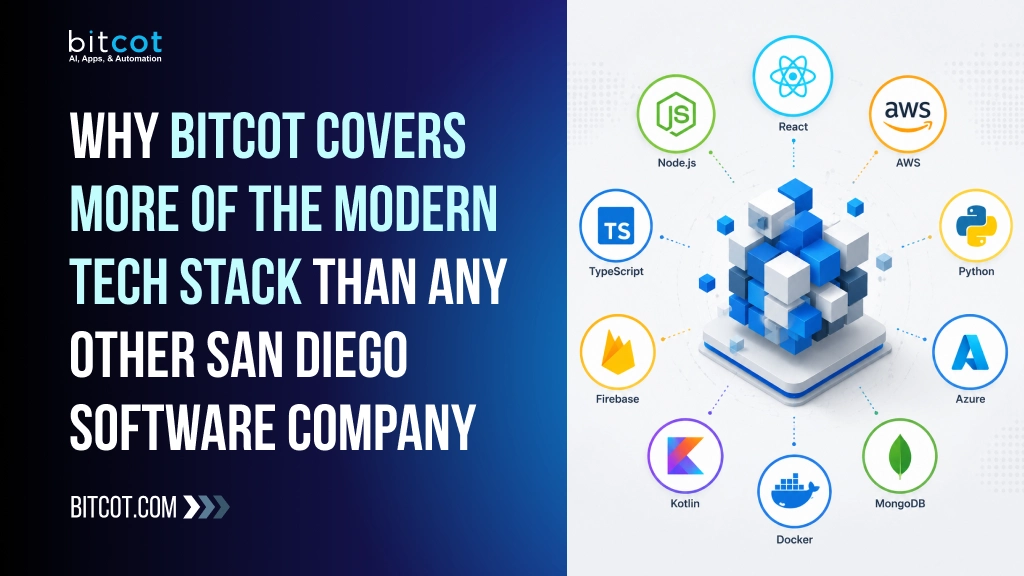
| Backend / API | Node.js, Python (Django/FastAPI), Go, Ruby on Rails | Powers business logic, order management, and the integration layer |
| Database | PostgreSQL, MySQL, MongoDB, Redis (caching) | Data structure choices affect query performance at scale significantly |
| Search | Algolia, Elasticsearch, Typesense | Critical for large catalogs – native platform search rarely performs at scale |
| Commerce Engine | Custom, Medusa.js, Commerce.js, or Shopify Headless | Defines the flexibility vs. speed-to-market trade-off |
| CDN / Hosting | AWS, Google Cloud, Vercel, Cloudflare | Core Web Vitals depend heavily on infrastructure architecture decisions |
| CMS (content) | Contentful, Sanity, Strapi, Prismic | Headless CMS enables marketing teams to publish without engineering dependency |
| Payments | Stripe, Adyen, PayPal, Braintree | PCI compliance, fraud prevention, and multi-currency support vary significantly |
The best software development companies recommend a technology stack based on your specific requirements – not based on what their team happens to be most comfortable building. Ask for the explicit reasoning behind every major architectural choice. A good partner will welcome that question.
2026 Ecommerce Development Trends You Cannot Ignore
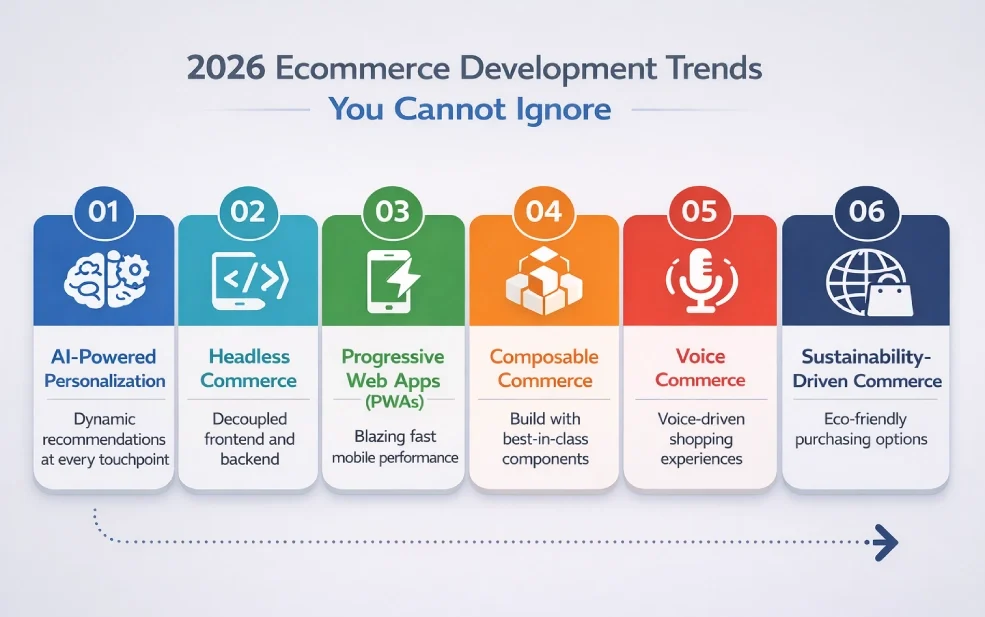
The ecommerce technology landscape in 2026 is defined by AI, composable architecture, and mobile-first performance. Businesses that invest in the right direction now will build compounding advantages over competitors still running on platforms from five years ago.
1. AI-Powered Personalization at Every Touchpoint
AI personalization is no longer an enterprise-only capability. Machine learning models now drive dynamic product recommendations, personalized homepage content by segment, predictive search, intelligent dynamic pricing, and post-purchase flow optimization. Businesses deploying AI personalization consistently report 20-35% increases in average order value. Custom development lets you build and own these models outright – rather than renting a black-box algorithm from a vendor who also serves your competitors.
2. Headless Commerce Architecture
Headless commerce decouples the frontend customer experience from the backend commerce engine (orders, inventory, payments, fulfillment). This lets marketing and UX teams ship experience updates in days rather than weeks, while the backend remains stable and tested. Brands like Nike, ASOS, and Patagonia use headless architecture to maintain engineering velocity at scale without sacrificing backend stability.
3. Progressive Web Apps (PWAs)
PWAs deliver near-native mobile performance in the browser: sub-second initial loads, offline browsing, push notifications, and home screen installation – without an app store submission or user download. For any business with significant mobile traffic (and that is most businesses), PWA architecture is a measurable competitive advantage. Research from Google shows PWAs can improve mobile conversions by up to 36%.
4. Composable Commerce and MACH Architecture
Composable commerce means assembling your platform from best-of-breed specialist components: Stripe for payments, Algolia for search, Contentful for CMS, and a custom cart and checkout layer. The MACH framework – Microservices, API-first, Cloud-native, Headless – delivers maximum flexibility, best-in-class functionality at each layer, and eliminates single-vendor lock-in.
5. Voice Commerce and Conversational Search
Smart speaker penetration and voice assistant usage continue to grow, and ecommerce platforms that cannot handle voice queries are leaving organic traffic on the table. Custom development lets you implement natural language search, voice-compatible navigation, and conversational checkout flows from the architecture level – not as an afterthought plugin.
6. Sustainability-Driven Commerce Features
Enterprise buyers and environmentally-conscious consumers are increasingly making purchasing decisions based on measurable sustainability practices. Custom ecommerce platforms can surface carbon offset selection, sustainable packaging options, green shipping alternatives, and supply chain transparency data at checkout – capabilities no template platform delivers natively or credibly.
Industry Use Cases: Which Businesses Benefit Most from Custom Ecommerce?
The businesses that benefit most from custom ecommerce are the ones that template platforms were never built to serve. Here is a look at the industries where a purpose-built solution makes all the difference.
| Industry | Custom Solution Built | Business Outcome |
| Wholesale / B2B Distribution | Tiered pricing logic, quote request workflows, net-30 checkout, PO-based ordering, ERP-native integration | 30-50% reduction in manual order processing; dramatic improvement in order accuracy |
| Fashion and Apparel (DTC) | Visual search, virtual try-on, complex variant management, size recommendation engine, return flow optimization | 25%+ conversion rate improvement; measurable reduction in return rates and support volume |
| Healthcare and Supplements | HIPAA-compliant checkout, prescription validation, subscription management, physician portal, multi-state compliance | Regulatory compliance achieved; predictable recurring revenue model enabled |
| Electronics and Technology | Spec-based filtering, product comparison engine, trade-in program logic, warranty management, B2B reseller portal | Higher average order value; significant reduction in pre-sales support ticket volume |
| Food and Beverage (DTC Subscriptions) | Subscription box management, perishable shipping logic, local delivery radius, flexible cadence and pause controls | 60%+ of revenue from predictable recurring subscriptions |
| Industrial / Manufacturing | CAD file upload support, custom product configurators, engineer-to-order quote engine, ERP-native ordering, dealer portal | Manual quoting process eliminated; shorter average sales cycle; higher close rate |
Why Bitcot Is the Right Software Development Company for Your Store
Custom ecommerce is a high-stakes investment. The wrong development partner means missed deadlines, brittle code, and a store that costs you sales instead of generating them. Here is what distinguishes Bitcot from generalist agencies and offshore-only vendors:
- Technology-agnostic selection: Shopify Plus, Magento, headless Next.js/React, and fully custom builds. Bitcot recommends the technology that fits your requirements – not the stack that is easiest for the team to build.
- Business-first discovery: Every project begins with a business analysis phase that maps your revenue model, customer journey, and operational workflows to the architecture. The result is a platform built to convert, not just function.
- Transparent Agile process: Two-week sprints, working demos at the end of every cycle, a dedicated project manager, and real-time access to your project board. You always know exactly where your project stands.
- Conversion-focused UX: Every design decision is evaluated against conversion rate impact. Bitcot clients consistently achieve 3-6% conversion rates within six months of launch – well above the industry average of 1.5-3%.
- Post-launch partnership: Retainer-based support covering performance monitoring, feature development, security updates, and technical SEO.
Conclusion: Custom Ecommerce Is a Business Decision, Not Just a Technology Decision
The businesses winning in ecommerce right now are not the ones with the cheapest platform. They are the ones with the fastest, most relevant, and most frictionless shopping experience for their specific customers.
Custom ecommerce development gives you that structural advantage: a platform built around your business model, your customer expectations, and your growth trajectory – not the limits of a template someone else designed.
Whether you are an established retailer outgrowing Shopify, an enterprise brand building a B2B wholesale portal, or a growth-stage business that needs a differentiated market position from day one, the path forward is a platform you fully own.
Bitcot has built custom ecommerce solutions for businesses across the US and globally, across every major vertical. If you are ready to build something that truly reflects your business – and outperforms the constraints you have been working around – we are ready to build it with you.

Frequently Asked Questions (FAQs)
What is custom ecommerce development?
Custom ecommerce development is the process of building an online store from the ground up, designed entirely around your business – its workflows, brand identity, customer experience requirements, and technical ecosystem. Unlike template platforms, you control every feature, integration, design element, and performance parameter, with no platform limitations or recurring licensing fees.
How much does custom ecommerce development cost?
Costs range from $30,000 for a foundational custom store to $350,000+ for enterprise marketplace or B2B portal builds. The most common range for a well-featured mid-market solution is $50,000-$150,000. Key cost drivers include feature complexity, integration count, design depth, developer location, and QA scope.
How long does it take to build a custom ecommerce website?
Most custom ecommerce website builds take 8 to 30 weeks. A straightforward store with standard integrations typically launches in 8-12 weeks. Complex platforms with enterprise ERP integration, custom checkout flows, multi-region support, and marketplace functionality typically take 20-30+ weeks from discovery through launch.
What is the difference between custom ecommerce and Shopify?
Shopify is a hosted SaaS platform with standardized features, fixed checkout logic, and recurring monthly fees. Custom ecommerce development gives you a unique codebase owned entirely by your business – no feature ceilings, no platform fees, and no dependency on a third-party roadmap. Shopify is right for early-stage businesses with standard needs; custom development suits businesses with complex workflows, high-volume requirements, or the need for deep system integrations.
Can I migrate from Shopify or WooCommerce to a custom platform?
Yes. Platform migration is one of the most common project types for growth-stage businesses. A capable software development company will manage data migration (products, customers, orders, reviews), 301 redirect mapping to preserve SEO equity, phased rollout planning, and full QA before cutover. Done correctly, migrations can be completed without meaningful organic traffic disruption.
Do custom ecommerce websites rank better on Google?
Yes – when built correctly. Custom platforms can be fully optimized for Core Web Vitals, semantic HTML structure, clean URL architecture, structured data markup, and server-side rendering. Template platforms often ship with bloated JavaScript, plugin-generated technical debt, and limited control over technical SEO elements that matter for competitive rankings.
What industries benefit most from custom ecommerce development?
B2B wholesale distributors, DTC fashion and apparel brands, healthcare and supplement companies, electronics and technology retailers, food and beverage subscription brands, and industrial manufacturers consistently see the highest ROI from custom development. These industries share complex pricing models, regulatory requirements, or customer experience demands that template platforms cannot accommodate natively.
What are the ongoing costs of a custom ecommerce platform?
After launch, expect ongoing costs including cloud hosting ($200-$2,000+/month depending on traffic and infrastructure), a maintenance and support retainer ($500-$5,000/month), third-party SaaS subscriptions (email, search, analytics), SSL certificates, and ongoing feature development. These costs are typically far lower than the combined cost of a SaaS platform subscription plus apps for businesses at meaningful scale.
How do I get started with a custom ecommerce project?
The right first step is a discovery consultation, not a proposal. A reputable software development company will spend time understanding your business model, current platform pain points, and growth goals before scoping or pricing anything. Bitcot offers a free initial strategy session and delivers a detailed project estimate within 48 hours – with no commitment required to have that conversation.