Remember when your biggest competitor couldn’t even spell “digital transformation“? Now they’re launching AI-powered products faster than your team can schedule meetings.
67% of enterprises are accelerating their digital transformation efforts. But speed without direction is just chaos. The real question isn’t whether to transform – it’s whether you’ll lead the change or scramble to survive it.
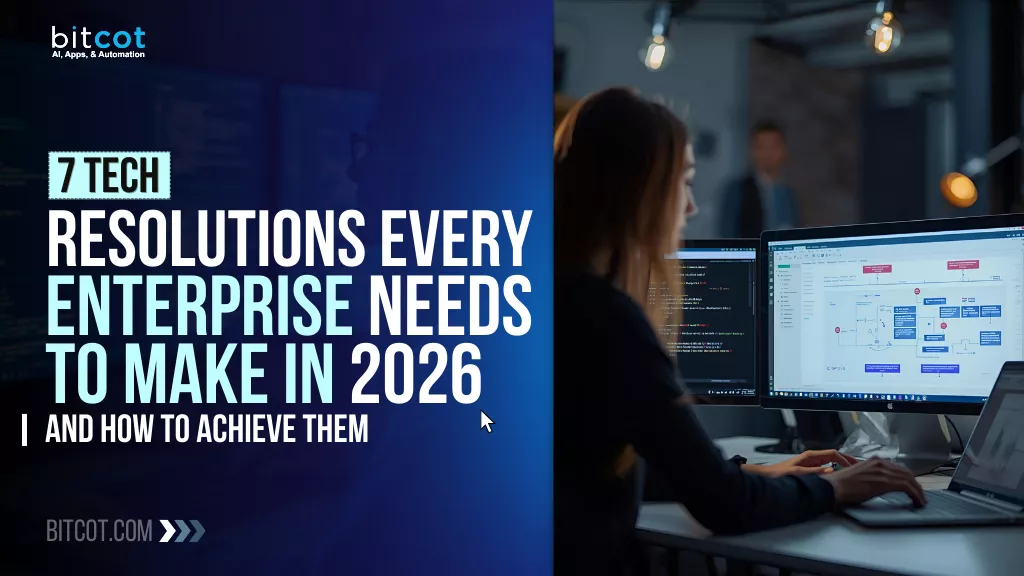
This guide breaks down seven critical tech resolutions for 2026 – not because they’re trendy, but because they’ll determine whether your enterprise thrives or becomes a cautionary tale.
This guide is for:
- Enterprise CTOs and IT leaders balancing innovation with operational stability
- Digital transformation executives tasked with modernizing legacy systems
- Business leaders who know technology is the answer but need a clear roadmap
If you’re the person who gets the call when technology fails – or when it needs to transform – this is for you.
Why Enterprise Digital Transformation Accelerates in 2026
Three seismic shifts making transformation urgent, not optional.
AI agents are replacing simple automation. While you’re still manually approving invoices, your competitors have AI agents negotiating with suppliers and identifying cost savings.
Cybersecurity threats cost more than ever. The average data breach now costs $4.88 million. The real cost? The trust you lose when customers’ data ends up on the dark web.
Cloud waste is eating profits. Enterprises waste 32% of cloud spend on unused resources.
What Enterprise Leaders Struggle With Most:
These aren’t abstract challenges – they’re keeping you awake at 2 AM.
External pressures:
- Competitors launching in months what takes you years
- Customers demanding B2B experiences that match their B2C expectations
- Security threats that could cost millions
- Regulatory compliance requirements multiplying quarterly
Internal problems:
- Disconnected systems requiring manual data transfers
- Talent leaving for companies with modern tools
- Legacy infrastructure consuming 70% of IT budget
- Change initiatives dying in committee
The emotional burden:
- Knowing what needs to change but facing organizational inertia
- Career stakes riding on technology decisions
- Responsibility for thousands depending on your choices
The seven resolutions below solve these exact problems with clear implementation plans you can start Monday.
Resolution #1: How to Deploy AI Agents Across Enterprise Operations
Transform repetitive work into strategic advantage – without replacing your people.
Benefits of AI Agents for Enterprise Operations
Your customer service team is drowning in tickets. Your sales team can’t respond fast enough. Your developers are buried in repetitive code reviews.
What if you could clone your best employees – the ones who never miss details, work around the clock, and constantly improve their skills?
The impact is real:
- Customer service teams cut response times by 40%
- Sales teams see 25% more qualified leads
- Development teams ship 30% faster
This isn’t about efficiency metrics. It’s about getting your life back.
AI Agent Implementation Strategy: Step-by-Step Roadmap
Identify high-impact use cases first. Target repetitive, time-consuming tasks: customer support triage, data entry, appointment scheduling, report generation, and code review.
Choose the right platform. Evaluate based on integration capabilities, customization options, security certifications, and scalability.
Start with a pilot program. Launch in one department, measure results, refine, then expand. Train teams on working alongside AI agents – when to delegate, when to intervene, and how to provide feedback.
Companies that succeed with AI agent development focus on augmenting human capabilities, not replacing them.
How Bitcot helps enterprises deploy AI agents:
- Discovery & Strategy – Map workflows, identify AI opportunities, estimate ROI
- Proof of Concept – Build a working prototype in one department (4-6 weeks)
- Integration – Connect AI agents to existing systems
- Training & Deployment – Prepare teams, deploy gradually, monitor performance
- Optimization – Refine based on real-world performance data
This is the same process used to help Fortune 500 companies transform operations without disrupting existing business.
Resolution #2: Zero-Trust Security Architecture Implementation Guide
Your perimeter is gone – it’s time to verify everything, trust nothing.
Why Traditional Security Models Fail in 2026
Picture this: It’s 3 AM. Your phone rings. Your CISO’s voice is shaking. “We’ve been breached.”
An employee’s laptop, compromised months ago, has been quietly siphoning customer data. Your “secure” network perimeter meant nothing.
Now you’re facing regulatory fines, class-action lawsuits, and explaining to customers why their trust was misplaced.
Zero-trust operates on one principle: Never trust, always verify.
Every user, device, and application must prove identity and authorization – every single time.
Because in 2026, one security mistake can end your enterprise. Zero-trust ensures you never make that call at 3 AM.
Zero-Trust Security Framework: Core Components
Four layers of defense that work together to protect your enterprise from the inside out.
Foundation: Identity and Access Management
Deploy multi-factor authentication (MFA) for all users, implement single sign-on (SSO) across applications, use adaptive authentication based on risk signals, and audit access regularly.
Modern identity and access management solutions form the backbone of zero-trust architecture.
Network: Micro-Segmentation – Divide your network into isolated segments to limit lateral movement during breaches.
Application: Secure by Design – Build security into applications from the ground up with encryption and API security best practices.
Endpoint: Device Trust – Deploy endpoint detection and response (EDR) tools and enforce device compliance policies.
Implementation Timeline: Budget 12-18 months for full zero-trust implementation.
Need help assessing your security posture? Contact Bitcot for a free security architecture consultation.
Resolution #3: Multi-Cloud Strategy: Cost Optimization and Performance
Stop wasting 32% of your cloud budget on resources nobody’s using.
Enterprise Multi-Cloud Adoption Trends
87% of enterprises use multi-cloud strategies across AWS, Azure, Google Cloud, and specialized platforms.
But here’s what nobody talks about: the CFO walking into your office asking why cloud costs have tripled. The sinking feeling when you realize you’re paying for resources you forgot existed.
The benefits of multi-cloud are real: redundancy when systems fail, flexibility to innovate fast, freedom from vendor lock-in.
Imagine knowing exactly where every dollar goes. Having the power to switch providers when it makes sense.
That’s what proper multi-cloud management delivers: not just efficiency, but peace of mind.
Multi-Cloud Management Best Practices
Right-size your resources. Implement automated scaling based on demand, schedule resources to shut down during off-hours, and right-size instances based on usage.
Optimize cloud costs. Set up detailed cost allocation tags, create budgets with spending alerts, and use reserved instances for predictable workloads.
Match workloads to the right cloud. Choose platforms based on cost efficiency, geographic availability, compliance requirements, and native capabilities. For data-intensive workloads, consider specialized big data and analytics solutions.
Centralize management. Use unified control planes for visibility across all environments and consistent security policies.
Cloud Migration Strategy: Phased Approach
Move fast without breaking things – the proven path to multi-cloud success.
Phase 1: Assessment (2-4 weeks) – Inventory applications, identify cloud-ready opportunities, calculate total cost.
Phase 2: Planning (4-6 weeks) – Design target architecture, select platforms for each workload.
Phase 3: Migration (3-12 months) – Start with non-critical applications, refactor for cloud-native capabilities.
Phase 4: Optimization (Ongoing) – Monitor performance and costs continuously, adjust resources.
Cloud application development expertise ensures migration success without business disruption.
Technology platforms for multi-cloud success:
- Cloud Providers: AWS (Lambda, ECS, RDS), Azure (Functions, AKS), Google Cloud (Cloud Run, BigQuery)
- Container Orchestration: Kubernetes for portability
- Infrastructure as Code: Terraform for consistent deployments
- Monitoring: DataDog, New Relic for unified observability
- Cost Management: CloudHealth, Kubecost
These tools enable cloud-agnostic architectures, preventing vendor lock-in while maximizing each platform’s strengths.
Resolution #4: AI-Powered Document Management Systems for Enterprises
Stop searching for files – let AI find, organize, and extract insights automatically.
Digital Document Management: Why Upgrade Now
Most enterprises have scanned papers and stored files. That’s not enough in 2026.
Modern document management means intelligent systems that understand, organize, and extract value automatically.
Intelligent Document Processing Features
Intelligent Document Processing (IDP) extracts key data from invoices, contracts, and forms automatically. It classifies documents by type and flags anomalies.
Smart Search enables natural language queries across all documents with semantic understanding and automatic summarization.
Version Control provides real-time collaboration with conflict resolution, complete version history, and granular permissions.
Document Management Implementation: 8-Month Roadmap
Transform document chaos into AI-powered organization – month by month.
Month 1: Audit repositories, identify pain points, assess compliance
Months 2-3: Choose platforms with OCR, intelligent recognition, integration
Months 4-6: Migrate documents in phases, clean up duplicates
Months 7-8: Train users, establish maintenance procedures
Many organizations benefit from custom software solutions tailored to their specific workflows.
Technologies powering modern document management:
- AI/ML: TensorFlow, OpenAI GPT-4
- OCR: Google Vision API, AWS Textract
- Storage: AWS S3, Azure Blob Storage
- Search: Elasticsearch
- Security: Role-based access control
When integrated with AI and machine learning development, intelligent document processing becomes part of broader automation strategies.
Resolution #5: Business Process Automation: From RPA to Hyperautomation
Give your people back the work that made them choose their careers – automate the rest.
Hyperautomation vs Traditional RPA
Robotic Process Automation handles repetitive tasks. In 2026, enterprises need intelligent automation handling end-to-end processes.
Here’s what your finance team won’t tell you: They hate their jobs. Not because they hate finance – but because they spend 60% of their time copying data between systems.
Your best people are glorified data entry clerks. They’re not learning. Not growing.
Then they leave. And you wonder why you can’t retain talent.
What is Hyperautomation: Key Technologies
Hyperautomation combines RPA, AI/ML for decisions, process mining for optimization, workflow orchestration, and analytics.
The real impact:
- 40% reduction in process cycle times
- 60% decrease in error rates
- 30% cost savings
- Your people finally do meaningful work
This isn’t about replacing humans. It’s about respecting them. For enterprises starting with basic automation, RPA solutions provide the foundation before expanding to hyperautomation.
Enterprise Automation Use Cases by Department
Where intelligent automation delivers the biggest impact – and fastest ROI.
Finance: Invoice processing, expense reports, financial close, compliance reporting
HR: Onboarding/offboarding, benefits administration, time tracking, performance reviews
Customer Service: Ticket routing, first-level resolution, escalation management
Supply Chain: Purchase orders, inventory management, shipment tracking, vendor monitoring
Automation Implementation Roadmap: 4 Phases
From discovery to deployment – your 17-week path to intelligent automation.
Phase 1: Process Discovery (Weeks 1-4) – Use process mining to map workflows, identify bottlenecks, prioritize by ROI.
Phase 2: Design (Weeks 5-8) – Define ideal future state, identify AI decision points, plan system integrations.
Phase 3: Build and Test (Weeks 9-16) – Develop incrementally, test with real scenarios, involve end users.
Phase 4: Deploy and Monitor (Week 17+) – Roll out in phases, monitor KPIs continuously, expand to additional processes.
Enterprises working with Bitcot’s AI automation services accelerate their automation journey and avoid common pitfalls.
Three ways to start your automation journey:
- Process Assessment (2 weeks) – Free evaluation of your top 3 processes for automation ROI
- Pilot Program (8-12 weeks) – Automate one high-impact process, prove value, then scale
- Full Transformation (6-12 months) – Enterprise-wide hyperautomation roadmap with dedicated team
Schedule a free consultation to discuss which approach fits your timeline and budget.
Resolution #6: Enterprise eCommerce and Omnichannel Strategy
Your customers expect Amazon-level experiences – can your B2B platform deliver?
B2B eCommerce: Market Demands in 2026
Even B2B enterprises need sophisticated eCommerce in 2026.
Your biggest customer just sent an email: “We’re reviewing all vendor relationships. We need self-service ordering, real-time inventory, and mobile access. If you can’t provide this, we’re moving to your competitor who can.”
63% of B2B buyers prefer to research and purchase online. They don’t want to call your sales team for a simple reorder. They want instant gratification, transparency, control.
Your “personal touch” is now your biggest weakness. Customers want relationships when they need expertise – not when they’re buying the same supplies for the twentieth time.
Modern eCommerce Platform Features
Headless Commerce Architecture separates frontend from backend, enabling experiences across web, mobile, voice, and AR/VR. Update touchpoints without changing backend systems.
AI-Powered Personalization drives conversions through dynamic pricing, product recommendations, personalized content, and predictive search.
Seamless Omnichannel Integration provides unified inventory, buy online/pick up in store, easy returns across channels, and consistent pricing everywhere.
How to Choose an Enterprise eCommerce Platform
The wrong choice costs millions – here’s how to get it right first time.
Choose the Right Platform – Evaluate based on B2B features (bulk ordering, approval workflows, custom pricing), ERP/CRM integration, and scalability.
Optimize for Conversion – Every second of load time reduces conversions by 7%. Optimize images, implement lazy loading, use CDNs. Streamline checkout with guest options and multiple payment methods. Build trust with security badges and customer reviews.
B2B eCommerce Requirements
B2B commerce requires account-based pricing, complex approval workflows, quote management, and procurement system integration.
Implementation: 8 months from platform selection to phased customer rollout.
For complex requirements, eCommerce development solutions ensure platforms meet business needs.
Resolution #7: Sustainable Technology Practices for Enterprises
Build the future your children will be proud of – while cutting costs and winning customers.
ESG and Technology: Why Sustainability Matters
Data centers consume 1% of global electricity – and that’s growing.
One day, your kids will ask harder questions. “Did you know? Did you care? Did you try?”
The pressure is real:
- Regulators demanding carbon reporting with penalties
- Customers choosing vendors based on sustainability
- Investors screening for ESG metrics
- Top talent turning down offers because your values don’t match
Sustainable technology isn’t a nice-to-have. It’s your license to operate.
Green Technology Implementation Strategies
Cut carbon footprint and costs simultaneously – four practical approaches.
Green Cloud Computing – Choose providers with renewable energy commitments, right-size resources
Energy-Efficient Data Centers – Upgrade to efficient hardware, implement intelligent cooling, decommission zombie servers
Sustainable Software Development – Optimize algorithms, reduce data transfers, cache effectively
E-Waste Management – Extend hardware lifecycles, partner with certified recyclers
How to Measure Technology Carbon Footprint
You can’t improve what you don’t measure – establish your baseline in 4 steps.
Step 1: Calculate current energy consumption across technology and data centers
Step 2: Set specific, measurable goals with timelines
Step 3: Deploy monitoring tools, report regularly
Step 4: Review and update goals, adopt emerging technologies
ROI of Sustainable Technology
Sustainable technology delivers cost savings, risk mitigation, and competitive advantage in RFPs.
Enterprise Technology Implementation Roadmap 2026
Your quarter-by-quarter blueprint from overwhelmed to transformed.
Quarterly Technology Implementation Schedule
Q1 2026: Launch zero-trust assessment, deploy first AI agents, implement cloud cost monitoring
Q2 2026: Complete IAM, migrate workloads to multi-cloud, roll out AI document management
Q3 2026: Expand AI agents to sales and operations, launch eCommerce platform beta
Q4 2026: Achieve full zero-trust architecture, deploy hyperautomation across processes
Key Performance Indicators for Digital Transformation
Track what matters – these metrics prove ROI to skeptical stakeholders.
Efficiency: Process cycle time reduction, productivity gains, system uptime
Cost: Cloud optimization savings, automation ROI, security incident reduction
Experience: Customer satisfaction, employee tool satisfaction, application performance
Strategic: Digital channel revenue, new market access, innovation velocity
Enterprises leveraging business intelligence services can track these KPIs in real-time dashboards.
Real Enterprise Results
Enterprises following this roadmap typically see:
- 40-60% reduction in manual process time within 6 months
- 25-35% decrease in cloud infrastructure costs year-over-year
- 3x faster time-to-market for new features
- 50% improvement in employee satisfaction scores
View real enterprise case studies to see how organizations achieved similar transformations.
Enterprise Technology Implementation: Common Mistakes to Avoid
Technology without strategy. Every investment should align with clear business objectives.
How to avoid: Link each initiative to specific business outcomes and KPIs before spending.
Neglecting change management. Technology projects fail more from people issues than technical ones.
How to avoid: Dedicate 20-30% of project budget to change management.
Underestimating integration complexity. New systems must work with existing infrastructure.
How to avoid: Map all integration points during planning. Build integration testing into every milestone.
Focusing only on implementation. Getting the system live is just the beginning.
How to avoid: Define success metrics before launch. Schedule monthly optimization reviews.
Ignoring security until late. Building security from the start is easier than adding it later.
How to avoid: Involve security team from day one. Use frameworks like NIST Cybersecurity Framework.
What Success Looks Like:
Successful enterprise transformations share these characteristics:
- Executive sponsorship that removes obstacles
- Cross-functional teams with authority to decide
- Phased rollouts that prove value incrementally
- Clear metrics tracked weekly
Enterprises that nail these fundamentals see 3x higher ROI. Choosing the right software development partner reduces risk and accelerates results.
Enterprise Digital Transformation: Taking Action in 2026
These seven resolutions aren’t optional. They’re competitive necessities.
But transformation is terrifying. You’re asking teams to abandon comfortable processes. You’re betting budgets on technologies that didn’t exist five years ago.
Every enterprise leader faces this moment. The moment when staying the course feels safer than taking the leap.
But “safe” is an illusion. While you hesitate, competitors are moving.
The enterprises that execute will:
- Operate with lean efficiency
- Deliver experiences that turn customers into advocates
- Attract top talent
- Adapt to market changes
The enterprises that delay will watch from the sidelines – losing their best people to companies that dared to transform.
You got here by seeing what needed to change and having the courage to change it.
The choice is yours. But the window is closing.
Ready to Take Action? Choose Your Starting Point
Three proven paths – pick the one that matches your readiness level.
Every enterprise is at a different stage. Some need comprehensive data to convince boards. Others need quick wins to build momentum. And some are ready to commit fully. There’s no wrong starting point – only the one that matches where you are today and where your organization needs to go.
Path 1: The Strategic Assessment
Best for: Executives who need board-level buy-in
What you get: 2-week assessment, ROI analysis, prioritized roadmap, executive deck
Next step: Schedule a strategy session
Path 2: The Quick Win Pilot
Best for: IT leaders who need to prove value first
What you get: 8-12 week pilot, measurable results to justify broader investment
Path 3: The Full Transformation
Best for: Enterprises ready for comprehensive change
What you get: 12-18 month program, dedicated team, change management
Next step: Explore enterprise partnerships
The best time to start was yesterday. The second best time is right now.
Frequently Asked Questions
What's the typical budget for implementing these resolutions?
Small enterprises ($50M-$500M) invest $2-5M over 12-18 months. Mid-size ($500M-$5B) invest $5-20M. Large enterprises ($5B+) invest $20-100M+.
Should we implement all seven simultaneously?
No. Focus on 2-3 resolutions initially, prove value, then expand.
How long to see ROI?
Quick wins like cloud optimization show ROI in 3-6 months. Comprehensive transformations in 12-18 months.
Do we need to replace all existing systems?
Not necessarily. Many resolutions enhance existing systems. Modern APIs enable progressive improvement.
How do we balance innovation with security and compliance?
Build security into the foundation. Use frameworks like NIST Cybersecurity Framework. The zero-trust resolution addresses this balance.
What if we need to pause mid-transformation?
Modular implementation protects your investment. Each resolution can be paused or accelerated independently. Phased approaches mean you’re never all-in on a single bet.
How do we mitigate risk?
Five strategies: (1) Start with non-critical systems, (2) Maintain rollback plans, (3) Use proven technology stacks, (4) Partner with experienced implementers, (5) Measure continuously. Enterprises following these principles reduce implementation risk by 70%.