Key Takeaways
- Cloud modernisation differs from migration: migration relocates workloads to the cloud, while modernisation rebuilds how those workloads are architected, deployed, and governed.
- According to Gartner, over 60% of cloud operations will involve AI-driven automation by 2026, making AI-ready data infrastructure the top modernisation priority.
- Enterprises that stop at lift-and-shift carry their legacy technical debt into a cloud bill: refactoring is required to capture real efficiency gains.
- San Diego healthcare and fintech teams are adopting hybrid container and serverless architectures to reduce idle compute while meeting data residency requirements.
- The most common modernisation failure is treating the effort as a one-time project rather than a continuous operating model built on iteration.
Introduction
According to McKinsey, enterprises that fully realise cloud modernisation capture three to four times more value than those that simply move existing workloads without rearchitecting. The gap comes down to one decision: did you modernise your software, or just relocate it? This article takes the position that most failed cloud programs are organisational failures before they are technical ones. Enterprises in San Diego, Los Angeles, and across California invest in new cloud infrastructure but leave behind the engineering practices, data pipelines, and governance models that determine whether that infrastructure actually performs. These cloud modernisation strategies are designed to close that gap, not by listing buzzwords, but by giving engineering and operations leaders a practical framework for what to change, in what order, and why.
What Cloud Modernisation Strategies Actually Mean (and What They Don’t)
Cloud modernisation strategies are structured approaches for refactoring applications, data infrastructure, and operational practices to fully exploit cloud-native capabilities. The operative word is “refactoring.” These strategies go beyond selecting a cloud provider or spinning up virtual machines; they address how software is built, how teams deploy it, and how organisations govern it at scale.
The confusion between migration and modernisation is responsible for a large share of cloud programs that deliver disappointing results. Migration is a location decision: you move a workload from a data centre to AWS, Azure, or Google Cloud. Modernisation is an architecture decision: you rebuild how that workload is structured so it benefits from elasticity, managed services, and cloud-native security. A monolithic application running on a cloud VM is still a monolith; it just costs more to operate than it did on-premises because the cloud pricing model rewards efficient, distributed architectures, not large, single-instance ones.
The main components of a complete cloud modernisation strategy include application portfolio assessment (which apps to change and how), target architecture design (microservices, containers, serverless, or hybrid), DevOps adoption with automated CI/CD pipelines, data layer modernisation for real-time processing and AI readiness, and integrated security governance. Each component depends on the others; a team that refactors an application into microservices without automated deployment pipelines has created operational complexity without the tooling to manage it.
Cloud Migration vs. Cloud Modernisation: What Does the Difference Cost You
The practical difference between cloud migration and cloud modernisation is most visible in the total cost of ownership after the first year of cloud operations. Migration delivers quick wins: you decommission physical servers, shift from capital expenditure to operational expenditure, and gain basic redundancy. These are real benefits. The problem is that a migrated-but-unmodified application cannot auto-scale independently, cannot take advantage of serverless pricing, and accumulates the same technical debt it carried on-premises, now inside a monthly cloud invoice.
Modernisation changes the economics permanently. A refactored application broken into independently deployable microservices can scale only the components under load. A checkout service can absorb a Black Friday traffic spike without scaling the entire application stack. Serverless functions handle sporadic API calls without idle compute charges between requests. These architectural changes are what produce the infrastructure efficiency that cloud providers advertise, but migration alone cannot deliver.
The practical path for most enterprises is a phased approach: migrate first to stop the bleeding on data centre costs, then modernise incrementally, starting with the highest-traffic or most revenue-critical applications. This avoids the risk of a complete rebuild while ensuring that technical debt is addressed systematically rather than left to compound. Teams working on legacy application migration to cloud consistently find that the planning done during migration, dependency mapping, and performance baselining, becomes the foundation for a faster modernisation phase that follows.

The 5 Cloud Modernisation Strategies Driving Enterprise Results in 2026
The following strategies are ranked by the impact they deliver relative to the engineering investment required. Each one addresses a specific architectural or operational gap that prevents cloud infrastructure from performing at its potential.
AI-Native Data Modernisation
The single largest driver of cloud modernisation investment in 2026 is not cost reduction; it is AI readiness. Enterprises attempting to deploy machine learning or generative AI capabilities are discovering that their data infrastructure cannot support them. Fragmented databases, inconsistent schemas, batch-only pipelines, and siloed data warehouses make it impossible to feed reliable data to AI models at inference time.
AI-native data modernisation involves migrating from self-managed, on-premises databases to managed cloud-native services (Amazon RDS, Azure SQL, Google Cloud SQL for relational workloads; DynamoDB, Cosmos DB, or Firestore for document and key-value use cases), then building real-time streaming pipelines on top of that foundation. Cloud data warehouses like Snowflake, Google BigQuery, or Amazon Redshift enable petabyte-scale analytics that integrate directly with AI/ML development workflows. The payoff is not just running AI, it is using AIOps to auto-tune workloads, predict infrastructure failures before they occur, and automate the operational tasks that currently consume engineering time.
Hybrid and Multi-Cloud Architecture
Single-cloud strategies introduce vendor lock-in and limit the ability to choose best-of-breed services for specific workloads. The dominant enterprise architecture in 2026 combines public cloud elasticity with private or on-premises infrastructure for workloads that require data residency controls or low-latency access to internal systems. This hybrid model is increasingly paired with a multi-cloud approach, where teams select services from multiple providers based on technical fit rather than contractual commitment.
Kubernetes and container orchestration are the enabling technologies for this architecture. Containerised workloads are portable across cloud environments, which prevents vendor lock-in and allows teams to migrate services between providers without rewriting application code. Organisations building cloud-native application development practices use container standards to ensure that the same application runs consistently across development, staging, and production environments, regardless of which cloud hosts each one.
Workload-Based Serverless and Container Optimisation
The choice between serverless and container orchestration should be driven by workload characteristics, not technology preference. Serverless compute (AWS Lambda, Azure Functions, Google Cloud Run) is optimal for event-driven, bursty, or sporadic workloads where paying per execution eliminates idle compute entirely. Container orchestration on Kubernetes is better suited for long-running services, stateful applications, and GPU-intensive workloads like AI model training that require dedicated, consistent compute allocation.
According to industry research cited by Gartner, over 78% of engineering teams are moving toward hybrid container and serverless architectures to capture the cost and performance benefits of both. The FinOps discipline, which applies financial accountability to cloud resource decisions, makes this workload-based selection process explicit: every service should have a documented cost model that justifies its deployment type based on usage patterns. Teams implementing DevOps consulting practices find that building this cost-awareness into deployment pipelines prevents the infrastructure sprawl that inflates cloud invoices without proportional performance gains.
Platform Engineering and FinOps Governance
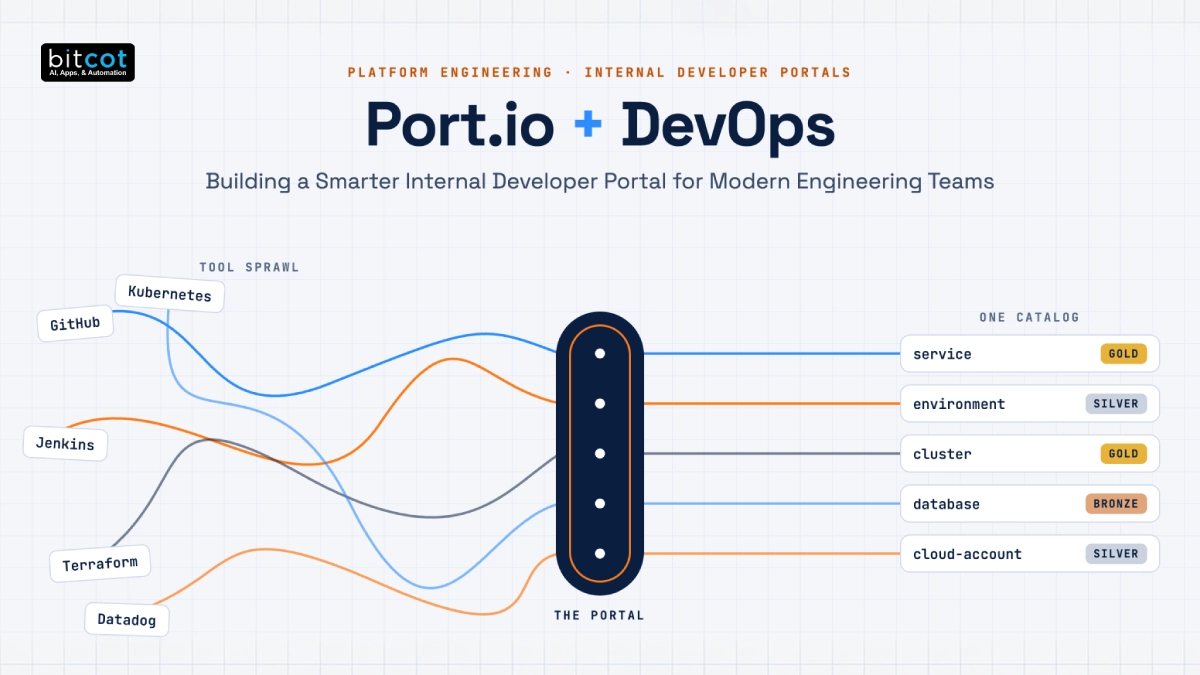
As cloud environments grow more complex, multi-cloud, multi-region, with containers and serverless running side by side, the DevOps model that worked for a single cloud account breaks down. Platform engineering addresses this by creating an Internal Developer Platform (IDP): a self-service layer of curated infrastructure tools, CI/CD pipelines, security scanning, and cost monitoring that developers use without needing deep cloud expertise themselves.
The business case for platform engineering is developer productivity. When every team manages its own infrastructure configuration, drift accumulates, incidents multiply, and senior engineers spend time on operational firefighting instead of product development. A platform team standardises the baseline so application teams can focus on building features. Paired with a FinOps practice that allocates cloud spend to the business units consuming it, this model makes the cost of each product decision visible, which changes the quality of those decisions. This connects directly to DevOps transformation at the organisational level, where tooling changes alone are insufficient without corresponding changes in team structure and accountability.
Edge Computing for Real-Time Use Cases
For industries where central cloud latency is a product constraint rather than an inconvenience, edge computing extends the modernisation perimeter beyond the data centre to the point of use. Manufacturing plants processing sensor data for quality control, retail environments running real-time personalisation at the point of sale, and healthcare facilities performing clinical inference at the bedside all share a requirement: decisions must happen in milliseconds, not the 50-100ms round-trip a central cloud region introduces.
Edge modernisation deploys containerised microservices or serverless functions onto edge compute nodes or IoT-capable hardware, using the same infrastructure-as-code tooling and CI/CD pipelines that manage central cloud workloads. This operational consistency is what makes edge viable at scale; it is not a separate infrastructure discipline, but an extension of the cloud-native patterns already in place. For organisations in sectors like healthcare, this architecture also reduces the volume of sensitive data transmitted to central cloud storage, which simplifies data governance without requiring complex data residency configurations.

How to Build a Cloud Modernisation Roadmap That Sticks
The most common reason cloud modernisation programs stall is that they start with technology selection instead of application portfolio analysis. Choosing Kubernetes before understanding which applications justify the orchestration overhead, or adopting serverless before profiling workload access patterns, leads to architectural decisions that need to be reversed six months later at high cost.
A roadmap that produces durable results follows three phases. The first phase is assessment and planning: audit every application in the portfolio for business criticality, technical complexity, external dependencies, and estimated cloud fit. Assign each application a modernisation strategy from the standard “R” framework (Rehost, Replatform, Refactor, Repurchase, Retire, Retain). Prioritise refactoring candidates that are high-value, frequently deployed, and architecturally isolated enough to be decoupled without breaking dependent systems. Establish a cloud landing zone, a secure, pre-configured base environment, before any workload moves into production.
The second phase is incremental execution. Start with a non-critical application as a proof-of-concept. This builds team fluency with the new tooling without risking production. According to McKinsey Digital, teams with mature DevOps and IaC practices deploy code 46 times more frequently than low performers. Use Infrastructure as Code tools (Terraform for multi-cloud, CloudFormation for AWS-only environments) to ensure every environment is reproducible and auditable. Implement blue/green or canary deployment patterns so new versions can be validated against real traffic before full rollout. Teams working on legacy system modernisation consistently find that the PoC phase surfaces integration assumptions that the original architecture documentation missed; it is not optional preparation, it is risk reduction.
The third phase is governance and continuous improvement. FinOps practices must be in place before cloud spend scales, not after the first large invoice arrives. Observability tooling, logs, metrics, and distributed tracing must cover all microservices and serverless functions because distributed systems fail in ways that monoliths do not and require different diagnostic approaches. Workforce development is not a separate workstream; it is a dependency. Teams that understand why an architectural decision was made maintain it better than teams handed a system they did not design.
What Cloud Modernisation Actually Delivers (Beyond the Cost Story)
The ROI narrative for cloud modernisation is dominated by cost reduction, and the cost story is real: eliminating capital expenditure on servers, shifting to pay-per-use billing, and right-sizing compute through auto-scaling all reduce the total cost of ownership. But framing modernisation purely as a cost program systematically undervalues the competitive benefits that drive the most significant business outcomes.
Agility is the benefit that changes competitive position most directly. Breaking a monolithic application into independently deployable microservices with automated CI/CD pipelines compresses release cycles from weeks to days or hours. Development teams can test new features against production traffic using feature flags and canary releases, then roll back instantly if a defect surfaces. This is not a marginal improvement; it is a structural change in how quickly a product can respond to market feedback. Organizations pursuing digital transformation find that modernisation is what makes the pace of change sustainable, rather than an isolated initiative that exhausts teams and then stalls.
Security posture improves materially through modernisation because refactoring eliminates the unpatched dependencies and outdated runtimes that represent the largest attack surface in most enterprise applications. A modernised application running on managed cloud services inherits the security infrastructure of providers who invest billions annually in threat detection, network security, and compliance tooling. Zero Trust Identity and Access Management, enforced through cloud-native IAM services like AWS IAM, Azure Entra ID, or Google Cloud IAM, removes the perimeter assumptions that make traditional network security brittle. Equally important: the monolithic vs microservices architecture decision directly determines blast radius when a security incident does occur. A compromised microservice can be isolated and rolled back; a compromised monolith requires taking the entire application offline.
Our Perspective
Working with engineering teams across healthcare and fintech in California, the pattern we see most often is not a technology problem; it is a sequencing problem. Organisations invest in refactoring before establishing the CI/CD pipelines and observability tooling that make refactored services manageable. The result is a more distributed architecture that is harder to debug than the monolith it replaced.
The teams that modernise successfully spend the first sprint building the deployment pipeline and the monitoring stack before writing a single line of refactored application code. San Diego healthcare technology companies we work with have used this approach to reduce production incident response time significantly, because every service emits structured logs and traces from the first deployment. The infrastructure investment precedes the application work, not the other way around. For organisations beginning this process, our AI workflow automation and legacy application modernisation experience provides a practical foundation for building the right sequence before committing to an architecture that is difficult to reverse.

Conclusion
Cloud modernisation strategies work when they treat architecture, team practices, and governance as a single system rather than separate workstreams. Moving workloads to the cloud without refactoring their architecture relocates the problem. Refactoring without automated deployment pipelines creates new operational complexity. Building cloud-native architecture without FinOps governance produces uncontrolled spend. The enterprises that extract durable value from cloud modernisation, faster releases, lower infrastructure waste, better security posture, and genuine AI readiness are the ones that address all three dimensions simultaneously, in the right sequence. If your organisation is assessing where to start or how to accelerate a program already in progress, the practical next step is a structured conversation about your application portfolio, not a technology evaluation.
Frequently Asked Questions
What are cloud modernization strategies?
Cloud modernization strategies are structured approaches for refactoring applications, data pipelines, and operational practices to fully exploit the capabilities of cloud-native infrastructure, including microservices, containers, serverless computing, managed databases, and automated CI/CD deployment. They go beyond cloud migration (which moves workloads without changing their architecture) to fundamentally redesign how software is built, deployed, and governed. The five primary strategies for enterprise infrastructure in 2026 are AI-native data modernization, hybrid and multi-cloud architecture, workload-based serverless and container optimization, platform engineering with FinOps governance, and edge computing for low-latency use cases.
What is the difference between cloud migration and cloud modernization?
Cloud migration is a location decision: it moves an application from an on-premises data center or existing cloud environment to a new cloud provider, typically with minimal changes to the application’s code or architecture. Cloud modernization is an architecture decision: it rebuilds how an application is structured so it can scale independently, use managed services, and take advantage of cloud-native pricing models. Migration delivers quick infrastructure cost savings but does not eliminate technical debt. Modernization eliminates technical debt and produces the agility, efficiency, and AI-readiness benefits that cloud providers advertise but migration alone cannot deliver.
How do you build a cloud modernization roadmap?
A cloud modernization roadmap starts with an application portfolio assessment that evaluates each application for business criticality, technical complexity, and external dependencies, then assigns an appropriate strategy (Rehost, Replatform, Refactor, Repurchase, Retire, or Retain) to each one. Before any application is refactored, the team establishes a cloud landing zone, implements CI/CD pipelines, and deploys observability tooling. Execution proceeds incrementally, beginning with a non-critical proof-of-concept to validate the tooling and process before applying them to revenue-critical systems. Governance, FinOps cost accountability, security scanning in the pipeline, and workforce development, runs in parallel, not as a later phase.
How are enterprises in California using cloud modernization strategies?
Healthcare and fintech companies in San Diego and Los Angeles are primarily driving cloud modernization investment around two priorities: AI-ready data infrastructure and hybrid architectures that satisfy data residency requirements while accessing public cloud elasticity for less-sensitive workloads. San Diego healthcare technology teams are containerizing clinical applications to enable independent deployment of individual services, which reduces the blast radius of incidents and allows faster feature releases without coordinating a full-stack deployment. Los Angeles fintech organizations are adopting serverless architectures for event-driven transaction processing, where per-execution pricing significantly reduces compute costs compared to always-on servers sized for peak load.
Is cloud modernization worth the investment for enterprises already on the cloud?
Yes, enterprises already running workloads in the cloud are often the strongest candidates for modernization because they have already eliminated data center costs and can focus investment on architectural improvements rather than infrastructure relocation. The most common situation is an organization that migrated applications using a lift-and-shift approach, reduced hardware costs, and then discovered that their cloud bills are growing faster than their usage because the applications were not designed to scale efficiently. Modernizing those applications, refactoring monoliths into microservices, replacing self-managed databases with managed cloud services, implementing auto-scaling, directly addresses that cost growth while simultaneously improving deployment speed and security posture.