Key Takeaways
- RPA development has evolved from simple screen-scraping bots into AI-augmented digital workers capable of handling unstructured data and making context-aware decisions.
- The highest-ROI automation targets in 2026 are accounts payable, customer onboarding, and healthcare claims, all of which share high volume, rule-based logic, and significant error risk.
- Scaling beyond 10 bots requires a modular architecture, a Center of Excellence, and reusable component libraries, not just more developers.
- For enterprises in California and New York already operating inside the Microsoft ecosystem, Power Automate reduces automation overhead significantly compared to standalone RPA vendors.
- The most common reason RPA projects stall is not a technology failure; it is skipping the process discovery phase and automating a broken workflow.
Introduction
The RPA software market continues to grow at double-digit rates. Yet, a significant share of enterprise automation programs stall before they ever move beyond a handful of pilot bots. The gap between buying an RPA platform and actually realizing sustainable operational value is where most organizations get stuck. RPA development, when done strategically, is not simply a technical project. It is a foundational shift in how your organization allocates its human capital.
This guide breaks down how robotic process automation works in 2026, which use cases deliver measurable results, what challenges consistently derail rollouts, and what a scalable implementation framework looks like in practice. Whether you are evaluating your first automation pilot or trying to move an existing program past the five-bot ceiling, what follows is a practical roadmap grounded in real-world deployment patterns.
What Is RPA Development and How Has It Changed?
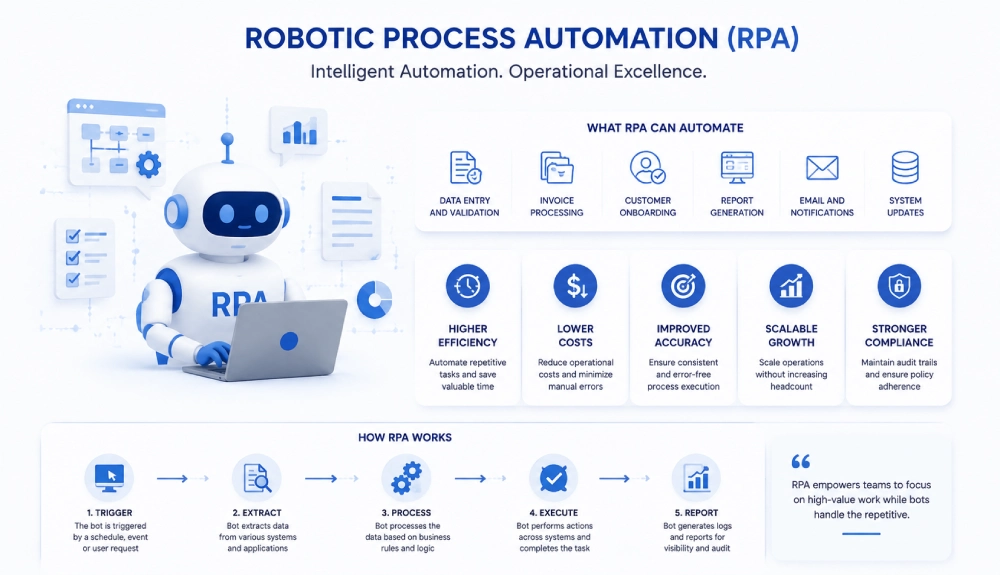
RPA development is the discipline of designing, building, and deploying software bots that execute rules-based, repetitive tasks by interacting with the user interface layer of existing applications. Unlike traditional integration, RPA does not require changes to the underlying systems it touches, making it especially valuable in environments where legacy software is deeply embedded.
The technology has gone through four distinct generations since the early 2000s:
| Generation | Era | Primary Focus | Key Trait |
|---|---|---|---|
| RPA 1.0 | 2000s | Individual productivity | Desktop-based virtual assistant for copy-paste tasks |
| RPA 2.0 | 2010s | Departmental efficiency | Server-based, 24/7 unassisted back-office automation |
| RPA 3.0 | Early 2020s | Enterprise scaling | Cloud-native with analytics and dynamic load balancing |
| RPA 4.0 | 2026 | Intelligent execution | LLM-integrated agents that handle unstructured data and reason through exceptions |
The most consequential shift in the current generation is the integration of Large Language Models (LLMs) and Computer Vision. According to McKinsey, generative AI and intelligent automation are converging into a single operational layer, allowing bots to interpret intent rather than follow rigid coordinate-based instructions. This makes modern AI/ML development a natural companion discipline to RPA, not a separate capability.
Which Business Processes Are the Best Candidates for Automation?
The best automation candidates share three traits: high transaction volume, rules-based decision logic, and significant downstream consequences when errors occur. Below are the use cases consistently delivering the strongest returns in 2026.
Accounts Payable and Invoice Processing
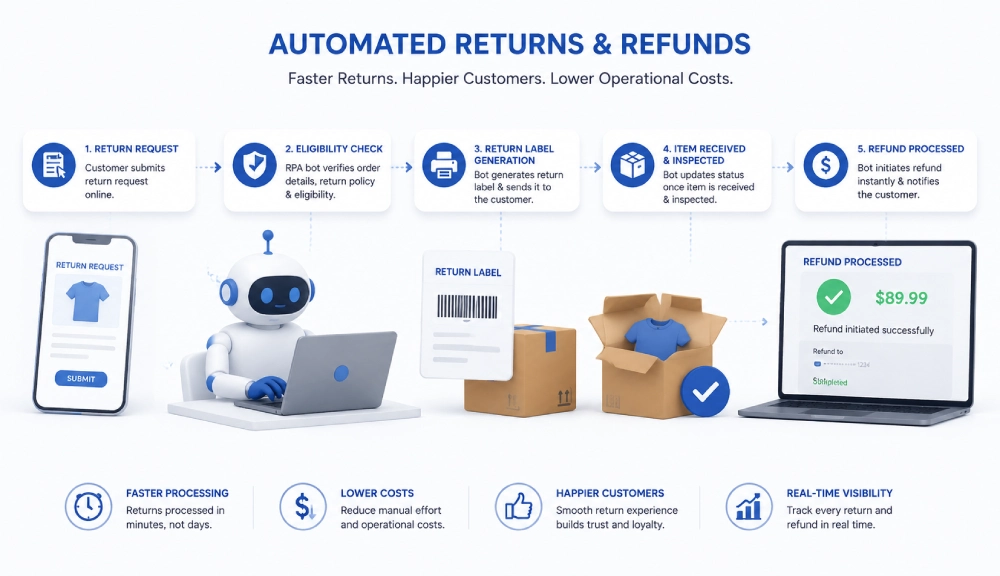
Bots use Intelligent Document Processing to extract line items, vendor IDs, and tax data from incoming invoices, then perform a three-way match against purchase orders and delivery records. Processing time drops from days to minutes, and duplicate payment risk is effectively eliminated. This remains the most frequently cited first automation deployment across finance teams.
Customer Onboarding and KYC Verification
In banking and fintech, onboarding a new customer involves aggregating data from credit bureaus, government databases, and internal systems. RPA bots can execute those checks in real time, compressing a multi-day process into minutes. According to McKinsey’s Financial Services research, faster onboarding directly correlates with lower customer abandonment rates, a measurable revenue impact.
Healthcare Claims Management
Healthcare providers deal with insurance claims that require precise coding, eligibility verification, and payer portal submissions. RPA bots coordinate between Electronic Health Records and payer systems to reduce manual errors. Teams building on platforms like OpenEMR have found that automation at the claims layer significantly reduces resubmission cycles.
Supply Chain Inventory Orchestration
Retail and manufacturing organizations use RPA to keep inventory levels synchronized across eCommerce storefronts, ERP systems, and supplier portals. When stock drops below a threshold, the bot triggers a reorder, updates the shipping log, and adjusts the customer-facing catalog, all without human intervention.
HR Onboarding and Offboarding
The moment a contract is signed, an RPA bot can provision the new employee’s software access, create payroll records, and schedule onboarding communications. Offboarding runs the same sequence in reverse, ensuring access revocation happens immediately rather than days after a departure.
IT Help Desk Triage
Bots integrated with Natural Language Processing can read incoming support tickets, categorize them by urgency and type, and resolve routine requests such as password resets without any engineer involvement. According to Harvard Business Review, automating tier-one support frees technical staff for the infrastructure and architecture work that actually requires domain expertise.

How Do You Launch a Scalable RPA Program?
A scalable RPA program follows a structured five-step lifecycle. Skipping any phase, especially the first one, is the leading cause of “pilot purgatory,” where organizations end up with two or three bots they are afraid to expand because the foundation was never solid.
Step 1: Process Discovery and Mining
Use process mining tools to analyze event logs from your ERP and CRM platforms before writing a single line of bot logic. This data-driven approach reveals the actual state of your workflows, independent of what stakeholders believe those workflows look like. Prioritize automation candidates using a complexity vs. impact matrix, targeting high-volume, low-exception processes first.
Step 2: Process Definition and Solution Design
Document every decision point, system interaction, and exception path in a Process Definition Document (PDD). This becomes the functional blueprint. A Solution Design Document (SDD) translates the PDD into the technical architecture, covering how the bot authenticates, which systems it touches, and how it handles failures.
Step 3: Modular Development with Agentic Integration
Build bots in a modular, sandbox environment using reusable components. In 2026, this phase will increasingly incorporate generative AI integration to handle semi-structured inputs. Use AI-driven object selectors instead of coordinate-based clicking; this single design decision prevents the majority of bot failures caused by UI updates.
Step 4: Testing and Security Review
Run User Acceptance Testing and stress testing in a staging environment that mirrors production. All bot credentials should be pulled from an encrypted vault at runtime and never stored within the script itself. Every bot action should generate an immutable log entry for audit purposes.
Step 5: Center of Excellence (CoE) and Ongoing Orchestration
Establish a Center of Excellence to govern bot performance, manage versioning, and standardize development practices across teams. The CoE is the mechanism that allows an organization to scale from 5 bots to 50 without accumulating unmanageable technical debt. It also manages human-in-the-loop handoffs for exception cases that require judgment beyond what the bot is designed to handle.
Microsoft Power Automate vs. Legacy RPA Platforms
The enterprise automation market has effectively split into two camps: specialist RPA vendors such as UiPath and Blue Prism, and ecosystem-native platforms led by Microsoft Power Automate. For organizations already operating inside the Microsoft stack, the calculus strongly favors the latter.
According to Forrester’s RPA Wave research, total cost of ownership is the most frequently cited evaluation criterion among enterprise buyers. Legacy vendors typically require a substantial upfront investment for orchestration infrastructure, per-bot licensing, and dedicated maintenance teams. Power Automate, by contrast, is bundled within most Microsoft 365 and Dynamics 365 agreements, eliminating the need for a separate platform license.
| Evaluation Pillar | Legacy RPA (UiPath / Blue Prism) | Microsoft Power Automate |
|---|---|---|
| Licensing model | Per-bot, high upfront cost | Included in existing M365/Azure agreements |
| Infrastructure | Dedicated local or hosted servers | 100% cloud-native on Azure |
| Security identity | Separate credential vault required | Native Microsoft Entra ID (Zero Trust) |
| AI capability | Requires add-on AI Center modules | Native Copilot and Azure OpenAI integration |
| Developer dependency | Pro-code heavy, specialist required | Low-code/pro-code hybrid, citizen developer ready |
| Maintenance overhead | High (brittle UI selectors) | Lower (AI-driven object recognition) |
The low-code/pro-code hybrid model of Power Automate also addresses the developer shortage challenge. Business users can automate their own daily workflows using Copilot-assisted builders, while platform architects focus on high-security, mission-critical processes. Bitcot’s Microsoft Power Automate consulting practice is built around this fusion team model.
What Are the Most Common RPA Development Challenges?
Three challenges consistently appear across enterprise RPA programs, regardless of industry or platform choice.
Brittle Bot Syndrome
Traditional RPA bots fail when a target application updates its UI; even minor layout changes can break a bot built on pixel-coordinate clicking. The fix is object-based selectors that identify elements by their underlying code properties rather than their screen position. In 2026, AI Computer Vision adds another layer of resilience, allowing bots to recognize interface elements by visual pattern even when the DOM structure changes.
Shadow IT and Security Exposure
As automation democratizes, individual departments begin building bots outside centralized oversight. These bots frequently handle sensitive data using hard-coded credentials and generate no audit trail. The architectural solution is Zero-Trust governance: all bots authenticate through an enterprise credential vault, and every action is logged centrally. This is non-negotiable for organizations handling personal data or financial records.
The Scalability Wall
Most organizations can get five to ten bots running without a formal program structure. Moving beyond that ceiling requires a reusable component library, standardized documentation practices, and a CoE with the authority to enforce them. According to organizations that establish an RPA Center of Excellence before scaling report significantly higher program maturity scores than those that add governance retroactively. When teams reuse 60 to 70 percent of code across different automation projects, deployment velocity increases and maintenance burden decreases proportionally.
Our Perspective
Working with healthcare and fintech teams across San Diego and nationally, one pattern stands out consistently: organizations that invest in process discovery before development ship better automations in less time. The temptation to start building immediately is strong, especially when leadership is applying pressure for quick wins. But the teams that skip the discovery phase end up in one of two places: they automate a process that should have been redesigned, or they build a technically functional bot, but nobody actually uses it because it does not reflect how the work really flows.
We have also seen a meaningful shift in what clients are asking for at the integration layer. Two years ago, most automation projects were straightforward rule-based workflows. Today, the requests coming through our AI consulting practice almost always involve some degree of unstructured data handling, whether that is reading a non-standard invoice format, extracting meaning from a patient intake note, or parsing a vendor email. The bots that succeed long-term are the ones designed with that variability in mind from the start.

Conclusion
RPA development in 2026 is not about replacing people. It is about giving your team the capacity to focus on the work that actually requires human judgment. The organizations seeing the strongest results share a common approach: they start with rigorous process discovery, build on modular and resilient architecture, and govern the program through a Center of Excellence before attempting to scale. Platform choice matters, but it matters less than the discipline behind the deployment.
If your automation program has stalled, or if you are still trying to identify where to begin, the answer almost always lies in the process layer, not the technology layer. A focused conversation with a team that has navigated these patterns across healthcare, fintech, and enterprise software can compress months of trial and error into a clear starting point. Get in touch and let’s identify where automation can have the most immediate impact for your team.
Frequently Asked Questions
What is RPA development?
RPA development is the process of designing and deploying software bots that automate high-volume, rules-based tasks by interacting with the user interface layer of existing applications. Unlike traditional system integrations, RPA does not require changes to the underlying software it connects with, making it practical for organizations that rely on legacy platforms. In 2026, modern RPA bots also incorporate AI and Computer Vision to handle unstructured data and adapt to interface changes automatically.
What is the difference between RPA and traditional automation?
Traditional automation typically requires API-level integration or custom-coded connectors between systems. RPA works at the presentation layer, meaning it interacts with applications the same way a human would: reading screens, entering data, and clicking buttons. This makes RPA faster to deploy and non-invasive to existing infrastructure. The tradeoff is that UI-dependent bots can break when an application updates its interface, which is why modern RPA development prioritizes object-based selectors and AI-driven object recognition over coordinate-based clicking.
How do you choose the right process to automate first?
The strongest first automation candidates share three characteristics: high transaction volume, rules-based decision logic, and a measurable downstream cost when errors occur. Accounts payable, customer onboarding, and IT help desk triage consistently meet all three criteria. The recommended approach is to run a process mining exercise against your ERP or CRM event logs before selecting a candidate. This surfaces the actual state of your workflows rather than relying on stakeholder assumptions, which frequently overestimate process consistency.
Which industries benefit most from RPA development in California?
Healthcare, fintech, and enterprise technology companies across California are among the heaviest adopters of RPA. Healthcare organizations use automation to manage claims processing, patient onboarding, and records reconciliation between EHR platforms and payer portals. Fintech firms apply RPA to KYC verification, fraud monitoring, and loan origination workflows. In both sectors, the combination of high transaction volume and strict data handling requirements makes automation a practical necessity rather than a purely cost-driven decision.
Is RPA still worth investing in when AI agents are becoming more capable?
Yes, and the two technologies are increasingly complementary rather than competing. AI agents excel at reasoning, interpreting unstructured content, and handling ambiguous inputs. RPA provides the execution layer: the reliable, auditable mechanism that actually performs actions inside your core business applications. According to Gartner, RPA is increasingly positioned as the foundational execution infrastructure for agentic AI systems. Organizations that build a stable RPA layer now are better positioned to layer more advanced AI capabilities on top of it as those tools mature.