Key Takeaways
- RPA helps eCommerce businesses automate repetitive tasks such as order processing, inventory updates, returns, refunds, reporting, and customer support workflows.
- It reduces manual effort, improves data accuracy, and helps teams handle higher order volumes without increasing workload at the same pace.
- The best RPA use cases are rule-based, high-volume, and measurable, such as inventory syncing, return processing, price monitoring, and fraud review support.
- A successful RPA rollout should start with one clear workflow, test it through a small pilot, and scale only after results are stable.
- For long-term value, eCommerce brands should combine RPA with proper governance, bot access controls, audit trails, and ongoing workflow optimization.
Remember when automation only meant setting up a simple out-of-office email?
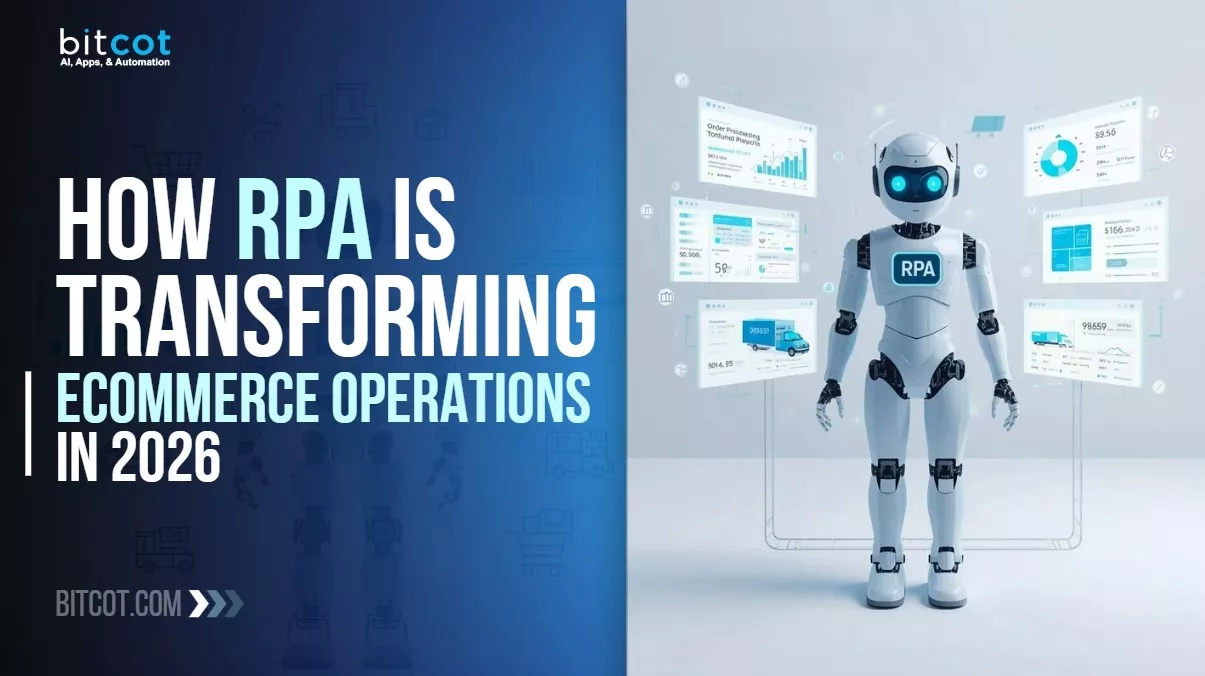
That version of automation is far behind us. In 2026, eCommerce teams are using Robotic Process Automation (RPA) to handle the repetitive work that slows down operations: order updates, inventory checks, invoice processing, returns, refunds, reporting, and customer support follow-ups.
For growing online stores, manual back-office work is no longer just inconvenient. It creates delays, increases the chance of errors, and makes it harder to scale when order volume suddenly jumps.
RPA helps solve that problem by using software bots to complete rule-based tasks across the tools your business already uses. These bots can log in to systems, move data, check records, update fields, send alerts, and keep processes running with far less manual effort.
In this guide, we’ll look at how RPA is changing eCommerce operations, where it delivers the most value, and how businesses can start implementing automation without disrupting their existing systems.
We’ll cover:
- How RPA works in eCommerce: What software bots do and where they fit into day-to-day operations.
- High-value use cases: Inventory syncing, order processing, returns, pricing, support, and fraud monitoring.
- Implementation strategy: How to choose the right processes, run a pilot, and scale automation safely.
Let’s break it down.
What is RPA and Why Should eCommerce Businesses Care?
Robotic Process Automation, or RPA, uses software bots to perform repetitive digital tasks that people usually complete manually. These bots are not physical robots. They are programs that can follow steps across websites, dashboards, spreadsheets, CRMs, ERPs, payment systems, and marketplace portals.
In eCommerce, RPA can help with tasks such as copying order details, updating inventory, generating invoices, checking shipment statuses, processing returns, and creating daily reports.
The biggest advantage is simple: RPA helps teams reduce repetitive work while keeping operations consistent, especially during busy sales periods.
Why It’s a Game-Changer for eCommerce
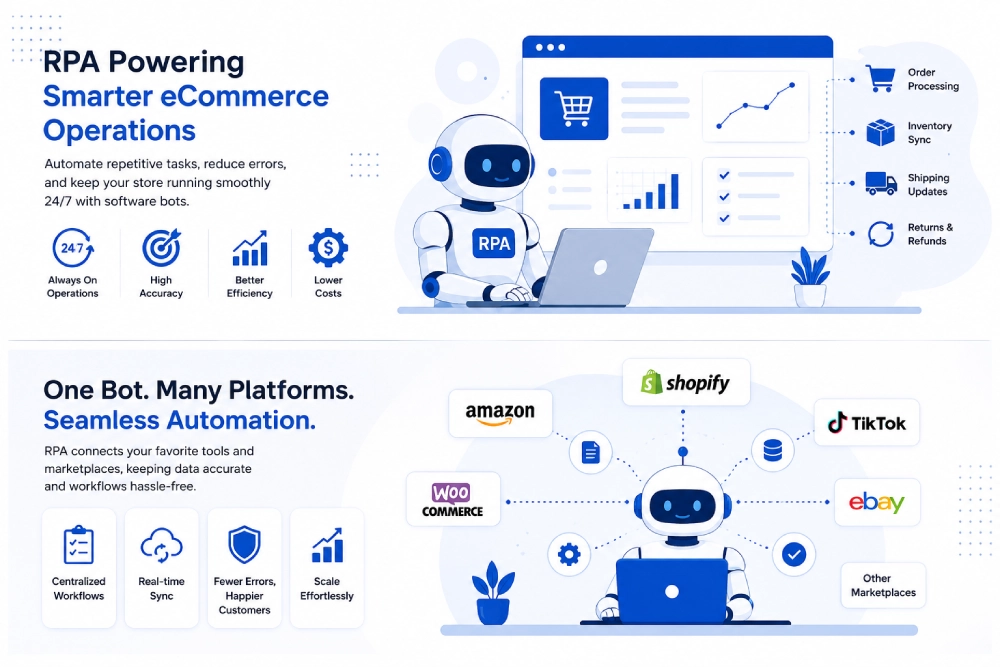
If your team is still manually updating stock levels across Shopify, Amazon, TikTok Shop, WooCommerce, or other sales channels, your operations are already exposed to delays and mistakes.
RPA can help eCommerce businesses improve:
- Operational speed: Bots can process routine tasks faster than a manual team, especially when the steps are repetitive and rule-based.
- Data accuracy: By reducing copy-paste work, RPA lowers the risk of errors in order details, invoices, SKU records, and inventory updates.
- Availability: Bots can run outside normal business hours, helping teams keep orders, reports, and alerts moving even when staff are offline.
- Scalability: During peak seasons, automation can support higher transaction volumes without requiring the same increase in manual workload.

What Makes RPA Different from Traditional Automation?
Traditional automation usually depends on backend integrations, APIs, and custom development. It is powerful, but it can take more time when systems are complex or older platforms do not provide clean integration options.
RPA works differently. It can interact with software at the user interface level, similar to how a person uses a screen. A bot can open a portal, click buttons, copy information, paste it into another system, and complete a workflow based on defined rules.
This makes RPA useful when a business wants to automate a process without rebuilding the entire technology stack.
- Surface-level interaction: RPA can work with existing software interfaces, even when APIs are limited or unavailable.
- Faster deployment: Many RPA workflows can be planned, tested, and launched faster than full custom integrations.
- Legacy-system support: RPA can help automate older systems that still matter to the business but are difficult to modernize immediately.
| Feature | Traditional Automation | RPA |
| Integration | Usually requires backend/API work | Can work through user interfaces |
| Time to Launch | Can take months depending on complexity | Can often start with smaller pilots in weeks |
| Flexibility | Strong but often harder to change | Useful for repeatable workflows that change over time |
| IT Requirement | Higher technical effort | Lower effort for rule-based workflows |
Key eCommerce Operations Being Transformed by RPA
RPA is most useful in eCommerce when the work is repetitive, high-volume, and dependent on accurate data movement between systems.
- Multi-channel inventory sync: Bots can help update stock levels across marketplaces and store platforms to reduce overselling and order cancellations.
- Returns and refund workflows: Bots can verify return details, update warehouse systems, trigger refund steps, and notify support teams when manual review is needed.
- Order processing: Bots can validate order details, check addresses, generate shipping labels, and flag exceptions for human review.
- Customer support triage: Bots can collect order status, tracking links, refund status, or account details before a support agent responds.
- Competitor price monitoring: Bots can collect pricing information and send alerts or trigger rule-based updates when pricing changes.
For eCommerce businesses, RPA is not only a back-office tool. It can improve speed, accuracy, and customer experience across the full order journey.
Benefits and ROI of RPA for eCommerce Brands
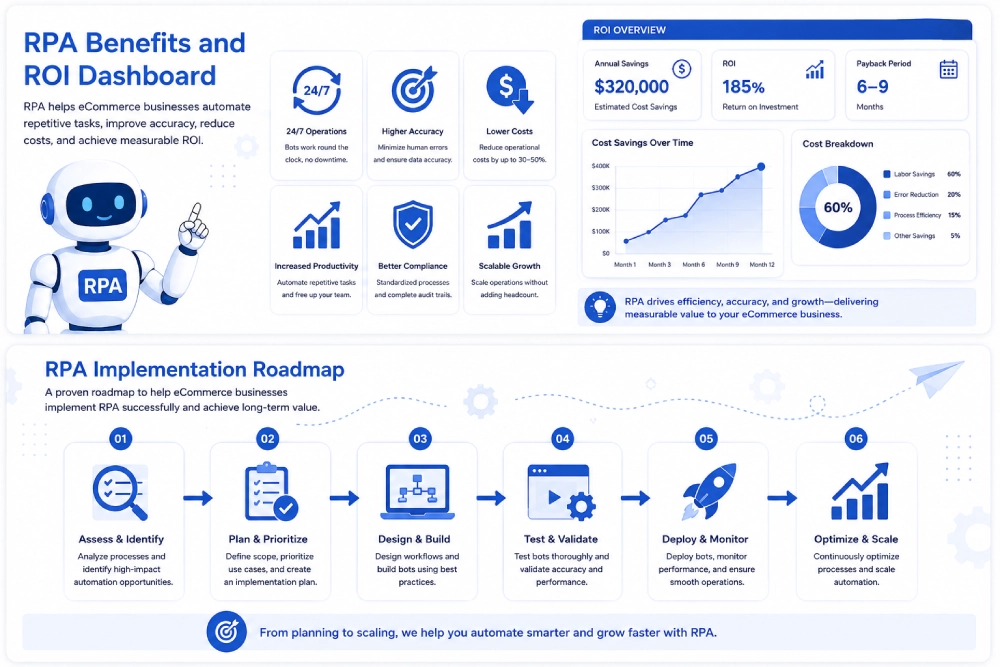
RPA can create measurable value when it is applied to the right workflows. The strongest results usually come from tasks that are repetitive, time-consuming, and easy to define with clear rules.
Instead of treating RPA as a broad technology upgrade, eCommerce businesses should start by identifying the tasks that create the most friction for operations teams and customers.
Drastic Reduction in Operational Costs
Manual work takes time, and time becomes expensive as order volume grows. RPA helps reduce the amount of repetitive work handled by employees, allowing teams to focus on higher-value tasks such as customer experience, operations planning, and growth strategy.
- Less repetitive admin work: Bots can handle routine updates, checks, and transfers across systems.
- Lower correction effort: Reducing manual entry can also reduce the time spent fixing incorrect data, duplicate records, or missed updates.
Accelerated Processing Speed
Speed matters in eCommerce because customers expect quick confirmations, accurate tracking, and fast refund updates. RPA can help reduce delays by moving routine steps forward automatically.
- Order-to-fulfillment support: Bots can help validate details, update systems, and prepare shipping steps faster.
- Return and refund support: Bots can move eligible returns through the process and escalate exceptions to the right person.
Scalability Without Matching Headcount Growth
When campaigns, seasonal sales, or viral product moments increase order volume, manual teams can quickly become overloaded. RPA helps businesses handle higher workloads by automating predictable steps in the process.
- Flexible digital capacity: Businesses can expand automation coverage for peak periods and reduce it when demand returns to normal.
Improved Data Quality and Better Reporting
RPA can help keep operational data cleaner by reducing inconsistent manual updates. Better data improves reporting, forecasting, customer communication, and decision-making.
- More reliable inventory visibility: Bots can help keep stock information updated across marketplaces, storefronts, and internal systems.
Overall, RPA works best when it is tied to clear business outcomes: fewer delays, fewer errors, faster processing, and more reliable operations.
| Metric | Manual Process | RPA-Enabled Process |
| Error Risk | Higher due to manual entry | Lower when rules are well-defined |
| Processing Time | Slower for repetitive tasks | Faster for routine workflows |
| Availability | Limited by team hours | Can run outside business hours |
| Cost per Task | Can rise with volume | Can become more efficient at scale |
4 High-ROI Use Cases for RPA in eCommerce
The best RPA use case is not always the most complex one. It is usually the workflow that is repeated often, follows clear rules, and creates visible business pain when delayed or done incorrectly.
Here are four practical areas where eCommerce businesses can use RPA effectively.
1. Intelligent Inventory and Supply Chain Orchestration
Multi-channel selling makes inventory harder to manage. When products are sold across Shopify, Amazon, TikTok Shop, WooCommerce, and retail systems, manual stock updates can quickly become unreliable.
- Real-time stock updates: Bots can help update inventory across connected systems after sales, returns, or restocks.
- Reorder alerts: Bots can notify teams when stock reaches a defined threshold.
- Business impact: Better inventory visibility can reduce overselling, stockout issues, and unnecessary manual checks.
2. Returns and Refund Processing
Returns can create pressure on support, finance, warehouse, and customer experience teams. RPA can help move eligible returns through the process faster while flagging exceptions for human review.
- Return verification: Bots can check order IDs, return windows, tracking numbers, and product eligibility.
- System updates: Bots can update the warehouse system, payment platform, and customer support ticket.
- Business impact: Faster return handling can improve customer trust and reduce support workload.
3. Competitor Price Monitoring and Dynamic Updates
Pricing changes quickly in competitive eCommerce categories. Manual price monitoring is slow and often inconsistent.
- Price tracking: Bots can monitor competitor websites or marketplaces on a defined schedule.
- Rule-based alerts: Teams can receive alerts when a competitor lowers prices or launches a promotion.
- Business impact: Faster pricing visibility helps teams respond more confidently to market changes.
4. Fraud Detection and Order Review Support
Fraud review needs speed and consistency. RPA can support fraud teams by checking repeatable risk signals before an order is approved or escalated.
- Pattern checks: Bots can review mismatched billing and shipping details, unusual order frequency, high-value orders, or suspicious locations.
- Escalation rules: Bots can place risky orders on hold and send them to a human reviewer.
- Business impact: Faster review helps protect revenue while keeping legitimate orders moving.
By starting with these high-friction workflows, eCommerce teams can build automation momentum without trying to transform everything at once.
How to Implement RPA in eCommerce: A 2026 Roadmap
RPA implementation does not need to begin with a massive transformation program. A better approach is to start with one well-defined workflow, prove the value, then scale carefully.
Here is a practical roadmap.
Step 1: Strategic Process Discovery
Do not automate a broken process. First, identify tasks that are repetitive, rule-based, high-volume, and measurable.
- Good candidates: Order entry, SKU updates, return label generation, invoice processing, stock alerts, and daily reports.
- What to avoid first: Processes with too many exceptions, unclear ownership, or poor data quality.
Step 2: Choose the Right Automation Approach
Not every workflow needs the same type of automation. Some tasks need simple rule-based bots, while others may require AI assistance for reading documents, interpreting emails, or handling unstructured data.
- Low-code/no-code RPA: Useful for simpler workflows that business teams can help define.
- AI-assisted RPA: Useful when workflows involve documents, emails, support tickets, or other unstructured inputs.
Step 3: Run a Small Proof of Concept
Start with one workflow that has clear value. For example, automate inventory syncing between two sales channels or automate return eligibility checks.
- Goal: Confirm that the bot completes the workflow accurately and consistently.
- KPI: Track time saved, error reduction, exception rate, and team feedback.
Step 4: Add Governance and Security
RPA bots often access customer records, order data, payment statuses, and internal systems. That means access control and auditability must be part of the implementation from the beginning.
- Bot identity: Give each bot its own login, access level, and ownership.
- Audit trails: Track what the bot did, when it did it, and which systems were affected.
- Exception handling: Define when the bot should stop and send the task to a person.
Step 5: Orchestrate and Scale
Once the first workflow is stable, expand automation in a controlled way. A central dashboard or automation owner can help monitor bot performance, failures, exceptions, and improvement opportunities.
Common Implementation Pitfalls to Avoid
- Automating too much too early: Start with the most repeatable 60–80% of a workflow instead of forcing full automation on day one.
- Skipping process cleanup: If the current workflow is messy, automation may only make the mess run faster.
- Ignoring team adoption: Explain how automation supports the team, what it will handle, and when people still need to step in.
With the right process selection and governance, RPA can become a practical operating layer for eCommerce growth.
Microsoft Power Automate: A Strong RPA Tool for eCommerce
Microsoft Power Automate is a strong option for eCommerce businesses that already use Microsoft 365, Excel, Outlook, Teams, SharePoint, Dynamics 365, or Azure-based tools.
It supports low-code automation, cloud flows, desktop automation, approvals, AI Builder, and integrations across many business applications. For teams that want to automate without building everything from scratch, it can be a practical starting point.
Why Power Automate Works Well for eCommerce
- Microsoft ecosystem integration: Teams can connect Outlook, Excel, Teams, SharePoint, and Dynamics workflows with less custom development.
- Low-code workflow building: Business and operations teams can help define flows without depending fully on engineering teams for every small update.
- AI Builder support: Teams can use AI features for document processing, invoice extraction, form reading, and sentiment analysis.
- Security and access controls: Microsoft-based governance features can help teams manage permissions, approvals, and audit trails.
High-Impact Use Cases for Power Automate in eCommerce
- Invoice and receipt processing: Extract supplier invoice details and send them to accounting tools for review.
- Inventory notifications: Alert teams when stock drops below a threshold or when marketplace inventory needs attention.
- Support ticket triage: Prioritize tickets based on keywords, sentiment, order status, or issue type.
- Operations reporting: Generate recurring reports from order, inventory, and customer service data.
Power Automate is not the only RPA option, but it can be especially useful for businesses that already rely on Microsoft tools and want to start with practical workflow automation.
| Feature | Microsoft Power Automate | Zapier | UiPath |
| Best For | Microsoft-heavy teams and mid-market workflows | Simple app-to-app automations | Complex enterprise automation |
| RPA Capability | Strong for business workflows and desktop automation | Limited for true RPA use cases | Advanced enterprise-grade RPA |
| Ease of Use | High for Microsoft users | Very high for simple flows | Moderate; often needs trained specialists |
| Microsoft Sync | Native | Available through connectors | Available through integrations |
Top 5 RPA Trends in eCommerce for 2026
RPA is moving beyond simple task automation. In 2026, the strongest eCommerce automation strategies combine RPA with AI, workflow orchestration, data visibility, and stronger governance.
1. AI-Assisted RPA
Traditional bots are best at following rules. AI-assisted automation helps bots handle more flexible inputs such as emails, PDFs, invoices, support tickets, and product documents.
- The trend: Bots can support decisions by extracting information, classifying requests, and routing exceptions.
- eCommerce impact: Teams can automate more support, finance, and operations workflows that involve unstructured data.
2. Hyperautomation as an Operating Model
Hyperautomation combines RPA, AI, process mining, integrations, and analytics to improve entire workflows rather than isolated tasks.
- The trend: Businesses are mapping bottlenecks before deciding what to automate.
- eCommerce impact: Fulfillment, returns, customer support, and finance processes become easier to measure and improve.
3. Zero-Touch Back-Office Workflows
Some routine workflows can move from request to completion with little or no manual involvement, as long as the rules are clear and exceptions are handled properly.
- The trend: More order, inventory, refund, and reporting workflows are being handled automatically.
- eCommerce impact: Teams can reduce repetitive workload while maintaining customer-facing speed.
4. Growth of Citizen Developers
Low-code and no-code platforms allow operations, finance, and customer service teams to participate directly in automation planning and improvement.
- The trend: Teams closest to the work are helping define and improve automations.
- eCommerce impact: Small but valuable workflow improvements can be delivered faster.
5. Security-First Automation
As bots access more systems, security becomes more important. Strong access controls, bot identities, audit logs, and exception rules are now essential for safe automation.
- The trend: Businesses are treating bots like digital users with defined permissions and accountability.
- eCommerce impact: Automation can scale while protecting customer data, payment-related workflows, and internal systems.
These trends show that RPA is becoming more strategic. The goal is no longer just to automate tasks. The goal is to build reliable systems that help eCommerce teams move faster with better control.
| Trend | Adoption Level | Primary Benefit |
| AI-Assisted RPA | Growing quickly | Handles documents, emails, and exceptions better |
| Hyperautomation | Increasing across larger teams | Improves end-to-end workflows |
| No-Code RPA | Mainstream for simple workflows | Speeds up automation adoption |
| Security-First Automation | Essential | Protects data and system access |

Partner with Bitcot to Build Your Custom RPA Solution
Off-the-shelf automation tools can help with simple workflows, but many eCommerce businesses need automation that fits their actual systems, rules, exceptions, and growth plans.
That is where Bitcot can help.
Bitcot builds custom software and intelligent automation solutions for businesses that want to reduce manual work, improve operational speed, and connect workflows across their existing tools.
Instead of forcing your team into a fixed automation template, we design RPA workflows around your tech stack, whether you use Shopify, BigCommerce, WooCommerce, VTEX, Microsoft tools, or a custom ERP.
Why eCommerce Leaders Choose Bitcot for RPA
- End-to-end implementation: From process discovery and workflow mapping to bot development, testing, deployment, and monitoring.
- Microsoft Power Automate expertise: We help teams build secure, scalable workflows using Power Automate, AI Builder, and Microsoft ecosystem tools.
- AI-assisted automation: We design workflows that can support document processing, triage, invoice handling, and exception routing.
- Scalable automation strategy: We help businesses start with practical use cases and expand automation where it creates measurable value.
For eCommerce brands looking to reduce repetitive work, improve accuracy, and scale operations, Bitcot acts as an automation partner focused on practical business outcomes.
Final Thoughts
Most eCommerce teams do not struggle because they lack ambition. They struggle because too much time is spent on repetitive operational work that should not depend on manual effort forever.
RPA gives businesses a way to reduce that burden. It helps teams automate routine work, keep systems updated, respond faster to customers, and operate with more consistency during growth periods.
The key is to start carefully. Choose one workflow, define success clearly, test the automation properly, and scale only when the results are stable.
If your team is spending too much time moving data between systems, checking orders manually, updating spreadsheets, or chasing repetitive support tasks, automation may be the next practical step.
Bitcot provides custom RPA development services for eCommerce businesses that want to improve operations without rebuilding everything from scratch.
Chat with a Bitcot expert today and explore where automation can create the fastest operational value for your business.
Frequently Asked Questions (FAQs)
1. How long does it take to see a return on investment (ROI)?
Most eCommerce brands in New York and Los Angeles report a full return on their investment within 6 to 9 months. Whether you are a growing startup in Chicago or an established retailer in Houston, the benefits of reducing manual errors and labor hours begin immediately. In tech hubs like Phoenix and Philadelphia, businesses often see their productivity triple within the first year of implementation.
2. Can RPA handle complex tasks like fraud detection?
Absolutely. While basic bots follow simple rules, modern solutions in San Antonio and San Diego now use agentic AI to spot anomalies in real-time. For a high-volume merchant in Dallas or Jacksonville, this means bots can instantly flag suspicious orders that a human in Fort Worth or San Jose might miss. This level of security is becoming the standard for digital storefronts from Austin to Charlotte.
3. Is RPA difficult to integrate with my existing Shopify or Amazon store?
Not at all. One of the biggest advantages for businesses in Columbus and Indianapolis is that RPA works on the surface level of your software. You don’t need to rewrite your code in San Francisco or Denver; the bot simply logs in and performs tasks just like a member of your team would in Boston or Seattle. This makes it incredibly easy to scale operations without a massive IT overhaul.
4. What is the difference between RPA and basic automation?
Think of basic automation as a fixed bridge, whereas RPA is a smart vehicle. In cities like Washington, D.C., and Nashville, traditional automation requires rigid APIs, but RPA can navigate different websites and apps just like a human. This flexibility is why retailers in Portland and Las Vegas prefer RPA for messy tasks like managing returns or syncing inventory across different social media marketplaces.
5. Do I need a large technical team to manage these bots?
In 2026, the rise of no-code platforms means a store manager in Miami or Anchorage (Alaska) can oversee a digital workforce with ease. Leading companies in Kansas City and Ashburn are empowering their existing staff to build micro-automations, meaning you don’t need to hire a fleet of developers to keep your bots running smoothly.