In the world of ecommerce, “good enough” is a dangerous gamble.
We’ve all seen it: an app looks great in a demo, but the moment you add 10,000 products or a sudden surge of holiday traffic, the UI lags, the checkout glitches, and your customers disappear.
The gap between a basic prototype and a production-ready powerhouse is wider than most businesses realize. To bridge that gap, our team at Bitcot built Fastest.
Fastest isn’t just another demo application. It’s a high-performance Proof of Concept (POC) designed to push React Native and Expo to their absolute limits. We wanted to see if we could create a “single-codebase” solution that didn’t just work on iOS, Android, and Web, but actually felt premium on all of them.
From AI-driven voice search and seamless product discovery to one-click checkouts and real-time order tracking, Fastest is our blueprint for what modern mobile commerce should look like.
Scaling isn’t just about surviving more traffic; it’s about maintaining a buttery-smooth mobile shopping experience while your codebase grows. It’s about ensuring that adding a new feature doesn’t turn your app into a “spaghetti-code” nightmare that’s impossible to maintain.
In this post, we’re pulling back the curtain on the Bitcot engineering approach. We’ll show you how we architected a completely type-safe, cross-platform storefront that’s built for the long haul.
Whether you’re a business leader looking for a faster time-to-market or a tech lead looking for an enterprise-grade roadmap, this is the blueprint for an app that grows as fast as your ambition.
Why Most eCommerce Apps Fail to Scale: Solving the Mobile Experience Gap
Building an ecommerce app is a high-stakes balancing act.
You aren’t just competing with other stores; you’re competing with the frictionless experiences of giants like Amazon and Instagram. If your app feels like a mobile-wrapped website rather than a high-performance tool, users will look elsewhere.
Here is why most ecommerce apps hit a performance wall and how a modern architectural approach solves it:
Eliminating the Performance-UX Gap
Many eCommerce apps struggle with slow performance and poor UX on mobile devices, often resulting in “janky” scrolling or sluggish transitions. Solving this requires an architecture that offloads heavy computations to the native thread.
By leveraging high-performance engines and optimized rendering patterns, you can ensure the interface remains buttery-smooth even during high-traffic sales events.
Streamlining Complex Integrations
Integrating secure payments, authentication, and real-time catalog updates is notoriously complex and error-prone. In eCommerce, every technical glitch is a potential lost sale.
A production-ready architecture utilizes strict type-safety across the entire stack, allowing developers to catch integration errors during the build phase rather than in the hands of a frustrated customer.
Decoupling State Management for Consistency
Maintaining a consistent state across screens, such as the cart, wishlist, and user session, without tight coupling is a significant technical challenge. A scalable app avoids the trap of “spaghetti code” by using centralized, predictable state containers.
This ensures that an action taken on one screen reflects instantly across the entire platform without causing performance bottlenecks.
Solving the Cross-Platform Voice Search Hurdle
Modern consumers increasingly expect AI-driven features like voice search to find products instantly. However, implementing this across platforms traditionally requires messy native module integration and platform-specific handling.
Modern frameworks now allow for a unified system that accesses device microphones and speech-to-text APIs through a single codebase, offering a premium feature set without doubling development overhead.
Architecting for Network Reliability and Resilience
Managing network reliability with token refresh, retry logic, and offline resilience adds significant development overhead but is vital for mobile users. A scalable app doesn’t just show a connection error; it employs robust caching and background synchronization.
This allows users to continue browsing or viewing their cart even with spotty connectivity, while the architecture handles the heavy lifting of data recovery behind the scenes.
Ensuring Scalable Architecture for Feature Growth
As an ecommerce business grows, the app must support feature growth without sacrificing maintainability. Without a modular foundation, adding features like AR product previews can lead to system-wide regressions.
By isolating features within the architecture, businesses can iterate quickly and deploy updates without the risk of breaking existing functionality.
Delivering a Unified Cross-Platform Strategy
The ultimate goal is to deliver a unified codebase for iOS, Android, and Web without compromising native performance. The primary reason to adopt a modern cross-platform framework is strategic efficiency.
Shipping three high-performance platforms from one source code eliminates the need for fragmented development teams and ensures a consistent, high-quality brand experience for every user.
What is a Scalable eCommerce Architecture for Modern Mobile Commerce?
A scalable ecommerce architecture is a sophisticated framework designed to handle growth in users, data, and features without compromising performance.
It is a synergy of React Native, Expo, and cross-platform architecture that creates a high-performance shopping environment.
At its core, a scalable architecture is designed to support change. Mobile commerce evolves quickly. New payment methods appear, personalization becomes more advanced, and customer expectations continue to rise.
An app built without scalability in mind often works well at launch but struggles as soon as traffic increases or new features are added.
React Native: The High-Performance Core
React Native is the engine that allows developers to build truly native mobile apps using JavaScript and React. Unlike hybrid apps that are essentially websites in a container, React Native uses native components.
This means your customers get the buttery-smooth scrolling and instant responsiveness of a native iOS or Android app, but your business benefits from the efficiency of a single codebase.
Expo: The Enterprise-Grade Framework
If React Native is the engine, Expo is the advanced cockpit and aerodynamic body. It is an open-source platform that adds a powerful layer of tools and services on top of React Native.
For a modern ecommerce app, Expo provides the infrastructure for seamless, URL-based navigation across mobile and web via Expo Router. It also simplifies the integration of complex features like microphones for voice search and camera access for barcode scanning.
Cross-Platform Architecture: One Codebase, Three Platforms
A true cross-platform architecture ensures that your application runs seamlessly on iOS, Android, and the Web from a single source code. This is a massive strategic advantage.
Instead of hiring three separate teams to build and maintain three different versions of your store, you maintain one unified codebase. This ensures that a new promotional banner or a security patch is deployed across all platforms simultaneously.
Type-Safe and Production-Ready Engineering
A scalable architecture is inherently type-safe. By using TypeScript, every data point is strictly defined. This eliminates the hidden bugs that often crash apps during peak shopping hours.
Being production-ready means the architecture includes built-in solutions for network resilience, such as token refresh logic and offline caching. This ensures the shopping experience never breaks, even when the user’s connection is spotty.
Modular Design for Feature Growth
The foundation of scalability refers to how the app is organized. A modular architecture treats every feature as an independent block. This allows your team to iterate, update, or add new features without the risk of creating a tangled mess of code.
It is a design built to evolve as fast as the market moves, allowing for the quick addition of tools like AR product previews or loyalty programs.
| Feature | Traditional Mobile Development | Scalable React Native & Expo Architecture |
| Codebase | Separate codebases for iOS, Android, and Web. | One unified codebase for all platforms. |
| Time-to-Market | Slow; requires synchronized releases across multiple teams. | Fast; simultaneous deployment to App Store, Play Store, and Web. |
| User Experience | Varies by platform; often feels inconsistent. | High-performance; native look and feel with a consistent brand UI. |
| Development Cost | High; requires specialized developers for Swift, Kotlin, and Web. | Optimized; one team manages the entire cross-platform ecosystem. |
| Scalability | Difficult; adding a feature requires three separate implementations. | Seamless; modular design allows for rapid feature expansion. |
| Maintenance | Complex; bugs must be fixed and tested on each platform separately. | Efficient; central logic updates apply everywhere instantly. |
| Reliability | Prone to runtime errors due to fragmented environments. | High; strictly type-safe (TypeScript) to catch errors during development. |
The shift toward a scalable eCommerce architecture isn’t just a technical preference. It is a strategic move to reduce Total Cost of Ownership (TCO) while increasing the agility of your digital storefront.
By using a unified foundation, you ensure that your business can respond to market trends, like AI search or social commerce, months ahead of competitors tethered to legacy systems.
Benefits of Using React Native and Expo for Scalable eCommerce
In the competitive world of digital commerce, the ability to scale isn’t just a luxury; it is a survival requirement.
For businesses in 2026, the combination of React Native and Expo has emerged as the gold standard for building mobile storefronts that can handle rapid growth, seasonal traffic spikes, and global expansion.
Here is why this tech stack is the powerhouse behind modern, scalable eCommerce.
1. Unified Codebase for Universal Reach
The most immediate benefit of React Native is the ability to write one codebase that powers both iOS and Android applications.
In eCommerce, where feature parity is crucial for brand trust, this ensures that a “Flash Sale” or a new “Loyalty Program” launches on both platforms simultaneously.
By sharing up to 90% of the code, development teams avoid the “silo effect” of separate native teams. This leads to:
- Faster Feature Rollouts: Implement a new payment gateway like Apple Pay or Google Pay once for both platforms.
- Lower Maintenance Costs: Fix a bug in the checkout logic once, and it’s resolved across the entire mobile ecosystem.
2. Performance at Scale with “The New Architecture”
As of 2026, React Native’s New Architecture (featuring Fabric and TurboModules) is the standard. For eCommerce, this translates to a “near-native” experience that can handle data-heavy interfaces.
- Fabric Renderer: Ensures high-priority UI updates, like adding an item to a cart or scrolling through a massive product catalog, remain fluid at 60 FPS.
- TurboModules: Lazy-loads native features only when needed, which significantly reduces the initial app startup time, a critical metric for reducing bounce rates in shopping apps.
3. Rapid Iteration with Expo Application Services (EAS)
Expo is no longer just a “beginner’s tool”; its EAS (Expo Application Services) is an enterprise-grade suite that automates the most painful parts of app scaling.
- Over-the-Air (OTA) Updates: eCommerce is fast-paced. If a pricing error occurs or a promotional banner needs to change instantly, EAS allows you to push “Live Updates” directly to users’ devices without waiting for 48-hour App Store approval cycles.
- Cloud-Based Builds: Scaling a team usually means complex CI/CD pipelines. EAS handles the heavy lifting of building binaries in the cloud, allowing your developers to focus on UX rather than managing Mac minis or build servers.
4. Modular Growth with Continuous Native Generation (CNG)
One of the biggest fears for growing eCommerce brands is “hitting a wall” where the framework can’t support a specific native feature (like advanced AR for “virtual try-ons”).
Expo’s Continuous Native Generation solves this. It allows teams to use custom native code and third-party libraries without ever “ejecting” into a messy, unmanageable state. You can stay within the managed workflow while scaling your app’s complexity, ensuring that your tech stack grows with your business, not against it.
5. Seamless Integration with the Commerce Ecosystem
React Native thrives in the modern “Headless Commerce” world. Whether you are using Shopify, BigCommerce, or a custom-built backend, the React ecosystem offers mature libraries for:
- Secure Payments: Deep integration with Stripe and Adyen.
- Analytics & Personalization: Easy hooks for Segment, Firebase, and AI-driven recommendation engines.
- Observability: Built-in support for Sentry and LogRocket to catch checkout friction before it costs you a sale.
For eCommerce brands, scalability is about velocity and reliability. React Native provides the performance, while Expo provides the infrastructure to ship, update, and manage that performance at a global scale.
| Business Factor | Native (Swift/Kotlin) | Expo & React Native |
| Speed to Market | Slower (2 separate teams) | Faster (1 unified team) |
| Development Cost | High (200% effort) | Optimized (~120% effort) |
| Maintenance | Complex (2 codebases) | Simplified (1 codebase) |
| Platform Reach | iOS & Android separately | iOS, Android, and Web |
An Overview of Bitcot’s PoC Solution for eCommerce Businesses
To help eCommerce businesses validate ideas quickly and launch with confidence, Bitcot developed “Fastest,” a high-performance eCommerce PoC designed to solve the common pitfalls of slow mobile performance and fragmented user experiences.
By combining the agility of Expo with an enterprise-grade modular architecture, we demonstrated how a unified codebase can deliver native-level speed across iOS, Android, and Web.
The solution demonstrates how modern architecture and cross-platform technologies can come together to create a production-ready mobile commerce experience.
The “Fastest” Architecture: Modular by Design
To ensure the PoC was not just functional but also scalable, we implemented a Clean Architecture using an MVVM-style (Model-View-ViewModel) approach.
This creates a strict boundary between:
- UI Layer: Focused on the user experience (React Native + Expo Router).
- Business Logic: Handling complex state transitions (Redux Toolkit).
- Data Layer: Managing API calls and persistence (Axios + Redux Persist).
Technology Stack Used
The success of any PoC lies in its foundation. We selected tools that minimize development “friction” while maximizing production stability.
| Category | Technology | Purpose in the PoC |
| Frontend Framework | React Native (Expo) | Cross-platform parity with a single codebase. |
| State Management | Redux Toolkit | Predictable state for carts and complex wishlists. |
| Navigation | Expo Router | Modern, file-based routing for mobile and web. |
| Payments | Stripe SDK | Secure, PCI-compliant checkout in minutes. |
| Search | @react-native-voice | Native voice-to-text for hands-free shopping. |
| Networking | Axios + Interceptors | Reliable API calls with automatic auth-token refresh. |
Key Features Built for 2026 Mobile Shoppers
The “Fastest” PoC focuses on the high-impact features that drive conversion and customer retention:
- Omnichannel Voice Search: Utilizing the Web Speech API and native modules to allow users to search the catalog using natural language.
- Real-time Persistence: Even if a user loses connection, Redux Persist ensures their cart and wishlist remain intact, syncing immediately once they are back online.
- Seamless Authentication: A frictionless login experience via Google Sign-In and Firebase, supporting secure session management and refresh token flows.
- Optimized Checkout: Integration with the Stripe React Native SDK allows for saved cards, “one-tap” payments, and real-time order tracking.
This PoC proves that you don’t need to choose between speed-to-market and technical excellence. By leveraging Expo Router for navigation and TypeScript for type-safety, we’ve created a “Production-Ready” template. This reduces the risk of technical debt and allows businesses to transition from a PoC to a full-scale launch with total confidence.
How Our PoC Solution Works
1. Intelligent App Launch & Walkthrough
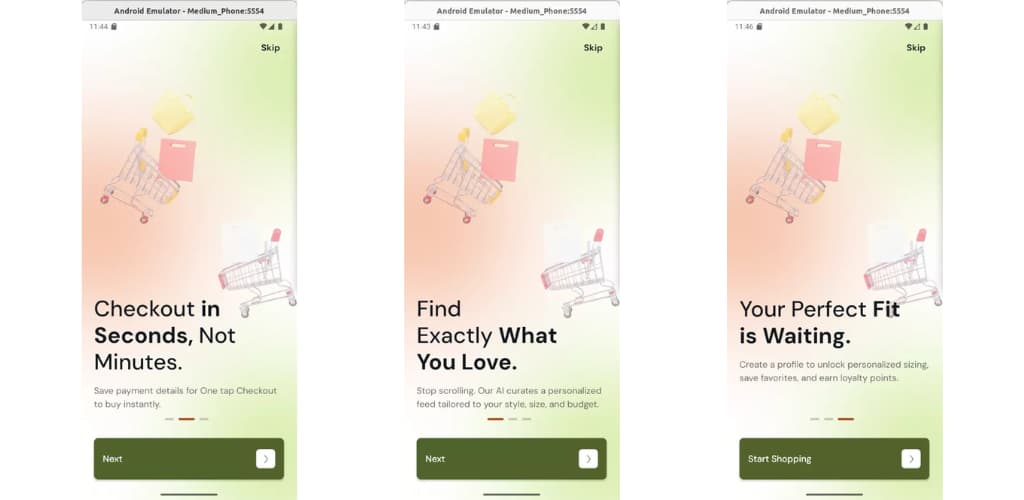
The user experience begins with a smart entry system. Instead of a generic landing page, the PoC uses conditional routing:
- Onboarding: New users receive a guided tour of the app’s unique value propositions.
- Session-Based Routing: Returning users skip the fluff. The app checks for an active session and instantly routes them to the dashboard or the login screen.
2. Secure Authentication Flow
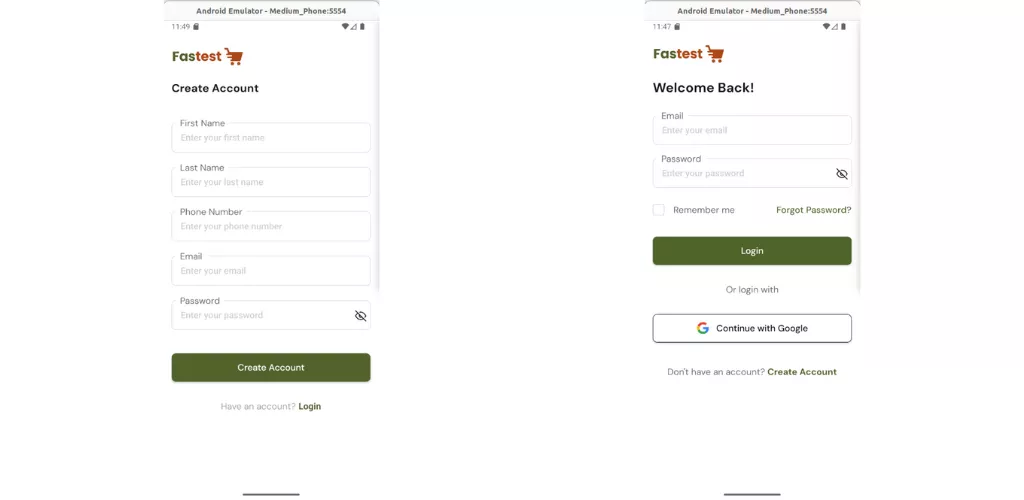
Security is handled with modern best practices, offering both traditional and social login options.
- Identity Providers: Integration with Firebase and Google Sign-In for frictionless access.
- Token Management: Using a secure refresh token flow, the app maintains persistent sessions without compromising security, storing tokens in protected device storage.
3. Data-Driven Home & Dashboard
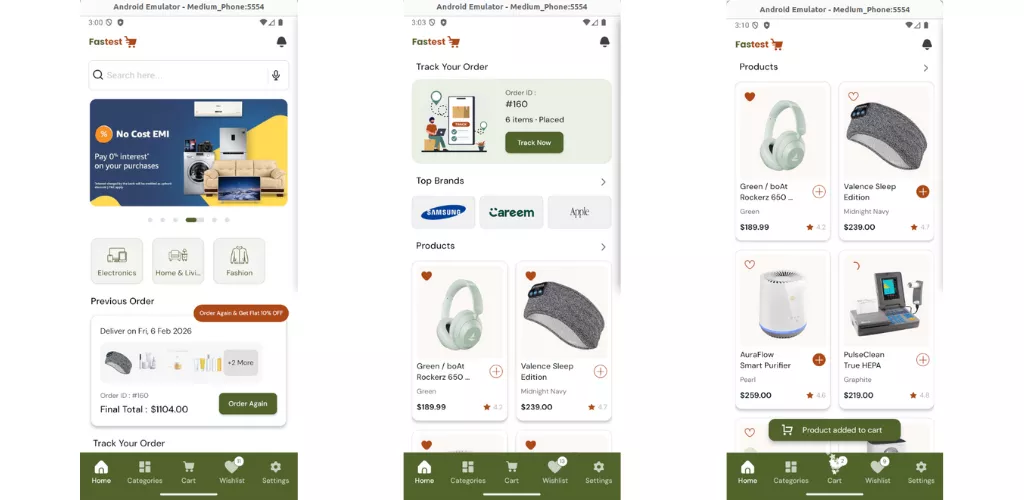
The dashboard serves as a personalized hub for the user, designed for quick action.
- Quick Access: Surfacing recent orders and frequently visited categories to reduce clicks.
- Discovery Tools: A prominent voice search button is integrated directly into the header for hands-free discovery.
4. High-Efficiency Catalog Browsing
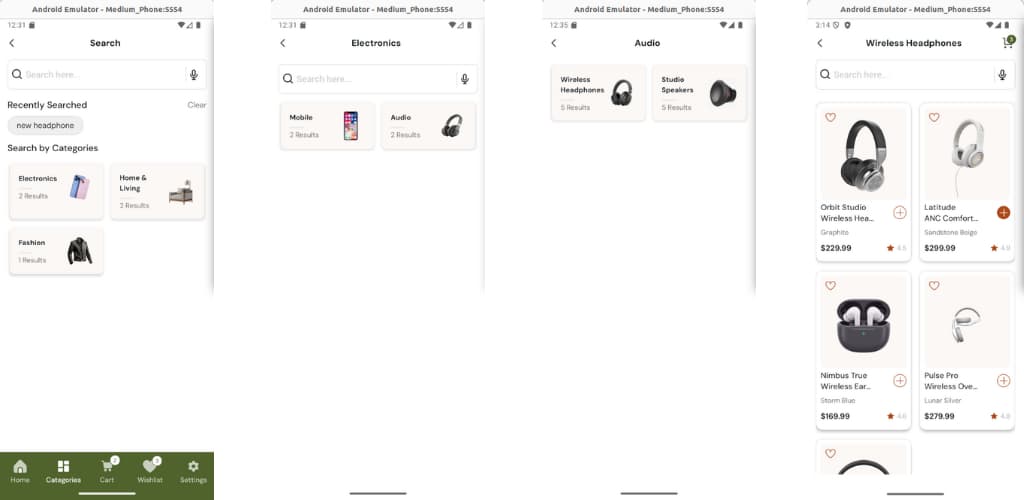
Navigating large inventories can be overwhelming, so we implemented a deep, hierarchical structure:
- Drill-Down Logic: Users move seamlessly from Categories → Subcategories → Product Types → Product List.
- Optimized Grids: Using paginated lists to ensure the app stays fast even with thousands of products, complete with high-res image caching.
5. Immersive Product Details & Actions
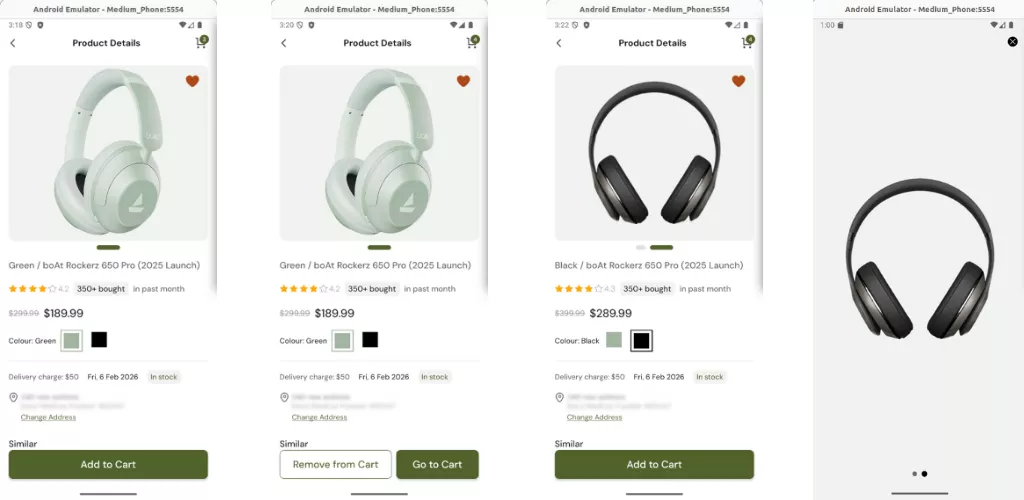
The product page is where decisions are made. We’ve optimized it for clarity and speed:
- Variant Management: Smooth switching between sizes, colors, and descriptions.
- Instant Action: “One-tap” wishlist and cart additions ensure that user intent is captured the moment it happens.
6. Real-Time Cart & Stripe Checkout
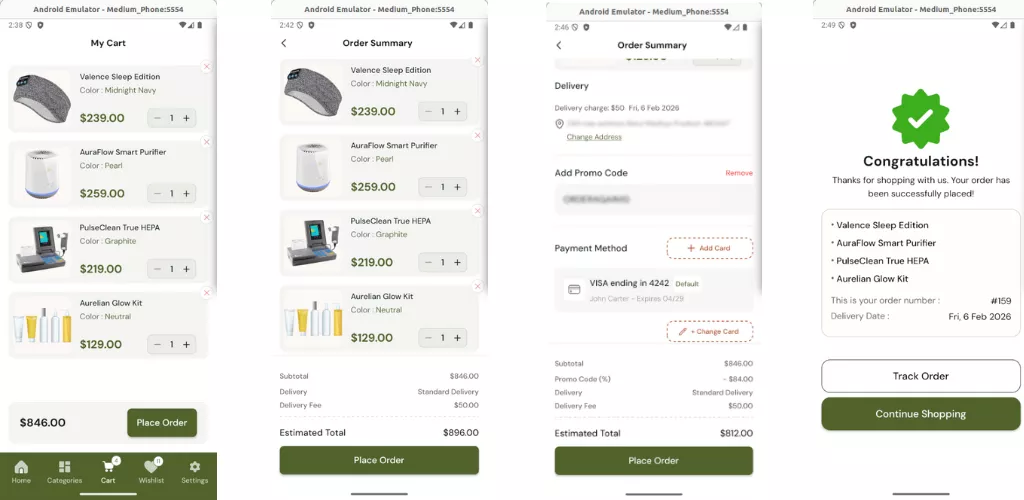
The transition from “browsing” to “buying” is the most critical part of the funnel.
- Dynamic Updates: Real-time quantity adjustments and item removals without page reloads.
- PCI-Compliant Payments: Leveraging the Stripe React Native SDK to handle saved card management and secure processing without sensitive data ever touching the app’s local state.
7. Order Tracking & Profile Management
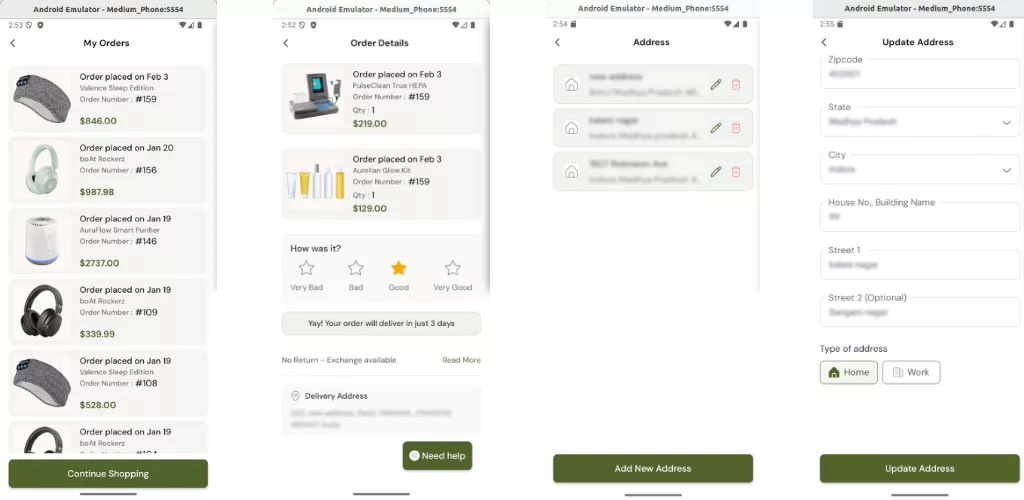
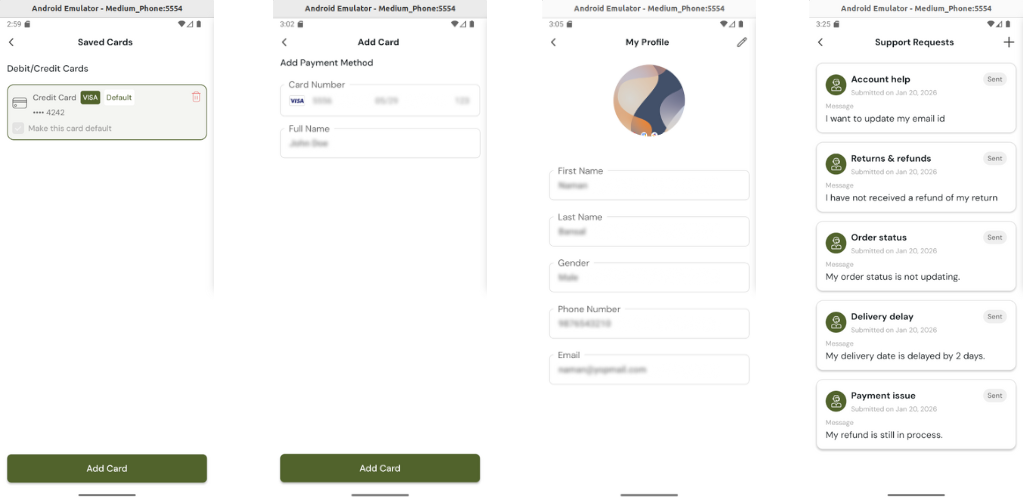
Post-purchase engagement is handled through a robust profile suite.
- Full Transparency: Users can view detailed order histories and real-time status updates.
- Data Control: A centralized location for managing delivery addresses, saved payment methods, and profile information.
8. Voice Search in Action
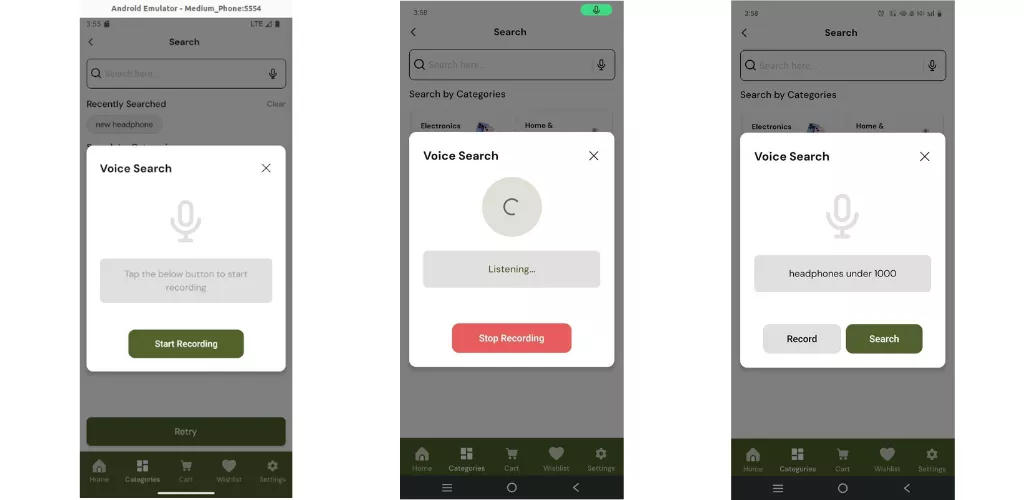
This feature brings a “modern commerce” edge to the PoC, catering to the trend of hands-free interaction.
- Speech-to-Text: By tapping the mic icon, the app converts audio input into text strings.
- Auto-Trigger: The converted text automatically triggers a search query, filtering the catalog instantly based on the user’s spoken word.
9. Engineering for Network Resilience
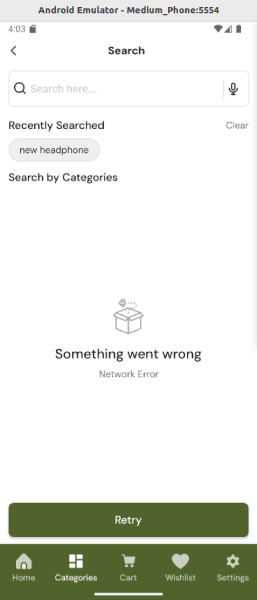
Mobile users are often on the move, so the app is built to handle spotty connections gracefully.
- The “Silent” Refresh: When a 401 error occurs (expired token), the app fetches a new one in the background and retries the failed request without the user noticing.
- Retry Modals: In cases of total timeout, a user-facing modal offers a simple “Retry” button rather than a generic error message.
10. Industry-Standard Code Quality
The PoC is built for long-term maintenance, not just a quick demo.
- Strict Typing: Consistent TypeScript interfaces across API payloads, Redux state, and component props prevent runtime crashes.
- Automated Linting: ESLint, Prettier, and Husky pre-commit hooks ensure that every team member contributes clean, standardized code.
Together, these flows and practices create a commerce experience that feels smooth to users while remaining robust and future-ready for businesses.
Bitcot’s Process Behind Building a React Native Mobile App
Building a high-performance eCommerce application isn’t just about writing code; it’s about establishing a rigorous architectural framework that can withstand growth.
At Bitcot, our process for building the PoC was rooted in a “Scale-First” mentality.
Here is the detailed architectural checklist and development process we followed to ensure this mobile app is as maintainable as it is fast.
1. Modular Project Structure
To prevent the “Spaghetti Code” trap common in large-scale apps, we enforced a strict directory hierarchy. This allows multiple developers to work on different features simultaneously without merge conflicts.
- screens/: High-level page components.
- components/: Reusable UI elements (buttons, inputs, cards).
- services/: All API calls and external integrations.
- redux/: State logic, slices, and store configuration.
- contexts/: Global providers for themes or user settings.
2. End-to-End TypeScript Integration
We moved beyond basic types to implement Strict Typing across the entire data lifecycle. By defining interfaces for API responses, Redux state, and navigation parameters, we eliminate a whole class of “null” and “undefined” errors before the app even reaches the testing phase.
3. Centralized and Intelligent API Layer
Instead of scattered fetch calls, we built a centralized Axios instance.
- Interceptors: These automatically inject authorization headers into every request.
- Logic: If a request fails due to an expired token, the interceptor triggers a “Silent Refresh” and retries the original request, ensuring zero interruption for the shopper.
4. State Management with Redux Toolkit
We chose Redux Toolkit (RTK) for its predictability. By using “Slices” and “Async Thunks,” we manage complex global states, like a shopping cart with 50+ items or a persistent user wishlist, with ease and high performance.
By leveraging Expo Router, we brought the best of web development to mobile.
- Route Groups: We organized the app into (auth), (tabs), and (product) groups to keep the navigation logic clean.
- Deep Linking: This architecture makes every screen “linkable,” allowing marketing teams to send users directly to a specific product page from an email or SMS.
6. Unified Voice Search Service
Innovation shouldn’t come at the cost of complexity. We created a unified search service that detects the user’s platform and switches between native iOS/Android voice modules and the Web Speech API for browsers, ensuring a consistent hands-free experience everywhere.
7. Secure Stripe Payment Architecture
Payments are the heartbeat of eCommerce. Our process involves a secure flow using the Stripe React Native SDK, which supports:
- Saved Card Management: Tokenized security so users can checkout in seconds.
- Receipt Handling: Automated verification to confirm successful transactions before updating the order history.
8. Declarative Form Management
Using React Hook Form, we moved away from heavy re-renders. This declarative approach ensures that even complex forms, like shipping address validators or profile editors, remain snappy, even on budget-friendly smartphones.
9. Dynamic Environment Configuration
Scalability requires moving between staging and production environments seamlessly. We utilized Expo environment variables to manage base URLs, API keys, and third-party secrets, ensuring that sensitive data is never hard-coded into the application.
10. Automated Development Tooling
To maintain code quality as the team grows, we integrated a “Guardian” system:
- ESLint & Prettier: For consistent syntax and formatting.
- Husky & lint-staged: These tools run checks on every “git commit.” If the code doesn’t meet our quality standards, it cannot be pushed to the repository.
By combining structured architecture, modern tooling, and platform-aware implementation strategies, this development process delivers a React Native app that is not only feature-rich but also scalable, maintainable, and ready for continuous growth.
Key Outcomes Delivered by Our Cross-Platform eCommerce Application
Developing a PoC isn’t just a technical exercise; it is about delivering tangible business results.
By implementing the “Fastest” architecture, we have secured a foundation that moves beyond a simple prototype into a high-conversion, market-ready asset.
From an executive standpoint, the React Native and Expo stack is a strategic asset for one primary reason: efficiency.
| Metric | Traditional Native (iOS + Android) | React Native + Expo (2026) | Business Impact |
| Development Cost | $150k – $200k+ | $80k – $120k | ~40-50% Cost Savings |
| Team Size | 2 Separate Teams | 1 Unified Team | Reduced Management Overhead |
| Time to Market | 6 – 9 Months | 2 – 4 Months | Faster Competitive Edge |
| Maintenance | Two Codebases to Update | One Codebase | 50% Lower Long-term OpEx |
1. High-Performance UX & Conversion Rates
User patience is at an all-time low. Our stack delivers smooth 60fps animations and lightning-fast screen transitions. By minimizing layout shifts and optimizing image loading, we ensure that the user’s journey from landing page to checkout is frictionless, directly impacting your bottom line through reduced bounce rates.
2. Secure, Trust-Based Transactions
Security isn’t an afterthought. With Stripe-powered payments, we deliver a checkout experience that users trust. Features like saved card management and real-time order tracking provide the “Amazon-like” convenience that modern consumers demand, while ensuring PCI compliance out of the box.
3. Massive Reduction in TCO (Total Cost of Ownership)
By utilizing a Unified Codebase via React Native and Expo, we eliminate the need for separate iOS, Android, and Web development teams. This approach typically reduces development and maintenance overhead by 30-50%, allowing you to reallocate your budget toward marketing and growth.
4. Future-Proof Scalability
Our modular architecture is built to evolve. The clean separation of concerns means that adding advanced features, such as AI-driven product recommendations, live chat, or customer reviews, can be done without rewriting the core application. Your tech stack grows as your business grows.
5. Enhanced Engagement & User Retention
We leverage “stickiness” through modern features:
- Voice Search: Reduces the “search effort” for users on the move.
- Persistent Wishlists: Encourages return visits and future purchases.
- Personalized Dashboards: Keep users engaged by surfacing relevant offers and recent orders immediately upon app launch.
6. Production-Grade Network Reliability
In a mobile-first world, connectivity is volatile. Our PoC is engineered for resilience. By implementing automatic retry logic and silent token refreshes, the app remains functional in “dead zones” or on weak public Wi-Fi, ensuring you never lose a sale due to a dropped connection.
7. Long-Term Code Maintainability
We deliver a codebase that is a joy for developers to work in. With TypeScript safety and automated quality checks (Husky/ESLint), we ensure the code remains clean and bug-free as it scales. This “Shift-Left” quality approach prevents the technical debt that often cripples successful startups during their second year of growth.
How to Build a Scalable eCommerce Mobile App with React Native and Expo
In 2026, the question for business leaders isn’t just about “building an app”; it’s about building a revenue engine that scales without multiplying costs.
By leveraging the synergy between React Native and Expo, businesses can bypass the traditional “double-spend” of native development (iOS + Android) and redirect that capital into market growth and customer acquisition.
Building a scalable eCommerce mobile app requires more than attractive screens and basic shopping features. To support growth in users, products, and functionality, the app must be designed with performance, maintainability, and flexibility in mind from the start.
React Native and Expo provide a strong foundation for achieving this when paired with the right architecture and development practices.
Here is your strategic roadmap.
Step 1: Defining the Minimum Viable Experience (MVE)
In eCommerce, “feature creep” is a budget killer. Before a single line of code is written, you must distinguish between “Core Revenue Drivers” and “Secondary Features.”
- The North Star: Focus on the “Add to Cart” and “Checkout” speed. Everything else is secondary.
- The 80/20 Rule: 80% of your revenue will likely come from 20% of your features. Identify these (e.g., one-click reordering or personalized recommendations) and prioritize them for the initial build.
Step 2: Market Validation and Prototyping
Don’t build a full-scale app based on assumptions. Start with high-fidelity prototypes to test the user journey.
- User Flow Audits: Use tools like Figma to simulate the shopping experience. Observe potential customers as they try to find a product. If it takes more than three taps to reach a product detail page, your strategy needs a pivot.
- Competitive Gap Analysis: Identify what your competitors’ apps do poorly (e.g., slow loading, forced account creation) and make your app’s “unfair advantage” the solution to those pain points.
Step 3: Selecting the Right Vendor or Team Structure
Scalability depends on the people behind the platform. When building with React Native and Expo, you need a specific type of talent.
- The Hybrid Advantage: You should hire (or outsource to) developers who understand both web and mobile. The beauty of this stack is that your web team can often contribute to the mobile codebase, reducing your “Headcount overhead.”
- Ownership of Data: Ensure your strategy includes full ownership of your customer data and API documentation. Avoid “vendor lock-in” where only one specific agency knows how your system works.
Step 4: The “API-First” Strategy
For an app to scale, it cannot be a silo. It must communicate seamlessly with your existing business infrastructure.
- Headless Commerce: Strategy-wise, consider a “Headless” approach. This means your backend (inventory, pricing, logic) is separate from your frontend (the app). If you want to launch on a new platform later (like smart mirrors or AR glasses), you don’t have to rebuild your business logic.
- Integration Audit: Map out your ERP, CRM, and Logistics providers. Your app strategy is only as strong as its weakest integration.
Step 5: Phased Rollout and Feedback Loops
A “Big Bang” launch is risky. A scalable business strategy utilizes a tiered release to manage server load and gather data.
- Beta Testing (The 1% Rule): Release the app to your top 1% of loyal customers first. They are more likely to provide constructive feedback and tolerate minor bugs.
- Performance Monitoring: Use business intelligence tools to track “Cart Abandonment Rates” and “App Load Times.” In mobile commerce, a one-second delay can result in a significant drop in conversion.
Step 6: Post-Launch Evolution (The “Growth” Phase)
Scaling isn’t just about handling more users; it’s about evolving the product based on how those users behave.
- Iterative Budgeting: Don’t spend your entire budget on the launch. Reserve 30% for “Post-Launch Optimization.” Once you see how users actually shop, you will want to move buttons, change layouts, and add features you didn’t realize were necessary.
Step 7: Future-Proofing with AI & Modern Commerce
By 2026, an eCommerce app is incomplete without intelligent features. The React Native ecosystem provides “plug-and-play” access to the latest trends:
- AI-Native Integration: Seamlessly integrate on-device AI for personalized shopping feeds and predictive search using TensorFlow Lite or PyTorch.
- Voice Commerce: Capture the growing hands-free market with cross-platform voice search services (iOS, Android, and Web).
- Immersive AR: Allow customers to “virtually try on” products using ARCore and ARKit, proven to increase buyer confidence and reduce return rates.
Choosing React Native and Expo is no longer just a “budget move.” It is a sophisticated choice for businesses that value velocity, scalability, and technical longevity. You get a native-quality experience at half the maintenance cost, with the agility to pivot as fast as the market moves.
Partner with Bitcot to Build Your Custom eCommerce Mobile Application
At Bitcot, we bring a proven, structured approach to eCommerce mobile development that helps retail brands move faster while achieving high-performance results.
We understand that a scalable shopping app requires more than just a product grid; it requires an aesthetic that emphasizes trust, seamless navigation, and a frictionless checkout experience.
One of the most valuable aspects of our approach is that our eCommerce core architecture is highly customizable. Because we have already engineered the foundational logic for modern retail, including secure payment processing, real-time inventory synchronization, and advanced search filtering, we don’t have to start from scratch for every client.
The Bitcot “Blueprint” Advantage
This “blueprint” approach allows us to deliver elite, enterprise-grade mobile apps without the elite price tag or the typical six-month wait times:
- Accelerate Time-to-Market: By leveraging our pre-engineered React Native and Expo framework, we can get your store into the hands of customers weeks faster than agencies starting from a blank page.
- Maximize Your ROI: We pass the efficiency of our pre-built structure on to you. You get a high-end, custom-feeling application that respects your capital expenditure goals while outperforming the competition.
- Fully Tailored Brand Identity: While the foundational engine is battle-tested and ready, the user interface, brand colors, custom animations, and unique shopping features are fully customized to reflect your brand’s specific identity and customer culture.
Future-Proof Your Retail Strategy
Your mobile app is your brand’s most important “digital storefront.” In an era where mobile commerce dominates, an outdated or slow interface is a direct barrier to revenue and customer loyalty.
Whether you are looking to launch a streamlined boutique shop or a complex marketplace with AI-driven recommendations and AR capabilities, Bitcot has the blueprint to get you there. As a leader in custom mobile development, we don’t just build apps; we build scalable engines for business growth.
Final Thoughts
Building a scalable eCommerce app can feel like trying to change the tires on a car while it’s going 70 mph.
You know you need to grow, but you’re worried that the tech might buckle under the pressure of a sudden surge in traffic or that a “quick fix” today will become a “massive headache” next year.
The truth is, scalability isn’t just a technical metric; it’s a business insurance policy. By choosing a flexible stack like React Native and Expo, you are essentially giving your business the room to breathe. You’re ensuring that whether you have ten customers or ten thousand, their experience remains fast, fluid, and focused on one thing: clicking that “Buy” button.
Our work with Fastest demonstrates exactly how a well-architected React Native eCommerce app can deliver a seamless, secure, and engaging shopping experience across both mobile and web platforms.
By combining Expo’s cross-platform capabilities, Redux for state management, Stripe for payments, and a modular service layer, we built a scalable foundation ready for future growth. It’s proof that high-end performance and a smooth developer experience can, and should, go hand in hand.
At the end of the day, your app should be a bridge to your customers, not a barrier. You don’t need to be a technical genius to launch a world-class digital storefront; you just need a strategy that prioritizes the user and a partner who has been in the trenches before.
Don’t let the complexities of mobile development hold back your brand’s potential. Whether you are migrating an existing store or launching a brand-new concept, Bitcot is here to turn your vision into a high-performance reality.
Our expert React Native development services ensure your app feels premium on every device, while our end-to-end eCommerce development services focus on driving the conversions your business needs to thrive.
Let’s build something your customers will love. Get in touch with our experts.