The wrong tech stack does not just slow down your product. It kills it.
Not eventually. Not gradually. It drains your budget, burns your engineers out, and leaves you rebuilding while competitors ship.
According to Mordor Intelligence, the global web development market has reached approximately $88 billion in 2026, growing at a CAGR of nearly 9%. The 2025 Stack Overflow Developer Survey of 49,000+ developers confirms JavaScript remains the most-used language at 66%, followed by Python at 58% (after a historic 7-point jump) and TypeScript at 44%.
With 84% of developers now using or planning to use AI tools in their workflow, the technology decisions you make today will define whether your product scales or stalls.
So if you have been asking yourself, “What is the best tech stack for my web app in 2026?” or “Which framework should a startup use for a new product?” – this guide was built to answer exactly that.
Most tech stack guides give you a list and walk away. This one maps every major stack to a specific business goal, flags the mistakes that cost teams months of rework, and covers frontend frameworks, backend tools, mobile development, cloud infrastructure, and AI-native stacks – tailored for US-based founders, CTOs, product leaders, and enterprise decision-makers.
Let’s get into it.
What Is a Tech Stack and Why Does It Matter in 2026?
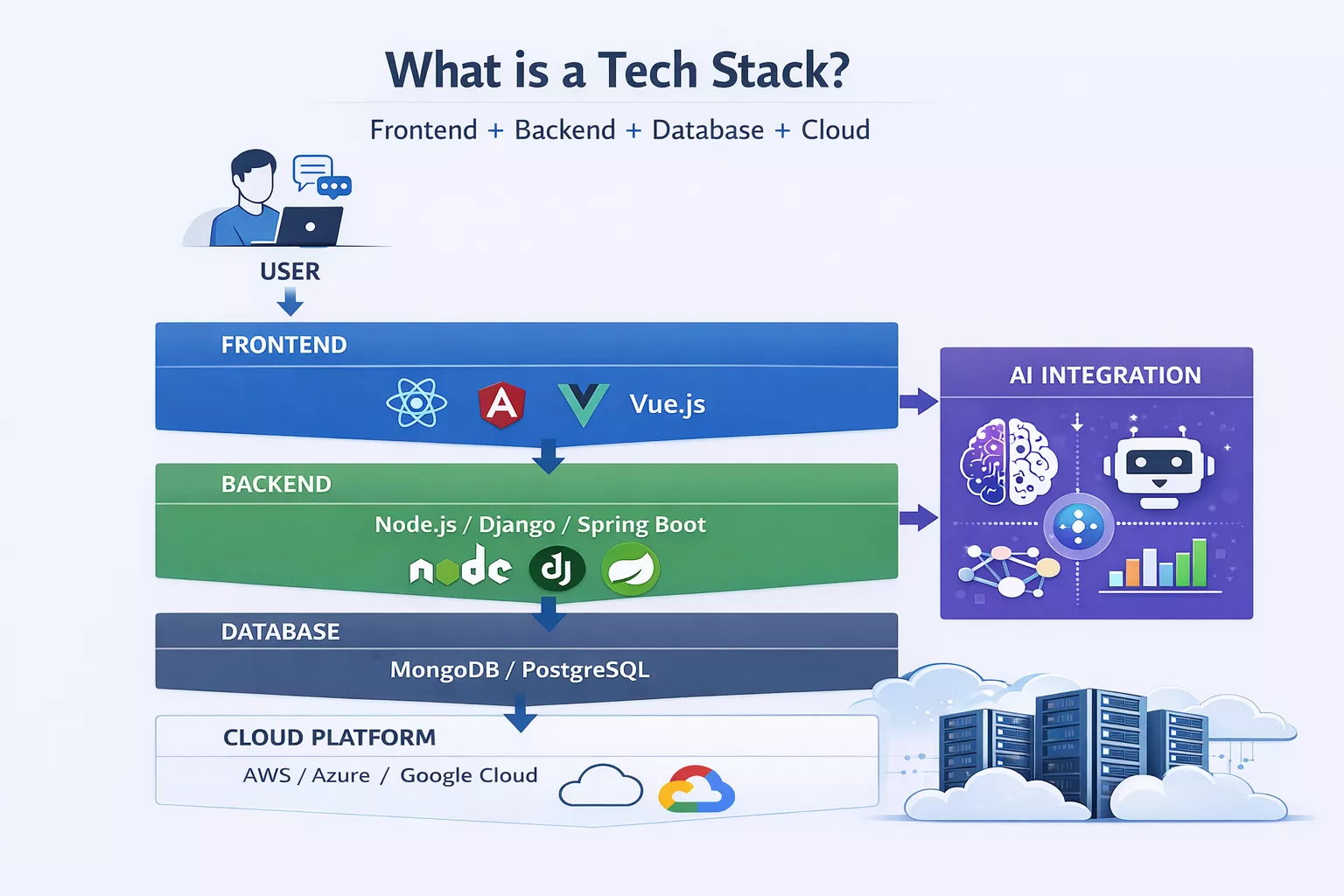
A tech stack is the combination of programming languages, frameworks, libraries, databases, and tools used to build and run a web or mobile application. It encompasses both frontend and backend technologies that work together to create a complete software solution.
Think of it as the foundation of your digital product. The frontend (client-side) handles what users see and interact with. The backend (server-side) manages data processing, business logic, and integrations. Together, they determine how fast your product loads, how securely it handles data, and how easily your team can maintain it.
Why does choosing the right stack matter more now than ever before?
In 2026, the playing field has shifted. AI-first development is no longer optional. Cloud-native architecture is standard. And user expectations for speed, personalization, and cross-device consistency continue to rise.
A poor tech stack choice leads to mounting technical debt, sluggish hiring pipelines, and products that cannot adapt when markets shift. Developer experience and deployment automation have become critical factors in maintaining competitive velocity.
“Software architecture is those decisions which are both important and hard to change.”
— Martin Fowler, Chief Scientist, ThoughtWorks
Stanford University research shows that 75% of users judge a company’s credibility by its web design, and Google’s data confirms 40% of visitors leave a site that takes more than three seconds to load. These are not just UX problems – they are revenue problems tied directly to the technologies powering your product.

Key Factors to Consider When Choosing a Tech Stack
Before jumping into specific frameworks, here are the strategic factors that should guide your decision. These apply whether you are a two-person startup or a Fortune 500 enterprise.
Project Complexity and Scope – A simple landing page has different needs than a real-time SaaS platform. Match the stack to what you are actually building, not what is trending on developer forums.
Scalability Requirements – Will your app need to support 1,000 users or 10 million? Stacks like MERN and serverless architectures scale differently. Plan for where you want to be in 18 months, not just where you are today. Consider both vertical scaling (adding resources) and horizontal scaling (adding servers) capabilities.
Team Expertise and Hiring – The best stack is one your team can execute with. If your engineers know React and Node.js, switching to an unfamiliar framework will slow you down. Also consider the local talent pool. JavaScript and Python developers are the most widely available in the US market, making full-stack development more accessible.
Time to Market – Startups racing to validate an idea need stacks that support rapid prototyping. Enterprises migrating legacy systems need stacks that ensure stability during the transition.
Security and Compliance – Healthcare, fintech, and government applications require stacks that support built-in security, data encryption, and regulatory compliance from day one – not as an afterthought.
Long-Term Maintenance Cost – A cheap stack today can become expensive tomorrow if the community shrinks or the framework stops receiving updates.
AI Integration Readiness – In 2026, nearly every new product includes some form of AI – whether that is a recommendation engine, chatbot, or predictive analytics. Your stack should support AI and machine learning integration without major rearchitecture.
Quick Reference: Stack Selection by Business Goal
| Business Goal | Recommended Stack | Best For |
| Rapid MVP/Prototype | MERN, Next.js + Supabase | Startups, solo founders |
| Enterprise SaaS | MEAN, Spring Boot + React | Large teams, complex business logic |
| AI-Powered Products | Python + FastAPI + Next.js | ML-heavy applications |
| eCommerce Platforms | Laravel + Vue.js, Shopify + Headless | Retail, D2C brands |
| Real-Time Applications | Node.js + WebSockets + React | Chat, collaboration, live data streaming |
| Content-Heavy Sites | JAMstack, Next.js + Headless CMS | Media, publishing, marketing |
| Cross-Platform Mobile | React Native, Flutter | iOS + Android from one codebase |
Top Tech Stacks for Web Development in 2026
With those decision factors in mind, let’s examine the specific stacks dominating web development in 2026. We’ll start with proven favorites, then move to emerging architectures reshaping how modern apps are built. Some of these will look familiar. One near the end might change how you think about your entire product roadmap.
1. MERN Stack (MongoDB, Express.js, React, Node.js)
MERN remains one of the most popular web development stacks in 2026. It is built entirely on JavaScript, meaning your team uses one language across the entire application – frontend, backend, and database queries.
React continues to dominate frontend frameworks with roughly 43% usage among professional developers, and Node.js leads backend web frameworks according to the 2025 Stack Overflow Developer Survey. Combined with MongoDB’s flexible document database and Express.js for routing, MERN delivers fast development cycles and excellent scalability.
Best for: Startups building MVPs, SaaS products, single-page applications, and teams that want rapid iteration with a large talent pool.
Who should use it: Founders who need to ship fast and plan to scale. If you are asking, “What tech stack should a startup use in 2026?” – MERN is one of the safest bets.
2. MEAN Stack (MongoDB, Express.js, Angular, Node.js)
MEAN is similar to MERN but swaps React for Angular on the frontend. Angular, maintained by Google, offers a more opinionated and structured framework, making it attractive for enterprise teams that need consistency across large codebases.
Angular enforces TypeScript by default, which improves code quality and reduces bugs at scale. For organizations with strict coding standards and large development teams, MEAN provides the guardrails that React’s flexibility sometimes lacks.
Best for: Enterprise applications, internal dashboards, CRM platforms, and large-scale projects requiring strict architecture patterns.
3. Next.js Full-Stack (Next.js + Vercel/AWS)
Next.js has evolved from a React framework into a full-stack solution. In 2026, it is the standard entry point for most professional web projects, handling server-side rendering, static site generation, API routes, and edge computing in a single framework.
With built-in React Server Components, image optimization, and automatic code splitting, Next.js dramatically reduces configuration overhead. Paired with Vercel for deployment or AWS for more control, this stack covers everything from marketing sites to complex SaaS platforms.
Best for: Teams that want a modern, full-stack JavaScript solution without managing separate frontend and backend repos.
4. Django + React (Python Backend + React Frontend)
Django paired with React is one of the top web development technologies in 2026, especially for teams working with data-heavy applications. Django brings Python’s security, built-in admin panel, and ORM, while React delivers a responsive, component-driven frontend.
This combination is ideal when your backend handles complex data processing, ML pipelines, or AI tool integrations. Python’s dominance in data science makes Django + React the natural stack for products merging web functionality with intelligent features.
Best for: HealthTech, FinTech, data platforms, and AI-powered web applications.
5. Spring Boot + React (Java Backend + React Frontend)
For enterprises that require battle-tested reliability, Spring Boot with React remains one of the strongest pairings in 2026. Spring Boot’s mature ecosystem, built-in security features, and compatibility with Java enterprise systems make it the go-to backend for regulated industries.
Best for: Banking, insurance, healthcare, and any enterprise application where compliance and long-term stability outweigh speed of development.
6. JAMstack (JavaScript, APIs, Markup)
JAMstack decouples the frontend from the backend entirely, serving pre-built static files through CDNs and pulling dynamic data via APIs. In 2026, JAMstack has matured with AI-driven build optimization and modern headless CMS integrations like Contentful, Strapi, and Sanity.
The result is blazing-fast page loads, reduced server costs, and improved security since there is no direct connection between the frontend and the database.
Best for: Content-heavy websites, marketing sites, blogs, and eCommerce platforms where speed and SEO performance are critical.
7. Laravel + Vue.js (PHP Backend + Vue.js Frontend)
Laravel continues to be one of the most developer-friendly PHP frameworks available. Paired with Vue.js, it offers an elegant stack for building applications quickly without sacrificing code quality.
For teams already in the PHP ecosystem or building on WordPress and Shopify, Laravel + Vue.js provides a natural upgrade path to modern single-page applications.
Best for: eCommerce development, content management systems, small-to-mid-size SaaS, and agencies handling multiple client projects.
8. AI-Native Stack (LangChain + FastAPI + Next.js)
This is the breakout stack of 2026. Designed specifically for products that integrate large language models, AI copilots, and automation tools, the AI-native stack combines LangChain for AI orchestration, FastAPI for a high-performance Python backend, and Next.js for the frontend.
If your product roadmap includes chatbots, document analysis, predictive workflows, or any LLM-powered feature, this stack eliminates the friction of bolting AI onto traditional architecture.
Best for: AI-first products, enterprise automation tools, intelligent search platforms, and apps that put generative AI at their core.
Top Tech Stacks for Mobile App Development in 2026
Web stacks are only half the equation. Mobile is where most users live, and the framework you choose here can save-or waste-six figures in development costs.
Mobile app development in 2026 centers on one critical question: Should we build native or cross-platform?
The answer depends on three factors: your budget, your timeline, and how performance-sensitive your app needs to be. Let’s break down each option.
React Native
React Native remains the leading cross-platform mobile framework. Teams can build iOS and Android apps from a single JavaScript codebase, sharing up to 90% of code between platforms. With the new architecture (Fabric and TurboModules), performance has closed the gap with native development.
Best for: Startups and enterprises that want to reach both platforms quickly without maintaining two separate codebases.
Flutter
Flutter, backed by Google, uses Dart and offers pixel-perfect UI control across platforms. Its hot reload feature and growing package ecosystem make it strong for apps where custom UI design is a priority. With the PWA market expected to grow from $5.23 billion in 2025 to $21.44 billion by 2033, Flutter’s web, desktop, and mobile support from a single codebase makes it increasingly relevant.
Best for: Apps with heavy custom animations, complex UI requirements, or teams that want to target mobile, web, and desktop simultaneously.
Native Development (Swift / Kotlin)
For apps where performance and platform-specific features are non-negotiable – think augmented reality, health sensor integration, or GPU-intensive applications – native development with Swift (iOS) and Kotlin (Android) remains the gold standard.
Best for: High-performance apps, apps requiring deep hardware integration, and products where user experience must be flawless on a specific platform.
Progressive Web Apps (PWAs)
PWAs offer a compelling middle ground. They run in the browser but deliver app-like experiences with offline access, push notifications, and home screen installation. For businesses that cannot justify separate native apps, PWAs provide broad reach with lower development overhead.
Best for: eCommerce, content platforms, service-based businesses, and any product where broad reach matters more than native hardware features.
Cloud Infrastructure and DevOps: The Hidden Layer of Your Stack
Here’s where most stack conversations fall short. Teams obsess over React vs. Angular and completely ignore the layer that actually determines whether their product stays online under load.
The truth is, choosing frontend and backend frameworks is only half the picture. Your cloud infrastructure and DevOps tools determine how reliably your product ships, scales, and recovers from inevitable failures. Let’s look at what matters in 2026:
Cloud Platforms – AWS, Google Cloud Platform, and Microsoft Azure dominate. Multi-cloud strategies are common in enterprises, while startups typically start with one provider and scale based on workload requirements.
Containerization – Docker and Kubernetes are standard for modern application architecture. Containers ensure consistent environments across development and production. Kubernetes automates scaling and deployment for cloud-native applications.
CI/CD Pipelines – GitHub Actions, GitLab CI, and CircleCI automate testing and deployment. AI-powered CI tools now predict build failures before code is merged.
Serverless Architecture – AWS Lambda, Google Cloud Functions, and Azure Functions let you run backend code without managing servers, ideal for startups watching burn rate.
Infrastructure as Code – Terraform and Pulumi let teams define cloud infrastructure in version-controlled, reproducible code.

How AI Is Changing Tech Stack Decisions in 2026
Beyond infrastructure, there’s another force reshaping the entire industry: artificial intelligence.
AI isn’t just a feature anymore-it’s fundamentally changing how developers build and which stacks they choose. And this shift is catching many teams off guard.
According to the 2025 Stack Overflow Developer Survey, 84% of developers now use or plan to use AI tools in their development process, up from 76% the year before. But the bigger shift is architectural. Applications are increasingly designed with AI in mind from the start – not as an add-on.
Here is what that means practically:
AI-Assisted Development – Tools like GitHub Copilot, Cursor, and Claude Code are accelerating coding speed by 2-3x. Smaller teams can now produce output that previously required much larger teams. Low-code and no-code platforms are also enabling faster prototyping and deployment cycles.
AI-Integrated Products – If your product includes recommendation engines, chatbots, or predictive analytics, your stack needs Python-based ML libraries, LLM API connections, and real-time data pipelines. AI integration is becoming a core consideration in technology selection. Consider working with an AI consulting partner to ensure your infrastructure supports intelligent features from the start.
AI-Optimized Infrastructure – GPU-enabled cloud instances, vector databases like Pinecone, and model serving platforms like AWS SageMaker are now standard in many stacks.
The practical takeaway: if your 2026 product roadmap involves AI, build your stack around it. Do not bolt AI capabilities onto a stack that was not designed for them. The AI-native stack (LangChain + FastAPI + Next.js) or Django + React with Python ML pipelines are purpose-built for this.
Startup vs. Enterprise: How Stack Choices Differ
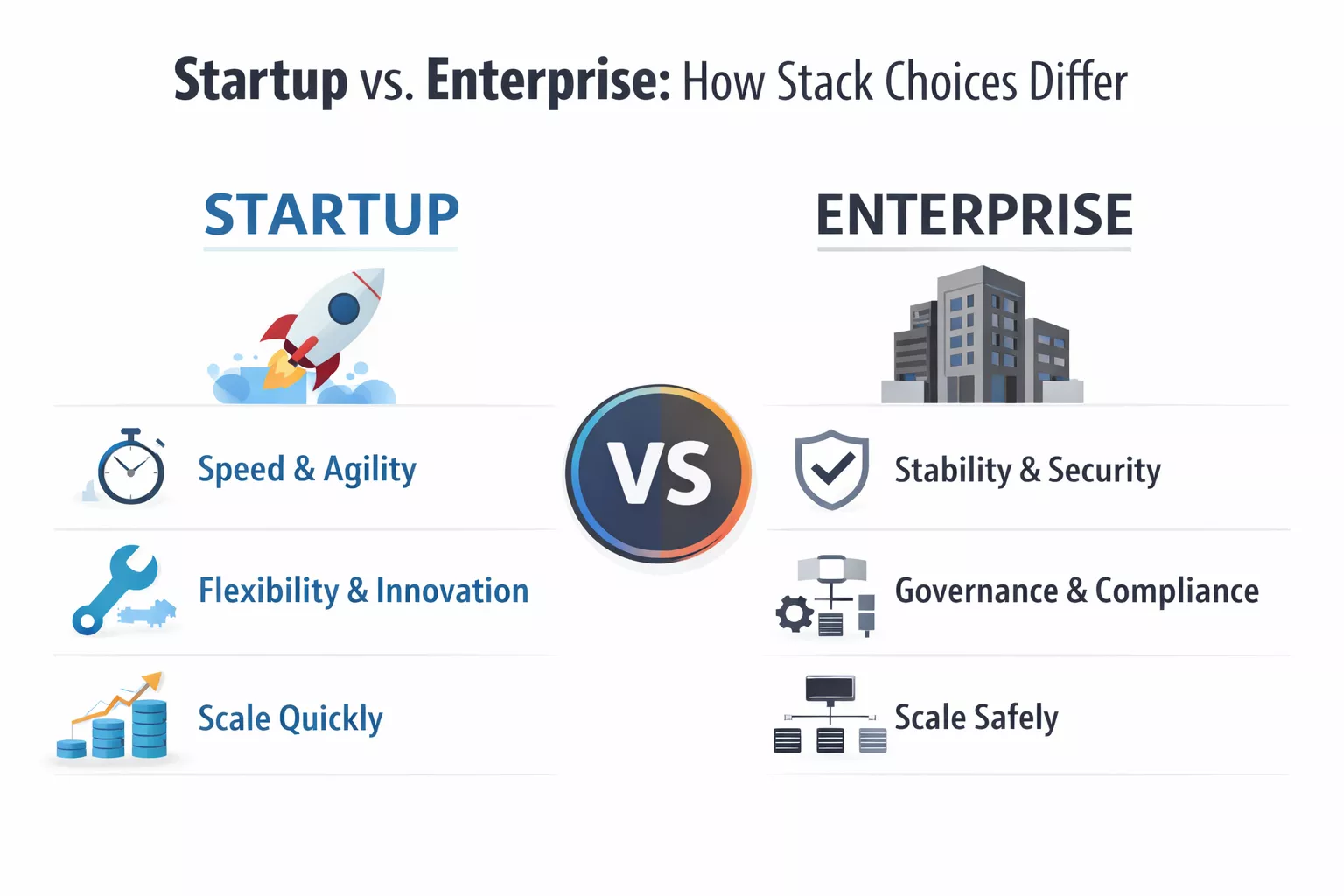
Now that we’ve covered the range of available stacks, here’s a critical insight many teams miss: the same tools require completely different playbooks depending on whether you’re a startup or an enterprise.
Understanding these differences can save you months of wasted effort.
Startups prioritize speed and flexibility. The goal is to validate the idea, get real users, and iterate fast. MERN, Next.js, and React Native are popular because they allow small teams to ship quickly with widely available talent. Pick a stack that lets your team move fast today, and plan for migration if the product takes off. Agile development methodologies and rapid prototyping are essential for startup success.
Enterprises prioritize stability, security, and scalability. MEAN with Angular, Spring Boot, and .NET are common because they offer structure, type safety, and mature ecosystems for compliance-heavy industries. Enterprises also need stacks that support microservices architecture, complex CI/CD pipelines, and legacy system integration.
The common mistake both make? Choosing a stack based on hype rather than fit. A startup does not need Kubernetes on day one. An enterprise should not adopt a bleeding-edge framework because it won a developer popularity contest. The best stack aligns with your team’s skills, your product’s requirements, and your growth roadmap.
Tech Stack Comparison: 2026 at a Glance
| Stack | Frontend | Backend | Database | Best For | Learning Curve |
| MERN | React | Node.js/Express | MongoDB | Startups, MVPs | Moderate |
| MEAN | Angular | Node.js/Express | MongoDB | Enterprise apps | Steep |
| Next.js Full-Stack | React/Next.js | Next.js API Routes | PostgreSQL/Supabase | Modern SaaS | Moderate |
| Django + React | React | Django (Python) | PostgreSQL | Data/AI products | Moderate |
| Spring Boot + React | React | Spring Boot (Java) | MySQL/PostgreSQL | Enterprise/FinTech | Steep |
| JAMstack | Static/React | APIs/Serverless | Headless CMS | Content sites | Low |
| Laravel + Vue.js | Vue.js | Laravel (PHP) | MySQL | eCommerce, agencies | Moderate |
| AI-Native | Next.js | FastAPI + LangChain | PostgreSQL/Vector DB | AI-first products | Steep |
| React Native | React Native | Varies | Varies | Cross-platform mobile | Moderate |
| Flutter | Flutter (Dart) | Varies | Varies | Custom UI mobile apps | Moderate |
Common Mistakes to Avoid When Picking a Tech Stack
Knowing the right stacks is half the battle. Avoiding catastrophic mistakes is the other half.
Even experienced teams fall into these traps. Here’s what to watch out for:
Chasing trends without strategic fit. A new framework might have buzz, but if your team does not know it and your timeline is tight, it is the wrong choice.
Ignoring the hiring market. JavaScript, Python, and TypeScript developers make up the vast majority of the US talent pool. Picking Go or Rust only makes sense if you have a specific performance need and the team to support it.
Over-engineering early. Microservices and Kubernetes are powerful but unnecessary for a product with 50 users. Start simple and add complexity as demand grows.
Underestimating migration costs. Switching stacks mid-project is expensive. Take time to evaluate options upfront.
Neglecting DevOps from the start. CI/CD, monitoring, and infrastructure automation need to be part of the plan from day one. Teams that skip this end up with fragile deployment processes.
“Every hour spent choosing the right stack saves ten hours of rework. Every shortcut in architecture becomes a wall you hit at scale.”
How We Help You Choose and Build with the Right Stack
Choosing the right tech stack is not just a technical decision – it is a business one. And making the wrong call can cost months of development time and hundreds of thousands of dollars.
That is where working with an experienced development partner makes the difference. Strategy first. Code second.
“The best tech stack is not the one with the most features. It is the one that aligns with your business goals, scales with your growth, and your team can actually execute on.”
— Raj Sanghvi, Founder & CEO, Bitcot
At Bitcot, we’re a full-service web and mobile app development company based in San Diego based in San Diego that has delivered digital products for over 3000+ clients across the United States. From startup MVPs to enterprise-grade platforms, our engineering team specializes in selecting and implementing the right tech stack for each project’s unique requirements.
Our approach starts with a discovery phase that evaluates business goals, technical constraints, and scalability needs before a single line of code is written. Whether you need a full-stack development team working in React and Node.js, a Python-based AI product, or a cross-platform mobile app in React Native or Flutter, we have hands-on experience across modern tech stacks.
For example, we built a centralized construction management platform using an optimized Next.js architecture with real-time collaboration features, reducing project delays and improving team transparency. In another project, our team developed a healthcare PWA on a customizable platform serving multiple stakeholders and health systems, demonstrating our ability to handle complex, compliance-sensitive builds.
We’ve also helped clients like Apex Investigation build scalable cloud-based web applications with custom integrations, and delivered an award-winning iOS app for evrmore across 50+ sprints. Our expertise extends to B2B eCommerce development, progressive web applications, and enterprise automation solutions. You can explore more at our case studies page.
The stack matters. But the team behind it matters more.
Conclusion
Picking the best tech stack for web and app development in 2026 is not about choosing the most popular option. It is about aligning technology with your product goals, team capabilities, and growth trajectory.
For startups, that usually means prioritizing speed and flexibility with stacks like MERN, Next.js, or React Native. For enterprises, it means choosing stability and scalability with Spring Boot, Angular, or Python-based backends that support AI integration.
The landscape is evolving fast. AI-first development, serverless architectures, and cross-platform frameworks are reshaping what is possible. The U.S. Bureau of Labor Statistics projects web developer employment to grow 8% from 2023 to 2033, faster than the average for all occupations, reflecting continued demand for well-built digital products.
Whatever you build, start with a clear understanding of your requirements, pick technologies your team can execute with, and plan for where your product needs to be in 18 months.
Ready to choose the right tech stack and start building? Talk to our engineering team to get a strategic roadmap for your next web or mobile app project.
Frequently Asked Questions (FAQs)
What is the best tech stack for a startup in 2026?
For most startups, MERN or a Next.js full-stack approach offers the best balance of speed, flexibility, and access to developer talent. These stacks support rapid MVP development while scaling with your user base. If your product is AI-focused, consider starting with FastAPI and Next.js.
How do I choose between React Native and Flutter for mobile app development?
React Native is ideal if your team already works with JavaScript and React. Flutter is better suited for apps requiring highly custom UI and pixel-perfect control across platforms. Both are mature in 2026. The right choice depends on your team’s skills and your app’s design requirements.
What tech stack does Netflix, Airbnb, or major SaaS companies use?
Most large-scale companies use a combination of stacks tailored to different services. Netflix relies heavily on Java and Node.js. Airbnb uses React with Ruby on Rails and Java on the backend. The key insight: these companies chose stacks based on specific performance and scaling needs, not trends.
Is Python or JavaScript better for web development in 2026?
Both are excellent, but they serve different purposes. JavaScript (with TypeScript) is essential for frontend development and dominant on the backend through Node.js. Python excels in backend applications involving data processing, machine learning, and AI. Many modern stacks combine both – such as Django backend with React frontend – to get the best of each.
What is an AI-native tech stack and do I need one?
An AI-native tech stack is designed from the ground up to support LLMs, ML pipelines, and AI-powered features. A common 2026 example is LangChain + FastAPI + Next.js. You need one if your product’s core value involves chatbots, document analysis, or predictive analytics. If AI is secondary, integrate it into traditional stacks like Django + React.
How much does it cost to build a web app with a modern tech stack?
Costs vary dramatically based on complexity. Simple landing pages run $1,000 to $3,000. Small business websites cost $3,000 to $10,000. Full web applications range from $50,000 to $500,000 or more. Working with an experienced development partner helps avoid costly stack mistakes that inflate budgets.
Should an enterprise migrate from a legacy tech stack to a modern one?
In most cases, yes, but the approach matters. A full rewrite is rarely the right move. Enterprises benefit from incremental modernization: decoupling components into microservices, replacing outdated frontend layers with React or Angular, and migrating to cloud-native platforms. This phased approach reduces risk while improving performance.