What if your retail store could identify operational problems before they hurt sales, understand customer behavior without surveys, and improve efficiency without hiring additional staff?
For many retailers across the United States, this is already happening.
Computer vision has moved beyond experimentation and pilot projects. Today, it is becoming a core part of how modern retailers operate. Businesses are actively using computer vision in retail and AI in retail technologies to reduce costs, improve security, and deliver faster, more personalized shopping experiences.
The business impact is significant and measurable.
Industry research indicates that the computer vision AI market in retail is projected to grow from under USD 2 billion today to more than USD 12 billion by the early 2030s, driven by annual growth rates above 20 percent.
Retailers implementing retail computer vision solutions report checkout time reductions of up to 30 percent and operational efficiency improvements ranging from 20 to 40 percent. Loss prevention teams using computer vision for retail security have documented meaningful reductions in shrinkage.
At the same time, surveys show that over 70 percent of US shoppers prefer stores that offer faster, technology-enabled shopping experiences.
Customer expectations have changed permanently.
Consumers now expect the same level of speed, accuracy, and personalization in physical stores that they experience online. Meeting these expectations while controlling costs, managing inventory, and preventing theft is increasingly difficult without intelligent automation.
This is where smart retail technology powered by computer vision is creating real competitive advantage.
For business owners overseeing multiple store locations, startup founders building modern retail brands, CEOs planning long term growth strategies, CTOs evaluating retail automation platforms, and enterprise leaders modernizing legacy systems, understanding computer vision in retail is no longer optional.
At Bitcot, we work with retail focused organizations to connect intelligent in store technologies with scalable eCommerce development services, helping leadership teams translate innovation into measurable business outcomes.
This guide explains how computer vision is transforming retail shopping, strengthening retail security, and elevating customer experience in retail, using clear language and a business first perspective.
What Is Computer Vision in Retail and Why It Matters
Computer vision is a branch of artificial intelligence that enables software systems to interpret and understand visual information from the physical world.
In simple terms, it allows machines to see, analyze, and respond to what is happening inside a retail environment.
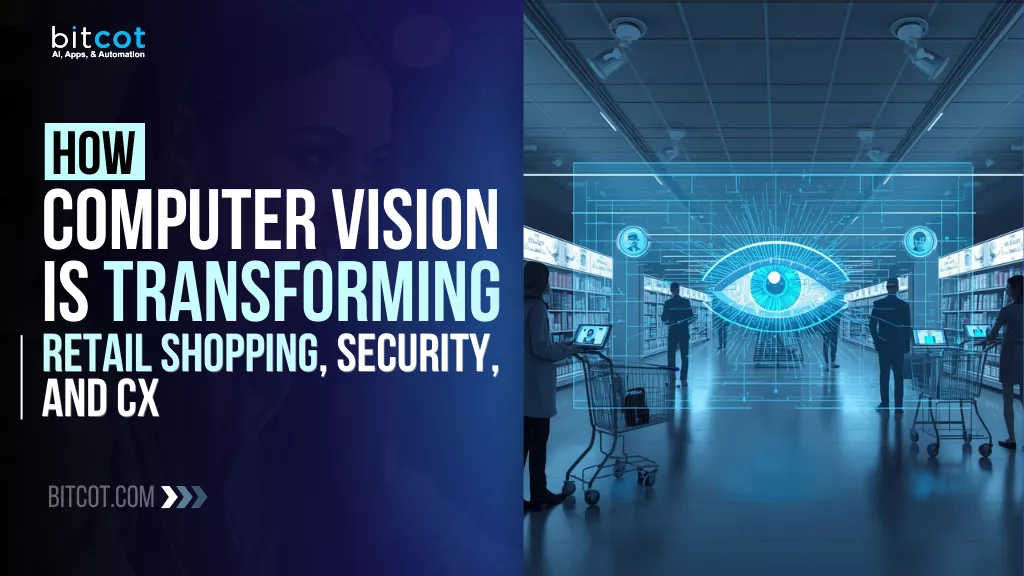
Traditional video surveillance systems capture footage that must be reviewed manually after an incident occurs. Computer vision changes this model entirely. Instead of passively recording video, AI models analyze live camera feeds in real time. They identify objects, recognize patterns, detect changes, and flag anomalies as they happen.
In retail environments, computer vision in retail is commonly used to:
- Recognize and track products on shelves
- Monitor inventory levels continuously
- Analyze customer movement and dwell time
- Identify suspicious or unsafe behavior
- Measure store layout and merchandising effectiveness
Cameras placed throughout the store collect video data. AI models process this data using visual analytics and machine learning algorithms. The output is structured, actionable retail analytics that store managers, operations teams, and executives can use to make faster and more informed decisions.
One of the most important advantages of modern retail computer vision solutions is adaptability. These systems learn from real store conditions. As lighting changes, new products are introduced, or store layouts evolve, accuracy improves automatically. This reduces the need for constant manual tuning.
For non-technical decision makers, the value is straightforward. Computer vision transforms everyday store activity into real time business intelligence. Instead of relying on delayed reports, manual audits, or intuition, retailers gain continuous visibility into what is happening on the sales floor.
This visibility directly supports cost reduction, revenue protection, and improved retail customer experience across locations.
With this foundation in place, let’s examine how retailers are applying computer vision in practical, high-impact ways.
Six Game-Changing Computer Vision Use Cases in Retail Stores
1. Automated Checkout Systems
Checkout is one of the most important moments in the retail customer journey.
Long lines, slow transactions, and pricing errors create frustration and often lead to abandoned purchases. Automated checkout systems powered by computer vision are designed to eliminate these issues.
Using overhead cameras and shelf sensors, the system tracks which products customers pick up and return. Items are automatically added to a virtual cart. When customers exit the checkout area or store, payment is completed without scanning barcodes or interacting with a cashier.
From an operational perspective, this creates immediate benefits.
Retailers implementing AI assisted checkout frequently report:
- Up to 30 percent faster checkout times
- Increased customer throughput during peak hours
- Reduced dependence on checkout staffing
- Fewer pricing discrepancies and scanning errors
From a customer perspective, the experience feels seamless and modern. Shoppers spend less time waiting and more time browsing.
Employees previously assigned to checkout can be redeployed to higher value activities, including customer assistance, restocking, and loss prevention. This improves both labor efficiency and service quality.
Automated checkout is especially impactful for grocery stores, convenience stores, urban retail formats, and high traffic locations where speed directly affects revenue.
2. Smart Inventory Management
Inventory accuracy remains one of the most persistent challenges in retail operations.
Out of stock products result in missed sales and frustrated customers. Overstocking ties up capital and increases waste. Manual inventory checks are labor intensive and often inaccurate.
Computer vision based inventory management systems address these issues by providing continuous, automated monitoring of shelf conditions.
AI powered cameras scan shelves throughout the day. When stock levels fall below predefined thresholds, alerts are generated instantly. The system can also detect misplaced items, incorrect facings, and empty shelves.
Retailers using computer vision for inventory management commonly experience:
- 25 to 40 percent improvement in inventory accuracy
- 20 to 35 percent reduction in out of stock incidents
- Lower labor costs associated with manual audits
- Improved replenishment planning
These systems also support planogram compliance, ensuring products are displayed according to merchandising standards. This consistency improves brand presentation and shopper confidence.
For executives, the benefit is reliable, real time inventory visibility across locations, enabling better forecasting and reduced lost sales.
3. Loss Prevention and Theft Reduction
Retail shrinkage continues to represent a major financial risk in the United States.
On average, shrinkage accounts for approximately 1.5 to 2 percent of total retail sales. This includes shoplifting, employee theft, and administrative errors. Traditional surveillance systems often detect incidents only after losses occur.
Computer vision based loss prevention technology takes a proactive approach.
Instead of focusing on individuals, these systems analyze behavior patterns. They identify actions associated with theft, fraud, or unsafe situations and generate real time alerts.
Retailers using computer vision for retail security report:
- 20 to 40 percent reduction in shrinkage
- Faster incident detection and response
- Fewer false positives compared to rule based systems
- Improved staff and customer safety
Because alerts are generated in real time, store teams can intervene before losses escalate. This proactive model delivers far better results than reactive review processes.
4. Customer Behavior Analytics
Understanding how customers move and interact within a store is essential for improving performance.
Customer behavior analytics in retail uses computer vision to generate heat maps that show traffic flow, dwell time, and engagement zones.
Retailers use this data to answer important questions:
- Which areas attract the most attention
- Where customers hesitate or disengage
- How layout changes impact movement
- Which displays drive interaction
By applying computer vision retail analytics, retailers optimize store layouts, improve merchandising strategies, and allocate staff more effectively. Many report 15 to 20 percent improvements in conversion rates after acting on these insights.
For leadership teams, this data replaces assumptions with evidence based decisions.
5. Virtual Try On and Augmented Shopping
Returns are a major cost driver, particularly in apparel, footwear, beauty, and accessories.
Computer vision enables virtual try on technology that allows customers to visualize products before purchasing.
Smart mirrors and mobile experiences allow shoppers to see how items will look in real time. This reduces uncertainty and increases purchase confidence.
Retailers using AI powered virtual try on solutions often see:
- 30 to 40 percent reduction in return rates
- Higher engagement and time spent in store
- Improved customer satisfaction
This technology bridges the gap between physical and digital shopping, enhancing the in store experience without increasing staff requirements.
6. Quality Control and Merchandising Compliance
Maintaining consistent standards across multiple retail locations is challenging.
Manual inspections are time consuming and subjective. Visual inspection systems powered by computer vision automate quality control processes.
Retailers use these systems to:
- Detect damaged or expired products
- Verify pricing labels and signage
- Ensure planogram compliance
- Maintain consistent brand presentation
Automated quality checks improve accuracy and reduce compliance risks, protecting brand reputation and customer trust.
With these use cases established, the broader business benefits become evident.
The Real Business Benefits of Computer Vision in Retail
Operational Efficiency and Cost Reduction
By automating repetitive monitoring tasks, retail automation powered by computer vision significantly reduces manual effort and human error.
Retailers frequently report 15 to 25 percent reductions in operational costs across inventory management, security, and compliance.
Improved Customer Experience
Faster checkout, better stocked shelves, and smoother in store journeys directly improve customer experience in retail.
At Bitcot, we help retailers connect intelligent in store systems with scalable eCommerce and omnichannel platforms, ensuring a consistent experience across physical and digital channels.
Shrinkage Reduction and Revenue Protection
Computer vision loss prevention solutions protect revenue while improving store safety and operational control.
Data Driven Decision Making
Insights from retail visual analytics support smarter pricing, promotions, staffing, and layout decisions. Many retailers report 10 to 20 percent revenue uplift from better optimization.
Despite these advantages, successful implementation requires careful planning.
Implementation Challenges and Considerations
Retailers should consider:
- Initial investment in cameras and software
- Integration with POS and inventory systems
- Data privacy and regulatory compliance
- Staff training and operational change management
Phased rollouts with clear ROI targets reduce risk and support adoption.
Looking ahead, computer vision will continue to reshape retail strategy.
The Future of Computer Vision in Retail
The future of retail will be driven by intelligence, automation, and personalization. In this transformation, computer vision in retail will play a central role.
As AI models become more accurate and affordable, computer vision will move beyond individual use cases and become deeply embedded across store operations, digital commerce, and supply chain systems.
Retailers will no longer use computer vision only to understand what happened in the past. Instead, they will use it to predict what is likely to happen next.
From Reactive Insights to Predictive Intelligence
Today, many retailers rely on reports that explain issues after they occur. In the future, AI in retail will help retailers anticipate problems before they impact business performance.
Computer vision will enable retailers to:
- Predict inventory shortages before shelves go empty
- Identify potential theft risks earlier
- Forecast customer demand using real time visual data
- Improve staffing decisions based on store activity patterns
This shift from reactive to predictive decision making will help retailers reduce losses and improve efficiency.
More Personalized In Store Experiences
Personalization in physical retail is also expected to improve significantly.
Computer vision will work alongside customer data platforms and loyalty systems to deliver more context aware shopping experiences. Instead of relying on intrusive data collection, retailers will use customer behavior analytics in retail to understand how shoppers interact with the store environment.
This will allow retailers to:
- Adjust store layouts based on customer movement
- Display relevant promotions through digital signage
- Improve product placement for higher engagement
- Enhance overall customer experience in retail
These improvements will feel natural to shoppers while delivering measurable business value.
Stronger Connection Between Physical and Digital Retail
The line between online and offline retail will continue to blur.
Retail computer vision solutions will increasingly integrate with eCommerce platforms, mobile apps, and omnichannel systems. This will ensure consistent pricing, inventory visibility, and promotions across all customer touchpoints.
In the future:
- Physical stores will act as intelligent extensions of digital commerce
- Inventory data will stay synchronized across channels
- Customers will experience a seamless journey across online and in store shopping
This integration will be critical for brands competing in an omnichannel retail environment.
Increased Automation Across Store Operations
Automation will expand beyond checkout and inventory.
Computer vision will support more autonomous store operations by enabling:
- Automated restocking recommendations
- Continuous planogram optimization
- Real time quality and compliance checks
- Reduced reliance on manual store audits
This level of retail automation will help retailers operate efficiently even as labor costs rise and workforce availability remains tight.
Smarter and More Accurate Retail Security
The future of retail security will focus on accuracy rather than volume of alerts.
Computer vision systems will become better at distinguishing between normal customer behavior and high risk situations. This will reduce false alerts while improving loss prevention outcomes.
Retailers will benefit from:
- Improved theft detection
- Faster response times
- Safer store environments for staff and customers
Long Term Value for Retail Leaders
For business leaders, the long term value of computer vision lies in scalability and adaptability.
As regulations, customer expectations, and retail formats evolve, computer vision systems can be updated without major infrastructure changes. This flexibility allows retailers to innovate while protecting their technology investment.
Retailers that invest early in computer vision in retail will be better positioned to compete, grow, and deliver consistent value in an experience driven market.
With these future trends in mind, it becomes clear why computer vision is a long term strategic priority for modern retailers.
Conclusion
Computer vision is no longer an emerging technology reserved for innovation labs or large enterprises. It has become a practical and scalable solution that is actively transforming how retail businesses operate, protect revenue, and serve customers across the United States. As retail environments grow more complex and customer expectations continue to rise, relying on manual processes and reactive decision making is no longer enough.
From automated checkout systems that reduce wait times, to smart inventory management that prevents lost sales, to retail security solutions that proactively reduce shrinkage, computer vision delivers value across the entire retail ecosystem. It also plays a critical role in improving customer experience in retail by enabling smoother store journeys, better product availability, and more engaging shopping environments. These improvements are not theoretical. Retailers adopting computer vision in retail are already seeing measurable gains in efficiency, cost control, and customer satisfaction.
For business leaders, the true advantage of computer vision lies in visibility and intelligence. Real time retail analytics and visual insights allow executives, operations teams, and store managers to make data driven decisions with confidence. Instead of reacting to problems after they occur, retailers can identify issues early, optimize performance continuously, and align physical store operations with digital commerce strategies.
At Bitcot, we help retailers move beyond experimentation by delivering custom computer vision development for retail. Our team builds computer vision and AI-powered custom retail solutions for use cases such as automated checkout, inventory intelligence, loss prevention, and in-store analytics. By integrating intelligent in-store systems with eCommerce platforms, omnichannel experiences, and retail analytics frameworks, we help organizations scale with confidence while delivering consistent value to customers.
Ready to explore how computer vision fits into your retail roadmap? Let’s talk. Get in touch with us today.
Frequently Asked Questions
What is computer vision in retail?
Computer vision in retail refers to the use of AI powered cameras and software to visually understand what is happening inside a retail store. Instead of simply recording video, computer vision systems analyze live footage to identify products, track inventory levels, monitor customer movement, and detect unusual behavior.
For retailers, this technology turns everyday store activity into actionable insights. It helps improve inventory accuracy, reduce theft, optimize store layouts, and enhance customer experience in retail. Computer vision works in the background, continuously collecting data that business leaders can use to make faster and more informed decisions without relying on manual audits or guesswork.
How much does computer vision implementation cost?
The cost of implementing computer vision in retail depends on several factors, including store size, number of cameras, use cases, and level of system integration. A small pilot project may focus on one use case such as inventory monitoring, while larger rollouts may include checkout automation, loss prevention, and customer analytics.
Most retailers approach implementation in phases to control costs and measure ROI early. Many retail computer vision solutions deliver measurable returns within 12 to 24 months by reducing shrinkage, improving inventory accuracy, lowering labor costs, and increasing sales conversion. For business leaders, the focus is not just upfront cost, but long term operational savings and revenue impact.
Does computer vision replace retail employees?
No, computer vision does not replace retail employees. Instead, it supports them by automating repetitive and time consuming tasks. Activities such as manual inventory checks, constant shelf monitoring, and reactive security reviews can be handled by AI powered retail automation systems.
This allows store teams to focus on higher value work, including customer service, sales assistance, and in store experience improvement. Retailers that use computer vision effectively often see improved employee productivity and job satisfaction because staff spend less time on routine tasks and more time engaging with customers.
Is computer vision safe and privacy compliant in the US?
Yes, when implemented responsibly, computer vision systems can be safe and privacy compliant in the United States. Most modern retail AI solutions are designed to follow data protection standards and privacy regulations. Many systems focus on behavior patterns rather than identifying individuals, which helps reduce privacy concerns.
Retailers also have control over how data is stored, processed, and accessed. Clear signage, transparent policies, and proper data governance further strengthen customer trust. For enterprise leaders, choosing the right technology partner and implementation strategy is key to ensuring compliance and maintaining brand reputation.
What results can retailers expect from computer vision?
Retailers adopting computer vision typically see improvements across multiple areas of their business. Common results include faster checkout times, improved inventory accuracy, reduced shrinkage, and better store performance insights. Many retailers also report higher customer satisfaction due to smoother shopping experiences and better product availability.
Over time, the data generated by computer vision in retail helps leadership teams make smarter decisions around pricing, promotions, staffing, and store layout. When combined with digital commerce platforms and analytics tools, computer vision becomes a long term competitive advantage rather than just a technology upgrade.