The online shopping world is exploding.
In 2024, U.S. eCommerce sales hit $1.19 trillion. That’s more than double what they were five years ago.
Global eCommerce is expected to reach $6.42 to $6.86 trillion in 2025, with online retail now making up 20.5% to 21% of all retail sales worldwide.
If you’re still relying on “build it and they will come,” you’re already behind.
Here’s the reality:
Just building a website and listing products won’t cut it anymore.
With nearly 28 million eCommerce sites competing globally, standing out requires a solid eCommerce growth strategy.
Whether you’re launching your first online store, looking to scale, or trying to boost sales, this guide covers what an eCommerce business strategy is, why it matters, and how to build one that works.
What is an eCommerce Growth Strategy and Why Does It Matter?
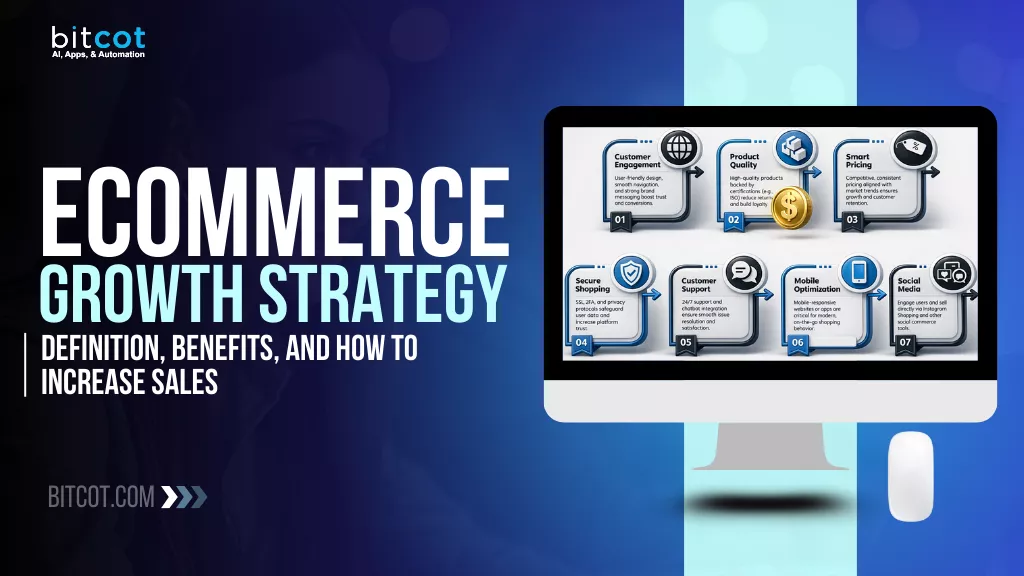
An eCommerce growth strategy is your complete roadmap for building and scaling a successful online business.
Think of it as your master plan that covers everything from attracting your first customer to turning one-time buyers into loyal customers who keep coming back.
This isn’t just about running ads or posting on social media.
Those are tactics.
A real eCommerce business growth strategy looks at the big picture:
- Understanding who your customers are
- What problems they’re trying to solve
- How to reach them effectively
- What makes your business different
- How to deliver an amazing customer experience
Your strategy should answer critical questions:
Who are your ideal customers?
What marketing channels will reach them?
How will website visitors convert into buyers?
What makes them choose you over competitors?
How will you turn them into repeat customers?
Whether you’re running a B2C store or a B2B business serving other companies, having a clear eCommerce marketing strategy means making smart, data-driven decisions based on customer insights and proven tactics.
Why Growing eCommerce Businesses Need a Solid Growth Strategy
Building an online store without a growth strategy is like opening a shop in the middle of nowhere and hoping customers magically find it.
Here’s why you need one:
Standing Out in a Crowded Digital Marketplace
Competition online is intense.
About 2,162 new eCommerce websites launch every single day.
Without a clear strategy, your store becomes just another option that online shoppers scroll past.
A solid growth strategy identifies what makes you unique and puts it front and center.
Making Smarter Decisions with Marketing Budgets
Marketing budgets are tight for most businesses.
A growth strategy helps you figure out which digital marketing channels actually bring in sales versus which ones burn through cash.
Instead of throwing money at every tactic, you invest where it counts.
Understanding Target Customers on a Deeper Level
When you have a strategy, you dig into who your target audience really is.
What they want.
How they shop.
This understanding helps you create better products, write compelling product descriptions, and build experiences that connect.
Growing Consistently Over Time
Random tactics might give you a few sales here and there.
But they won’t build a sustainable business.
A growth strategy creates systems that work together to bring in new customers while keeping existing customers happy.
This leads to predictable, steady growth.
Measuring Success with Real Data
With a strategy, you set specific goals and track performance metrics that matter.
It becomes clear what’s working and where to focus your energy.
Building Long-Term Customer Loyalty
Getting a new customer costs five to 25 times more than keeping an existing one.
A good growth strategy includes plans for turning first-time buyers into repeat customers who love your brand.
The bottom line:
eCommerce businesses with clear growth strategies grow faster, waste less money, and build stronger customer relationships.
Essential Elements of a High-Converting eCommerce Strategy
Every winning eCommerce growth strategy is built on several core elements working together.
Understanding these foundational components helps create a roadmap for sustainable growth.
Deep Customer Research and Target Audience Analysis
Selling to everyone means selling to no one.
Getting crystal clear on who your ideal customer is makes everything else easier.
What problems are they solving?
Where do they hang out online?
What makes them buy?
Creating detailed customer profiles goes beyond basic demographics.
You need to understand motivations, fears, shopping habits, and what people value most.
The better you know your audience, the easier it becomes to reach them with the right message at the right time.
Competitive Analysis and Market Positioning
You don’t operate in a vacuum.
Study what your competitors do well and where they fall short.
Look at their websites, marketing, customer service, and product offerings.
This isn’t about copying.
It’s about finding gaps where you can offer better, faster, or different solutions.
These gaps are your opportunities.
Setting SMART Goals and Key Performance Indicators
Vague goals like “increase sales” don’t help anyone.
You need specific targets using the SMART framework: Specific, Measurable, Achievable, Relevant, and Time-bound.
For example:
“Increase monthly revenue by 25% within six months by launching email campaigns and improving website conversion rates.”
Now you have something concrete to work toward and measure.
Key eCommerce Metrics to Track:
| Metric | What It Measures | Why It Matters |
| Conversion Rate | Percentage of visitors who make a purchase | Shows how effective the site is at turning traffic into sales |
| Customer Acquisition Cost | Cost to acquire each new customer | Determines marketing efficiency and profitability |
| Average Order Value | Average amount spent per transaction | Indicates upselling success and revenue per customer |
| Return on Ad Spend | Revenue generated per dollar spent on ads | Measures advertising effectiveness |
| Customer Lifetime Value | Total revenue from one customer over time | Predicts long-term business sustainability |
| Cart Abandonment Rate | Percentage of carts not completed | Reveals checkout process problems |
Building an Outstanding User Experience
Your eCommerce website is your storefront.
If it’s slow, confusing, or looks unprofessional, people will leave.
Your site needs to:
- Load fast
- Work perfectly on mobile devices
- Make it easy to find products
- Have a quick checkout process
Use high-quality product images, write detailed descriptions, and include customer reviews.
Every extra step or moment of confusion is a chance for customers to abandon their cart.
Building an intuitive user experience that guides customers from browsing to purchase is critical.
Developing a Strong Brand Identity That Resonates
In a sea of options, branding is what makes people remember you.
Your brand includes your logo, colors, voice, values, and the overall feeling people get when they interact with your business.
Consistency across every touchpoint matters.
Whether someone sees your Instagram post, visits your website, or opens an email, they should instantly recognize your brand.
Strong branding builds trust, and trust drives sales.
Choosing the Right eCommerce Technology Stack
Your eCommerce platform matters.
Popular options like Shopify work great for small to medium businesses.
Larger companies might need more customizable solutions.
Whatever you choose needs to grow with your business and integrate with tools for email marketing, inventory management, customer service, and analytics.
Start with the essentials and add more as you grow.
At Bitcot, we help businesses choose the right eCommerce platform and implement solutions that scale efficiently.
Proven Strategies to Increase eCommerce Sales and Revenue
Now let’s look at specific tactics you can implement to drive more web traffic and convert more sales.
Search Engine Optimization for eCommerce Success
Search engine optimization is how customers find you when they’re looking for products.
Research the exact words and phrases your target customers use when searching online.
Then optimize product pages, category pages, and blog content with those keywords.
Your site structure needs to be clean, page titles and meta descriptions need optimization, and you need to create valuable content that answers customer questions.
SEO takes time, but it brings in free, targeted organic traffic that keeps coming month after month.
Strategic Paid Advertising Campaigns
While SEO builds over time, paid ads bring immediate results.
Platforms like Google Ads, Facebook Ads, and Instagram Ads allow laser-precise targeting.
Start small.
Test different ad types and messages.
Track return on investment carefully.
Once you find what works, scale up your ad spend.
Focus on ads that actually convert to sales, not just clicks or likes.
Social Media Marketing for Brand Growth
Social media is where your customers spend time, so meet them there.
Choose platforms where your target audience actually hangs out.
A B2B software company might focus on LinkedIn, while a fashion brand needs Instagram and TikTok.
Post consistently.
Engage with followers.
Share user-generated content.
Run targeted promotions.
Social media builds brand awareness and community, which leads to sales over time.
Email Marketing That Converts
Email marketing remains one of the highest-return channels for eCommerce.
Build your email lists from day one by offering value in exchange for email addresses like discounts, free shipping, or exclusive content.
Segment your lists based on customer behavior and preferences.
Send personalized emails with product recommendations, exclusive offers, and valuable content.
Set up automated email sequences for abandoned carts, post-purchase follow-ups, and customer re-engagement.
Content Marketing to Drive Organic Traffic
Content marketing establishes your authority and helps customers find your business.
Start a blog answering common questions your customers have.
Create how-to guides, product comparison articles, and industry insights.
Video content works especially well.
Product demos, unboxing videos, customer testimonials, and behind-the-scenes content all build trust and show what makes your products special.
Personalization and Customer Experience Optimization
Modern customers expect personalized experiences.
Use data and AI tools to:
- Show product recommendations based on browsing history
- Suggest complementary items
- Tailor messaging to individual customers
Personalization can significantly increase conversion rates because it shows people exactly what they want.
Advanced eCommerce platforms now offer AI-powered personalization that adapts in real-time.
Smart Pricing Strategies and Promotional Tactics
Strategic discounts and promotions drive sales without hurting your bottom line.
Use limited-time offers to create urgency.
Offer free shipping thresholds to increase average order value.
Create bundle deals that move inventory and introduce customers to new products.
Test different promotional strategies and track which ones actually drive profitable sales.
Mobile Commerce Optimization
Over 60% of eCommerce sales happen on mobile devices.
If your site doesn’t work perfectly on phones and tablets, you’re losing half your potential customers.
Your mobile experience needs to be fast, intuitive, and optimized for smaller screens.
Consider whether a mobile app makes sense for your business.
Apps can improve customer retention and make repeat purchases easier.
Mobile optimization is no longer optional. It’s fundamental.
Customer Loyalty Programs That Work
Rewarding loyal customers costs less than constantly finding new ones.
Create a loyalty program that gives customers points, discounts, or exclusive perks for repeat purchases.
Make your programs simple to understand and easy to use.
The best loyalty programs feel rewarding rather than forcing customers to jump through hoops.
Exceptional Customer Service as a Growth Driver
Outstanding customer service turns one-time buyers into brand advocates.
Make it easy for customers to get help through multiple channels like live chat, email, phone, and social media.
Respond quickly to questions and resolve problems without making customers fight for solutions.
Consider AI-powered chatbots for instant answers to common questions, but always offer a path to human support when needed.
Leveraging User-Generated Content for Social Proof
Customer reviews, photos, and testimonials are incredibly powerful.
People trust other customers more than they trust marketing messages.
Make it easy for customers to leave reviews, share photos, and tell their stories.
Feature this content prominently on your product pages and in marketing.
User-generated content provides social proof that helps hesitant shoppers feel confident buying.
Influencer Marketing for Audience Expansion
Influencer marketing helps you reach new audiences who already trust the influencer’s recommendations.
Look for influencers whose audience matches your target customers and whose values align with your brand.
Start with micro-influencers who have smaller but highly engaged followings.
They’re often more affordable and can deliver better results than celebrities with millions of followers.
Retargeting Campaigns to Recover Lost Sales
Most people who visit your site won’t buy on their first visit.
Retargeting ads follow these visitors around the web, reminding them about your products and bringing them back to complete purchases.
Retargeting works because it focuses your ad spend on people who’ve already shown interest in your products, making it one of the most cost-effective advertising strategies available.
How to Track and Measure Your eCommerce Growth Strategy Results
You can’t improve what you don’t measure.
Here are the essential metrics every eCommerce business should track.
Understanding Conversion Rate Optimization
Conversion rate shows what percentage of website visitors make a purchase.
If 100 people visit your site and three buy something, your conversion rate is 3%.
Industry average is around 2-3%, but this varies by industry.
Track your overall conversion rate, plus conversion rates for specific pages, traffic sources, and customer segments.
Maximizing Average Order Value
AOV tells you how much customers spend per transaction.
Calculate it by dividing total revenue by number of orders.
Increasing AOV through upsells, cross-sells, and bundles is often easier than getting more traffic.
Calculating Customer Acquisition Cost
How much does it cost you to get a new customer?
Add up all your marketing and advertising expenses and divide by the number of new customers gained.
Your CAC should be significantly lower than customer lifetime value, or you’re losing money.
Predicting Customer Lifetime Value
CLV predicts how much revenue one customer will generate over their entire relationship with your business.
Businesses with high CLV can afford to spend more on acquisition and should focus heavily on retention strategies.
Reducing Cart Abandonment
This shows how many people add items to their cart but leave without buying.
The average cart abandonment rate is around 70%.
That’s a massive opportunity for improvement.
Optimize your checkout processes and use abandoned cart emails to recover lost sales.
Analyzing Traffic Sources and Channels
Know where your visitors come from: organic search, paid ads, social media, email, or direct visits.
This helps you double down on what’s working and fix or eliminate what’s not.
Measuring Return on Ad Spend
For every dollar you spend on advertising, how much revenue do you generate?
A good ROAS varies by industry but should typically be at least 4:1 to remain profitable after accounting for product costs and other expenses.
Benchmark Performance Goals by Business Stage:
| Business Stage | Conversion Rate Goal | ROAS Target | Customer Retention Rate | Monthly Growth Target |
| Startup (0-1 year) | 1-2% | 2:1 to 3:1 | 20-30% | 10-20% |
| Growth (1-3 years) | 2-3% | 3:1 to 4:1 | 30-40% | 5-15% |
| Established (3+ years) | 3-5% | 4:1 to 5:1 | 40-50% | 3-10% |
| Enterprise | 5%+ | 5:1+ | 50%+ | Steady optimization |
Track these metrics consistently, compare them against your goals, and use the insights to refine your strategy over time.
Common eCommerce Growth Mistakes That Kill Sales
Even with a solid strategy, certain mistakes can derail success.
Here’s what to watch out for.
Trying to Appeal to Everyone
Selling to everyone means connecting with no one.
Get specific about who you serve and tailor everything to that target audience.
Neglecting Mobile Users
If your site doesn’t work well on mobile devices, you’re automatically losing the majority of potential customers.
Test your site on multiple devices and fix any issues immediately.
Poor Product Photography and Descriptions
Online shoppers can’t touch or try your products, so your photos and descriptions need to do the selling.
Invest in high-quality images from multiple angles and write detailed product descriptions that answer every question a customer might have.
Complicated Checkout Process
Every extra step in your checkout process increases cart abandonment.
Remove unnecessary form fields, offer guest checkout, provide multiple payment options, and be transparent about shipping costs from the start.
Ignoring Post-Purchase Communication
The sale isn’t the end of the relationship. It’s the beginning.
Follow up with thank you emails, request reviews, recommend complementary products, and stay in touch with valuable content.
Post-purchase communication builds loyalty and drives repeat sales.
Not Using Data and Analytics
Analytics tell you exactly what’s working and what’s not.
But only if you actually look at them.
Review your metrics regularly, identify trends, and adjust your strategy accordingly.
Focusing Only on New Customer Acquisition
Acquiring new customers is important, but retaining existing ones is more profitable.
Don’t neglect your current customers in the rush to find new ones.
Balance your acquisition and retention strategies.
Failing to Test and Optimize Continuously
What worked last year might not work today.
Markets change, customer preferences shift, and competitors evolve.
Continuously test different approaches, learn from your results, and optimize your strategy.
Final Thoughts
An eCommerce growth strategy isn’t optional for building a successful online business.
It’s the difference between stumbling around in the dark hoping for sales and following a clear path to consistent growth and profitability.
Start by understanding customers deeply, studying competition, and setting specific goals.
Build a website that delivers an excellent user experience, establish a strong brand identity, and choose the right technology to support growth.
Then implement proven tactics like SEO, paid advertising, email marketing, social media, content creation, and personalization.
Focus on both acquiring new customers and keeping existing ones happy through loyalty programs and exceptional customer service.
Measure results consistently using key metrics like conversion rate, average order value, and customer lifetime value.
Use what you learn to continuously refine and improve.
The online retail market is only getting bigger.
Global eCommerce is projected to hit $7.89 trillion by 2028.
The businesses that thrive will be those with clear strategies, strong execution, and the flexibility to adapt as markets evolve.
For businesses looking to build or optimize their eCommerce platforms with the latest technologies and best practices, Bitcot can accelerate your growth and ensure your technical foundation supports long-term success.
Ready to transform your eCommerce strategy? Let’s talk about how we can help you achieve your growth goals.
Don’t let your business get left behind.
Take what’s covered here and start building an eCommerce growth strategy today.
Your future success depends on the actions you take now.
FAQs
What is the most important element of an eCommerce growth strategy?
Understanding your target customer is the foundation of everything else. If you don’t have clarity on who you’re selling to, what they want, and how they shop, no amount of marketing or optimization will consistently drive results. Start with customer research and build your strategy from there.
How long does it take to see results from an eCommerce growth strategy?
Some tactics like paid advertising show results within days or weeks. Others including SEO and content marketing take 3 to 6 months to gain traction. A complete strategy typically shows meaningful improvement within 6 to 12 months, with results compounding over time as different elements work together.
How much should I budget for an eCommerce growth strategy?
This varies widely based on your business size, goals, and competition. A good starting point is allocating 7 to 10% of your projected revenue to marketing and growth activities. As you identify what works, you can adjust your budget accordingly. Focus on return on investment rather than arbitrary spending amounts.
Can small businesses compete with major eCommerce retailers?
Absolutely. While you can’t match Amazon’s resources, you can win by offering better service, more specialized products, stronger brand connection, and personalized experiences. Focus on niche markets where your expertise and attention to detail give you advantages over generic mass-market retailers. Small businesses can leverage specialized eCommerce solutions that provide enterprise-level features at accessible price points.
What's the difference between B2B and B2C eCommerce strategies?
B2C eCommerce typically involves shorter sales cycles, emotional buying decisions, and higher volume of smaller transactions. B2B strategies deal with longer sales cycles, multiple decision-makers, larger order values, and more emphasis on relationships and service. Both need solid strategies but with different emphases and tactics tailored to their unique audiences.
How important is social media for eCommerce growth?
Very important for most businesses. About 27% of consumers discover new products through social media, and 73% research brands on social platforms before buying. However, the specific platforms that matter depend on your target audience. Focus energy where customers actually spend their time.
Should I focus on getting new customers or keeping existing ones?
Both are essential, but retention is more profitable. It costs five times more to acquire a new customer than to keep an existing one. A balanced strategy invests in both acquisition to grow your customer base and retention to maximize the value of customers you’ve already gained.
What role does artificial intelligence play in eCommerce growth?
AI is transforming eCommerce through personalized product recommendations, dynamic pricing, chatbots for customer service, predictive analytics for inventory management, and automated marketing campaigns. Even small businesses can leverage AI tools to compete more effectively and deliver better customer experiences.
How often should I update my eCommerce growth strategy?
Review your strategy quarterly to assess what’s working and adjust tactics. Do a comprehensive strategy refresh annually to account for market changes, new competitors, and evolving customer preferences. Stay flexible and willing to pivot when your data shows current approaches aren’t delivering results.
What are the biggest eCommerce growth opportunities in 2025?
Key opportunities include mobile commerce optimization, AI-powered personalization, social commerce integration, subscription models, sustainability initiatives, augmented reality for product visualization, and cross-border selling to international markets. The specific best opportunities depend on your industry and target market.