
Running an online store without regular audits is like driving with your eyes closed.
Whether you’re an eCommerce store owner, marketing director, or CTO responsible for growing online revenue, you face the same challenge.
You might feel fine right now. But hidden problems are costing you thousands in lost sales every day.
Sound familiar?
You’re watching traffic come in. But conversions are dropping.
You’re spending money on marketing. But ROI keeps declining.
You’re trying different tactics. But nothing seems to work.
You feel overwhelmed by all the possibilities. Uncertain which fixes will actually move the needle. Stressed about investing time and money in the wrong solutions.
Here’s the truth: The $5.5 trillion eCommerce industry is brutally competitive.
A slow page? Customers leave.
A broken checkout? They abandon their carts.
A security issue? They never come back.
You’re frustrated watching competitors grow while your store stagnates. Worried you’re wasting money on fixes that don’t deliver results.
An eCommerce website audit shows you exactly what’s broken. And more importantly, how to fix it.
Let’s dive in.
What is an eCommerce Website Audit?
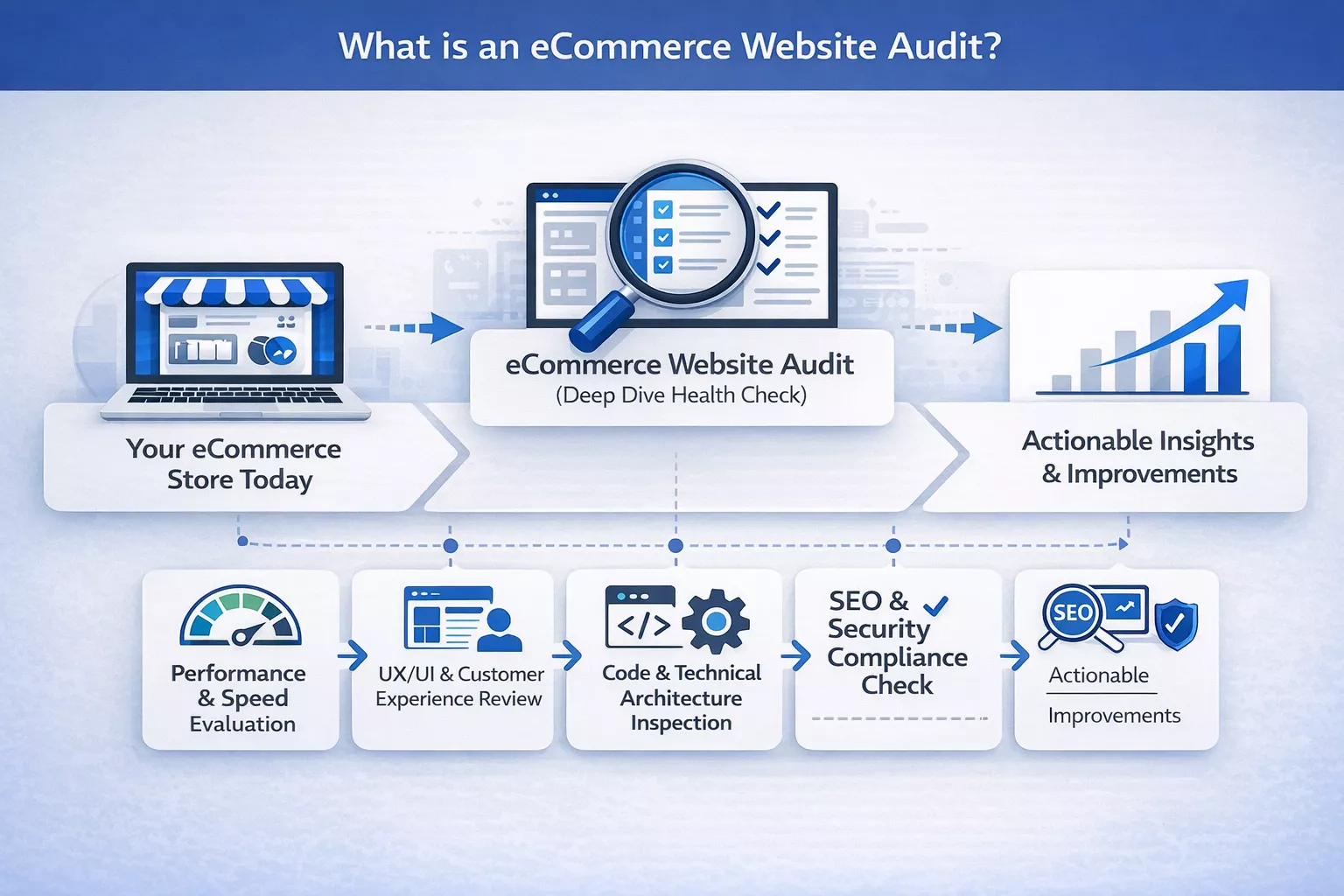
It’s your store’s report card. But better.
Think of it as a comprehensive health check for your online store.
It evaluates everything that affects your sales and customer satisfaction.
The audit examines:
- Code quality and technical architecture
- Page load times and site speed
- User interface and customer journey
- Mobile responsiveness
- SEO implementation
- Security protocols
- Checkout functionality
But here’s what makes it different from basic monitoring.
An audit digs into root causes. Not just symptoms.
Low conversion rates? The audit reveals if it’s slow checkout speeds, confusing navigation, or mobile usability issues.
You get answers. Not more questions.
Now here’s why this matters for your bottom line.
Why eCommerce Store Audits Matter for Business Growth
Want proof? Here’s the data.
Performance Impact: A 1-second page delay kills 7% of conversions.
Speed up from 3 seconds to 1 second? You’ll see 20-30% more conversions.
Revenue Protection: Data breaches cost retailers $4.24 million on average.
Worse? Research shows majority of customers won’t return after a security breach.
Customer Experience: Fix UX friction points and watch conversions jump 15-25% in the first quarter.
SEO Benefits: Technical SEO fixes boost organic traffic by 40% within 6 months.
Beyond metrics, audits give you clarity.
No more guessing. No more wasted budget on the wrong fixes.
Just data-driven insights that guide your next move.
Want to see what issues are costing you sales right now? Get your free audit consultation here.
Here’s what every professional audit covers.
Core Components of a Complete eCommerce Audit
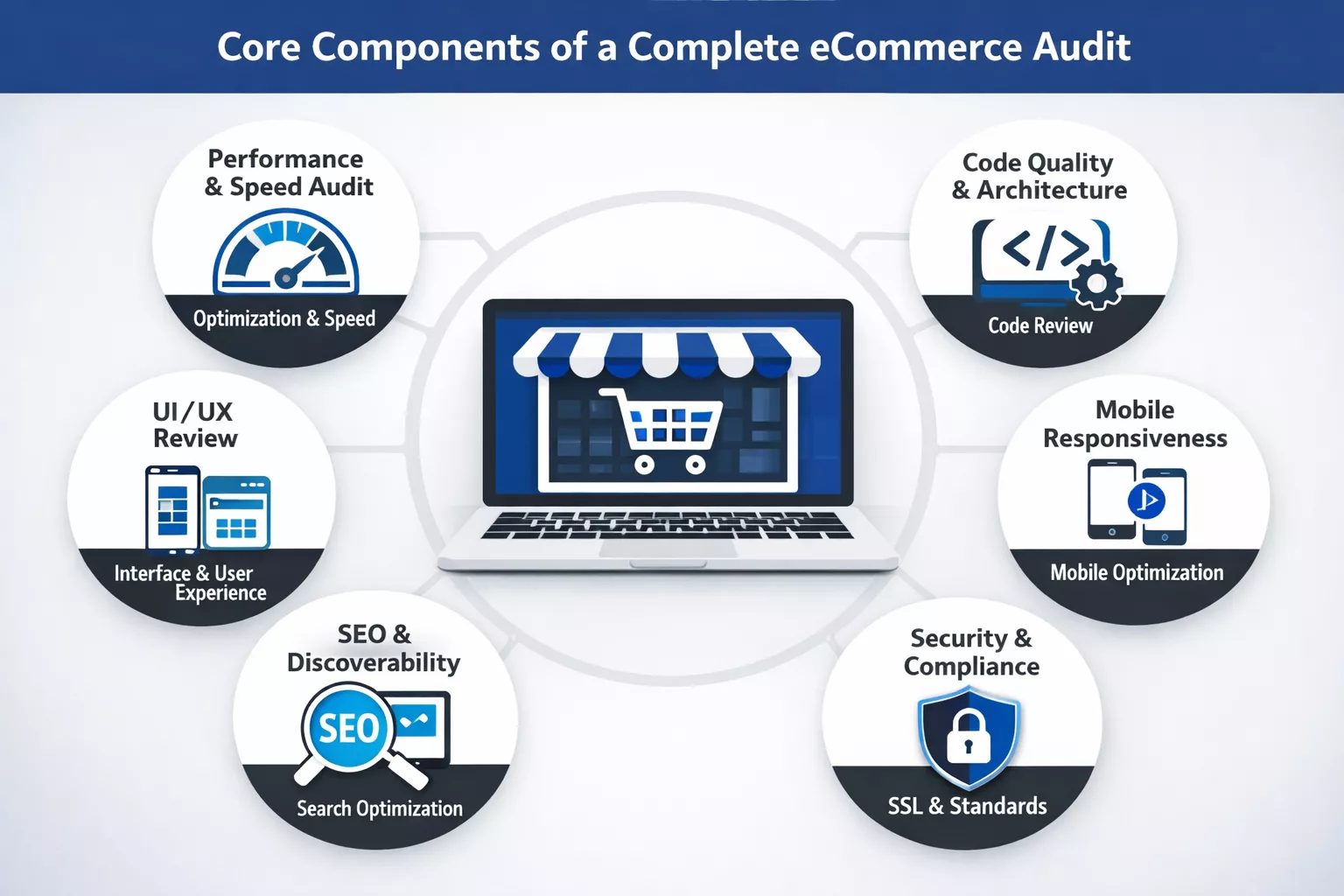
Every audit should dig deep into these 8 critical areas.
Technical Performance Analysis
Here’s the truth about speed: it makes or breaks your conversions.
Speed matters. A lot.
Over 60% of eCommerce traffic comes from mobile devices. And mobile users expect lightning-fast load times.
Sub-2-second load times are now the standard. Not the goal.
Here’s what we analyze:
Page Speed Testing: We test homepage, category pages, product pages, and checkout across devices.
Real user conditions matter. Not just lab tests.
Database Optimization: Inefficient database queries slow everything down.
We identify slow queries, optimize database structure, and implement proper indexing.
Image Optimization: Unoptimized images are conversion killers.
Large file sizes, missing compression, and poor format choices add seconds to load times.
Caching Strategy: Proper caching configuration can reduce server load by 70-80%.
We evaluate browser caching, server-side caching, and CDN implementation.
Infrastructure Architecture: Your hosting environment makes or breaks performance.
We evaluate hosting configuration, CDN setup, and scalability potential.
Modern B2B eCommerce platforms need architecture that handles traffic spikes without crashing.
Code Quality and Architecture Review
Your code is either making you money or costing you money. There’s no in-between.
Clean code isn’t just for developers. It affects your bottom line.
Code Structure: We examine custom code for efficiency, deprecated functions, and plugin conflicts.
Security vulnerabilities? We find them.
Platform-Specific Analysis: Every platform has its quirks.
Shopify, WooCommerce, Magento, BigCommerce. Each needs specialized review.
Third-Party Integrations: Payment gateways, shipping calculators, email marketing tools.
If they’re poorly integrated, they create bottlenecks.
API Performance: Slow API calls delay page loads and frustrate customers.
We test every integration that touches your store.
User Experience (UX) and Interface Design
Customer experience drives conversions. Period.
Professional UX/UI design services enhance these elements through data-driven checkout optimization and customer journey mapping.
Navigation Analysis: Clear navigation reduces bounce rates and cart abandonment.
We evaluate:
- Menu structure and labeling
- Search functionality and filters
- Product categorization logic
- Breadcrumb navigation
- Mobile menu usability
Shopping Cart Functionality: 69% of shopping carts are abandoned before checkout.
We test:
- Add-to-cart button visibility
- Cart summary clarity
- Easy quantity adjustments
- Price transparency
- Upsell placement
- Exit intent strategies
Checkout Process: Every extra step increases abandonment by 10%.
We map your entire checkout flow to identify:
- Form field complexity
- Payment option variety and payment gateway integration reliability
- Trust signal placement
- Error message clarity
- Mobile checkout optimization
Proper API integrations ensure seamless payment processing security and faster transaction completion.
Product Page Design: This is where buying decisions happen.
We analyze:
- Product image quality and zoom
- Description completeness
- Review display and authenticity
- Pricing visibility
- Stock availability indicators
- Related product recommendations
Every one of these elements either increases conversions or kills them.
Ready to see how your store stacks up? Schedule your free UX audit.
Mobile Responsiveness Testing
Mobile shoppers are ruthless. Your site better be perfect.
With mobile users expecting lightning-fast experiences, any friction loses customers immediately.
We test:
- Touch target sizes
- Form field usability on small screens
- Image scaling and quality
- Horizontal scrolling issues
- Mobile checkout flow
- Mobile payment options
Security and Compliance Assessment
One security breach can destroy your business overnight.
Implementing robust DevOps practices and secure cloud infrastructure strengthens your defense.
Vulnerability Detection:
- SSL certificate validity
- PCI DSS compliance for payment processing
- Outdated software versions
- Known security patches
- Backdoor or malicious code injections
- Data encryption standards
Compliance Review:
- GDPR requirements
- CCPA regulations
- Cookie consent implementation
- Privacy policy accessibility
- Terms of service clarity
Marketing and Conversion Optimization
Here’s the hard truth: Traffic without conversions is just a vanity metric.
Sales Funnel Analysis:
- Traffic source performance
- Landing page effectiveness
- Cart abandonment patterns
- Checkout completion rates
- Post-purchase engagement
Conversion Rate Optimization:
- Call-to-action placement
- Value proposition clarity
- Trust signals and social proof
- Urgency and scarcity tactics
- Email capture strategies
Analytics Configuration:
- Google Analytics setup accuracy
- E-commerce tracking implementation
- Goal configuration completeness
- Custom event tracking
- Attribution model review
Search Engine Optimization (SEO) Audit
Want free traffic forever? Fix your SEO.
Organic traffic is free traffic. But only if you rank.
Technical SEO:
- XML sitemap accuracy
- Robots.txt configuration
- Canonical tag implementation
- Structured data markup
- Site architecture and internal linking
- 404 error identification
On-Page SEO:
- Title tag optimization
- Meta description effectiveness
- Header hierarchy
- Image alt text
- Content quality and uniqueness
- Keyword targeting strategy
Content Strategy:
- Product description quality
- Category page optimization
- Blog content effectiveness
- Content gap analysis
- Duplicate content issues
Now let’s look at what we actually find when we audit stores.
Common Issues Found in eCommerce Website Audits
We’ve audited hundreds of stores. Here’s what shows up again and again.
Here’s what we find in most audits:
| Issue Category | Common Problem | Business Impact | Recommended Fix | Priority | Improvement Potential |
| Performance | No image optimization | Slow load times, high bounce | Image compression, WebP format | High | 40-60% speed boost |
| Performance | No CDN implementation | Slow international loads | CDN setup (Cloudflare, AWS) | Low | 40-60% global speed boost |
| Performance | Inefficient caching | Server overload, slow response | Redis/Memcached implementation | Medium | 50-70% load reduction |
| UX | Complex checkout (5+ steps) | Up to 68% cart abandonment | Streamlined 1-2 step checkout | Critical | 30-40% completion boost |
| UX | Missing mobile optimization | Up to 60% mobile traffic lost | Responsive design overhaul | Critical | 50-80% mobile retention |
| UX | Poor product filtering | Low engagement, high exit | Advanced filtering system | Medium | 25-35% category engagement |
| Security | Missing SSL or expired cert | Trust loss, SEO penalty | SSL certificate renewal | Critical | Immediate trust restoration |
| Security | Outdated platform/plugins | Up to 95% attack prevention | Regular update schedule | High | 70-90% vulnerability reduction |
| Security | No backup system | Business continuity risk | Automated daily backups | High | Risk elimination |
| SEO | Missing meta descriptions | Lower CTR from search | Complete meta optimization | Medium | 20-30% CTR improvement |
| SEO | Broken internal links | Crawl issues, poor UX | Link audit and fixing | Medium | 15-25% SEO improvement |
| SEO | Duplicate content | Up to 50% ranking penalty | Canonical tags, content revision | High | Ranking recovery |
| Code | Render-blocking JavaScript | Slow initial page load | Async/defer implementation | High | 30-50% initial load boost |
| Code | Large CSS files | Wasted bandwidth, slow loads | CSS minification, splitting | Medium | 20-30% load improvement |
| Code | Multiple tracking scripts | Page weight, privacy concerns | Tag manager consolidation | Low | 10-20% load boost |
Business impact percentages represent typical ranges observed across multiple audits. Actual results vary.
Every store has issues. The question is: which ones are costing you the most money?
Let’s find out. Get your personalized audit report.
Now here’s how to pick the right team to audit your store.
How to Choose the Right eCommerce Audit Provider
Not all audits are created equal. Some are garbage. Some change businesses forever.
Technical Expertise
Here’s the first thing to check: Do they actually understand eCommerce?
You need a team that understands eCommerce. Not just websites.
Our eCommerce audit team combines full-stack developers, certified platform specialists, and conversion rate optimization experts.
We’ve audited stores across every major platform.
No critical issues go undetected during website performance testing and technical SEO analysis.
Tools That Matter: We use industry-leading audit tools: Google Lighthouse for performance analysis, Screaming Frog for comprehensive SEO crawls, GTmetrix for speed testing, and platform-specific debuggers to identify code-level issues your customers never see but always feel.
Platform Specialists: Shopify experts don’t automatically understand WooCommerce architecture.
Find auditors experienced in your specific platform.
Development Background: Marketing agencies can spot UX issues. But they miss technical problems.
Choose a provider with actual development expertise.
Industry Experience
Generic doesn’t cut it in eCommerce.
eCommerce has unique challenges.
Inventory management. Payment processing. Shipping calculations. Tax compliance.
General web developers miss these nuances.
Whether your store runs on Shopify, WooCommerce, Magento, or BigCommerce. Platform-specific expertise matters.
For businesses looking for experienced partners, Bitcot’s eCommerce development services combine technical expertise with deep industry knowledge.
Our team has audited and optimized stores across multiple eCommerce platforms.
Comprehensive coverage for digital commerce audits.
Proven Track Record
Talk is cheap. Show me the results.
Ask for case studies. Demand measurable results.
Look for examples showing:
- Specific issues identified
- Solutions implemented
- Measurable outcomes achieved
- Timeline for improvements
Vague promises mean nothing. Data tells the truth.
Audit Methodology
Transparency matters.
Documented Process: How do they conduct audits? What tools do they use?
Deliverable Clarity: What exactly do you receive? Reports? Recommendations? Implementation support?
Timeline Expectations: How long does the audit take? When do you get results?
Post-Audit Support
Finding problems is easy. Fixing them is harder.
Implementation Assistance: Do they help fix issues or just point them out?
Priority Guidance: Which problems should you tackle first?
ROI Projections: What impact will fixes have on your bottom line?
Now let’s talk money. What should you actually pay?
eCommerce Audit Service Levels and Pricing
Here’s the reality: You get what you pay for.
Different stores need different audit depths.
| Feature | Starter Audit | Growth Audit | Enterprise Audit |
| Price Range | $2,000-$3,500 | $5,000-$8,000 | $10,000-$15,000+ |
| Timeline | 3-5 days | 1-2 weeks | 2-4 weeks |
| Page Analysis | Up to 50 pages | Up to 200 pages | Unlimited |
| Technical Review | ✓ Basic | ✓ Comprehensive | ✓ Deep dive + architecture |
| Code Audit | ✓ Surface level | ✓ Detailed | ✓ Line-by-line + security |
| Performance Testing | ✓ Desktop + mobile | ✓ Multiple devices | ✓ Full device matrix |
| SEO Audit | ✓ Basic (100 pages) | ✓ Comprehensive | ✓ Enterprise + content strategy |
| UX Analysis | ✓ Key pages only | ✓ Full journey | ✓ Advanced heatmaps + session recordings |
| Security Scan | ✓ Basic vulnerabilities | ✓ Comprehensive | ✓ Penetration testing |
| Competition Analysis | ✗ | ✓ Top 3 competitors | ✓ Top 10 + market positioning |
| Implementation Support | ✗ | ✓ Priority roadmap | ✓ Hands-on implementation |
| Follow-up | ✗ | ✓ 30-day check-in | ✓ Quarterly reviews |
Choose based on your store size, budget, and current pain points.
Our audits are designed to provide clear, actionable insights that help you identify genuine growth opportunities for your store.
Not sure which level you need? Let’s talk – we’ll recommend the right fit.
You’ve got the audit. Now comes the important part.
Taking Action After Your eCommerce Website Audit
The audit is worthless if you don’t act on it.
You’ve got the audit results. Now what?
Prioritization Framework
First rule: Don’t try to fix everything at once.
Not all issues carry equal weight.
Consider:
- Impact: How significantly does it affect conversions or revenue?
- Effort: How much time and resources does the fix require?
- Dependencies: Do other fixes need to happen first?
Quick wins first. High impact, low effort improvements.
Build momentum. Demonstrate value fast.
Implementation Timeline
Speed matters. But quality matters more.
Don’t rush. Plan properly.
Account for:
- Development resources available
- Testing requirements
- Deployment schedules
- User training needs
Rushed implementations create new problems.
Better to implement fixes correctly than quickly.
Our Agile Implementation Approach:
For clients choosing implementation support, we follow an agile methodology.
We deliver improvements in 2-week sprints through our expert team.
Here’s our proven 5-step process:
- Discovery – Comprehensive audit identifying all issues and opportunities
- Strategy – Prioritize fixes by ROI impact and implementation complexity
- Development – 2-week Agile sprints with continuous testing and feedback
- Quality Assurance – Rigorous testing before any code touches production
- Optimization – Ongoing monitoring and iterative improvements
This approach allows for:
- Quick wins deployed first
- Continuous testing and validation
- Flexible adjustments based on results
- Regular client communication
- Support for multi-channel selling integration and cart abandonment reduction strategies
Fixes don’t disrupt operations. Improvements come quickly.
Continuous Monitoring
Here’s what most people get wrong: They audit once and forget about it.
One audit isn’t enough.
Monthly Monitoring: Track key metrics continuously.
Performance changes. User behavior shifts. Competition evolves.
Quarterly Reviews: Deep-dive analysis every 3 months.
Catch issues before they become expensive problems.
Annual Comprehensive Audits: Full evaluation once per year.
Technology changes. Customer expectations rise. Your store needs to evolve.
Partnering with experienced eCommerce developers ensures continuous optimization.
Maintain peak performance as technology and expectations evolve.
Every industry has unique challenges. Here’s what to focus on for yours.
Industry-Specific eCommerce Audit Considerations
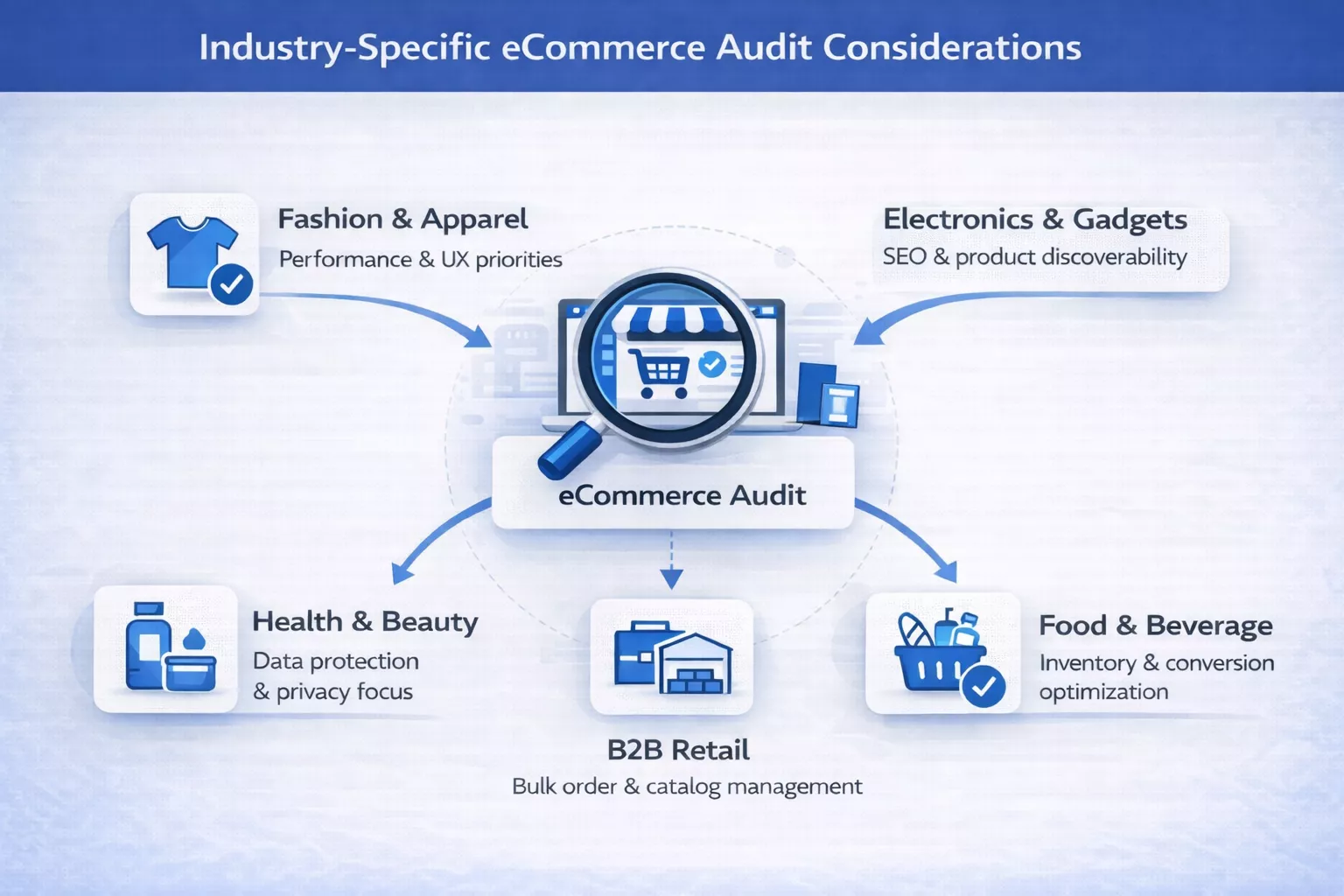
One size doesn’t fit all in eCommerce.
Different industries have unique requirements.
Fashion and Apparel
Critical audit areas:
- Size chart accuracy and accessibility
- Color variation display
- Virtual try-on integration
- Return policy clarity
- Style guide content
Electronics and Tech
Focus points:
- Technical specification accuracy
- Comparison tool functionality
- Warranty information clarity
- Product compatibility filters
- Review authenticity verification
Health and Beauty
Key concerns:
- Ingredient disclosure compliance
- Age verification systems
- Subscription management functionality
- Bundle and kit configuration
- Regulatory compliance (FDA, etc.)
B2B eCommerce
Specialized focus:
- Quote request functionality
- Bulk ordering capabilities
- Custom pricing by customer account
- Integration with ERP systems through enterprise software development and business software solutions
- Credit term management
Food and Grocery
Critical areas:
- Freshness date tracking
- Dietary restriction filtering
- Delivery time slot management
- Substitution preferences
- Recipe integration
Don’t just fix today’s problems. Prepare for tomorrow’s opportunities.
Future-Proofing Your eCommerce Store Through Regular Audits
What worked last year won’t work next year.
The market doesn’t stand still. Neither should your store.
Preparing for Growth
Audits assess scalability:
- Can infrastructure handle 10x traffic?
- Does architecture support new sales channels?
- Will integrations scale with increased volume?
- Can the team maintain growing codebase?
Emerging Technology Integration
Forward-thinking audits consider readiness for:
- Artificial intelligence for personalization and conversion rate optimization
- Augmented reality for product visualization
- Voice commerce capabilities
- Progressive web app functionality
- Headless commerce architecture
- Cloud computing infrastructure for scalability
Platform migration assessment ensures seamless integration.
Sustainability and Accessibility
Modern audits evaluate:
- Website accessibility compliance (WCAG 2.1)
- Carbon footprint and green hosting
- Sustainable shipping options
- Ethical sourcing transparency
- Inclusive design practices
Want to go deeper? Here are the pro-level audit tools and techniques.
Advanced eCommerce Audit Techniques
For complex stores, basic audits aren’t enough. You need advanced tools.
Performance Profiling Tools
- Chrome DevTools: Detailed performance analysis.
- GTmetrix: Comprehensive speed testing.
- WebPageTest: Real-world performance simulation.
- Google PageSpeed Insights: Mobile and desktop optimization.
User Behavior Analysis
- Heatmap Tools: Hotjar, Crazy Egg – see where users click.
- Session Recording: Watch actual user sessions. Find friction points.
- A/B Testing Platforms: Optimizely, VWO – test improvements.
Security Scanning Tools
- Sucuri SiteCheck: Malware and vulnerability scanning.
- Qualys SSL Labs: SSL/TLS configuration analysis.
- OWASP ZAP: Security vulnerability testing.
SEO Analysis Platforms
- Screaming Frog: Comprehensive crawling and analysis.
- Ahrefs: Backlink analysis and keyword tracking.
- SEMrush: Competitive analysis and opportunity identification.
Your integrations can make or break your store. Let’s audit them.
Integration and Third-Party Service Audits
Here’s the brutal truth: Your store is only as strong as your weakest integration.
Payment Gateway Evaluation
Audit focus:
- Transaction success rates
- Declined payment reasons
- Alternative payment methods
- Fraud detection accuracy
- International payment support
Shipping Integration Assessment
Critical checks:
- Real-time rate calculation accuracy
- Multi-carrier integration functionality
- International shipping configuration
- Tracking update reliability
- Return shipping automation
CRM and Marketing Automation Integration
Effective audits examine customer data flow.
Modern workflow automation services and CRM integrations streamline these processes.
Better cart abandonment reduction. Better customer retention.
Email Marketing Platforms: Integration with Klaviyo, Mailchimp.
Abandoned cart recovery. Customer segmentation. Lifecycle marketing.
Customer Data Platforms: How customer information consolidates across touchpoints.
Personalized experiences through intelligent automation.
Retention Marketing: Post-purchase email flows. Loyalty program integration.
Customer lifetime value optimization that supports multi-channel selling.
Want us to audit your integrations? Start with a free consultation.
Here’s the bottom line.
Conclusion: The Audit Advantage
Success in eCommerce isn’t luck. It’s strategy.
Markets change. Technology advances. Customer expectations rise.
Regular, comprehensive audits give you competitive advantages:
Financial Impact: Audit-driven improvements typically increase revenue 20-40% in the first year.
Better conversion rates. Higher average order values. Increased customer lifetime value.
Risk Mitigation: Proactive security and performance monitoring prevents catastrophic failures.
Data breaches cost millions. Reputation damage takes years to recover.
Strategic Clarity: Data-driven insights guide technology investments.
Budgets flow toward improvements delivering measurable ROI. Not vanity features.
The online retail landscape has never been more competitive.
Stores that ignore technical debt steadily lose market share.
Without regular audits, you risk: Losing customers to faster competitors. Getting blindsided by security breaches that destroy trust. Watching your market share erode while others optimize and grow.
Stores that embrace regular audits continuously improve. They stay ahead of problems before customers notice.
Whether running a startup store or managing enterprise eCommerce, comprehensive audits provide the foundation for sustainable growth.
The investment in understanding what works, what’s broken, and what opportunities exist pays dividends far exceeding the initial cost.
Start with a free basic audit to identify obvious issues.
Then invest in comprehensive professional audits annually to maintain peak performance.
The insights transform guesswork into strategy. Hidden problems into growth opportunities.
The question isn’t whether to audit your eCommerce website.
It’s whether you can afford not to.
Ready to stop losing sales and start growing?
Stop guessing. Start knowing.
We combine technical expertise with strategic digital commerce knowledge.
Our expert team delivers actionable audit insights that drive measurable growth.
As a leading eCommerce development company, we specialize in online store optimization, conversion rate optimization (CRO), and platform migration strategies.
Whether launching a new store, scaling an existing business, or troubleshooting performance issues, professional audits provide the foundation for informed decision-making.
The difference between stores that thrive and those that struggle comes down to understanding what’s working, fixing what’s broken, and continuously optimizing.
Get started today:
- Free initial consultation to discuss specific challenges
- Customized audit scope matching business needs and budget
- Clear roadmap for implementation
- Ongoing optimization support
Schedule a free eCommerce audit consultation with us and discover exactly how to turn website visitors into loyal customers.
Maximize revenue from existing traffic starting today.
Got questions? We’ve got answers.
eCommerce Website Audit FAQs
How much does a comprehensive eCommerce audit cost?
Here’s the straight truth about pricing.
Professional audits range from $2,000 to $15,000.
Depends on:
- Store size and complexity
- Audit scope
- Platform complexity
- Business size and traffic volume
The investment typically delivers ROI within 60-90 days.
Improved conversions and reduced operational costs pay for themselves.
How long does an eCommerce website audit take?
Timeline varies:
- Basic audit: 3-5 business days
- Comprehensive audit: 1-2 weeks
- Enterprise-level audit: 4-6 weeks
Larger stores with complex integrations take longer.
Can I perform my own eCommerce audit?
Yes. But it’s challenging.
Free tools exist:
- Google PageSpeed Insights
- Google Analytics
- Google Search Console
- GTmetrix
- W3C Validator
But you need expertise to interpret results.
And you need technical skills to implement fixes.
Professional audits cost money. But they save time and deliver better results.
How often should I audit my eCommerce website?
Depends on your store.
Monthly: Key metrics monitoring.
Quarterly: Quick health checks.
Annually: Comprehensive professional audits.
After major changes: Platform updates, redesigns, new integrations.
Before major campaigns: Holiday seasons, big promotions.
Regular monitoring catches problems early.
What's the ROI of an eCommerce website audit?
Most stores see 3-5x ROI within the first year.
How?
- 15-25% increase in conversion rates
- 20-40% improvement in page speed
- 30-50% reduction in cart abandonment
- 40%+ boost in organic traffic
- Significant reduction in security risks
Small improvements compound.
A 1% increase in conversion rate on a $1M revenue store = $10,000 more per year.
Do I need an audit if my site is new?
Absolutely.
New sites often have issues out of the gate.
Audit before launching:
- Catch critical problems early
- Optimize before bad habits form
- Ensure proper foundation
- Avoid expensive fixes later
Prevention is cheaper than correction.
What tools do professionals use for eCommerce audits?
We use multiple tools:
- Screaming Frog for SEO crawling
- GTmetrix for performance
- Google Analytics for behavior analysis
- Hotjar for user experience
- Sucuri for security scanning
- Chrome DevTools for debugging
- Custom scripts for platform-specific issues
We offer flexible engagement models supporting businesses at every stage.
From audit through implementation and ongoing optimization.
Can an audit help if my sales are already good?
Yes. Growth requires optimization.
Even successful stores have:
- Untapped conversion potential
- Performance bottlenecks
- Hidden security risks
- SEO opportunities
- UX improvements
Audits reveal opportunities you didn’t know existed.
What happens after I receive my audit report?
You get:
- Detailed findings
- Prioritized recommendations
- Implementation roadmap
- ROI projections
- Action items with timelines
Then you decide:
- DIY implementation
- Hire your team
- Partner with audit provider
- Hybrid approach
Your choice. Your timeline.
How do I know if the audit findings are accurate?
Legitimate audits include:
- Specific examples
- Screenshots and data
- Reproducible test results
- Industry benchmarks
- Competitive analysis
- Clear metrics
Vague generalizations are red flags.
Good audits provide evidence.
Still have questions? Let's talk - no pressure, just answers.
Get expert guidance for your eCommerce business. Bitcot analyzes your website, identifies issues in code, UX/UI, performance, and integrations, and provides clear solutions. Schedule your free consultation today and unlock growth.