Key Takeaways
- Seven scope decisions set most of an app’s build effort.
- Pew Research Center reports 91% of U.S. adults own smartphones.
- Compare vendors’ written assumptions, not their final totals.
- San Diego clinics and Irvine lenders feel integration effort most.
- Yearly Apple and Google deadlines make upkeep a fixed cost.
A scenario we see often in San Diego: a physical therapy group brings us two proposals for the same booking app, and one is far larger than the other. Neither vendor is padding the number. One assumes the app will read and write appointments in the clinic’s existing scheduling system, while the other assumes a fresh, standalone calendar. That gap is the real answer to the cost to make a mobile app: the price reflects decisions, and most buyers never see which decisions a quote is built on.
The stakes for getting it right keep rising. According to Pew Research Center, 91% of U.S. adults now own a smartphone, and 16% rely on it as their only way online at home. For many of your customers, your app is the business.
This guide takes the buyer’s side of the table. Instead of a price chart that ages in six months, it shows the seven decisions that size a build, the yearly platform rules that turn launch into an ongoing commitment, and a method for reading two proposals so you can tell which one is honest.

Why Do Two Vendors Quote Different Prices for the Same App?
Two vendors quote differently because each one fills the gaps in your feature list with its own assumptions, and those assumptions carry the cost. A line like “users can book appointments” can mean a single screen or a two-way sync with a practice management system, reminders, cancellations, and a waitlist. The vendor who reads it narrowly looks cheaper until the missing pieces show up as change requests.
Effort also depends on what the vendor plans to do before writing code. A team that budgets for discovery, clickable prototypes, and user testing spends more at the start and less fixing the wrong screens later. A team that skips those steps is betting your requirements are complete, and very few first drafts are.
Assumptions worth asking every vendor to write down
- Platforms: iPhone only, Android only, both, or a web version as well.
- Data source: whether the app talks to systems you already own or needs a new backend.
- Admin tools: who manages content, users, and refunds, and through which dashboard.
- Post-launch scope: how many months of fixes, updates, and monitoring are included.
When those four items are written down, most of the gap between two proposals explains itself. A quote without them is a guess with a number attached.
The Seven Decisions That Set the Cost to Make a Mobile App
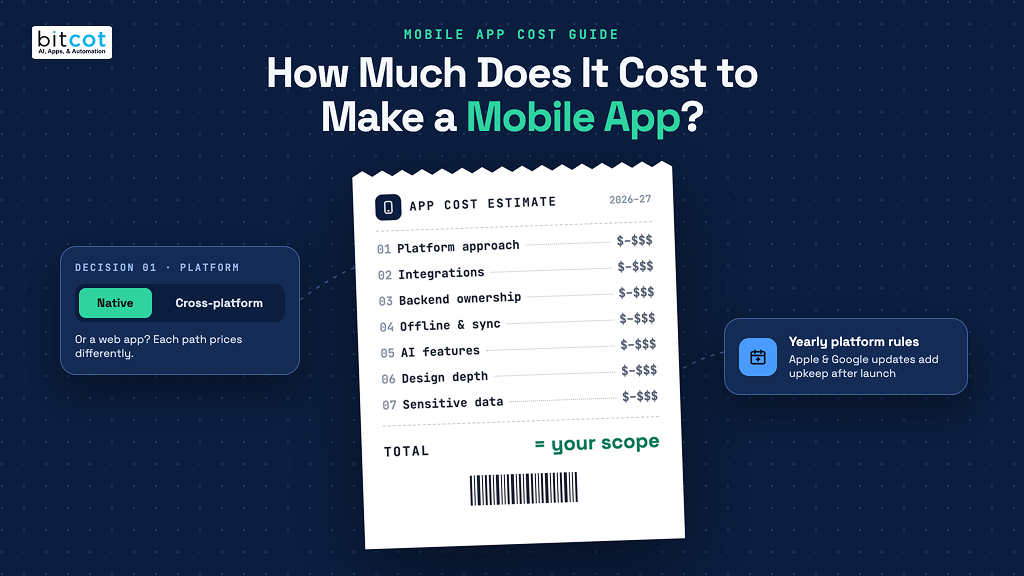
The cost to make a mobile app is driven by seven decisions you control, and every one of them can be made smaller or larger on purpose. Listing them in order of impact helps you trim scope without cutting what your customers came for.
- Platform approach. Building separate native apps for iOS and Android means two codebases to write and test. A single cross-platform codebase through Flutter app development shares most of that work, while native builds still win for heavy camera, sensor or graphics use.
- Integrations. Every connection to a payment processor, CRM, EHR, or accounting tool needs mapping, error handling, and testing against someone else’s rules. In our experience, integrations are the line item buyers underestimate most.
- Backend ownership. Reusing a working API is far lighter than designing a new database, user system, and server logic from scratch.
- Offline behavior. An app that keeps working without signal, then syncs safely, needs conflict rules for when two people edit the same record.
- AI features. Search, summaries, or a chat assistant add design work plus a usage-based running bill from the model provider, which keeps arriving every month after launch.
- Design depth. Stock components ship faster; custom animations, branded illustrations and accessibility testing take longer and usually pay back in retention.
- Sensitive data. Health and financial data change how storage, logging and access are built. For example, HIPAA requires healthcare organizations to protect patient information, so a clinic app needs encryption, audit trails and access controls designed in from day one.
A useful exercise is to mark each decision as “must have at launch” or “can wait for version two.” Most of the businesses we advise move two or three items to the second column, and the launch date moves closer as a result.

How Yearly Platform Rules Change the Cost to Make a Mobile App in 2026-2027
Launching an app is no longer a one-time purchase, because Apple and Google now set fresh technical deadlines every year that every listed app has to meet. Missing one does not crash your app overnight, but it blocks updates or shrinks who can download it.
The 2026 calendar shows how concrete this is. According to Apple Developer, apps uploaded to App Store Connect from April 28, 2026 must be built with Xcode 26 and the matching 26-generation SDKs. Any fix you want to ship after that date requires a project that compiles cleanly on the new toolchain.
Android followed with its own deadline later in the year. Teams that planned only for iOS felt the second wave as a surprise.
According to Android Developers, new apps and updates submitted to Google Play from August 31, 2026 must target Android 16 (API level 36), and existing apps below Android 15 stop appearing for new users on newer devices. An app nobody touched for two years usually needs dependency upgrades, permission changes and retesting to clear that bar.
What to budget time for every year
- Toolchain upgrades: moving to the new Xcode and Android SDK each spring and summer.
- Library updates: payment, maps and analytics SDKs that drop support for old versions.
- OS behavior changes: new privacy prompts, background limits and notification rules.
- Recurring services: hosting, AI model usage and third-party subscriptions.
Our article on total cost of ownership for digital products walks through how to plan these lines across a multi-year horizon. The short version: ask every vendor what the first twelve months after launch include, in writing.
How to Read a Vendor Proposal Before You Compare Numbers
Read a proposal by checking its assumptions, team, and post-launch plan first, and look at the total last. This order stops a low number from anchoring your judgment before you know what it leaves out.
- Match the scope line by line. Put both proposals in two columns against your feature list and highlight anything one vendor includes and the other ignores.
- Find the discovery phase. A proposal with no research, wireframes, or prototype stage expects you to have answered every design question already.
- Ask who is on the team. Request named roles for design, development, QA, and project management, plus how many hours each role is assigned.
- Check the testing plan. Look for device coverage, automated tests, and an app store submission step, not just “QA included.”
- Read the change request policy. Know how new ideas get estimated once work starts, because they always appear.
- Confirm code and account ownership. Your business should own the source code, the developer accounts, and the cloud environment from day one.
A quote that is far below the others deserves questions, not suspicion alone. Sometimes the vendor found a smarter route, such as reusing your existing API. More often, a missing line explains it, and that pattern sits at the heart of why software projects fail after a promising kickoff.
Native, Cross-Platform or Web App: Which Fits Your Business?
Cross-platform apps fit most small and mid-size businesses, native apps fit products that lean on device hardware, and web apps fit tools used occasionally or mostly on desktop. The right pick depends on how often customers open the app and what they do inside it.
| Approach | Best fit | Trade-off to plan for |
|---|---|---|
| Native (Swift, Kotlin) | Camera, Bluetooth, AR, heavy animation, wearables | Two codebases to build, test and upgrade each year |
| Cross-platform (Flutter, React Native) | Booking, ordering, loyalty, account and dashboard apps | Some device features need native plugins |
| Web app / PWA | Internal tools, occasional-use portals, desktop-first users | Weaker push notifications and no app store presence |
If your audience skews heavily toward iPhone users, as many premium retail and wellness brands do, starting with iOS app development and adding Android later is a valid phased plan. The decision also overlaps with whether to license an off-the-shelf product, which our guide to build vs buy software covers in depth.
AI deserves its own note in 2026. Bolting a chat feature onto a finished app tends to cost more than designing around it from the start, which is the core idea behind AI-native app development.
What California Businesses Are Building Apps For Right Now
California businesses are mostly building apps to own the customer relationship that marketplaces and third-party platforms used to hold. Digital buying keeps expanding: according to the U.S. Census Bureau, e-commerce reached 17.1% of total U.S. retail sales in the second quarter of 2026, up 12.2% from a year earlier.
The pattern differs by region. In San Diego, clinics and wellness studios want booking, intake forms and reminders tied to their existing systems, so integration effort decides their timelines. Teams evaluating partners for software development in San Diego often ask first how the app will connect to the tools staff already use.
Irvine and Los Angeles lenders and payment startups focus on identity checks, bank connections and audit-friendly records, work that sits closer to fintech software development than to a typical retail app. Their apps carry heavier testing and review cycles, and those cycles belong in the plan from week one.
Bay Area founders, meanwhile, tend to ship a narrow first version fast to test demand with investors. Companies comparing options for mobile app development in San Francisco usually trade breadth for speed, then expand once usage data shows what customers actually open.
What Clinic and Lender Apps Taught Us About Scope Drift
Across healthcare and fintech builds, the biggest overrun we see is not technical. It happens when a third-party system turns out to be harder to connect than anyone assumed, and the plan has no buffer for it.
One recurring case: a practice management platform that advertises an API but only exposes read access, so appointment changes need a workaround. At Bitcot, we now run a short integration spike, a few days of test calls against each external system, before we finalize scope for clinic and lending clients in San Diego and across California.
That small step has changed our proposals more than any estimating spreadsheet. It turns the riskiest assumption into a known fact before the client commits, and it gives owners a firm basis for deciding what launches first.

Conclusion
The cost to make a mobile app in 2026-2027 comes down to decisions you can see and control: platforms, integrations, backend, offline needs, AI, design depth, and data sensitivity. Yearly Apple and Google deadlines add a predictable upkeep layer that belongs in every plan from the start.
The most useful move you can make this week is simple. Ask each vendor to list its assumptions and its first-year post-launch scope in writing, then compare those lists before you compare totals. If you would like a second set of eyes on a proposal or a feature list, our team is happy to walk through it with you.
Frequently Asked Questions
What determines the cost to make a mobile app?
The cost to make a mobile app is determined by seven scope decisions: platform approach, integrations, backend ownership, offline behavior, AI features, design depth and sensitive data handling. Integrations are usually the most underestimated item. Trimming or phasing two or three of these decisions often shortens the path to launch.
What is the difference between native and cross-platform app development cost?
Native development builds and maintains two separate codebases, while cross-platform development shares one codebase across iOS and Android. That shared code reduces build and yearly upgrade effort for booking, ordering and account apps. Native remains the better choice when the app depends heavily on camera, Bluetooth, AR or advanced graphics.
How do I compare two mobile app development quotes?
Compare the written assumptions, team roles, testing plan and post-launch scope first, and look at the total last. Line both proposals up against your feature list and highlight what each one includes or skips. Also confirm that your business will own the source code, developer accounts and cloud environment.
What are California businesses building mobile apps for in 2026?
California businesses are building apps mainly to own the direct customer relationship. San Diego clinics focus on booking and intake tied to existing systems, Irvine and Los Angeles lenders focus on identity checks and bank connections, and San Francisco founders ship narrow first versions to test demand quickly.
Is building a mobile app worth it for a small business?
Building a mobile app is worth it when customers interact with your business often enough to keep it on their phone, such as for booking, reordering or loyalty. Pew Research Center reports that 91% of U.S. adults own a smartphone, so the audience is there. If customers visit only once or twice a year, a well-built web app is usually the smarter first step.