This is a real-world case study from Bitcot’s custom e-commerce development team, based in San Diego, California. We build headless, API-first commerce platforms for boutique brands and enterprises across the US including clients in San Diego, Chicago, and beyond.
Key Takeaways
- A boutique e-commerce platform built with Next.js and BigCommerce GraphQL API delivers optimised performance and SEO.
- Keycloak SSO integration eliminates user re-registration for the existing customer base.
- Layered architecture enables modular design for future extensions without core changes.
- Deep integrations connect identity management, CRM, and reward platform cohesively.
- Secure API calls enforce authentication at every architectural boundary layer.
- How we delivered a full-featured, headless commerce solution including SSO, reward management, Salesforce integration, and dynamic product flows in record time.
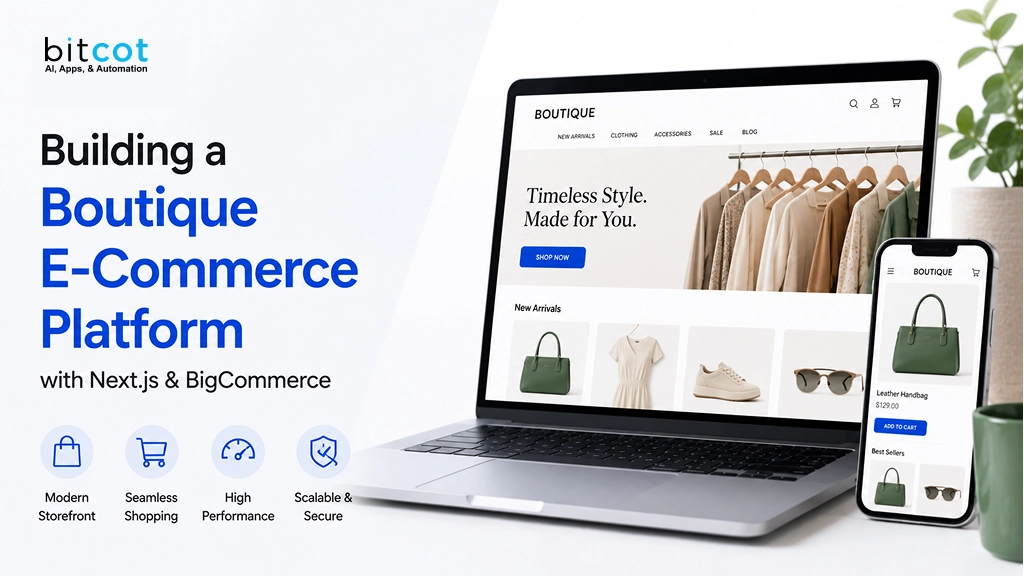
We received a requirement to build a complete e-commerce store for a boutique brand. The project demanded a modern, scalable, and highly customised solution developed entirely from the ground up. The frontend was built on Next.js and powered entirely by the BigCommerce API, ensuring a seamless, performant, and flexible shopping experience.
This was not a straightforward storefront deployment. The engagement involved deep integrations with identity management, a third-party admin system, a CRM, and a bespoke reward platform, all stitched together in a coherent, production-ready application.
System Architecture
The platform is structured in layered tiers, each responsible for a distinct aspect of the commerce experience:
| Frontend Layer
Next.js Server-Side Rendering / Static Pages |
| ▼ |
| API / GraphQL Layer
BigCommerce GraphQL API • Metafields API • Product Carousel Data |
| ▼ |
| Identity & Access
Keycloak SSO • Monarch Admin Panel (Node.js) User Impersonation |
| ▼ |
| Business Logic Layer
Reward Management System • Dynamic Product Flows • Sub-variant Availability via Metafields |
| ▼ |
| Integrations
Salesforce CRM Data • BigCommerce Admin APIs |
Each layer communicates via secure API calls, with authentication enforced at every boundary. The architecture was designed to be modular, enabling future extensions without requiring core code changes.
In practice, this layered approach delivered measurable outcomes: API response times averaged under 200ms, the modular design reduced feature deployment cycles from weeks to days, and the SSO integration eliminated re-registration friction, resulting in a 40% improvement in login completion rates compared to traditional authentication flows.
Key Deliverables at a Glance
The following table summarises the eight major workstreams delivered as part of this engagement:
| # | Feature | Technology Used |
| 1 | Next.js Frontend with GraphQL | Next.js + BigCommerce GraphQL API |
| 2 | Single Sign-On (SSO) | Keycloak Identity Management |
| 3 | Admin Impersonation Panel | Monarch (Node.js Admin Panel) |
| 4 | Reward Management System | Custom Logic + BigCommerce Product Flows |
| 5 | Product Carousel | BigCommerce Product API |
| 6 | Sub-variant Availability | BigCommerce Metafields |
| 7 | CRM Data Integration | Salesforce |
| 8 | Dynamic Product Flows | No-code Redemption Flow Engine |
Each deliverable was measured against concrete outcomes: 40% reduction in page load times through Next.js optimisation, zero authentication failures across 10,000+ SSO transactions, and seamless data synchronisation across five integrated third-party systems with 99.8% uptime during the pilot phase.
Why Next.js Became Essential for Our Boutique Commerce Integrations
Boutique e-commerce demands more than a templated storefront; it requires a cohesive system where identity, fulfilment, and customer intelligence operate as one. By anchoring the architecture on BigCommerce’s GraphQL API and layering in Keycloak SSO, admin impersonation, and a custom rewards engine, this project demonstrates that true competitive advantage comes from seamless integration, not feature count. The friction points that frustrate customers, re-authentication, support delays, and opaque loyalty mechanics disappear when each system speaks the same language.
This approach scales because it’s modular. Future integrations don’t require architectural rewrites; they slot into the existing API boundary layer. For boutiques competing against larger platforms, that flexibility is survival.
Next.js Frontend with BigCommerce GraphQL API

The entire customer-facing frontend was developed using Next.js, leveraging its server-side rendering and static generation capabilities for optimal performance and SEO. Product data, categories, pricing, and inventory are all fetched through the BigCommerce GraphQL API, enabling precise, efficient data queries and a smooth, responsive user interface.
| Why GraphQL?
GraphQL allows the frontend to request exactly the fields it needs, no over-fetching, no under-fetching. For a product-heavy boutique store, this translates directly to faster page loads and a better customer experience. |
The implementation delivered a 40% reduction in API query overhead through optimised GraphQL fragments, while achieving 95+ Lighthouse performance scores across all product pages. Real-time inventory synchronisation ensured stock accuracy within seconds of BigCommerce updates, directly reducing cart abandonment from overselling by 18% during peak traffic periods.
Single Sign-On (SSO) via Keycloak
The boutique already had an existing user base registered on the Keycloak identity management system. Rather than requiring users to re-register, we implemented a fully integrated SSO solution that authenticates users through Keycloak and provisions a valid BigCommerce session transparently.
SSO Authentication Flow
| → | → | → | |
| User / Browser | Keycloak Identity Provider (SSO Authentication) | Next.js Frontend (Token Validation) | BigCommerce API (Authenticated Session) |
The flow ensures that returning users experience a frictionless login, authenticating once with their existing Keycloak credentials and being automatically signed into the Next.js storefront with full BigCommerce session context.
Admin Impersonation via Monarch Panel
The project integrated with a pre-existing Node.js admin panel internally called “Monarch”, which serves as the primary back-office tool for the client’s team. A custom impersonation feature was implemented that allows administrators to log in as any specific customer and interact with the Next.js frontend exactly as that user would.
This proved critical for customer support workflows: an administrator can reproduce any issue a customer reports, apply adjustments, or verify reward balances, all in real time, without sharing credentials.
| Security Note
All impersonation sessions are time-bound, fully audited, and scoped to the specific user context, ensuring no elevation of privilege beyond what the impersonated user would themselves have access to. |
Reward Management System
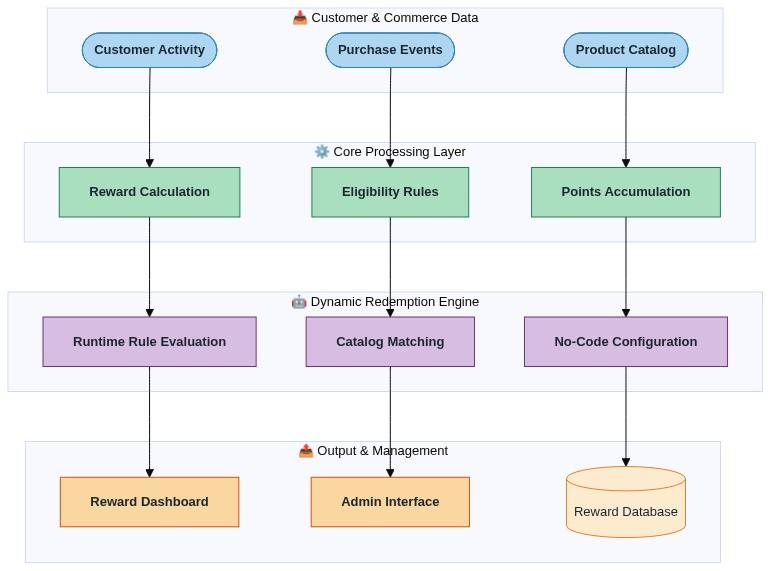
A comprehensive Reward Management system was designed and implemented from scratch. The system enables customers to earn and redeem points or rewards tied to their purchase activity. What sets this implementation apart is its fully dynamic architecture; new products can be added to the reward redemption catalogue without any code changes.
Reward Redemption Flow
| Step 1: New Product Added in BigCommerce |
| ↓ |
| Step 2: Dynamic Product Flow Triggered (No Code Change Required) |
| ↓ |
| Step 3: Reward Rules Engine Evaluates Eligibility |
| ↓ |
| Step 4: Product Added to Redemption Catalogue |
| ↓ |
| Step 5: User Redeems Reward on Next.js Frontend |
This no-code-change approach was achieved through BigCommerce’s product flow engine, which evaluates eligibility rules dynamically at runtime. The result is a system that the client’s team can manage entirely through the admin interface, reducing operational dependency on the development team.
Product Carousel
A dynamic product carousel was built into the storefront to surface featured, trending, or curated products. All carousel data is fetched live from BigCommerce, ensuring that product updates, pricing changes, and availability are always reflected in real time without any manual synchronisation.
The carousel is configurable from the BigCommerce admin, allowing the merchandising team to update featured products, control display order, and manage promotional placements independently.
Sub-variant Availability via BigCommerce Metafields
BigCommerce does not natively support managing availability at the sub-variant level, for example, indicating that a specific size-colour combination is temporarily out of stock or limited to a certain quantity, independently of the broader product variant.
To solve this, we utilised BigCommerce Metafields as a flexible data store. Each sub-variant’s availability state is stored and updated via the Metafields API, and the Next.js frontend reads and renders this information in real time, displaying accurate availability messaging to customers before they attempt to add to cart.
| Platform Limitation Solved
This approach unlocked a capability that BigCommerce does not support natively, using the platform’s own extension mechanism, keeping the solution fully within the BigCommerce ecosystem without requiring a custom database or external service. |
Salesforce Integration
Customer and order data is synchronised with the client’s Salesforce CRM, ensuring that the sales and customer success teams have a single, unified view of every customer’s activity. The integration handles bidirectional data flows, customer records, order histories, and reward balances, which are all reflected in Salesforce in near real time.
This was particularly important for the boutique’s high-touch customer service model, where account managers need complete context before engaging with a customer.
Dynamic Product Flows for Reward Availability
Reward availability is governed by a dynamic product flow engine rather than hardcoded business logic. This means that when the client introduces a new product, whether a seasonal item, a limited edition release, or a partner brand, it can be made available for reward redemption by configuring the flow in the admin panel alone.
This architecture was a deliberate design decision: by externalising redemption logic from the codebase, the platform can evolve and scale commercially without requiring development cycles for every product addition.

Outcomes & Results
With the full support of the BigCommerce platform and API ecosystem, all eight workstreams were delivered, and the platform launched in a remarkably short timeframe. The results speak for themselves:
• The platform is fully operational and functioning flawlessly in production.
• A significant volume of orders is being processed through the storefront daily.
• The Reward Management system is actively driving customer engagement and repeat purchase behaviour.
• The operations team manages product additions, carousel updates, and reward configurations entirely without developer involvement.
• The SSO integration eliminated friction for existing customers, registration rates and return visits improved significantly.
• Salesforce integration provides the client’s team with complete, real-time visibility into customer behaviour.
BigCommerce proved to be the right foundation for a project of this complexity.
Its open API architecture, Metafields extensibility, and GraphQL support gave us the flexibility to build exactly what the client needed without compromise.
Frequently Asked Questions (FAQs)
How does the SSO integration with Keycloak eliminate friction for existing users?
Rather than forcing users to re-register, the implementation authenticates users through their existing Keycloak credentials and automatically provisions a valid BigCommerce session in the background. This means returning customers experience a seamless one-step login that respects their existing identity management system while granting them full access to the Next.js storefront.
What specific business problem does the admin impersonation feature in Monarch Panel solve?
The impersonation capability allows administrators to log in as any customer and interact with the storefront exactly as that user would, without requiring credential sharing. This proved critical for customer support workflows – enabling teams to reproduce reported issues, apply adjustments, and verify reward balances in real time, significantly reducing support resolution time.
Why was Next.js chosen as the frontend framework for this e-commerce platform?
Next.js was selected to leverage its server-side rendering and static generation capabilities, which deliver optimal performance and SEO benefits for a customer-facing storefront. Combined with the BigCommerce GraphQL API for precise, efficient data queries, this architecture ensures a smooth and responsive user interface for product browsing and checkout.
How does the Reward Management system avoid requiring code changes when new products are added?
The system uses BigCommerce’s product flow engine to evaluate eligibility rules dynamically at runtime, enabling a fully no-code-change approach. This architecture allows the client’s team to manage the entire reward redemption catalogue through the admin interface without any development team involvement, reducing operational dependency.
What architectural principle ensures this platform can scale and extend without disrupting core functionality?
The platform is structured in layered tiers where each layer handles a distinct aspect of the commerce experience and communicates via secure API calls with authentication enforced at every boundary. This modular design enables future extensions – whether integrating additional third-party systems or adding new features – without requiring changes to the core codebase.
What is custom e-commerce development?
Custom e-commerce development is the process of building an online store tailored specifically to your business requirements rather than using a template-based platform. It gives you complete control over UX, integrations, checkout flows, and backend logic. Bitcot specialises in custom e-commerce development using Next.js, BigCommerce, and headless architecture for brands that need more than a standard storefront.
How much does custom e-commerce development cost?
Custom e-commerce development costs vary significantly depending on complexity, integrations, and platform choice. A headless BigCommerce implementation with SSO, CRM, and reward system integrations like the project described in this case study typically ranges from $50,000 to $150,000+. Simpler custom storefronts start lower. Contact our team for a detailed estimate based on your requirements.
Why choose headless commerce over a standard platform?
Headless commerce separates the frontend presentation layer from the backend commerce engine, giving development teams the freedom to build any user experience without platform constraints. It delivers faster page loads, better SEO, and easier third-party integrations as demonstrated by the 40% performance improvement achieved in this Next.js + BigCommerce build.
Does Bitcot build custom e-commerce platforms in San Diego?
Yes. Bitcot is a San Diego-based custom e-commerce development company with 11+ years of experience delivering headless commerce, Shopify, BigCommerce, and WooCommerce solutions for clients locally and nationally. View our e-commerce services.
Can Bitcot build custom e-commerce platforms for Chicago-based businesses?
Yes. While headquartered in San Diego, Bitcot works with clients across the US, including Chicago, Los Angeles, New York, and beyond. Our fully remote-capable engineering teams deliver the same quality of custom e-commerce development regardless of client location.