
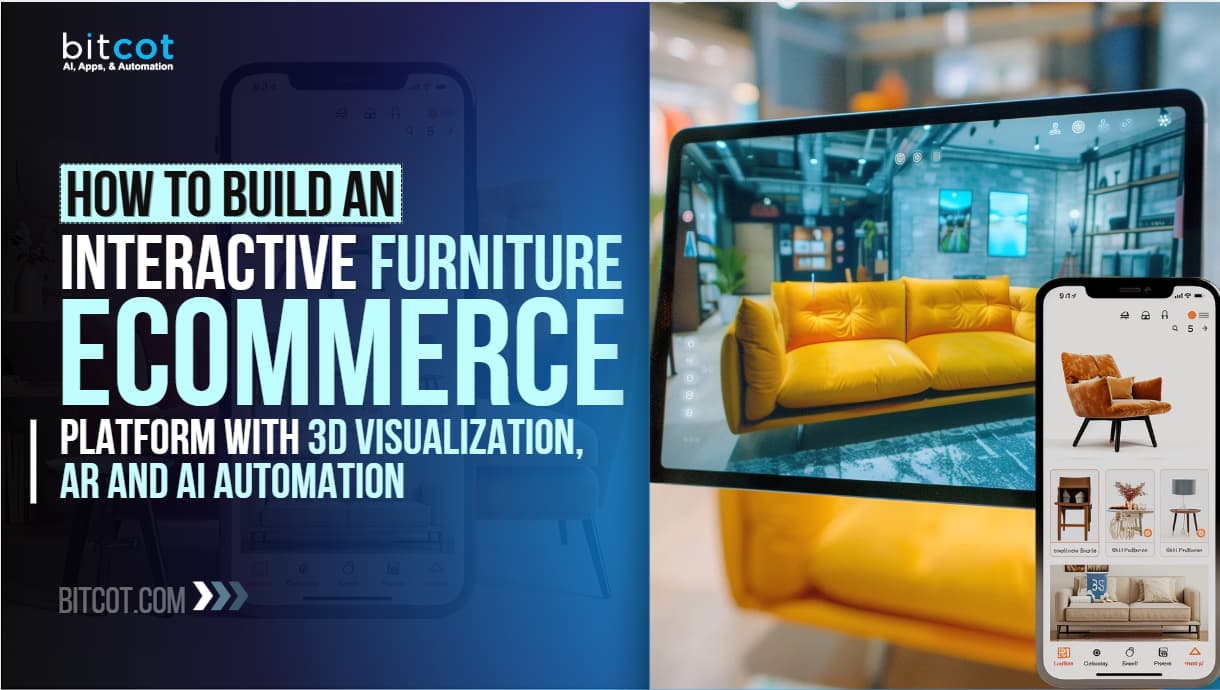
Today, the “I hope this fits” phase of furniture shopping is officially over.
For business leaders in the home furnishings space, this isn’t just a consumer convenience; it’s a massive shift in the bottom line.
We’ve all seen the data: the traditional 2D eCommerce model is hit with high return rates and “decision paralysis” from customers. When a buyer can’t visualize how a $3,000 sectional scales in their specific living room, they don’t buy. Or worse, they buy, realize it doesn’t fit, and cost your company a fortune in reverse logistics.
The competitive edge has shifted from inventory volume to experience confidence. By integrating 3D Visualization, Augmented Reality (AR), and AI Automation, you are effectively removing the friction that kills conversions.
Why this matters for your strategy:
- Drastic Return Reduction: High-fidelity AR allows customers to “test drive” furniture in their own space, ensuring the scale and color are right before the truck ever leaves the warehouse.
- Increased Average Order Value (AOV): AI-driven recommendation engines can analyze a user’s uploaded room photo to suggest complementary pieces, turning a single chair purchase into a full-room set.
- Scalable Personalization: AI automation handles everything from real-time stock updates to 24/7 design consultations, allowing you to scale without a linear increase in headcount.
In this guide, we’ll walk you through how to build an interactive furniture eCommerce platform that combines 3D visualization, AR, and AI automation. Whether you’re a startup looking to disrupt the market or an established retailer aiming to elevate your digital presence, these strategies will help you create a shopping experience that’s engaging, intuitive, and downright irresistible.
What is an Interactive Furniture eCommerce Platform?
In the traditional eCommerce model, a digital storefront is essentially a static catalog. For high-consideration purchases like a $4,000 mahogany dining set or a modular sectional, this model often fails because it leaves too much to the customer’s imagination.
An interactive furniture eCommerce platform solves this by shifting from a passive viewing experience to an active, immersive one. It is a digital shopping environment designed to engage users through advanced technologies that make online furniture shopping intuitive, immersive, and personalized.
Unlike traditional eCommerce sites that rely on static images and basic product descriptions, interactive platforms allow customers to explore furniture in three dimensions. Users can rotate, zoom, and view products from every angle, giving them a realistic sense of size, texture, and style.
Many platforms also incorporate augmented reality, enabling shoppers to place furniture in their own space using a smartphone or tablet. This helps them visualize how a sofa, table, or chair will fit in their home before making a purchase.
Another key component of these platforms is AI automation. From personalized product recommendations to automated inventory management and dynamic pricing, AI helps businesses streamline operations while offering a tailored shopping experience for each customer.
In short, an interactive furniture eCommerce platform combines technology, design, and intelligence to bridge the gap between online and offline shopping. It transforms browsing into an engaging experience, reduces purchase hesitation, and increases the likelihood of conversion, making it a powerful tool for furniture retailers aiming to grow in the digital age.
For a business leader, this platform isn’t just a “feature update.” It is a fundamental shift in unit economics. By providing total clarity before the “Buy” button is clicked, you are directly targeting the two biggest drains on furniture profitability: abandoned carts and logistics-heavy returns.
| Emerging Technology | What It Does | How It Improves the Shopping Experience | Business Impact |
|---|---|---|---|
| 3D Product Visualization | Enables customers to view furniture in interactive 3D, rotate models, and zoom into details | Gives a realistic understanding of size, form, and design | Increases conversions and reduces returns |
| Augmented Reality (AR) | Allows users to place furniture virtually in their own space using mobile or web-based AR | Helps customers see how products fit in real environments | Builds buyer confidence and lowers purchase hesitation |
| AI-Powered Personalization | Analyzes user behavior to recommend relevant products and collections | Creates tailored shopping journeys instead of generic browsing | Boosts engagement and average order value |
| Intelligent Search (AI-Driven) | Uses machine learning to understand the intent and context behind searches | Helps users find the right furniture faster | Reduces friction and improves discovery |
| AI Automation for Operations | Automates inventory updates, pricing rules, and order workflows | Ensures product availability and accurate pricing | Improves operational efficiency and scalability |
| Real-Time Product Configuration | Updates 3D models instantly when users change materials, colors, or finishes | Makes customization interactive and transparent | Supports premium and made-to-order offerings |
Why Interactive eCommerce Matters for Furniture Brands
Furniture is one of the hardest categories to sell online.
Customers are making high-value decisions based on size, style, comfort, and fit, all without physically seeing or touching the product. When brands rely only on static images and text, uncertainty creeps in, and that hesitation often leads to abandoned carts or returns.
Interactive eCommerce directly addresses this challenge.
For business leaders, the move toward an interactive platform isn’t about chasing an eCommerce tech trend; it is a clinical response to the specific economic pressures of high-ticket retail.
When you move beyond static images, you aren’t just “updating your site”; you are fundamentally re-engineering your sales funnel.
Solving the High-Cost Return Crisis
Returns are the single biggest drain on furniture margins. Shipping a returned sofa isn’t just a lost sale; it is a logistical nightmare involving two-way freight, potential transit damage, and restocking labor.
- The Data: Brands implementing 3D and AR see return rate reductions of up to 40%.
- The Cause: Most returns happen because of “misfit”; the scale was wrong, the fabric clashed, or the color didn’t match the lighting. Interactive tools allow customers to verify these variables in their own space before the checkout button is even clicked.
Radical Conversion Lift
Furniture is a high-consideration purchase. The longer a customer spends wondering if a piece will work, the more likely they are to talk themselves out of the purchase.
- Real-World Impact: Retailers like Home Depot and IKEA have reported conversion increases of 200% when 3D and AR tools are present.
- The Logic: Interactivity builds “buyer’s confidence.” When a customer can rotate a chair 360 degrees and zoom into the 4K texture of the leather, the digital experience finally rivals the tactile reassurance of a physical showroom.
Boosting Average Order Value (AOV)
An interactive platform doesn’t just sell one item; it sells the whole room.
- Strategic Upselling: By using AI-driven configuration, you can show a customer how a rug, lamp, and coffee table look alongside their chosen sofa.
- Modular Sales: Interactive platforms allow users to build modular sets in real-time. When customers can see the price and visual impact of adding that extra ottoman or chaise lounge instantly, they are significantly more likely to increase their basket size.
Future-Proofing for a New Demographic
Gen Z and Millennials make up the core of the home-buying market. This demographic is “digitally native” and increasingly avoids traditional high-pressure showroom environments. Over 90% of these shoppers express a preference for brands that offer AR tools. Providing an interactive experience is now the price of entry to earn the loyalty of the next generation of homeowners.
Key Features to Include in Your Furniture Platform or Website
Building a high-performance interactive platform requires more than just “adding 3D.”
To drive actual business results, the features must be integrated into the user journey in a way that feels seamless and intuitive.
For leadership, the goal is to prioritize features that offer the highest return on engagement and data collection.
Here are the non-negotiable features for a competitive furniture platform:
1. Photorealistic 360-Degree Product Configurator
Static images show a product; a configurator lets the customer “own” it. This feature should allow users to swap materials, colors, and hardware in real-time.
- The Business Value: It reduces the need for expensive photoshoots of every single SKU variation. One high-quality 3D “master model” can generate thousands of digital permutations.
- Critical Detail: Use physically based rendering (PBR) materials to ensure that velvet looks soft and oak looks grainy, matching the real-world product exactly.
2. App-Less WebAR (Augmented Reality)
The biggest friction point in AR is forcing a customer to download an app. Web-based AR (WebAR) allows users to launch a “view in my room” experience directly from their mobile browser.
- The Business Value: Lowering the barrier to entry increases tool usage by up to 3x.
- Scale Accuracy: Ensure the AR tool uses LiDAR (on supported devices) or SLAM technology to ensure the furniture is placed with 1:1 scale accuracy, preventing the “it looked smaller on my phone” complaint.
3. AI-Powered “Room Scanner” and Interior Designer
Advanced platforms now allow users to upload a photo or scan their room. AI then analyzes the existing floor plan, lighting, and style.
- The Business Value: This enables “Hyper-Personalization.” The AI can automatically suggest a mid-century modern coffee table because it “sees” the customer’s existing mid-century lounge chair.
- Automation: AI agents can handle the technical work of calculating whether a king-sized bed will actually fit given the room’s dimensions and door clearance.
4. Interactive “Exploded” Views and Hotspots
Furniture is an investment in quality. Use interactive hotspots to highlight the “unseen” value of a piece.
- The Business Value: Clicking a hotspot on a sofa might reveal a 3D cross-section of the kiln-dried hardwood frame or the 8-way hand-tied springs. This justifies premium pricing by proving the build quality that a 2D photo cannot communicate.
5. Instant Multi-Device Synchronization
High-consideration purchases often start on a mobile device (discovery) and end on a desktop (finalizing/payment).
- The Business Value: A “Send to Desktop” or “Save to Room” feature ensures the customer doesn’t lose their 3D configuration when they switch devices. This persistence is key to reducing cart abandonment during the 7 to 14-day decision window common in furniture retail.
6. Intelligent Inventory and Dynamic Pricing
An interactive platform must be “aware” of your supply chain to prevent customer frustration.
- Stock-Sync Automation: If a specific upholstery fabric is delayed at a mill in Italy, the AI automatically updates the 3D configurator to show a “Lead Time: 12 Weeks” warning or hides the option entirely.
- Dynamic Bundling: Automation engines can detect when a customer is building a “set” in the 3D planner and trigger a real-time discount (e.g., “Add these two nightstands to your bed configuration for 15% off”) to close the sale instantly.
Building an interactive furniture eCommerce platform requires more than adding visual enhancements. The right features must work together to improve customer confidence, streamline operations, and support long-term business growth.
Technology Architecture for an Online Furniture Store or Marketplace
For business leaders, the technical architecture isn’t just about “code”; it is about building a system that is scalable, fast, and cost-effective. A poorly designed stack will result in slow page loads and high bounce rates, while a robust architecture ensures that complex 3D models load as quickly as a standard JPEG.
Here is the high-level blueprint for a modern, interactive furniture stack:
1. The Frontend: WebGL and Real-Time Rendering
To provide 3D experiences directly in the browser without plugins, you need a framework that talks to the user’s graphics card.
- Three.js / React Three Fiber: This is the industry standard for rendering 3D on the web. It allows for “Photorealistic Rendering” that adjusts to lighting and shadows in real-time.
- WebGPU: For forward-thinking brands, WebGPU is the next evolution, offering even higher performance for complex textures like grain patterns in wood or weave in upholstery.
2. Asset Management: The 3D Pipeline
You cannot treat 3D models like standard images. They require a specialized “Content Delivery Network” (CDN) and specific file formats.
- Universal File Formats: You must support GLB/GLTF (the “JPEG of 3D” for web/Android) and USDZ (the format required for Apple’s Quick Look AR).
- Optimization Layer: Large 3D files can be 50MB+, which is unacceptable for mobile. Use “Mesh Compression” (like Draco) to shrink files down to 2–5MB without losing visual detail. This optimization is essential for 3D furniture visualization for eCommerce to perform seamlessly across devices.
3. The Backend: Headless Commerce Integration
A headless architecture separates your frontend (the 3D experience) from your backend (inventory, pricing, and checkout).
- API-First Design: This allows your 3D configurator to pull real-time data. If an “Oak” finish goes out of stock, the 3D toggle should automatically grey out.
- Scalability: Using platforms like Shopify Plus, BigCommerce, or Commercetools via APIs ensures that your interactive features don’t break when your traffic spikes during a holiday sale.
4. The AI Layer: Computer Vision and LLMs
The “AI” in your platform should be split into two distinct functional areas:
- Computer Vision: This powers the AR “Room Scan.” It identifies floor planes, wall boundaries, and existing furniture to ensure your 3D sofa doesn’t clip through a real-world coffee table.
- Vector Databases: To provide personalized recommendations, your AI needs to “understand” your catalog. By using vector embeddings, the AI can recognize that a customer looking at “industrial-style” desks would also like “Edison-bulb” floor lamps. These AI-powered furniture recommendations drive higher engagement and conversion rates.
5. Deployment, Edge Computing, and AI Design Intelligence
To minimize latency (lag), 3D assets should be served from the “Edge.”
- Edge Delivery: This places your heavy 3D files on servers physically closer to your customer.
- Cloud Rendering: For ultra-high-end “Virtual Showrooms,” some brands use cloud streaming (like Pixel Streaming), where the heavy lifting is done on a powerful server and streamed to the user’s phone like a Netflix video.
- AI Design Agents: Use LLMs trained on your product specs to answer complex spatial questions in real-time, such as, “Will this sectional fit if I have a radiator in the corner?”
- Marketing Asset Automation: Use your 3D assets to automatically generate thousands of AI-rendered “lifestyle” images in different room styles, eliminating the need for expensive, manual photoshoots.
6. Sales-to-Production Automation (The “Quote-to-Order” Bridge)
This is where the platform pays for itself by removing human error from the manufacturing process.
- Automated CAD Generation: Once a customer finalizes a custom 3D configuration, the platform can automatically generate technical CAD drawings or “shop drawings” for your production team.
- Instant Quote Automation: Instead of waiting for a sales rep to “get back to them,” customers receive an immediate, accurate quote for their custom configuration, cutting design-to-order cycles by up to 70% through automated quote generation.
A successful interactive furniture eCommerce platform is built on a flexible, scalable technology architecture. The goal is not just to adopt advanced features like 3D, AR, and AI, but to ensure they integrate seamlessly with core business systems and support future growth.
How to Build an Interactive Furniture eCommerce Platform in 7 Steps
Building an interactive furniture eCommerce platform requires a structured approach that balances customer experience, technology, and business outcomes.
For business leaders, the focus should be on creating a platform that is scalable, measurable, and aligned with long-term growth objectives.
Step 1: Define Business Goals and Success Metrics
Start by identifying what success looks like for your platform. This may include improving conversion rates, reducing product returns, increasing average order value, or expanding into new markets. Clear goals help guide technology decisions and ensure that investments in 3D, AR, and AI deliver measurable returns. Whether you’re planning furniture ecommerce website development or a mobile solution, defining KPIs upfront is critical.
Step 2: Design the Customer Experience
Map the end-to-end customer journey, from product discovery to post-purchase engagement. Identify where interactive elements such as 3D visualization, AR placement, and personalized recommendations add the most value. A strong user experience strategy ensures these features enhance the buying journey rather than complicate it. For businesses exploring furniture store app development, mobile-first design becomes especially important.
Step 3: Prepare High-Quality Product Data and Assets
The foundation of your platform is quality. Interactive experiences rely heavily on accurate and consistent product data. This includes detailed specifications, pricing, inventory levels, and high-quality 3D models. Investing early in clean data and standardized asset creation reduces future rework and supports scalability across product lines.
Step 4: Select the Right Technology Stack
Choose technologies that align with your business size, growth plans, and internal capabilities. This includes frontend frameworks, 3D and AR tools, backend commerce platforms, AI services, and cloud infrastructure. Prioritize flexibility and integration capabilities so the platform can evolve as your business needs change. If you aim to build an online furniture marketplace, selecting modular, API-first technologies will be essential.
Step 5: Build and Integrate Core Platform Components
Develop the frontend, backend, and integration layers in parallel where possible. Ensure that 3D viewers, AR features, AI models, and commerce workflows are fully integrated with product catalogs, inventory systems, and payment gateways. Seamless integration is key to delivering a consistent customer experience. Seamless integration is key to delivering a consistent customer experience across your online furniture shop.
Step 6: Test Performance, Usability, and Accuracy
Thorough testing is critical before launch. Validate that 3D and AR experiences perform well across devices, that AI recommendations are relevant, and that pricing and inventory data are accurate. Testing should also include load performance and security checks to ensure the platform can handle real-world usage.
Step 7: Launch, Monitor, and Optimize
Before the rollout, focus on performance metrics that impact the bottom line. After launch, monitor key metrics such as engagement, conversions, and returns. Use analytics and AI insights to continuously optimize product presentations, recommendations, and workflows. An interactive platform is not a one-time build but an evolving system.
Cost Factors in Interactive Furniture eCommerce Platform Development
The cost of building an interactive furniture eCommerce platform varies widely depending on the level of interactivity, scale, and integration required.
For business leaders, understanding the major cost drivers helps in setting realistic budgets and making informed investment decisions.
Scope and Feature Complexity
The overall scope of the platform is the primary cost driver. A basic interactive experience with 3D product viewers will cost significantly less than a platform that includes AR placement, real-time customization, and AI-driven personalization. Each additional feature increases development effort, testing requirements, and long-term maintenance costs. When planning furniture eCommerce platform development, it’s essential to prioritize features that align with your target market and business objectives.
3D Modeling and AR Asset Creation
High-quality 3D models are essential for realistic visualization and AR experiences. Costs depend on the number of products, level of detail, and whether models need to support customization options such as fabric or finishes. For large catalogs, brands should consider phased rollouts or prioritizing best-selling products to manage costs effectively.
Technology Stack and Licensing
The choice of technologies has a direct impact on the budget. Open-source frameworks can reduce upfront costs, while commercial AR SDKs, AI platforms, or analytics tools may involve licensing or usage-based fees. Cloud infrastructure costs also scale with traffic, data storage, and compute requirements.
Backend Development and Integrations
Integrating the interactive furniture eCommerce platform with existing systems such as ERP, CRM, inventory management, and logistics platforms adds complexity and cost. Custom integrations require careful planning to ensure data accuracy and system reliability, especially for brands with legacy systems.
AI and Automation Capabilities
AI features such as personalized recommendations, intelligent search, and demand forecasting require data pipelines, model training, and ongoing optimization. Initial development costs are often followed by recurring expenses for model updates, data processing, and monitoring to ensure accuracy and relevance.
Performance, Security, and Compliance
Investing in performance optimization and security is critical for protecting customer data and maintaining trust. Costs in this aspect may include penetration testing, compliance requirements, encryption, and monitoring tools. These investments help avoid costly breaches or downtime in the long run.
Ongoing Maintenance and Optimization
Post-launch costs are often underestimated when building an eCommerce platform. Regular updates, bug fixes, feature enhancements, and content updates are required to keep the platform competitive. AI models and interactive features also need continuous tuning based on customer behavior and business goals.
Partner with Bitcot to Build Your Custom Interactive Furniture Platform
Building an interactive furniture eCommerce platform requires more than technical execution. It demands a partner who understands business objectives, customer experience, and the complexity of integrating advanced technologies at scale.
This is where Bitcot comes in.
At Bitcot, we specialize in designing and building custom eCommerce platforms that combine 3D visualization, augmented reality, and AI automation into a seamless digital experience. Our expertise in custom furniture eCommerce development ensures that every solution is tailored to your unique business requirements and growth trajectory.
Our approach starts with understanding your business goals, whether that is increasing conversions, reducing returns, improving operational efficiency, or creating a differentiated brand experience.
We work closely with your leadership and product teams to define a clear roadmap, select the right technology stack, and prioritize features that deliver measurable value. From high-performance frontend experiences to scalable backend architectures and intelligent automation, our solutions are built to grow with your business.
Bitcot’s experience across eCommerce, AI-powered applications, and enterprise software enables us to integrate your platform with existing systems such as ERP, CRM, inventory management, and logistics providers. This ensures your interactive platform is not just visually impressive but also operationally sound.
Most importantly, we focus on long-term partnership. After launch, we continue to support optimization, feature enhancements, and performance improvements based on real user data. The result is an interactive furniture platform that drives engagement, builds trust, and delivers sustainable business impact.
If you are looking to move beyond traditional online catalogs and create a truly immersive, intelligent furniture shopping experience, partnering with Bitcot gives you the expertise and execution needed to make it happen.
Final Thoughts
In the world of high-end furniture, the “buy now” button has always been a bit of a leap of faith.
But as we’ve seen throughout this guide, that’s no longer the case. We are entering an era where the digital showroom is actually more informative than the physical one.
When you strip away the flashy 3D visuals and the “cool factor” of AR, what you’re left with is a fundamentally better business model. It’s a model that respects the customer’s time, eliminates the anxiety of a “misfit” purchase, and protects your margins by killing the return cycle before it even starts.
For business leaders, the transition to an interactive platform is a “when,” not an “if.” The technology has finally caught up with the vision:
- 3D provides the detail.
- AR provides the context.
- AI Automation provides the scale.
Building this isn’t just about keeping up with the competition; it’s about setting a new standard for how people furnish their lives. It’s about moving from being a vendor to becoming a trusted design partner in every customer’s pocket.
Navigating the complexities of spatial computing and AI integration requires a partner who knows how to turn technical potential into actual revenue. At Bitcot, we specialize in custom eCommerce development services that bridge the gap between imagination and reality.
Whether you’re looking to digitize your first 100 SKUs or build a fully autonomous AI design assistant, our team is ready to engineer your competitive edge.
Get in touch with us!
Frequently Asked Questions (FAQs)
Is an interactive furniture eCommerce platform only suitable for large brands?
Not at all. Brands of all sizes across markets like New York, Los Angeles, Chicago, Houston, and Phoenix use interactive platforms to improve customer confidence, stand out digitally, and scale without adding physical showrooms.
How long does it take to build an interactive furniture eCommerce platform?
Timelines vary based on features and integrations, but most projects roll out in phases. Businesses in Philadelphia, San Antonio, San Diego, Dallas, Jacksonville, and Fort Worth often start with core eCommerce and add 3D, AR, and AI features incrementally.
Do 3D and AR features work well on mobile devices?
Yes, absolutely. Modern platforms are optimized for mobile-first experiences, which is critical for customers shopping on the go in cities like San Jose, Austin, Charlotte, Columbus, Indianapolis, and San Francisco.
How does AI automation add real business value beyond personalization?
AI supports smarter inventory planning, demand forecasting, and operational efficiency. Furniture brands in Denver, Boston, Seattle, Washington, D.C., Nashville, and Portland use AI to reduce manual effort and make faster, data-driven decisions.
Can interactive eCommerce platforms scale across regions and logistics networks?
Absolutely. With the right cloud architecture and integrations, platforms scale smoothly across diverse markets such as Las Vegas, Miami, Anchorage (Alaska), Kansas City, and Ashburn, while maintaining consistent performance and customer experience.