Key Takeaways:
- 88% of organizations now use AI in at least one business function, with Fortune 500 adoption even higher, per McKinsey’s 2025 State of AI report
- Gartner projects $2.52 trillion in global AI spending for 2026 – a 44% jump year-over-year
- Agentic automation has replaced simple RPA as the new enterprise standard
- The top platforms (UiPath, Automation Anywhere, Microsoft, Salesforce, ServiceNow) now combine AI agents with orchestration and governance
- Process intelligence before automation is the winning playbook for 2026
- The right implementation partner is the difference between a stalled pilot and enterprise-wide scale
What if 80% of Fortune 500 companies are already running active AI agents in production – not because they’re experimenting, but because those who didn’t act are losing ground fast?
That’s not a prediction. It’s today’s reality, backed by Microsoft’s latest enterprise telemetry data. So what’s actually driving this shift, and why does it matter so urgently right now?
And the companies that didn’t? They’re bleeding millions every quarter from manual workflows, siloed systems, and preventable human error.
While market leaders automate intelligently – boosting efficiency by 40-60% – too many enterprises are still stuck with legacy operations that choke innovation and drag down performance.
Here’s the truth: companies that don’t aggressively scale AI automation in 2026 won’t just fall behind. They’ll be left behind.
Forward-thinking organizations are already partnering with us at Bitcot, leveraging enterprise-grade AI solutions that integrate fast, comply with strict security standards, and deliver ROI in months.

This guide breaks down the top 25 AI automation tools transforming the Fortune 500 landscape in 2026. Whether you’re a CEO sharpening your competitive edge or a CTO hunting for scalable, secure platforms, this list gives you the clarity to move fast – and smart.
Why Is AI Automation Non-Negotiable for Fortune 500 Companies in 2026?
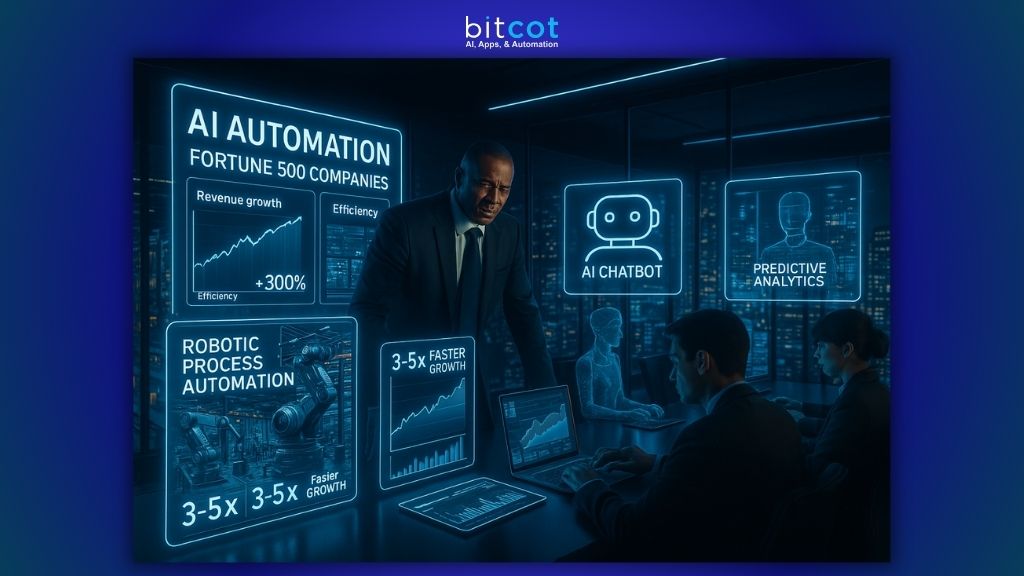
The game has changed. What used to take hundreds of employees can now be handled by a digital workforce of AI tools running nonstop. No breaks. No errors. No sick days.
For Fortune 500 companies, AI automation isn’t a nice-to-have. It’s survival.
McKinsey data backs this up: sectors with high AI exposure in the United States and globally show three times higher revenue growth per worker compared to those slower to adopt. This isn’t just about cutting costs. It’s about hyperautomation – reinventing how business happens at scale.
Top Fortune 500s focus on three big wins from AI automation:
- Boosting operational efficiency by optimizing processes across departments
- Reducing costs through intelligent automation of repetitive, rule-based tasks
- Accelerating innovation by freeing talent to focus on high-value, strategic work
That said, Gartner notes that in 2026 AI sits in the “Trough of Disillusionment” – meaning enterprises are shifting from speculative pilots to investments with measurable, predictable ROI. The companies winning right now aren’t betting on moonshots. They’re scaling what works.
The numbers still speak for themselves.
Gartner projects worldwide AI spending will total $2.52 trillion in 2026, with AI infrastructure alone adding $401 billion. The four largest tech hyperscalers in the USA (Alphabet, Amazon, Meta, and Microsoft) plan to spend a combined $650 billion on AI infrastructure this year.
AI is no longer the fastest-growing segment of enterprise tech. It’s now the foundation.
Why are enterprises investing so aggressively? Because manual processes just don’t cut it at enterprise scale anymore. Leaders face pressure from all sides. Customers expect instant, personalized service. Regulations keep getting tougher. Hiring top talent is more expensive than ever.
Relying on humans for routine work is becoming a costly risk.
AI automation tackles these problems all at once. Customer service bots handle thousands of inquiries per hour. Compliance tools monitor regulations in real-time. Predictive analytics spot market opportunities before the competition even notices.
As of 2025, 88% of organizations use AI in at least one business function, according to McKinsey’s State of AI report. Among Fortune 500 companies specifically, that share is even higher – and 62% of organizations are already experimenting with or actively deploying AI agents, with roughly a quarter scaling them across at least one function.
The global AI agent market alone is projected to grow from $7.84 billion in 2025 to over $52 billion by 2030, at a CAGR of 46.3%.
The question is no longer should we automate? It’s how fast can we scale?
Knowing the urgency is one thing. Knowing which tools to actually bet on is another. That’s exactly what the next section addresses.
How Do Fortune 500 Companies Choose the Right AI Automation Tools?
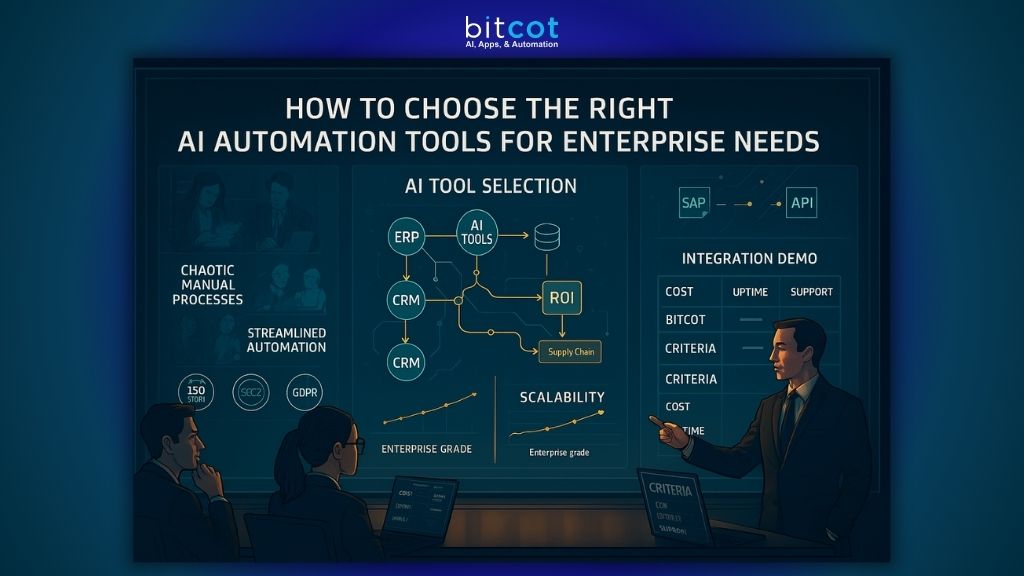
When you’re operating at Fortune 500 scale, the stakes of a wrong tool choice are measured in millions: wasted integration work, stalled adoption, and missed ROI windows. So how do you cut through the noise? It’s a strategic process that balances what you need now with what you’ll need down the road.
When evaluating tools, we always advise clients to start by auditing current workflows. Where are the bottlenecks? Which tasks drain resources but don’t add strategic value?
Those are your low-hanging fruit. Automation here delivers fast ROI with less risk.
When evaluating tools, focus on enterprise essentials:
Scalability and Integration – Can the tool handle enterprise-scale volumes and support enterprise AI integration with your existing ERP, CRM, and legacy systems without massive rework?
AI and Agentic Capabilities – In 2026, the bar has moved beyond simple rule-based automation. Look for platforms that support agentic automation – AI agents that can reason, plan, and execute multi-step tasks autonomously, not just follow scripts.
Security and Compliance – Fortune 500 companies operate in heavily regulated environments. Your tools must meet SOC 2, ISO 42001, FedRAMP, GDPR, and industry-specific standards.
Governance and Observability – With 78% of executives saying they need to reinvent operating models for agentic automation, governance-as-code, audit trails, and centralized control planes are now table stakes.
Vendor Ecosystem and Support – Look for platforms with strong partner ecosystems, pre-built connectors, and reliable enterprise support.
Fortune 500 companies can’t afford shortcuts or unreliable vendors. At Bitcot, we specialize in AI automation for large organizations, helping ensure tools fit seamlessly into existing ecosystems while keeping security and compliance a top priority.
With those principles in mind, here are the tools that are actually delivering results at scale in 2026.
Top 25 AI Automation Tools for Fortune 500 Companies in 2026
Not every automation tool belongs in every enterprise stack. Some platforms are built for end-to-end orchestration across thousands of workflows. Others specialize in a single function like document processing, conversational AI, or predictive analytics and do it exceptionally well.
What separates the tools on this list from the noise is simple: proven enterprise adoption, active development in 2025 and 2026, and the ability to scale without breaking under the weight of Fortune 500 complexity.
We’ve organized this list to reflect how enterprises actually build automation stacks. It starts with the platform leaders that anchor most deployments, moves through the cloud infrastructure layer, then into specialized tools for intelligence, integration, and department-specific use cases. Each tool is evaluated on its current capabilities, not promises.
One more thing worth noting before you dive in: no single tool on this list does everything. The enterprises getting the best ROI in 2026 aren’t chasing an all-in-one solution. They’re building a deliberate stack of a few core platforms, tightly integrated, with clear ownership and governance. That’s the model we help our clients build, and it’s the lens through which this list is written.
1. UiPath
UiPath dominates the enterprise automation market with its comprehensive Agentic Automation Platform. It goes far beyond traditional RPA.
In fiscal year 2026, UiPath reported ARR of $1.78 billion (up 11% year-over-year) and revenue of $411 million in Q3 alone (up 16% YoY) – with its first-ever GAAP profitable quarter. The platform now unifies AI agents, robots, and people through AgentBuilder and Maestro orchestration.
- Agentic automation platform combines traditional RPA with autonomous AI agents that handle complex, non-deterministic tasks across departments
- Maestro AI orchestration coordinates multi-agent workflows with enterprise-grade governance, having orchestrated over 11,000 process instances since launch
- AI-powered document processing through Intelligent Document Understanding extracts and processes information from unstructured documents using advanced ML and OCR
- Process mining analyzes workflow patterns to identify automation opportunities and optimize existing business processes for maximum efficiency
- Vendor-agnostic architecture integrates with any AI framework including OpenAI, Google Gemini, Azure AI Foundry, Anthropic, and NVIDIA
2. Automation Anywhere
If UiPath owns the agentic automation conversation, Automation Anywhere owns the cloud-native one. Trusted by Fortune 500 companies worldwide, the platform earned AWS Generative AI Competency in 2025 and was rated Exemplary in the 2026 ISG Buyers Guide for Automation and Orchestration Platforms.
- Cloud-native architecture reduces IT maintenance with automatic updates and streamlined deployment across global enterprise environments
- AI-powered bot creation with generative AI capabilities enables intelligent, context-aware workflows that go beyond simple scripted automation
- Enterprise-grade integration connects seamlessly with SAP, Oracle, Microsoft 365, Salesforce, and ServiceNow, while supporting legacy system connectivity
- Centralized Control Room oversees bot deployment, scheduling, and monitoring, ensuring efficient governance and compliance across the enterprise
- Consumption-based pricing models allow organizations to scale automation investments in line with actual business outcomes
3. Microsoft Power Platform (Power Automate + AI Builder + Copilot Studio)
Microsoft Power Platform has become the most widely deployed enterprise automation ecosystem, backed by a $3.6 trillion market cap. Over 97% of Fortune 500 companies already use Microsoft products, making this the dominant choice for organizations in the Microsoft ecosystem.
- AI Builder creates predictive analytics models and intelligent bots without requiring data science expertise, directly embedded in business workflows
- Copilot Studio empowers enterprises to build sophisticated conversational AI agents within their existing Microsoft ecosystem with built-in governance
- Power Automate connects across 1,000+ connectors to automate workflows across departments, from simple approval chains to complex multi-system orchestration
- Deep integration with Azure AI services, including Azure OpenAI Service, enables enterprises to build custom AI solutions with enterprise security and compliance
- Pricing starts at $15/user/month standalone or is included with Microsoft 365 subscriptions, lowering barriers to adoption
4. Salesforce Einstein (now Agentforce)
Salesforce Einstein – rebranded and expanded under the Agentforce umbrella – integrates AI directly into the world’s leading CRM platform. The AgentExchange marketplace now offers pre-built AI agents from Salesforce and trusted partners.
- Predictive lead scoring analyzes customer behavior patterns to identify high-value prospects and optimize sales team focus with AI-driven precision
- Agentforce agents handle customer service, lead qualification, case summarization, and sales forecasting autonomously within the Salesforce environment
- Einstein Trust Layer provides built-in data masking, toxicity detection, and auditing for secure enterprise AI deployment
- Automated workflow management streamlines repetitive tasks and ensures consistent follow-up processes across sales cycles
- Industry-specific AI agents are available for verticals like finance, healthcare, and retail, built by partners with deep domain expertise
5. ServiceNow (Now Assist + Flow Designer)
ServiceNow has cemented its position as a leader in enterprise workflow automation, earning top rankings in ISG’s Intelligent Automation assessment. The $2.85 billion Moveworks acquisition in 2025 – the largest in ServiceNow’s history – signals an aggressive push into agentic AI.
The combined platform now serves over 5.5 million employee users worldwide.
- Now Assist brings generative AI to enterprise service management, automatically categorizing, prioritizing, and routing support requests based on content and urgency
- Flow Designer provides an intuitive drag-and-drop interface for creating automated processes across IT, HR, customer service, and procurement without coding
- Moveworks integration adds a front-end AI assistant, enterprise search, and agentic Reasoning Engine to ServiceNow’s backend workflow automation
- Intelligent case summarization provides concise overviews of complex support interactions for faster agent handoffs and knowledge sharing
- Cross-platform integration connects seamlessly with third-party applications through pre-built connectors and APIs across multiple enterprise systems
Those are the platform leaders – the tools most Fortune 500 companies anchor their automation strategy around. But platforms only execute as well as the infrastructure powering them. That’s where the cloud heavyweights come in, bringing raw AI infrastructure that the tools above are built on top of.
6. Google Cloud AI Platform (Vertex AI + Gemini)
Google Cloud AI Platform excels in multimodal AI capabilities following the launch of Gemini 3 in November 2025, with Gemini 3 Flash added in December 2025 for speed-focused enterprise workflows.
- Vertex AI provides end-to-end ML development tools for building, training, and deploying AI models at scale across enterprise applications
- Gemini 3 (launched November 2025) features Pro, Flash, and Deep Think mode – multimodal capabilities that process text, images, video, and audio simultaneously, with a context window of over one million tokens
- AutoML simplifies model creation for business users without deep ML expertise, accelerating time-to-value for enterprise AI initiatives
- Deep Google Workspace integration streamlines information retrieval and enhances productivity with real-time web access for decision-making
- Enterprise-grade security with comprehensive data governance tools ensures compliance with regulatory requirements across industries
7. AWS SageMaker + Bedrock
When Fortune 500 companies need to build AI from scratch – not just plug into a platform – AWS is where most of them start. Bedrock has become the go-to for building generative AI applications with serverless access to foundation models from leading providers.
- SageMaker offers a fully managed environment for building, training, and deploying ML models at scale with enterprise-grade security
- Bedrock provides serverless access to foundation models from Anthropic, Meta, Mistral, and Amazon’s own Titan models, enabling custom AI agent development
- Pre-built AI services cover common enterprise needs including natural language processing, computer vision, and predictive analytics
- Deep integration with the broader AWS ecosystem connects AI capabilities with data lakes, analytics, and enterprise applications
- FedRAMP and HIPAA compliance makes it suitable for highly regulated industries including government, healthcare, and financial services
8. Microsoft Power BI (AI-Enhanced)
Data without visibility is just noise. Microsoft Power BI turns enterprise data into decisions through AI-powered business intelligence. Native Copilot integration now enables natural language querying and AI-generated insights directly within dashboards.
- AI-powered analytics automatically surface insights, anomalies, and trends from large datasets, reducing time spent on manual data exploration
- Natural language querying through Copilot lets business users ask questions in plain English and receive instant visual answers
- Real-time dashboards and automated reporting keep decision-makers informed with up-to-the-minute data across the organization
- Deep integration with the Microsoft ecosystem connects seamlessly with Power Automate, Azure, and Dynamics 365 for end-to-end intelligence
- Enterprise-scale data handling supports massive datasets with governance, row-level security, and compliance controls
9. Appian
Appian was recognized as a Leader in the 2025 Gartner Magic Quadrant for Enterprise Low-Code Application Platforms. Gartner ranked it #1 for Business Workflow Automation with Integration Use Case. It was also rated Exemplary in the 2026 ISG Buyers Guide for Process Intelligence.
- Low-code automation platform enables rapid application development and process automation, reducing development time by up to 80%
- AI Copilot delivers practical value to boost developer productivity with intelligent code suggestions and automated workflow building
- Process mining capabilities provide data-driven visibility into enterprise workflows, identifying inefficiencies and optimization opportunities
- Enterprise-grade governance with audit trails, version control, and compliance monitoring meets stringent Fortune 500 requirements
- Robust integration with legacy systems and modern cloud applications supports complex, multi-system automation at scale
10. Pegasystems (Pega)
Pegasystems delivers AI-powered solutions for customer engagement and process optimization, closing fiscal year 2025 with $1.75 billion in revenue and a 22.5% net profit margin, a sharp improvement driven by accelerating cloud adoption and AI-integrated workflows. Pega was rated Exemplary in the 2026 ISG Buyers Guide for Automation and Orchestration Platforms.
- AI-powered decisioning engine provides real-time next-best-action recommendations across sales, service, and marketing channels
- Process mining combined with task mining identifies end-to-end process variations and bottlenecks for targeted automation
- Low-code application development enables business users to build and modify applications without extensive coding knowledge
- Customer engagement automation personalizes interactions at scale, with proven deployments at global banks and telecommunications companies
- Unified platform spans process discovery, analytics, automation, and application development with built-in AI support
The platforms above handle execution well. But execution without visibility and intelligence is just automated chaos. The next five tools focus on the intelligence, integration, and orchestration layers that make automation actually work across complex enterprise environments.

11. Celonis
Celonis leads the process mining and execution management market, helping Fortune 500 companies discover and optimize actual business processes using real data. Not sure where to automate first? Celonis removes the guesswork.
- Process mining technology analyzes event logs from ERP, CRM, and other systems to create a digital twin of enterprise operations
- AI-powered process intelligence identifies bottlenecks, deviations, and automation opportunities with surgical precision
- Execution management connects insights directly to action, triggering automated workflows when process inefficiencies are detected
- Real-world impact includes manufacturing clients discovering 47 process variations instead of the documented 3, enabling targeted standardization
- Deep integrations with SAP, Oracle, Salesforce, and ServiceNow ensure compatibility with existing Fortune 500 tech stacks
12. Zapier (Enterprise / Teams)
Zapier has evolved from a simple app connector into an enterprise-grade automation platform with AI orchestration capabilities. With 8,000+ integrations and SOC 2 Type II compliance, it serves as the connective tissue between business applications.
- AI-powered Zap builder creates automations using natural language descriptions, dramatically reducing setup time for non-technical users
- AI Agents and Chatbots as add-ons enable building intelligent automation systems that go beyond simple trigger-action workflows
- App integration platform connects over 8,000 applications, covering virtually any business tool in the enterprise tech stack
- Enterprise features include centralized oversight, team collaboration, shared workflow management, and GDPR compliance
- Task-based pricing model offers flexibility, from a free tier for exploration to enterprise plans for large-scale deployment
13. Blue Prism (SS&C)
Blue Prism, now part of SS&C Technologies, remains a pioneer in enterprise-grade RPA with a strong focus on security, governance, and scalability – particularly in regulated industries like financial services and healthcare.
- Secure, centrally managed platform for deploying digital workers powered by AI, machine learning, and rule-based logic
- AI Skills Library and integration with Azure Cognitive Services enable intelligent decision-making beyond simple automation
- Decipher IDP (Intelligent Document Processing) provides built-in document processing with accurate OCR for automated data extraction
- Enterprise-wide governance with built-in compliance tooling meets audit-heavy industry requirements
- Cloud-based deployment option provides a full development environment with centralized controls for scaling bots across departments
14. Workato
Most automation tools connect apps. Workato orchestrates entire business functions. Built for enterprise IT, HR, finance, and operations teams, it blends deep integration with role-based AI agents for large-scale deployments.
- Enterprise integration platform with custom SDKs, prebuilt connectors, and advanced data mapping capabilities
- Role-based AI agents orchestrate complex workflows across IT, HR, finance, and operations
- Cross-department automation connects applications at enterprise scale with role-based access controls and governance
- AI-enhanced workflows enable intelligent routing, decision-making, and adaptive process management
- Enterprise-grade security and compliance certifications support deployment in regulated Fortune 500 environments
15. Microsoft Copilot Studio
Microsoft Copilot Studio empowers Fortune 500 companies to build sophisticated conversational AI solutions and autonomous agents within their existing Microsoft ecosystem. It’s central to Microsoft’s vision of agents as “the apps of the AI era.”
- Build custom AI copilots with connectors, grounding in enterprise data, and multi-step orchestration capabilities
- Deep integration with Microsoft 365, Dynamics 365, and Azure enables agents that operate across the entire Microsoft ecosystem
- Low-code/no-code agent building allows business users and developers alike to create production-ready AI agents
- Bidirectional integration with UiPath allows embedding enterprise automation directly into copilot workflows
- Enterprise-grade security, governance, and compliance with built-in Zero Trust principles and least-privilege access controls
So far, the list has covered broad automation platforms and the infrastructure layer beneath them. The next cluster gets more targeted, with tools purpose-built for specific functions like HR, developer workflows, and visual automation design where generic platforms often fall short.
16. Workday HCM
Workday HCM revolutionizes human capital management for Fortune 500 companies through AI-powered talent acquisition, workforce planning, and performance management. Struggling with the talent crunch? This addresses it head-on.
- AI-driven talent acquisition uses machine learning to match candidates with roles, reducing hiring costs by up to 30%
- Workforce planning and analytics leverage predictive models to forecast talent needs and optimize resource allocation
- Automated onboarding workflows streamline the employee experience from offer acceptance through first-day readiness
- Skills-based matching supports internal mobility and workforce development, helping enterprises retain top talent
- Comprehensive compliance management ensures adherence to labor laws and regulations across multiple jurisdictions
17. n8n
n8n has emerged as the leading open-source, developer-focused automation platform with LangChain integration for building custom AI agents. It’s the go-to for technical teams prioritizing data sovereignty and cost optimization.
- Self-hostable architecture gives enterprises complete control over data, critical for organizations with strict privacy requirements
- LangChain integration enables building sophisticated AI agents with custom code steps and advanced branching logic
- Open-source flexibility allows unlimited customization with no per-execution costs for self-hosted deployments
- Cloud option (starting at €24/month) provides managed infrastructure for teams that prefer not to self-host
- Developer-oriented design with AI nodes, webhooks, and API connectivity supports complex enterprise workflows
18. Make (formerly Integromat)
Make offers an advanced visual workflow builder for users who need more control than Zapier but less code than developer tools. It’s ideal for complex, multi-step automations with 3,000+ integrations.
- Visual scenario builder with branching logic and deep control over data mapping enables sophisticated automation design
- 3,000+ pre-built integrations covering enterprise applications, SaaS platforms, and custom APIs
- AI-powered workflow suggestions help users optimize and improve their automated processes
- Operations-based pricing starting at $10/month provides predictable costs with usage tiers for every scale
- Fully managed SaaS platform eliminates infrastructure management while maintaining enterprise-grade reliability
19. DataRobot
DataRobot automates the entire machine learning lifecycle. Build and deploy ML models in record time, turning raw data into actionable insights at enterprise scale.
- Automated machine learning streamlines data prep, feature engineering, and model selection, reducing months of work to days
- Enterprise-grade AI governance provides model monitoring, bias detection, and explainability for regulatory compliance
- Production deployment tools ensure ML models perform reliably in real-world enterprise environments
- Industry-specific solutions for healthcare, finance, and manufacturing address vertical use cases with pre-built templates
- Scalable platform allows organizations to move from proof-of-concept to company-wide AI deployment efficiently
20. Anthropic Claude (Enterprise API)
Anthropic’s Claude has become a foundational AI model for enterprise automation. The Claude 4.6 family – the latest generation as of early 2026, with Opus 4.6 and Sonnet 4.6 – builds on the 4.5 series (Opus, Sonnet, Haiku, released September through November 2025) to offer state-of-the-art reasoning, coding, and agentic capabilities used through the API for complex document processing, code generation, and autonomous workflows.
- Advanced reasoning capabilities handle complex multi-step enterprise tasks including analysis, summarization, and decision support
- Claude 4.6 model family (Opus 4.6 and Sonnet 4.6) alongside the proven 4.5 tier (Opus, Sonnet, Haiku) offers flexibility to match performance needs with cost optimization
- Enterprise-grade security with SOC 2 compliance, data handling controls, and no training on customer data
- Agentic capabilities through Claude Code and tool use enable autonomous task execution within governed enterprise workflows
- Deep integration with platforms like UiPath, AWS Bedrock, and custom enterprise applications
The final five round out the stack with specialized capabilities most enterprises overlook until a gap costs them. From open-source ML to conversational AI and employee support automation, these tools handle the use cases that fall between the cracks of the bigger platforms.
21. OpenAI (GPT-5 + Enterprise API)
GPT-5, released in August 2025, powers enterprise AI with approximately 700 million weekly active users at launch, a figure that reflects just how deeply OpenAI has embedded itself in both consumer and enterprise workflows. It’s the foundation behind a growing wave of AI agent platforms capable of reasoning, planning, and executing multi-step tasks.
- GPT-5 delivers advanced reasoning, planning, and multi-step task execution for complex enterprise use cases
- Enterprise API with memory, retrieval, code execution, and the Responses API enables building sophisticated autonomous agents
- Custom GPTs and fine-tuning capabilities allow enterprises to create domain-specific AI tools tailored to their workflows
- Enterprise-grade data controls including data encryption, no training on business data, and SSO support
- Massive developer ecosystem with extensive documentation, libraries, and community support for rapid integration
22. H2O.ai
Not every automation challenge needs a platform. Some need a model. H2O.ai provides powerful open-source ML tools for data analytics and predictive modeling that empower Fortune 500 companies to build and deploy custom AI models at scale.
- H2O Driverless AI simplifies model building with automated ML capabilities accessible to both data scientists and business users
- Open-source foundation provides transparency, flexibility, and freedom from vendor lock-in for enterprise AI initiatives
- Automated feature engineering and model selection dramatically reduce the expertise and time required for ML development
- Enterprise deployment options support on-premises, cloud, and hybrid environments to meet diverse security requirements
- Industry applications span finance (risk modeling, fraud detection), healthcare (diagnostics), and manufacturing (predictive maintenance)
23. IBM watsonx
For enterprises that need AI governance baked in from the start, IBM’s watsonx is hard to ignore. The platform combines foundation models, data management, and AI lifecycle governance in a unified enterprise offering.
- Foundation model library with access to IBM’s Granite models and open-source models for flexible enterprise AI development
- watsonx.governance provides end-to-end AI lifecycle management with bias detection, explainability, and regulatory compliance tools
- Integration with IBM’s broader enterprise portfolio including Red Hat OpenShift enables hybrid cloud AI deployment
- Industry-specific AI solutions address healthcare, finance, supply chain, and manufacturing use cases
- RPA tools integrate AI to simplify business processes, with proven enterprise deployments achieving significant operational savings
24. Kore.ai
What about the customer-facing side of automation? Kore.ai focuses squarely on conversational AI – enabling Fortune 500 companies to build, deploy, and manage AI-powered virtual assistants across both customer and employee use cases.
- No-code bot builder enables rapid development of sophisticated virtual assistants without deep technical expertise
- Pre-built industry solutions for banking, healthcare, retail, and HR accelerate deployment timelines
- Multi-channel deployment across web, mobile, voice, messaging apps, and enterprise collaboration tools
- Advanced NLP engine with multi-language support handles complex enterprise conversations with high accuracy
- Enterprise governance including analytics, role-based access, and compliance monitoring meets Fortune 500 requirements
25. Moveworks (now part of ServiceNow)
The $2.85 billion price tag tells the story. Moveworks, acquired by ServiceNow in 2025, pioneered AI-powered IT and employee support. Now embedded in ServiceNow’s AI platform, it combines conversational AI with an agentic Reasoning Engine and ServiceNow’s workflow automation backbone.
- AI-powered employee support automatically resolves IT, HR, and finance requests through natural language conversation
- Agentic Reasoning Engine handles complex, multi-step employee requests that span multiple enterprise systems
- Enterprise search delivers instant, contextual answers by indexing knowledge across multiple enterprise platforms
- Broad connector ecosystem integrates with Microsoft, Slack, and other enterprise tools for seamless deployment
- Serves over 5.5 million employee users worldwide with proven ROI in reducing ticket resolution times and support costs
What Are the Key Trends Shaping Enterprise AI Automation in 2026?
Understanding where the market is heading matters just as much as knowing which tools to pick today. The tools that win over the next two to three years will be shaped by these five shifts – and if your automation strategy isn’t already accounting for them, it’s worth revisiting before you commit to a platform.
“AI adoption is fundamentally shaped by the readiness of both human capital and organizational processes, not merely by financial investment. The improved predictability of ROI must occur before AI can truly be scaled up by the enterprise.”
The Rise of Agentic Automation: 2026 marks the transition from simple task automation to autonomous AI agents that reason, plan, and execute multi-step processes. UiPath’s Maestro, Salesforce’s Agentforce, and Microsoft’s Copilot Studio are racing to define this category. Solo agents are out. Multi-agent orchestration is in.
Governance-as-Code Becomes Essential: With 78% of executives saying they need to reinvent operating models for agentic AI, governance is no longer optional. ISO 42001 certification and frameworks like AIUC-1 are becoming requirements, not nice-to-haves.
Process Intelligence Before Automation: Leading enterprises are using tools like Celonis and Appian to understand actual workflows before building autonomous workflows. The old pattern of “automate first, optimize later” is being replaced by “discover, optimize, then automate.”
Convergence of RPA and AI: The traditional distinction between RPA (deterministic, rule-based) and AI (probabilistic, adaptive) is dissolving. Winning platforms combine both under unified governance, handling the full spectrum of intelligent process automation needs.
Consumption-Based Pricing: Enterprise vendors are shifting from seat-based licensing to consumption-based models that align costs with actual business outcomes. This makes it easier for Fortune 500 companies to scale automation without massive upfront commitments.

How We Help Fortune 500 Teams Implement AI Automation
Picking the right tools from this list is step one. But here’s what most enterprise leaders already know: the real challenge isn’t the technology. It’s the execution.
That’s where working with an experienced implementation partner changes the outcome.
“The biggest mistake enterprises make with AI automation isn’t choosing the wrong tool. It’s treating implementation as an IT project instead of a business transformation. The ROI comes from execution, not experimentation.”
– Raj Sanghvi, Founder and CEO, Bitcot
Bitcot has been building AI-powered automation solutions for enterprises across industries – helping teams move from pilot to production without delivery risk, scope creep, or unclear timelines. With expertise across UiPath, Microsoft Power Platform, AWS Bedrock, n8n, and custom AI agent frameworks like LangGraph and CrewAI, the focus is always on measurable ROI.
Here’s what that looks like in practice:
- Workflow Audit and Automation Strategy: Mapping existing processes, identifying high-ROI automation opportunities, and building a phased roadmap that avoids the “automate everything at once” trap
- Custom AI Agent Development: Designing and deploying intelligent agents tailored to specific business workflows, whether for customer support, document processing, or cross-department orchestration
- Platform Integration and Migration: Connecting automation tools with existing ERP, CRM, and legacy systems without disrupting operations
- Governance and Compliance Setup: Ensuring every automated workflow meets enterprise security, data privacy, and regulatory requirements from day one
- Ongoing Optimization: Post-launch monitoring, performance tuning, and scaling support as automation needs evolve
Enterprises like ResMed, Stanford University, and Evolus already trust us with their most critical digital initiatives. For a deeper look at how AI automation strategy works at the enterprise level, our guide on best enterprise platforms for integration, automation, and AI covers the strategic side in detail.
The difference between a successful automation rollout and a stalled pilot usually comes down to one thing: having people who’ve done it before.
Conclusion
The Fortune 500 game has changed. It’s not slowing down.
Companies delaying AI automation are watching competitors pull ahead with 40-60% productivity gains and 25-40% cost savings. Every quarter without action is a quarter lost.
The tools in this guide aren’t experimental. They’re real-world solutions already transforming operations at scale.
With worldwide AI spending projected to reach $2.52 trillion in 2026, 88% of organizations already using AI in at least one function, and 62% actively experimenting with or deploying agents, the question is no longer whether to automate. It’s how fast and how smart.
But here’s the truth most leaders miss: picking a tool is just step one.
Real success comes from execution. Smart strategy. Strong change management. And people who know how to deliver at the enterprise level.
Don’t overthink it. Don’t wait for the “perfect time.” And don’t go it alone.
A proven AI automation agency like Bitcot helps enterprise leaders move fast with confidence – offering deep technical expertise and hands-on implementation support to unlock ROI faster. Whether it’s deploying UiPath’s agentic platform, building custom AI agents on AWS Bedrock, or orchestrating workflows across Microsoft’s ecosystem, the right partner makes the difference between pilots that stall and automation that scales.
Ready to automate smarter? Schedule a free consultation with Bitcot to map your AI automation roadmap and start delivering ROI in weeks – not quarters.
Frequently Asked Questions (FAQs)
What are the best AI automation tools for Fortune 500 companies in 2026?
The top tools include UiPath, Automation Anywhere, Microsoft Power Platform, Salesforce Agentforce, ServiceNow, Google Cloud AI, and AWS Bedrock. The best choice depends on your tech stack, industry requirements, and whether you need RPA, agentic AI, process mining, or a combination.
How much are Fortune 500 companies spending on AI automation?
Gartner projects worldwide AI spending will reach $2.52 trillion in 2026. The four largest hyperscalers alone – Alphabet, Amazon, Meta, and Microsoft – plan to invest $650 billion in AI infrastructure this year. At the enterprise level, AI now accounts for roughly 12% of IT budgets across Fortune 500 companies.
What is agentic automation and why does it matter?
Agentic automation goes beyond traditional RPA by deploying AI agents that can reason, plan, and execute multi-step tasks autonomously. Instead of following rigid scripts, these cognitive automation systems adapt to changing conditions and make decisions. Platforms like UiPath (Maestro + AgentBuilder), Salesforce (Agentforce), and Microsoft (Copilot Studio) are leading this shift. Over 80% of Fortune 500 companies now use active AI agents in production.
How do enterprises choose between UiPath, Automation Anywhere, and Microsoft Power Automate?
UiPath leads in agentic automation with Maestro orchestration and vendor-agnostic architecture – ideal for complex, cross-platform automation. Automation Anywhere excels in cloud-native RPA with strong SAP and Oracle integration. Microsoft Power Automate is the best fit for organizations already deep in the Microsoft 365 ecosystem. Many enterprises use two or more of these platforms for different use cases.
What security and compliance standards should enterprise AI tools meet?
At minimum, Fortune 500 automation tools should meet SOC 2 Type II, GDPR, and industry-specific standards. In 2026, ISO 42001 and frameworks like AIUC-1 for AI agent security are becoming enterprise requirements. FedRAMP certification matters for public sector work. Always evaluate governance features like audit trails, role-based access, and data residency controls.
Can AI automation tools integrate with legacy enterprise systems?
Yes. Leading platforms like UiPath, Automation Anywhere, and Blue Prism were specifically designed to work with legacy systems through screen scraping, API connections, and database integrations. This is often one of the highest-value use cases – automating processes that still run on older systems where API access is limited.
What ROI can enterprises expect from AI automation?
Results vary by use case, but enterprises commonly report 40-60% improvement in operational efficiency, 25-40% cost savings on automated processes, and 30-50% reduction in cycle times. UiPath customers like USI Insurance Services project over $32 million in savings over three years.