
In 2026, skilled Node.js developers are in very high demand. Leading companies like Netflix, PayPal, and Uber rely on Node.js for its speed, scalability, and reliability.
With a large portion of developers worldwide working with Node.js, hiring the right talent has become a crucial decision for founders and CTOs across the United States and beyond.
If you’re a founder or tech leader, this probably feels familiar: big product goals, tight deadlines, and pressure to build the right team quickly.
Whether you’re creating a SaaS product, a real-time app, or a backend for mobile, hiring the wrong developer can cost you time, money, and momentum.
The right hire, on the other hand, can move your business forward faster and with confidence.
Without the right Node.js developers, you risk:
- Falling behind competitors
- Creating poor-quality code that slows future growth
- Explaining delays to investors instead of progress
- Constant stress about hiring decisions
This guide helps you hire Node.js developers who actually deliver results. It offers practical advice whether you’re building your first MVP or scaling your startup.
This guide is ideal for:
- First-time founders building their first tech team
- Technical founders who need to scale beyond themselves
- Non-technical founders hiring developers for the first time
- CTOs and engineering leaders at growing startups
- Product managers shaping development teams
- CEOs deciding whether to build in-house or outsource
If your hiring choices affect your product’s future, this guide will help you make smarter, safer decisions.
Why Hire Node.js Developers: Key Benefits and Use Cases
Node.js has grown into a core technology behind many modern web applications. Today, it powers millions of websites and is trusted by startups and large companies alike.
Developers like it because it’s fast, flexible, and easy to scale. Thanks to its huge library of ready-made tools, teams can build products faster and at lower cost.
Why Companies Choose Node.js
Node.js helps teams build fast, scalable apps using one language and lower costs.
- Scales easily: Node.js can handle many users at the same time, making it great for real-time apps, APIs, and growing platforms.
- One language: Using JavaScript for both frontend and backend saves time and simplifies development.
- Lower costs: Pre-built packages reduce development effort and speed up delivery.
- High performance: Node.js runs fast and uses server resources efficiently.
The Real Impact of Hiring the Right Developers
The right developers speed delivery, reduce bugs, and keep products stable as they grow.
When you hire the right Node.js developers:
- Your product launches faster
- Your app stays stable even with many users
- Your code remains clean and easy to maintain
- Your team stays focused on building, not fixing issues
- Investors and customers see real progress
When you hire the wrong ones:
- Development slows down
- Your app struggles with traffic
- Bugs keep appearing with every update
- The team spends more time fixing problems than building
- Costs rise without real results
The difference between success and failure often comes down to one thing: hiring the right Node.js developers at the right time.
Essential Skills to Look for When Hiring Node.js Developers
Hiring the right Node.js developer starts with knowing what truly matters. Great developers build reliable, scalable products, not just code.
Core Technical Skills
Strong technical basics that help developers build fast, secure, and scalable apps.
Strong JavaScript Basics: A good Node.js developer understands modern JavaScript, async code, and how Node.js works. TypeScript is important because it reduces bugs and keeps code clean as projects grow.
Framework Experience: Developers should have hands-on experience with common Node.js frameworks like Express or NestJS to build faster and more organized applications.
Database Knowledge: A solid developer can work with both SQL and NoSQL databases such as MongoDB, PostgreSQL, or MySQL, and use Redis for caching.
API Skills: They should know how to build and secure APIs using REST or GraphQL, including authentication and basic security practices.
Testing and Deployment: Good developers test their code, debug issues, and understand basics like Docker, cloud platforms, and automated deployments.
Essential Soft Skills
Non-technical skills that ensure smooth teamwork and successful project delivery.
Problem Solving: Strong developers break complex problems into simple steps and think clearly under pressure.
Clear Communication: They explain technical ideas in simple language and keep everyone aligned.
Adaptability: Node.js evolves quickly, so good developers keep learning new tools and methods.
Team Collaboration: Great developers work well in teams, accept feedback, and support shared goals.
Where to Find and Hire Node.js Developers in 2026
The best talent isn’t always found through traditional job boards. Diversify your search across multiple channels to maximize your chances of finding exceptional developers.
Developer Communities and Open Source Platforms
GitHub: Search for active contributors to Node.js projects. Filter repositories by language (JavaScript/TypeScript), stars, and recent activity. Developers with consistent commit histories and meaningful contributions demonstrate passion and expertise.
Stack Overflow: Identify developers who consistently answer Node.js-related questions. High reputation scores and detailed responses indicate deep technical knowledge.
Dev.to and Medium: These platforms host technical writers who share insights about Node.js development. Technical bloggers often make excellent hires because they can communicate complex concepts clearly.
Professional Networks
LinkedIn: Use advanced search filters to find developers with Node.js experience. Look beyond job titles – examine their skills endorsements, recommendations, and project descriptions. Engage with Node.js-related content to increase visibility among developer networks.
Twitter/X: The tech Twitter community is vibrant and active. Follow hashtags like #nodejs, #javascript, and #webdev to discover talented developers sharing their work.
Specialized Job Boards
We Work Remotely: Perfect for finding remote Node.js developers with flexible working arrangements.
Toptal: Pre-vetted senior developers, though at premium rates. The rigorous screening process ensures high-quality candidates.
Node.js Jobs: A niche job board specifically for Node.js positions.
AngelList: Ideal for startups seeking developers interested in early-stage companies.
Outsourcing and Development Partners
For US founders, partnering with a Node.js development company offers rapid access to experienced teams.
Bitcot specializes in Node.js development with teams that work during US business hours, making them an ideal partner for startups in San Diego, California, and across the United States.
Key advantages for US companies:
- Start building within 1–2 weeks
- Teams work 9–5 in your time zone (nearshore advantage)
- 40–50% cost savings vs. local US hiring
- No recruitment or HR overhead
How to Hire Node.js Developers: Step-by-Step Process
A structured hiring process minimizes risks and ensures you find developers who align with both technical requirements and company culture.
Step 1: Define Your Requirements Precisely
Vague job descriptions attract unqualified candidates and waste everyone’s time. Be specific about:
Technical Requirements: List required technologies, frameworks, and tools. Specify minimum experience levels for each.
Project Context: Describe what the developer will build. Real-world context helps candidates self-assess their fit.
Team Structure: Explain who they’ll work with and report to. Clarify whether it’s a solo role or part of a larger team.
Work Arrangement: Specify remote, hybrid, or in-office expectations. Include time zone requirements for distributed teams.
Example requirement: “Seeking a senior Node.js developer with 5+ years of experience building microservices architectures using NestJS and TypeScript. Must have production experience with PostgreSQL, Redis, and AWS. Will lead backend development for a SaaS healthcare platform serving 50,000+ users.”
Step 2: Source and Screen Candidates Efficiently
Initial Screening: Review portfolios, GitHub profiles, and past projects. Look for:
- Code quality and organization
- Contribution frequency
- Project complexity and scale
- Documentation quality
Technical Assessment: Design practical coding challenges that mirror real work scenarios:
// Example: Build a rate-limiting middleware
// Tests understanding of Node.js, middleware patterns, and Redis

const rateLimit = require('express-rate-limit');
const RedisStore = require('rate-limit-redis');
const redis = require('redis');

// Candidate should demonstrate understanding of:
// - Express middleware
// - Redis integration
// - Error handling
// - Configuration best practices
Keep assessments focused (2–3 hours maximum) and relevant to actual job responsibilities.
Step 3: Conduct Comprehensive Technical Interviews
Structure interviews to evaluate both technical depth and problem-solving approach:
Architecture Discussion: Present a real-world scenario and ask how they would architect a solution. Strong candidates will ask clarifying questions, consider trade-offs, and propose scalable designs.
Code Review: Share actual code from your codebase (sanitized if necessary) and ask for feedback. This reveals their ability to read, understand, and improve existing code.
Behavioral Questions:
- “Describe a challenging bug you encountered. How did you identify and resolve it?”
- “Tell us about a time you disagreed with a technical decision. How did you handle it?”
- “How do you stay current with Node.js ecosystem changes?”
Live Coding: Solve a problem together while the candidate explains their thought process. Focus on reasoning over perfect syntax.
Step 4: Evaluate Cultural Fit and Long-Term Potential
Technical skills get developers hired, but cultural alignment determines retention:
- Do they share your company’s values?
- Are they excited about your product and mission?
- Do they demonstrate growth mindset and eagerness to learn?
- Will they thrive in your work environment?
Step 5: Make Competitive Offers
Top developers evaluate opportunities based on multiple factors:
Compensation: Research market rates for Node.js developers in your region. In 2026, expect to pay:
- Junior developers: $60,000–$90,000 annually
- Mid-level developers: $90,000–$130,000 annually
- Senior developers: $130,000–$180,000+ annually
Remote and offshore developers may command different rates depending on location.
Benefits: Comprehensive health insurance, retirement plans, and generous PTO are table stakes. Consider offering:
- Professional development budgets
- Home office stipends for remote workers
- Flexible working hours
- Latest tech equipment
Growth Opportunities: Articulate clear career paths and opportunities for skill development.
Equity: For startups, equity compensation can be a significant differentiator.
Best Node.js Hiring Models: In-House vs Outsourcing vs Freelance
Different projects need different approaches. Here’s how to choose the right hiring model for your situation.
Quick Comparison
| Factor | In-House Team | Development Partner | Freelancers |
| Start Time | 2–3 months | 1–2 weeks | 1–3 days |
| Monthly Cost | $10,000–$15,000+ | $4,500–$8,000 | $2,500–$6,000 |
| Scaling Speed | Slow | Fast | Limited |
| Best For | Long-term core product | Rapid scaling | Short-term tasks |
| Management | High effort | Low effort | Medium effort |
| Quality Control | Direct | Partner manages | Varies widely |
| Risk Level | Medium | Low | High |
When to Build In-House
Choose this if: You’re building your core product and need long-term commitment.
Pros:
- You control everything directly
- Team understands your business deeply
- Builds strong company culture
- No intellectual property concerns
Cons:
- Takes 2–3 months to hire
- Higher total costs (benefits, office, equipment)
- Hard to scale quickly
- Need HR infrastructure
When to Use a Development Partner
Choose this if: You need to scale fast, lack technical leadership, or want specialized expertise.
Pros:
- Start building in 1–2 weeks
- Pre-vetted developers ready to work
- Scale up or down easily
- No HR headaches or overhead
- Access to diverse skill sets
Cons:
- Less day-to-day control
- May need to manage time zones (depending on location)
Best for: Most startups who can’t wait months to hire or risk bad hires. Partners like Bitcot offer nearshore teams working your hours at 40–50% cost savings, which is particularly beneficial for companies in California seeking rapid scaling.
When to Hire Freelancers
Choose this if: You have a specific short-term task or need specialized skills temporarily.
Pros:
- Start immediately
- Pay only for work delivered
- Good for one-off projects
- Flexible terms
Cons:
- Quality varies dramatically
- Often unavailable for ongoing work
- Less invested in your success
- Time zone issues with offshore talent
The Smart Hybrid Approach
Many successful companies combine all three:
- In-house core team – For your main product and strategy
- Development partner – For scaling during growth phases
- Freelancers – For specialized tasks or temporary needs
This gives you maximum flexibility while controlling costs and maintaining quality. For businesses needing custom software development solutions that combine both internal and external resources, a hybrid model often delivers the best results.
Common Mistakes When Hiring Node.js Developers (And How to Avoid Them)
Even experienced founders make these hiring mistakes. Each one can cost you months of progress and thousands of dollars – but they’re all avoidable.
What Bad Hires Actually Cost You:
- Average loss: $50,000–$150,000 per bad hire
- Time wasted: 3–6 months before you realize the mistake
- Recovery time: 6–12 months to hire again and get back on track
- Missed opportunities: Features your competitors shipped while you were stuck
Mistake #1: Hiring “Full-Stack” When You Need Backend Expertise
Someone who “knows Node.js” isn’t the same as a backend specialist. Building scalable server applications requires different skills than adding a few API endpoints.
Solution: For backend-heavy projects, hire developers with deep Node.js backend development experience, even if their frontend skills are limited. You can pair them with frontend developers.
Mistake #2: Focusing on Frameworks Instead of Fundamentals
A developer who knows Express but doesn’t understand JavaScript will struggle when things get complex. Frameworks change, but core skills last forever.
Solution: Test JavaScript knowledge first, framework knowledge second. Strong JavaScript developers can learn any framework quickly.
Mistake #3: Ignoring Modern Development Practices
Hiring someone who writes good code but doesn’t use version control, testing, or CI/CD is hiring future problems.
Solution: Ask about their development workflow during interviews. How do they test code? How do they deploy? What’s their code review process?
Mistake #4: Writing Unrealistic Job Descriptions
Asking for “5+ years of experience with a 3-year-old technology” or listing 15 required skills scares away good candidates.
Solution: List 3–5 core requirements. Mark everything else as “nice-to-have.” Remember: great developers learn fast.
Mistake #5: Overlooking Team Fit
A brilliant developer who won’t collaborate or take feedback will slow down your entire team.
Solution: Test soft skills as seriously as technical skills. Include team members in interviews to check compatibility.
Mistake #6: Rushing to Fill the Position
Hiring someone quickly because you’re desperate usually backfires. Bad hires cost 30% or more of the annual salary to fix.
Solution: Plan for 6–8 weeks to hire senior roles. Don’t lower your standards just because you’re in a hurry.
How to Retain Node.js Developers: Proven Strategies
Hiring exceptional developers is only half the battle. Creating an environment where they thrive ensures long-term success.
Provide Challenging Work
Talented developers seek intellectual stimulation. Offer opportunities to:
- Solve complex technical problems
- Architect new systems
- Explore emerging technologies
- Contribute to open-source projects
Invest in Continuous Learning
Support professional development through:
- Conference attendance (virtual or in-person)
- Online course subscriptions (Udemy, Pluralsight, Frontend Masters)
- Technical book budgets
- Time allocated for learning during work hours
Foster Technical Excellence
Create a culture that values quality:
- Conduct regular code reviews with constructive feedback
- Dedicate time for refactoring and technical debt reduction
- Encourage experimentation and innovation
- Celebrate technical achievements
Offer Growth Paths
Not every developer wants to become a manager. Provide career advancement options:
- Technical leadership tracks (Principal Engineer, Staff Engineer)
- Specialization opportunities (architecture, security, performance)
- Mentorship and teaching roles
Maintain Competitive Compensation
Regularly review market rates and adjust compensation accordingly. Don’t wait for developers to ask for raises or receive competing offers.
Respect Work-Life Balance
Burnout destroys productivity and morale:
- Avoid sustained overtime and weekend work
- Offer flexible working hours
- Respect personal time and vacation
- Promote healthy work habits
Gather and Act on Feedback
Regular one-on-ones and anonymous surveys help identify issues before they become resignation triggers. When developers raise concerns, address them promptly and transparently.
How Much Does It Cost to Hire a Node.js Developer in 2026?
Cost is one of the biggest concerns when hiring Node.js developers in 2026. The final price depends on experience, location, and how you choose to hire.
Average US Node.js Developer Salaries
US salaries vary by experience level, location, and project responsibility.
- Junior developers: $70,000–$90,000 per year
Best for simple features and bug fixes - Mid-level developers: $105,000–$140,000 per year
Most common hire, works independently - Senior developers: $130,000–$175,000 per year
Designs systems and mentors teams
Developers in major tech hubs like San Francisco, San Diego, and other California cities typically command salaries 15-25% above national averages due to higher cost of living and intense competition for talent.
Hiring Options for US Founders
Founders can hire in-house, nearshore teams, or development partners.
In-House US Developers
- Cost: $95,000–$175,000 per year
- Best for long-term, core product development
- Highest cost and slowest to hire
Nearshore Developers (Latin America)
- Cost: $45,000–$95,000 per year
- Work in similar time zones (ideal for California companies)
- Save around 40–50% compared to US hiring
Development Partners
- Cost: Based on hours or project size
- Start in 1–2 weeks
- No hiring, HR, or management overhead
Most startups in the USA choose nearshore teams or development partners to balance speed and cost while maintaining time zone alignment.
The Real Cost of In-House Hiring
Salary is only part of the expense. Benefits, taxes, hiring, and tools add 30–40% more.
Example: A developer earning $110,000 can actually cost $160,000–$190,000 per year.
Cost of Development Partners
Pricing depends on hourly rates, project scope, and delivery timeline.
- Nearshore hourly rates: $35–$75/hour
- MVP development: $30,000–$100,000
- Full production apps: $100,000+
While hourly rates may look higher, you avoid recruiting costs, benefits, equipment, and long hiring delays.
The best choice balances cost, speed, control, and long-term goals.
- In-house teams offer control but cost the most
- Nearshore hiring saves money with minimal trade-offs
- Development partners are best for fast delivery without hiring risk
If speed, budget, and reliability matter, development partners are often the smartest choice for growing startups in the United States.
Future Trends in Node.js Development (2026 and Beyond)
As we look toward 2026, several trends are shaping the Node.js landscape that founders should consider:
Serverless Dominance: More companies are adopting serverless architectures with Node.js, reducing infrastructure management and scaling automatically.
Edge Computing Integration: Node.js is increasingly used in edge computing scenarios, bringing computation closer to users for faster real-time applications.
Enhanced TypeScript Adoption: TypeScript continues to grow as the standard for large-scale Node.js applications, improving maintainability and reducing runtime errors.
AI/ML Integration: Node.js developers are increasingly working with AI/ML libraries and APIs, making it crucial to find talent familiar with these integrations.
Sustainable Coding Practices: With growing focus on energy efficiency, developers who understand performance optimization and resource management are in high demand.
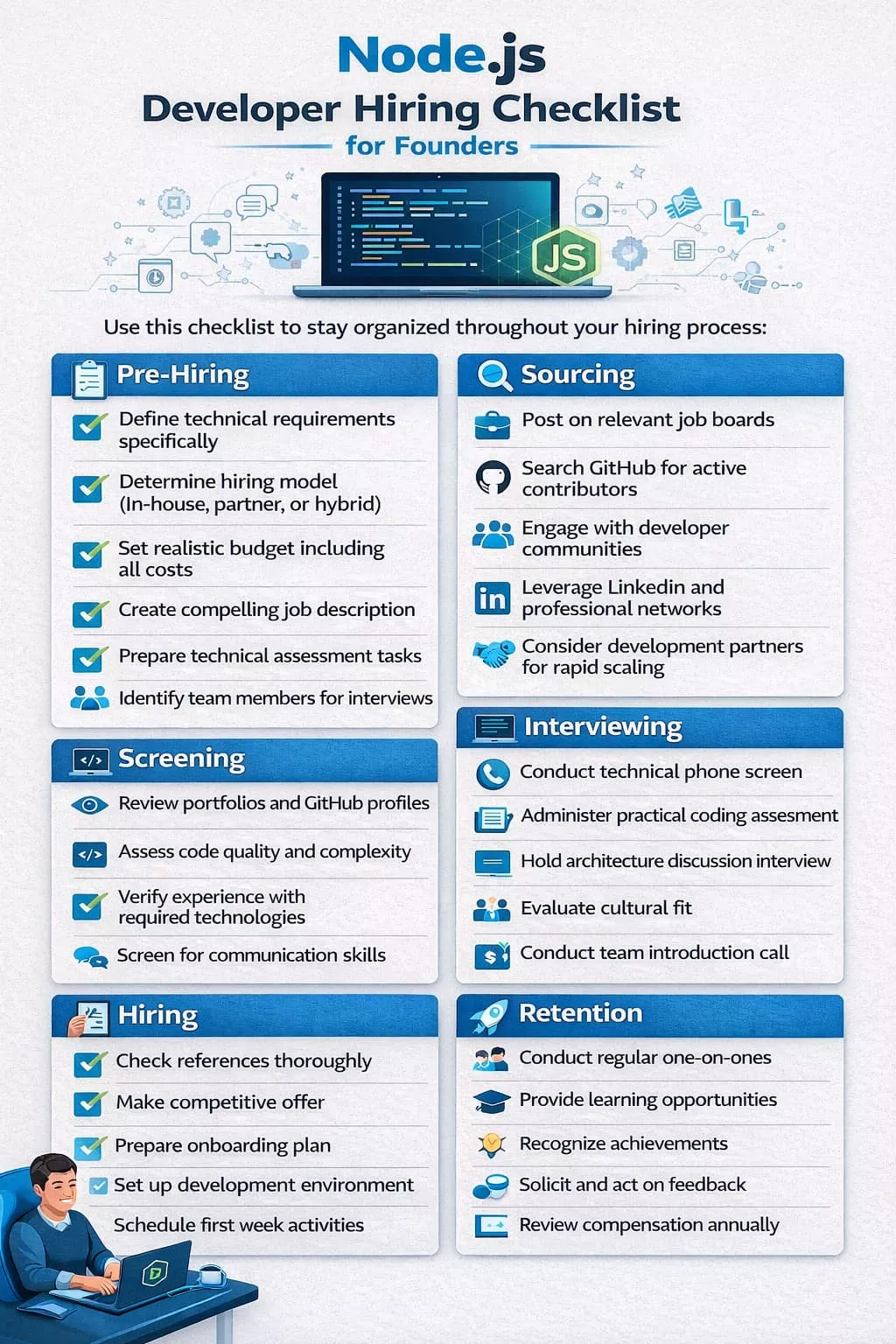
Node.js Developer Hiring Checklist for Founders
Fast-Track Your Development with Our Proven Process
At Bitcot, we help US founders build Node.js teams quickly without long hiring delays. You get experienced developers who work during US business hours and fit easily into your process.
How Our Process Works
A simple, step-by-step process to plan, hire, and start building fast.
Week 1: Planning
- We understand your project and goals
- We recommend the right tech stack
- We decide team size and roles together
- We set timelines and milestones
Week 2: Developer Selection
- You get access to our pre-vetted Node.js developers
- You review skills and past work
- You interview candidates during your work hours
- You finalize your team
Week 3–4: Start Building
- We set up tools and codebase
- We plan the first sprint
- We integrate with your workflow
- We begin development
Ongoing Development
- Daily updates during US hours
- Regular sprint reviews
- Continuous testing and deployment
- Direct communication via Slack
What Our Node.js Teams Can Build
Scalable APIs, SaaS platforms, and high-performance Node.js applications.
- APIs and backend systems
- SaaS and scalable platforms
- Cloud and serverless applications
- Real-time and high-performance apps
Why US Founders Choose Us
Fast hiring, lower risk, US time-zone teams, and proven delivery results.
- Start in 1–2 weeks, not months
- Pre-vetted developers only
- No HR, hiring, or overhead costs
- Teams work in your time zone
- Easy to scale up or down
- Trusted by 500+ US projects
Schedule a free consultation with us to discuss your Node.js development needs, whether you’re based in San Diego, elsewhere in California, or anywhere in the United States.
Conclusion
Hiring the right Node.js developers in 2026 is about making smart choices, not finding “perfect” people. The best founders focus on skills, mindset, and long-term fit, then help their teams grow.
Why Hiring Right Matters
If you hire wrong, you risk:
- Months of delayed product work
- Wasted money on bad hires
- Falling behind competitors
- Low team morale
- Messy code that slows growth
If you hire right, you gain:
- Products that scale smoothly
- Faster feature delivery
- Clean, future-ready architecture
- A strong development culture
- A real competitive advantage
Your Simple Hiring Plan
No matter how you hire, these steps always matter:
- Clearly define what you need
- Test skills and team fit properly
- Offer competitive pay and growth
- Create an environment developers want to stay in
Delaying hiring only helps your competitors move faster.
If you want to move fast without hiring stress, our Node.js experts can help. Our pre-vetted developers work US business hours and can start immediately. We offer flexible models for API development, custom Node.js solutions, full development teams, and MVP builds. Discuss Your Project Requirements →