
- IDD organizations that rely on generic job boards face persistent hiring delays because those platforms have no mechanism to filter for care-type fit, a gap that Path-Now’s Job Resource Section directly addresses.
- Path-Now’s applicant dashboard shows matching percentages per role, giving job seekers a structured basis for deciding which positions align with their skills and schedules before applying.
- Organizations gain a centralized dashboard for posting roles, reviewing candidates side by side, and communicating with applicants, removing the spreadsheet-and-email workflows that slow most IDD hiring teams.
- San Diego-based teams building software for disability services organizations have found that role-fit specificity at the posting stage, not just the screening stage, is the primary driver of lower caregiver turnover.
- The planned addition of AI-driven job-applicant matching and video interview integration will advance Path-Now from a structured hiring tool to a full recruitment ecosystem built specifically for the IDD community.
Introduction
Direct support professional turnover in the intellectual and developmental disabilities sector runs as high as 45 percent annually, according to research published by the Administration for Community Living — a figure that generic hiring platforms do nothing to address because they were never designed for this sector’s specific dynamics. Most applicant tracking systems treat every job post the same: title, description, location, and apply. What they miss is the defining variable in IDD hiring: whether a candidate’s experience and availability align with a specific care type, whether personal care, speech therapy, day programming, or crisis support. That mismatch, repeated at scale, is what drives turnover before a role even feels like a long-term fit.
When our team at Bitcot partnered with Path-Now to build the Job Resource Section, the design brief was not “a job board for IDD.” It was a structured hiring system where role-fit specificity begins at the posting stage, not the screening stage. Organizations working with individuals with IDD across San Diego and beyond now use it to post targeted roles, track applicants in one place, and connect with candidates whose skills, certifications, and availability actually match what the role requires. This article walks through how the platform was built, why the architecture differs from standard recruitment tools, and what the outcomes have been for organizations and applicants alike.
Why Standard Hiring Platforms Fall Short for IDD Organizations
The staffing challenge in the IDD sector is not a volume problem. There are people who want to work in disability services. The structural problem is that most recruitment infrastructure was built for industries where a job description, a resume, and an interview are sufficient signals of fit. In IDD care, fit is more granular: a candidate experienced in behavioral support may not be the right match for a role centered on physical rehabilitation assistance. A worker available evenings may not fit a day program. Generic platforms have no fields, no filters, and no workflows designed to surface that distinction.
According to the U.S. Bureau of Labor Statistics, demand for home health and personal care aides is projected to grow 22 percent through 2032, far outpacing most occupations. IDD organizations that depend on fragmented hiring systems, spreadsheets, and inboxes spread across multiple job boards face that growth curve with tools that don’t scale. The result is what IDD program managers report consistently: open positions sit unfilled for weeks, existing staff absorb the gap, and service quality erodes before a single qualified applicant is turned away.
The specific friction points we heard from organizations before building Path-Now’s Job Resource Section were consistent: no structured way to specify care type in postings, no centralized applicant view, no built-in communication channel between hiring teams and candidates, and no visibility for applicants into where their application stood. Each of these is a solvable design problem, not an inherent property of the hiring process.
What the Path-Now Job Resource Section Actually Does
The Job Resource Section in Path-Now is a structured recruitment module embedded within a broader platform that also handles registration, communication, and subscription workflows for IDD service organizations. The hiring module was designed around three distinct actors: organizations that post roles, applicants who apply, and the individuals with IDD who are ultimately affected by whether the right hire is made. Every feature decision was evaluated against outcomes for all three.
Organization-Side Functionality
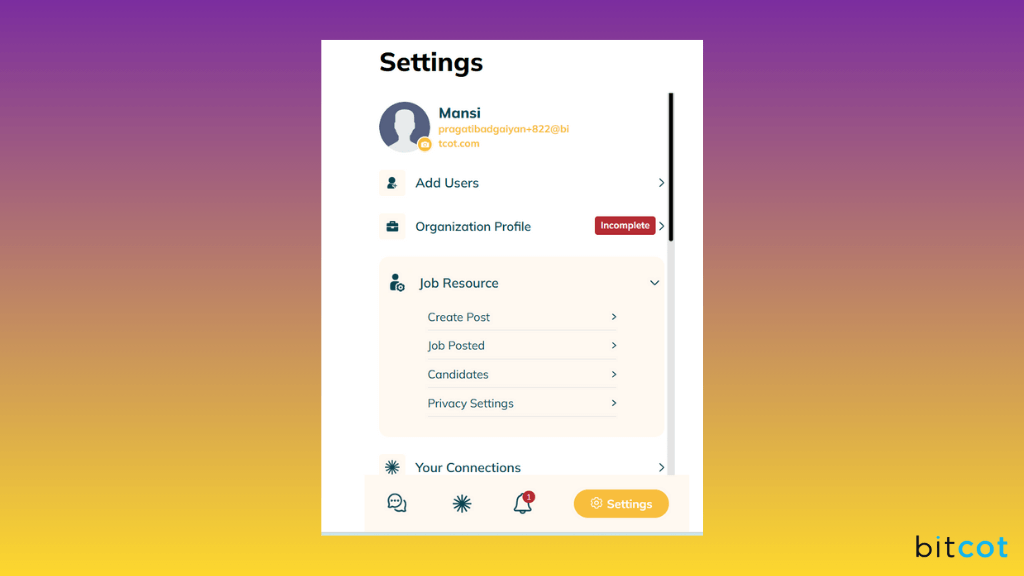
Hiring teams access an Organization Settings dashboard that consolidates four functions: job creation, active listing management, candidate tracking, and privacy controls. When creating a post, organizations specify service type (personal care, speech therapy, day programs, or similar), engagement type (part-time, full-time, or temporary), location, availability requirements, and preferred certifications. This structured input is what makes downstream matching viable. A role posted with these fields populated becomes filterable by the system; a generic free-text description does not.
The candidate view within the dashboard allows hiring teams to review resumes and qualifications and compare multiple applicants against the same role. Organizations can accept or reject candidates directly in the platform, keeping communication structured and logged rather than scattered across personal inboxes. Privacy settings give organizations control over which role details are publicly visible, which matters when posting positions that involve sensitive care contexts.
Applicant-Side Functionality
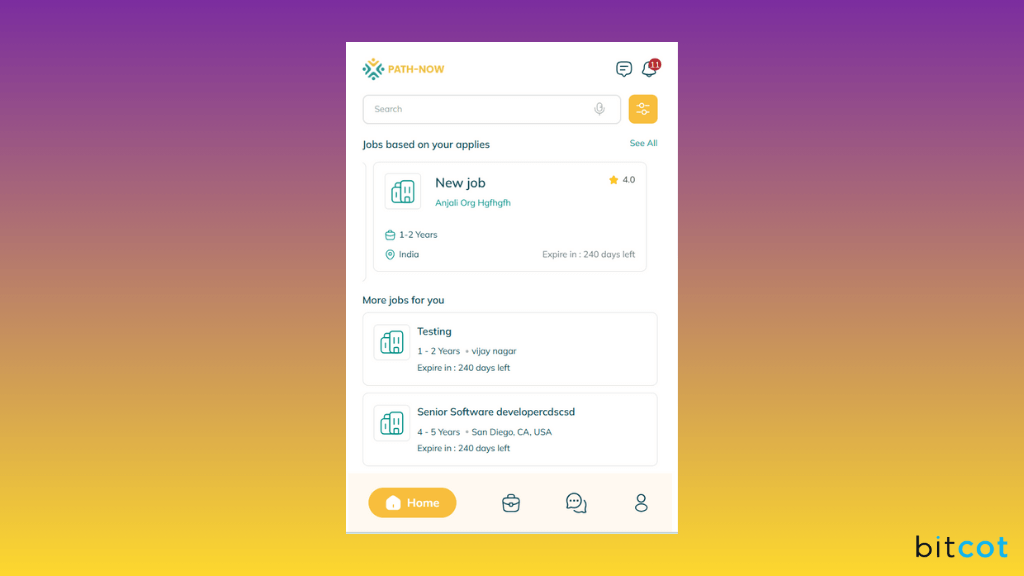
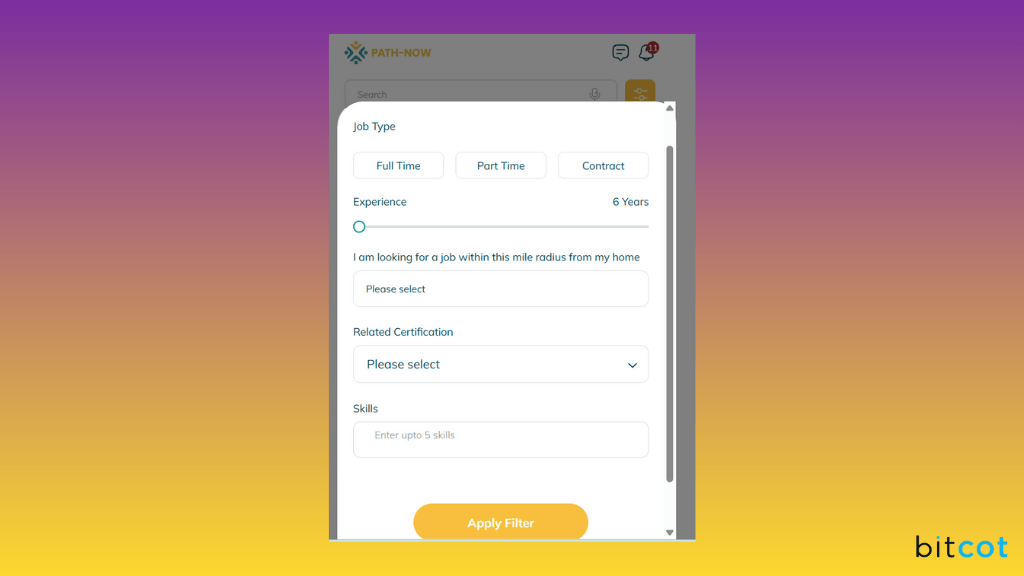
Applicants access a personalized dashboard that reflects their profile against available roles. The home view shows open positions with matching percentages, a feature that surfaces relevant roles without requiring applicants to manually read through dozens of postings. Filters let job seekers narrow by skill set, location, or schedule. The My Applications view provides real-time status on submitted applications, showing whether a review is pending, whether an offer has been extended, or whether a position has been filled.
A built-in chat function allows applicants to communicate directly with the hiring organization about a specific role, a channel that replaces the informal email threads that most candidates use and most hiring teams lose track of. This feature also signals to applicants that the organization is engaged, which affects whether a strong candidate stays active or moves on to another opportunity.

How Does the Hiring Process Work Inside Path-Now?
The process follows a defined sequence that keeps both organizations and applicants on the same track. An organization creates a role with structured fields, the post goes live on the platform, applicants with matching profiles see it surface with a fit percentage, and interested candidates apply through the platform. The organization reviews the candidate pool in the dashboard, compares applicants by qualifications, and moves candidates to accepted or rejected status. Throughout this sequence, both parties have visibility into where things stand, and the built-in chat keeps clarifying questions in context rather than in a separate inbox.
This sequence matters because it removes the parallel workflows that typically create delays in IDD hiring. There is no “check email for new applicants, copy to spreadsheet, reply from personal inbox” loop. The loop closes inside the platform. For organizations managing multiple open roles simultaneously, this consolidation is where the most tangible time savings appear. For digital transformation in healthcare-adjacent sectors like IDD services, workflow consolidation at the operational level often delivers more immediate impact than higher-visibility features.
What Makes IDD Hiring Different from Other Healthcare Recruitment?
Recruitment platforms built for clinical healthcare staffing, travel nursing registries, or general home health agencies share some surface similarity with what IDD organizations need, but the care model differences create distinct design requirements. Clinical settings typically have licensed role categories with standardized credentialing (RN, LPN, CNA), which makes matching straightforward: verify the license, confirm the specialty. IDD roles are more varied. A direct support professional may hold a general certification but have specialized experience in one care area and none in another. The mismatch is less visible in a resume and more visible after three months on the job.
According to research published by the American Journal on Intellectual and Developmental Disabilities, continuity of care from consistent direct support staff is a meaningful factor in quality of life outcomes for individuals with IDD. Staff turnover is not a neutral administrative event; it is a care disruption. This is the underlying rationale for building role-fit specificity into the posting stage rather than leaving it to the screening stage. A job post that accurately describes the type of support required self-selects for candidates who have that experience, before any resume review happens.
This distinction shapes the custom software development decisions behind Path-Now’s job resource module. The structured service-type fields in the posting form are not optional metadata — they are the input that makes the matching percentage calculation in the applicant dashboard meaningful. Remove them, and the platform reverts to a generic job board with a better interface. Retain them, and the system can surface a physical rehabilitation specialist to a day program posting at a lower relevance score than it would for an applicant whose prior roles all involved day program settings.
Measured Outcomes Since Launch
Since the Job Resource Section went live within Path-Now, the observable changes for organizations have centered on three areas: speed of qualified candidate access, reduction in administrative overhead, and applicant engagement quality. Organizations report that roles they previously spent weeks advertising across multiple external platforms are now filled faster because the platform reaches an audience already oriented toward IDD work, and the structured posting format filters out poorly matched applicants before the review stage.

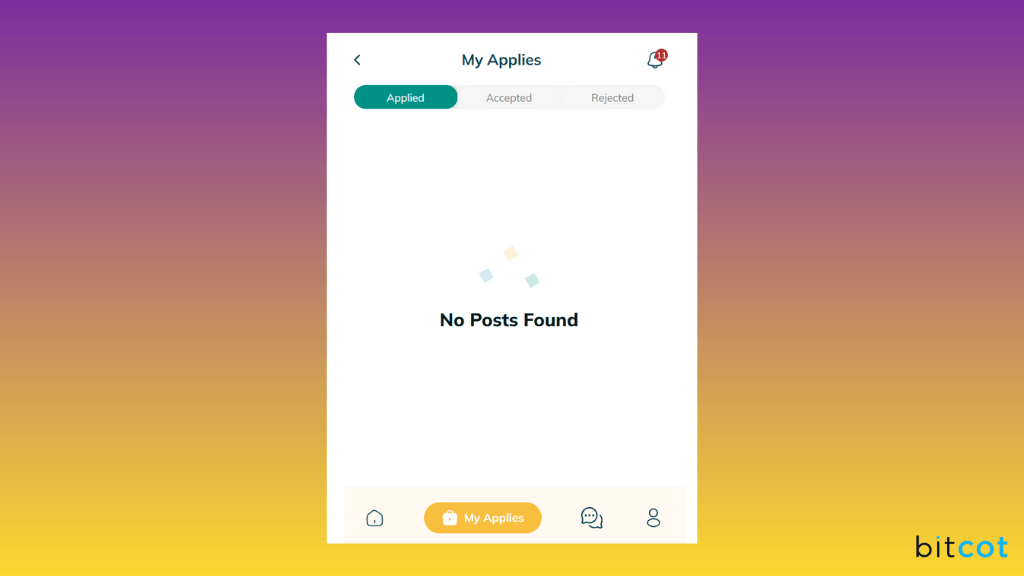
For applicants, the matching percentage view has reduced the volume of applications submitted to roles that are not a strong fit, which also benefits organizations by increasing the signal-to-noise ratio in their candidate queues. The My Applies status tracker addresses one of the most commonly cited frustrations among job seekers in any field: not knowing whether an application has been reviewed. Eliminating that uncertainty keeps engaged candidates in the process longer and reduces the likelihood that a strong applicant accepts a competing offer simply because they received no signal from the first organization.
The broader platform context matters here as well. Path-Now also handles registration, communication, and subscription management for IDD service organizations, meaning the Job Resource Section is not an isolated tool but part of an integrated operational environment. For organizations managing multiple service delivery workflows, having hiring within the same platform they use for other operational functions reduces context-switching and creates a more coherent administrative experience. This kind of SaaS platform development integration is where purpose-built solutions consistently outperform assembled point solutions for sector-specific organizations.
What’s Next: Planned Enhancements to the Platform
The current Job Resource Section handles structured posting, applicant tracking, matching visibility, and in-platform communication. The next phase of development adds capabilities that move the platform from structured hiring management to intelligent hiring assistance.
AI-driven job-applicant matching is the most significant planned addition. Rather than relying solely on applicants to filter by the criteria in a post, the system will generate candidate recommendations based on a combination of skills, availability, and prior service-type experience. This shifts matching from a reactive filter to a proactive suggestion, surfacing candidates who might not have applied to a specific role but whose profile indicates a strong fit. The underlying logic requires training on role-fit outcomes rather than application volume, which is why this feature is being developed in a second phase rather than at launch.
Advanced hiring analytics will give organizations data on average time-to-fill by role type, applicant drop-off points in the funnel, and trends in candidate availability for specific care categories. This is particularly useful for organizations planning staffing ahead of program expansions or seasonal demand shifts. Video interview integration rounds out the planned roadmap, allowing initial screening conversations to happen within the platform rather than through external scheduling tools. For healthcare web application development projects that serve time-sensitive operational needs, reducing handoff points between tools is consistently one of the highest-return design decisions available.
Organizations building or expanding disability services platforms in Los Angeles and San Francisco are also looking at similar recruitment infrastructure challenges, and the Path-Now architecture offers a replicable model for how sector-specific hiring modules can be embedded within broader service delivery platforms rather than bolted on as external integrations.
Our Perspective
Building the Job Resource Section for Path-Now reinforced something we’ve observed across multiple digital healthcare solutions projects: the highest-friction part of sector-specific software is rarely the UI. It’s the data model. In this case, the question was how to represent “care type fit” in a way that was specific enough to drive meaningful matching but flexible enough that organizations with different service structures could use the same fields.
The structured service-type fields in the posting form took more iterations than any other feature, because they had to cover a range of IDD service contexts (residential, day programs, behavioral support, therapy-based) without becoming so granular that organizations abandoned the form mid-creation. Getting that balance right is the kind of problem that only surfaces when you’re building for a specific sector rather than adapting a generic tool. Our team in San Diego has encountered similar design constraints on software solutions for other care-adjacent sectors, and the consistent finding is that the field structure in your data model determines the ceiling of what your matching logic can achieve — regardless of how sophisticated the algorithm on top of it becomes.

Conclusion
Path-Now’s Job Resource Section works because it was built around the specific friction in IDD hiring, not a generalized recruitment model. The structured posting form, the care-type matching, the centralized applicant dashboard, and the in-platform communication channel each address a discrete failure mode that organizations in this sector encounter when relying on general-purpose tools. The result is a hiring process in which organizations find qualified staff faster, applicants find roles that genuinely fit their skills and schedules, and individuals receiving care experience more consistent support from teams that were thoughtfully matched from the start.
If you are building or scaling a platform for disability services, aged care, or any care delivery organization with nuanced staffing requirements, the architecture decisions behind this module offer a concrete model for how recruitment functionality should be embedded in a service delivery platform. Reach out to explore how this type of purpose-built feature could work within your product.
Frequently Asked Questions
What is Path-Now's Job Resource Section?
Path-Now’s Job Resource Section is a purpose-built recruitment module within the Path-Now platform that allows IDD service organizations to create and post structured job listings, track applicants, and communicate with candidates, all in one place. Unlike generic job boards, it includes structured fields for care type, service category, and availability requirements that make role-fit matching possible. The module was built by Bitcot specifically to address the staffing and hiring challenges unique to organizations serving individuals with intellectual and developmental disabilities.
How does Path-Now's job matching differ from a standard applicant tracking system?
Standard applicant tracking systems process resumes and applications based on keyword matching or manual review, without sector-specific fit logic. Path-Now’s Job Resource Section uses structured data from both the job posting (service type, care category, availability requirements) and the applicant’s profile to generate a matching percentage, shown to applicants before they apply. This means candidates self-select based on actual role fit, not just job title, which reduces poorly matched applications and improves the quality of the candidate pool organizations review.
How does an IDD organization post a job and manage applicants in Path-Now?
An organization accesses the Organization Settings dashboard, selects “Create Job,” and fills in structured fields including service type, engagement model, location, and preferred qualifications. Once posted, the listing appears to eligible applicants with a calculated fit percentage. The organization reviews incoming applicants in the Candidates view, where they can compare qualifications side by side, accept or reject candidates, and communicate directly through the built-in chat feature without leaving the platform or switching to email.
Is a specialized hiring platform like Path-Now better than general job boards for IDD organizations in California?
For IDD organizations in California, including those operating in Los Angeles, San Diego, and San Francisco, a specialized platform delivers a fundamentally different candidate pool than general job boards. General job boards attract applicants across all industries and rely on job seekers to self-identify relevant experience in free-text fields. Path-Now reaches applicants already oriented toward IDD and disability services work, and its structured matching fields filter for care-type fit before any manual review is required — directly reducing the time and administrative effort needed to identify qualified candidates.
Does IDD organizations need a custom hiring platform, or is adapting an existing ATS sufficient?
Adapting a general ATS for IDD hiring typically produces a tool that handles application volume but not care-type fit, because the data model underlying a generic ATS has no fields designed for the service-type specificity that IDD roles require. Custom platforms built for this sector, like Path-Now’s Job Resource Section, embed that specificity at the data model level, which is what enables meaningful matching logic rather than basic filtering. Organizations that have tried adapting generic tools consistently report that structured role creation and applicant transparency features remain unavailable without significant customization effort.