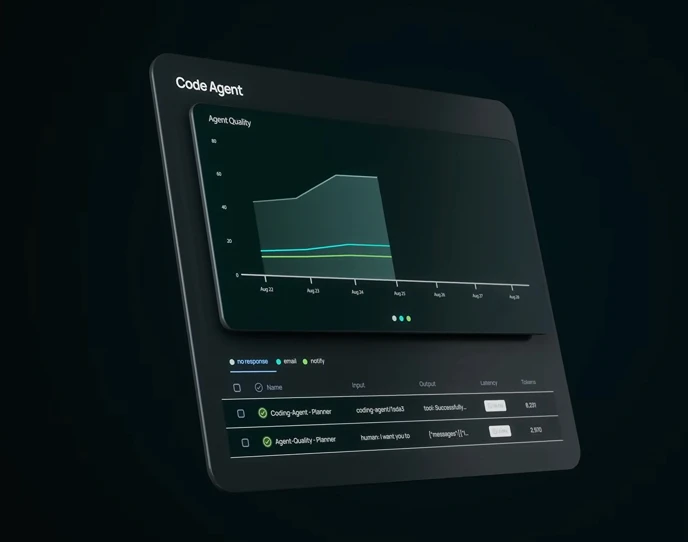
An AI-powered healthcare platform that leverages multi-agent coordination to automate complex tasks, streamline workflows, and enhance both operational efficiency and patient care.
Custom LangChain Development Services
Building the Intelligent Enterprise. From Cloud to Agent Orchestration
We transform LangChain and Generative AI pilots into production-grade agent workflows using the LangChain, LangGraph, and LangSmith stack seamlessly integrating tools, data, and infrastructure for the final mile to production.
Trusted by CIOs and CTOs building what’s next
Need AI agents that can reason? make decisions? use tools?
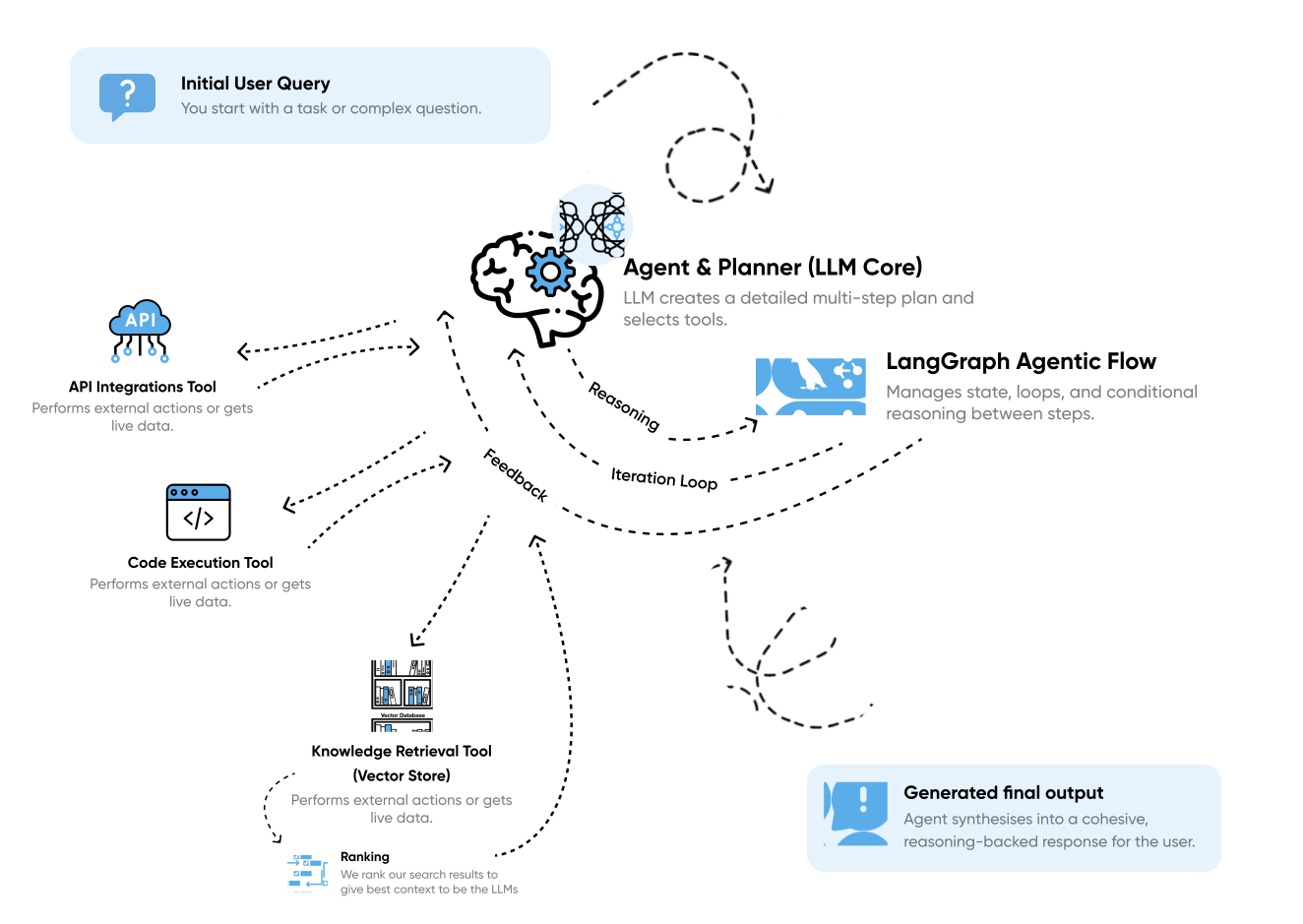
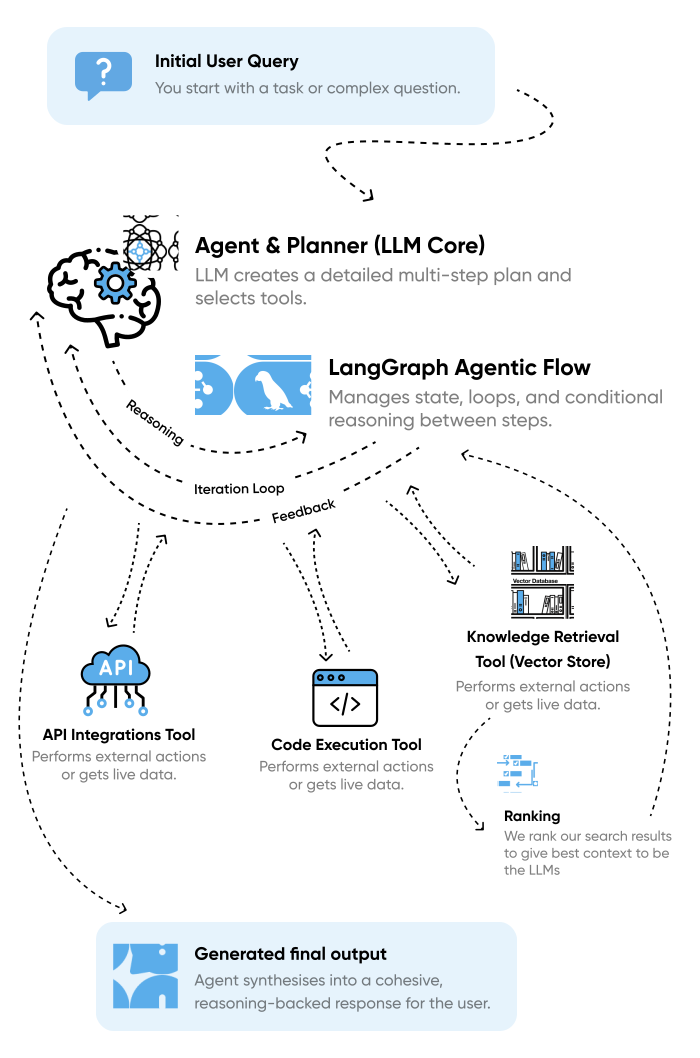
We build custom LangChain agents capable of multi-step workflows, API calls, data processing, and autonomous task execution.
Accelerate AI Development
Our LangChain Accelerator
Build reliable, scalable AI applications
- Production-Ready RAG Frameworks
- Optimized Prompt & Chain Libraries
- Built-In Evaluation & Guardrails
- Scalable Vector Database Architecture
- Deployment & Infrastructure Blueprints
Start Building with LangChain

Our Proven AI & LangChain Technology Stack









Our Featured work
Autonomous HR Service Desk
Autonomous HR Service Desk
An AI-driven platform that automates HR operations by seamlessly orchestrating specialized agents to handle policy-related queries, generate legal documents, and update job descriptions—ensuring fast, compliant, and autonomous employee experiences.
Auto-CRM Sales Assistant
Auto-CRM Sales Assistant
An AI-powered Sales Assistant that streamlines field sales workflows by automating visit preparation, real-time client interaction handling, and post-visit data entry, empowering sales reps to focus on relationship-building while ensuring data accuracy and CRM automation.
Our Custom LangChain Development Services
- LLM Application Architecture Services
- RAG Pipeline Services
- Agentic Workflow Services
- Fine Tuning
- Voice AI
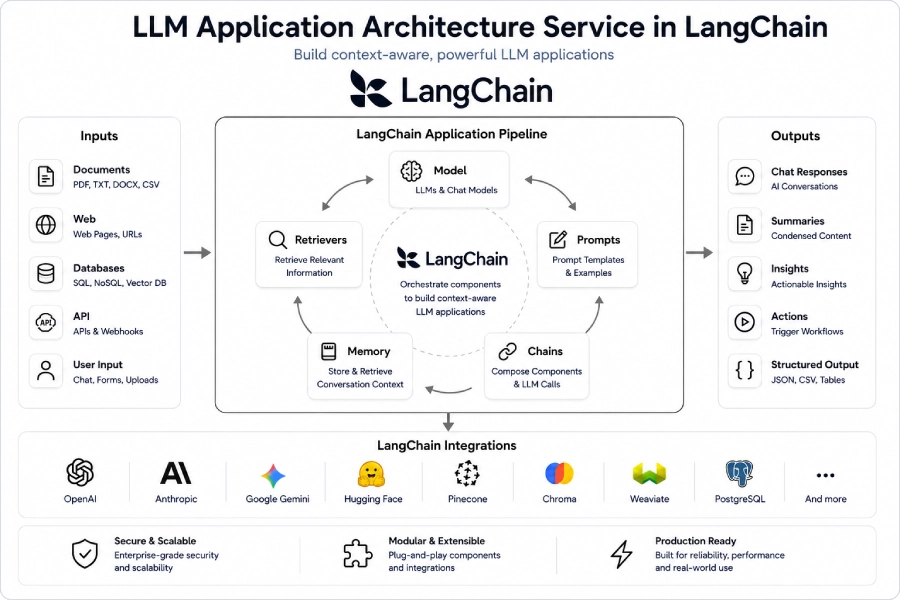
LLM Architecture
From model selection to LangChain orchestration patterns, we design end-to-end LLM architectures that align AI capabilities with real business workflows on the LangChain.
- Chain and agent orchestration pattern design
- LangChain integration across all providers
- Prompt caching strategies and cost optimization
RAG Pipeline Services
We architect high-performance RAG pipelines, manuals, SOPs, tickets, logs, PDFs, and internal docs that are instantly searchable via natural language. In 2026, we will build Agentic RAG with LangGraph loops that re-retrieve when confidence is low.
- Hybrid search semantic + keyword combined
- Multi-vector and parent-document retrieval
- 50+ vector stores: Pinecone, Weaviate, pgvector, MongoDB
- Hallucination reduction via source grounding + citation
- Agentic RAG LangGraph conditional re-retrieval loops
- Streaming Integration Streamed the agent response
- LangSmith RAG evaluation automated testing with correctness, groundedness, relevance, and retrieval quality metrics using LLM-as-judge evaluators
- Enterprise guardrails input/output validation, toxicity detection, and prompt-injection protection

Agentic Workflows
We build LangGraph powered agents and DeepAgent with durable state, human-in-the-loop breakpoints, and task caching production-grade, not demo-grade
- Durable state resumes exactly where interrupted (server restart, long workflow)
- Human-in-the-loop pause at any node for human review/approval
- Multi-agent coordination and subgraph orchestration
- Streaming Integration Streamed the agent response
- LangSmith Agent Builder no-code agent prototyping (public beta)
- Async subagents non-blocking background tasks (Mar 2026)
- LangSmith agentic workflow evaluation full agent trajectory tracing with tool calls, reasoning steps, and intermediate step scoring using LLM-as-judge evaluators
- Enterprise guardrails input/output validation, toxicity detection, and prompt-injection protection

Fine Tuning
For specialized industries, general-purpose models aren’t enough. We fine-tune compact language models on your terminology, workflows, and edge cases then wire them into LangChain orchestration with LangSmith evaluation.

Voice AI
We develop voice-enabled AI agents combining speech recognition, language models, and action workflows all orchestrated through LangGraph for durable, stateful multi-turn voice conversations.
- STT → LangChain agent → TTS pipeline
- Implemented streaming to stream the speech output
- Multi-turn conversation with durable state across calls
- Tool use mid-conversation

Prebuilt platform features that drive massive adoption
150
%
Increase in User Engagement
360
+
Partner Sign-Ups
20
x
Beta Launch Revenue Projection
Why Choose Our LangChain Development Company
Deep LangChain Expertise
We build advanced solutions, from intelligent chatbots to complex multi-agent systems. We specialize in chains, agents, tools, memory, and vector stores.
End-to-End AI Development
From strategy to deployment, we deliver production-ready AI systems with robust backends, secure data pipelines, and seamless user experiences.
Seamless Integration with the Stack
Whether you need to connect LLMs with internal databases, CRMs, APIs, or proprietary tools, our solutions are designed to fit into your existing ecosystem.
Performance & Scalability First
Applications must be fast, reliable, and cost-efficient. We optimize prompt flows, caching strategies, and retrieval pipelines so your system performs at scale.
FAQs
What is LangChain and how is it used in AI applications?
LangChain is a framework for building AI-powered applications using large language models (LLMs). It helps create chatbots, AI agents, RAG systems, copilots, and workflow automation tools.
What is the difference between LangChain and LangGraph?
LangChain is primarily used for building AI workflows and integrations, while LangGraph is designed for stateful, multi-agent, and long-running AI systems with advanced orchestration capabilities.
Can you build AI agents using LangChain?
Yes. We build AI agents that can reason, use tools, access enterprise data, call APIs, and automate complex workflows using LangChain and LangGraph.
What are AI agents?
AI agents are autonomous systems powered by LLMs that can make decisions, execute tasks, interact with tools, and complete multi-step workflows with minimal human input.
What is Retrieval-Augmented Generation (RAG)?
RAG is an AI architecture that combines large language models with external data sources such as documents, databases, and APIs to improve response accuracy and reduce hallucinations.
Do you build enterprise-grade RAG systems?
Yes. We develop scalable RAG systems with vector databases, hybrid search, reranking, observability, and enterprise security.
What vector databases do you support?
We support Pinecone, Weaviate, Qdrant, ChromaDB, pgvector, Milvus, Redis, and FAISS depending on project requirements.
What observability tools do you use for AI systems?
We use tools like LangSmith, DSPy, tracing systems, and evaluation pipelines to monitor prompts, latency, hallucinations, and agent performance.
What is LangSmith and why is it important?
LangSmith is an observability and debugging platform for monitoring, testing, and evaluating AI applications and agents in production.
Do you support Claude, OpenAI, Gemini, and open-source models?
Yes. Our AI solutions support Anthropic Claude, OpenAI GPT models, Google Gemini, Llama, Mistral, DeepSeek, and other open-source models.
Can AI agents integrate with enterprise tools and APIs?
Yes. Our AI agents can integrate with CRMs, ERPs, Slack, Salesforce, HubSpot, databases, internal APIs, and third-party SaaS platforms.
How do you reduce hallucinations in AI systems?
We reduce hallucinations using RAG pipelines, prompt engineering, guardrails, structured outputs, evaluation systems, and human-in-the-loop validation.
Can you build multi-agent AI systems?
Yes. We develop multi-agent systems where specialized AI agents collaborate, share context, and execute complex workflows.
What is Deep Agents and when should it be used?
Deep Agents is an advanced framework for building autonomous AI systems capable of planning, reasoning, and managing long-running workflows.
Can you build voice AI agents?
Yes. We develop voice-enabled AI agents that combine speech recognition, LLM reasoning, tool usage, and workflow orchestration.
How do you monitor AI agent performance in production?
We monitor AI agents using observability dashboards, tracing, evaluations, token analytics, logs, and workflow telemetry systems.
Is LangChain suitable for enterprise AI applications?
Yes. LangChain and LangGraph are widely used for enterprise AI systems because they support scalability, orchestration, observability, and secure integrations.