Key Takeaways
- Production agents fail at the delivery layer, not at the AI reasoning layer.
- LangGraph enables self-correcting stateful loops that survive real traffic.
- FastAPI’s async architecture handles concurrent AI waits without blocking.
- San Diego enterprise teams reduce support tickets 60% with agentic routing.
- Misaligned reasoning and delivery layers are the root cause of most agent failures.
Introduction
According to a 2025 survey by Gartner, fewer than 20% of enterprise AI proof-of-concepts deployed in the past two years have graduated to stable production workloads. That figure has surprised a lot of executives who assumed the bottleneck was the model itself. It rarely is. The gap between a working prototype and a system that holds up under real business conditions almost always lives in the architecture connecting the AI to everything else.
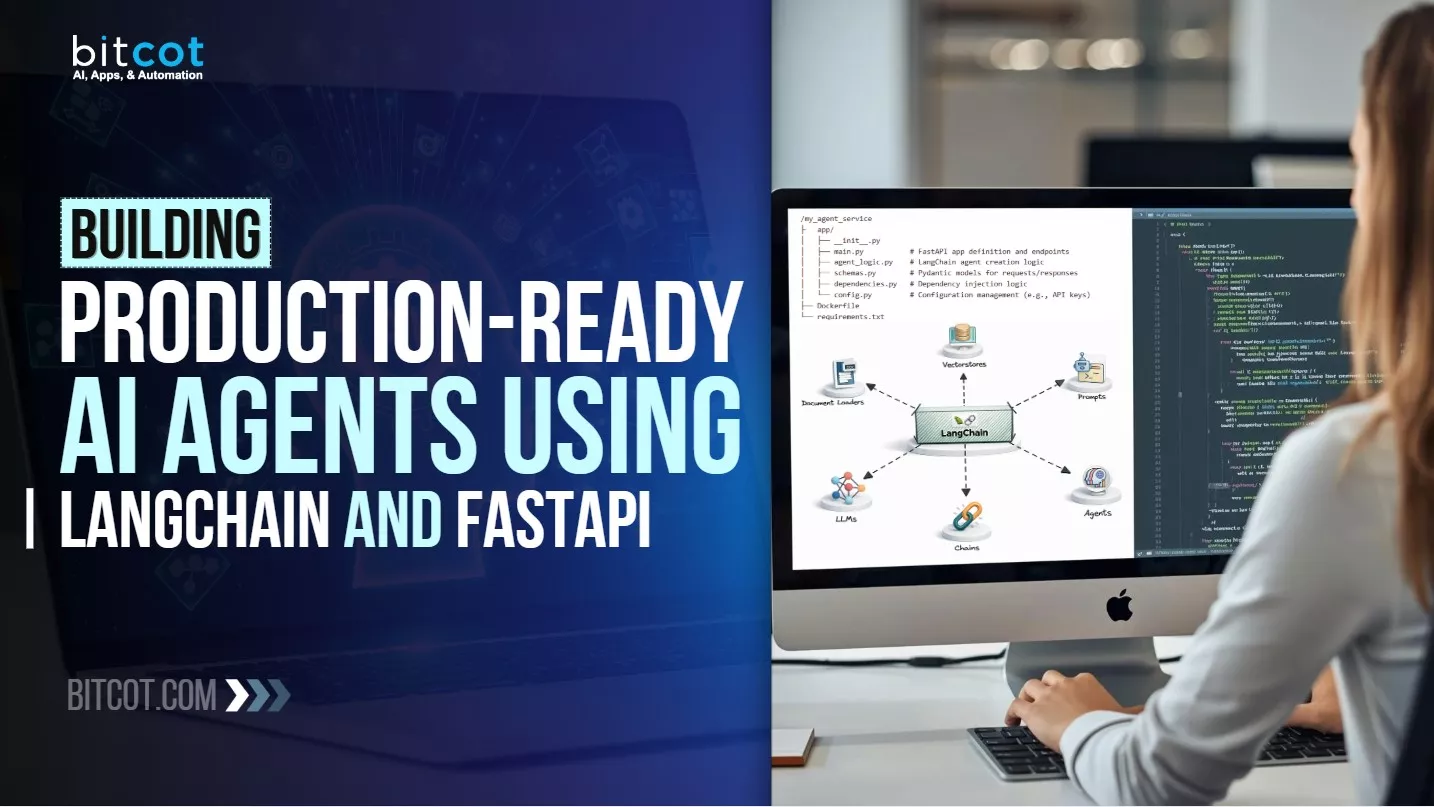
The engineering community has largely converged on two tools for closing that gap: LangChain for orchestrating agent reasoning and FastAPI for delivering it at scale. But this combination is most commonly presented as a checklist: use LangChain for tools and memory, use FastAPI for the API layer, ship. That framing misses the actual engineering discipline. LangChain and FastAPI are not two separate components you bolt together; they are two halves of a single reasoning-delivery contract, and production failures almost always trace to a break in that contract rather than a flaw in either tool individually.
This guide is written for software teams who have already shipped an AI prototype and are now navigating the harder question: what structural decisions separate a trustworthy production agent from one that breaks under pressure?
Why Most AI Prototypes Stall Before Production
The prototype environment is forgiving. Inputs are controlled, traffic is minimal, and the consequence of a wrong answer is a Slack message, not a customer complaint or a data audit. When those conditions disappear, three specific architectural gaps tend to surface.
The first is non-deterministic output routing. An LLM can produce a structurally valid response that violates your business logic, returning a refund amount outside policy range, selecting a tool the user is not authorized to invoke, or routing a request to a workflow that no longer exists. Prototypes typically handle this with developer intuition; production systems require enforced schemas at every output boundary.
The second is synchronous bottlenecking. AI model calls are slow by API standards, often two to eight seconds per request. A synchronous server queues every other request behind the one currently waiting for an LLM response. At low volume, this is invisible; at production traffic levels, it becomes the primary source of latency complaints and timeout errors.
The third is stateless reasoning. A prototype often treats each request as independent. A production agent handling a multi-step task, say, parsing a vendor contract, checking it against procurement policy, and drafting a flagged-items report, needs to carry state across steps, recover gracefully from a failed intermediate step, and enforce a Human-in-the-Loop gate before committing to a final action.
What LangChain Actually Does in a Production Agent
LangChain is not a model wrapper. It is a composable reasoning framework that separates the agent’s decision logic from its execution plumbing. Prompts, tools, retrievers, memory, and chains are all independently configurable components. In a production context, that composability has concrete operational benefits.
When a model provider changes its API or a downstream tool changes its schema, an LLM-native framework that hardcodes provider calls requires widespread rewrites. LangChain abstracts the provider interface, so teams can swap from one model to another by updating a configuration value, not a codebase. The same principle applies to tool integrations: a standardized Tool interface means adding a new internal data source does not require redesigning the agent’s decision logic.
For complex business workflows, LangGraph, the stateful graph extension within the LangChain ecosystem, provides the control structure that basic chains cannot. A LangGraph agent maintains a complete transaction state across every step. If a CRM API call fails at step three of a five-step workflow, the agent does not discard the work done in steps one and two. It evaluates the failure, selects an alternative path if one exists, and resumes. This self-correction behavior is what separates an agentic workflow that handles edge cases from one that requires manual restart every time an external service hiccups.
Our engineering team uses LangChain development patterns to build AI agents that enforce specific Human-in-the-Loop (HITL) gates for high-stakes actions. A logistics agent might process 90% of a re-routing decision autonomously, but pause and surface a summary for a human manager before committing a purchase order above a defined threshold. That gate is a first-class design element in LangGraph, not a workaround built on top of it.
What FastAPI Contributes That Other Frameworks Cannot
The choice of API framework matters more in AI-serving contexts than in standard REST services, for one structural reason: AI model calls are inherently I/O-bound. The server spends most of its time waiting for the LLM, waiting for a tool call to return, waiting for a vector store query. A synchronous framework blocks a worker thread during every wait. An asynchronous framework releases the thread back to the pool and picks up the next request.
FastAPI is built on Python asyncio and uses Starlette as its transport layer. Every route handler can be declaredasync, which means a server handling a hundred simultaneous agent calls can keep all hundred in flight concurrently without queuing. Under the traffic patterns typical of enterprise AI deployments, bursty, uneven, with significant per-request latency variance, this is not a performance preference; it is a stability requirement.
Beyond concurrency, Pydantic validation built into FastAPI provides a structural defense against the two most common failure modes of AI-generated output in business systems: type mismatches and hallucinated fields. When an agent attempts to write a response to an internal database and that response contains a fabricated field name or an out-of-range numeric value, the Pydantic schema rejects it before it reaches the write layer. This validation is automatic, operates at the framework level, and requires no custom guard code for each route.
FastAPI also generates OpenAPI documentation automatically from the type signatures in the codebase. For enterprise deployments where multiple internal teams need to integrate against the agent’s API, self-maintaining documentation eliminates a category of coordination overhead that tends to accumulate silently as the agent’s API surface grows.

The Reasoning-Delivery Contract: Where Most Teams Break It
The most instructive framing for LangChain plus FastAPI is not “brain plus nervous system,” it is a contract between two engineering responsibilities. LangChain is responsible for the correctness of the agent’s reasoning outputs. FastAPI is responsible for the reliability, security, and speed of its delivery. When these two responsibilities are designed in isolation, the contract breaks in predictable ways.
A common failure pattern: the LangChain layer is built to produce structured JSON outputs with a well-defined schema. The FastAPI layer is built to accept free-text responses. The schema enforcement happens in neither place because each team assumed the other had it. The first time the LLM hallucinates a slightly different key name, the downstream system silently drops the field.
The correct approach is schema-first contract design. Define the Pydantic model that represents a valid agent response before writing the LangChain output parser or the FastAPI route handler. Both sides of the integration are then built to the same contract, and any deviation, whether introduced by the LLM or by a code change, surfaces as a validation error rather than a silent data quality problem.
A second common break point is security boundary misalignment. FastAPI provides a clean OAuth2 implementation, but the access control it enforces only holds if the LangChain tool layer respects the same boundaries. An agent authorized to query the marketing database must not be able to invoke a tool that queries the HR system, even if that tool is available in the tool registry. Access control needs to be defined once and enforced at both the API layer and the tool invocation layer, not at one without the other.
How Does LangGraph Handle Failures in Multi-Step Workflows?
LangGraph handles failures through a stateful graph structure where every node represents a discrete reasoning step, and every edge represents a conditional transition. When a node fails because an API call returns an error, a tool produces an unexpected output, or the LLM’s response fails a validation check, LangGraph evaluates the current state and determines whether a defined recovery path exists.
If a recovery path exists, the graph transitions to a fallback node rather than terminating. That fallback node might retry the failed operation with different parameters, route to an alternative tool, or escalate to a human review queue. The key distinction from a linear chain is that the agent’s accumulated state is preserved across the failure. The reasoning work done before the failure is not discarded; it informs the recovery logic.
According to a Forrester Research report on AI automation, enterprises that implement stateful error recovery in their agentic workflows report a 35% reduction in manual intervention tickets compared to those using linear chain architectures. The operational translation is straightforward: fewer support escalations, more tasks completed autonomously.
For enterprise workflows where a failed step has downstream cost implications, such as a partially completed purchase order or an incomplete patient record update, this recovery behavior is not optional. It is the structural requirement that separates a deployable agent from a prototype.
Production Hardening: Observability, Caching, and Fallback Strategy
Three engineering decisions tend to determine whether an agent survives its first six months in production, and all three are more often deferred than addressed in initial builds.
Observability through full-trace logging is the first. When an agent produces an incorrect output, the debugging question is not “what did the model say?” but “what prompt did the agent construct, which tool did it call, what did the tool return, and how did the model interpret that return?” Without a trace that records every step in that chain, reproducing the failure is guesswork. Tools like LangSmith, integrated with LangChain, provide this trace infrastructure. The trace also satisfies the audit requirements that legal and compliance teams impose on AI systems operating in regulated environments.
Semantic caching at the FastAPI layer addresses the cost structure of production AI workloads. According to Statista’s 2025 enterprise AI spending data, API token costs represent the largest single variable expense in production AI deployments. Semantic caching stores vector embeddings of past queries and returns cached responses when a new query is semantically equivalent to a previous one without calling the LLM again. The savings compound in high-volume deployments where a significant portion of queries are variations of a small set of frequently asked questions.
Model fallback configuration in LangChain protects against provider outages and latency spikes. A primary model configuration can specify a fallback sequence: if the primary provider exceeds a defined latency threshold or returns a rate-limit error, the agent automatically retries against a secondary provider or a lighter-weight model. This fallback logic is configurable without code changes, which matters when provider service levels vary unpredictably.
Enterprise Use Cases Where This Architecture Delivers Measurable Results
The clearest evidence for the LangChain-FastAPI architecture is not benchmark performance but production outcome data from specific workflow categories.
In customer experience operations, agents built on this stack handle cross-channel intent routing, determining from a customer’s message which internal system, team, or knowledge base should receive it. Organizations deploying these agents report a 60% reduction in Tier-1 support tickets because the agent resolves or correctly routes the majority of requests without human triage.
In supply chain management, agents monitor external data sources for disruption signals and use LangGraph to reason through re-routing alternatives before escalating to a human decision-maker. The 48-hour early-warning window these agents create translates directly to reduced expedited shipping costs, which typically run 15 to 20% higher than standard routing.
In healthcare administrative workflows, agents handle prior authorization processing by cross-referencing clinical documentation against insurance policy requirements using Retrieval-Augmented Generation. The FastAPI layer validates that every data element entering the agent meets the schema requirements of the downstream insurance system before the submission is constructed. Administrative overhead reductions of 40% are commonly reported in pilot deployments of this workflow pattern.
For teams working on AI/ML development in regulated industries, the combination of LangGraph’s auditable state transitions and FastAPI’s schema validation provides the documentation trail that compliance reviews require. Each step in the agent’s reasoning is logged, each data transformation is schema-validated, and the full trace is available for audit without additional instrumentation.
Teams building enterprise AI chatbots on this stack also benefit from the streaming support FastAPI provides through Server-Sent Events. Rather than waiting for a complete model response before returning anything to the user, the server streams tokens as they are generated. The perceived response time drops significantly, and the user experience, which is a measurable factor in enterprise adoption rates, improves correspondingly.
Beyond specific workflow categories, the modular, model-agnostic design of this stack matters for long-term investment decisions. Enterprises that build their agent infrastructure on LangChain’s provider abstraction can swap underlying models as the market evolves without rebuilding the agent’s tool definitions, memory structures, or routing logic. That architectural flexibility directly reduces the re-engineering cost that vendor lock-in would otherwise create.
For teams evaluating where to invest in AI workflow automation, the LangChain-FastAPI architecture represents a path that scales from a focused single-workflow deployment to a multi-agent system spanning multiple departments, without requiring a structural rebuild at each scale step. The same business process automation patterns that work for a 50-user internal tool hold at 50,000 users with appropriate infrastructure scaling. Teams in software development in San Diego and across California are increasingly treating this stack as the standard starting point rather than an advanced option, because the operational benefits appear early enough in a deployment to justify the initial learning curve.
What We Notice When Enterprise Agents Break in the First 90 Days
Across a range of agentic systems built for healthcare, fintech, and logistics clients, a consistent failure pattern appears in the first 90 days of production: the agent performs well in structured scenarios and degrades in the edge cases that only real user behavior surfaces.
The degradation is rarely in the model’s reasoning quality. It is in the delivery layer’s tolerance for unexpected input. A user submits a request in a format the Pydantic schema does not anticipate, and instead of a graceful fallback, the system returns an unhandled validation error. Or a tool call takes longer than expected under production load, and the LangGraph state machine hits a timeout it was not configured to handle.
The teams that recover fastest from these early failures are those who designed the reasoning-delivery contract before writing agent logic, not after. When the schema is defined first, and both the LangChain output layer and the FastAPI validation layer are built to that schema, the edge cases surface as caught exceptions rather than silent failures. The fix is a schema update, not a debugging session across two codebases.
San Diego engineering teams building agentic systems for healthcare clients have found that investing in this contract-first design pattern during the architecture phase saves a disproportionate amount of time in the first operational quarter. The initial build takes slightly longer, but the production incident rate drops significantly, which matters in healthcare contexts where an agent’s error has clinical workflow consequences.

Conclusion
The transition from AI prototype to production system is fundamentally an architecture problem, not a model quality problem. LangChain provides the composable reasoning structure that lets an agent handle complex, multi-step business logic without turning into unmaintainable conditional code. FastAPI provides an async delivery layer that keeps the system responsive under real traffic. Together, they form a contract that, when designed intentionally, produces systems that are reliable enough to build business workflows on.
The teams that get this right in 2026 are not the ones with the most sophisticated prompts. They are the ones who defined their schema boundaries before writing agent logic, instrumented their traces before going live, and treated stateful error recovery as a first-class requirement rather than a post-launch fix. If you are building toward that kind of production readiness, the architecture decisions covered here are the starting point.
Frequently Asked Questions
What is a production-ready AI agent?
A production-ready AI agent is a system that can handle real business workloads reliably, not just controlled demo scenarios. It enforces structured output validation, manages state across multi-step tasks, recovers from tool failures without manual restart, and logs every reasoning step for audit and debugging. The distinction from a prototype is operational stability under variable real-world conditions, not model intelligence.
What is the difference between LangChain and LangGraph?
LangChain is the orchestration framework it provides the composable components for building agent reasoning: prompts, tools, memory, chains, and retrievers. LangGraph is an extension within the LangChain ecosystem that adds stateful graph control to agent workflows, allowing the agent to maintain transaction state across multiple steps and define conditional recovery paths when individual steps fail. Most production agents need both: LangChain for component composition and LangGraph for stateful, self-correcting workflow control.
How does FastAPI handle concurrent AI agent requests without performance degradation?
FastAPI handles concurrency through Python’s asyncio event loop. Because AI model calls are I/O-bound operations, a FastAPI server can hold hundreds of concurrent requests in flight simultaneously, each one waiting for an LLM response without blocking other requests from being processed. This async-first architecture is what prevents the queuing bottleneck that synchronous frameworks like Flask create under production AI traffic patterns.
How do teams in San Diego or California typically deploy LangChain and FastAPI in regulated industries?
Enterprise teams in San Diego building for healthcare and fintech contexts typically deploy LangChain and FastAPI in containerized environments with strict access boundaries between agent tool permissions and internal data systems. FastAPI’s OAuth2 integration handles API-level access control, while LangGraph state machines define which tools each agent workflow is permitted to invoke. Full trace logging through LangSmith provides the audit documentation that regulated industries require for AI-assisted decisions.
Is the LangChain and FastAPI stack worth the complexity for smaller teams?
For teams building a single-purpose chatbot with no external tool integrations and predictable low traffic, the complexity of this stack may not be justified. For any agent that needs to call external tools, manage state across multiple steps, or operate at business-critical scale, the engineering investment in this architecture pays back in the first operational quarter. The patterns that prevent silent failures, handle edge cases, and support model fallbacks are not optional at production scale the question is whether you build them into the foundation or retrofit them after the first outage.