Key Takeaways
- HIPAA guidelines define specific software behaviors, not just legal policies.
- The Security Rule maps directly to encryption, access control, and audit logging.
- Minimum necessary access is a data architecture decision, not a policy one.
- San Diego healthcare teams often discover PHI exposure at the API layer first.
- Most HIPAA-related breaches trace back to software architecture gaps, not intent.
Introduction
HIPAA guidelines establish the federal floor for how protected health information must be handled across every system that touches it. Most engineering teams treat this as a legal problem to hand off to counsel. The teams that build the most defensible healthcare software treat it as a set of technical requirements embedded directly into how their applications are designed, from database schema to API response structure to session management.
The distinction matters because HIPAA guidelines are not satisfied by documentation alone. They are satisfied or violated at the code level, through decisions about what data gets logged, who can query what, how credentials are managed, and whether the system can produce an audit trail on demand. Healthcare software teams in San Diego, Los Angeles, and across California building applications that handle patient records or clinical workflows need to understand exactly which engineering decisions each HIPAA guideline is actually governing.
This article maps each major HIPAA guideline directly to the software layer it affects, so engineering teams can make informed architecture decisions rather than responding to legal checklists after the fact.
What HIPAA Guidelines Actually Cover in a Software Context
HIPAA guidelines are organized into three rules that have direct software implications: the Privacy Rule, the Security Rule, and the Breach Notification Rule. Each one governs a different layer of how a healthcare application handles protected health information (PHI), which is any individually identifiable health data connected to a real person.
The Privacy Rule defines the boundaries of what patient data a system is permitted to hold and share. From a software perspective, it is primarily a data minimization constraint: an application should only store PHI that it has a defined purpose for, and its API responses should not surface fields that the requesting function has no business receiving. Every attribute in a patient data model that the application collects is a deliberate choice that carries Privacy Rule implications.
The Security Rule is the most engineering-dense of the three. It works through three safeguard categories, administrative, physical, and technical, and it is the technical safeguards that translate most directly into software implementation decisions: how access is restricted at the code level, how data is encrypted at rest and in transit, how system activity is logged, and how the integrity of records is verified over time. Unlike the Privacy Rule, which is primarily about data scope, the Security Rule is about the properties the system must enforce on any PHI it holds.
The Breach Notification Rule governs what a covered entity must do after a security incident involving PHI. For software teams, this means the application must be capable of detecting and reporting unauthorized access, identifying exactly what data was exposed, and producing that information within the timeframe the rule specifies. A system that cannot answer “what data did this user access between these two dates” cannot satisfy the Breach Notification Rule regardless of how well the rest of the application is designed.
How the HIPAA Security Rule Maps to Software Engineering Decisions
The Security Rule is structured around three categories of safeguards: administrative, physical, and technical. The technical safeguards are the ones with the most direct software engineering implications, and they are specific enough that each one points to a discrete implementation requirement.
Access Control
Access control under the Security Rule is an application-layer requirement, not just a network perimeter one. Placing a firewall in front of a service does not satisfy the guideline if the application itself does not enforce identity-based restrictions on which records a given user can reach. In software terms, this means role-based access control (RBAC) built into the data retrieval layer, not bolted on at the routing level. Every API endpoint that returns PHI must verify not just that the requesting identity is authenticated, but that this identity is permitted to access data for this specific patient in this specific context.
Audit Controls
Under the Security Rule’s audit controls standard, every system that holds or processes PHI must generate a verifiable record of activity within it. For application developers, this translates into a non-negotiable requirement: each read, write, and delete operation touching PHI must produce a durable, tamper-evident log entry capturing the user identity, timestamp, action type, and the identifier of the data involved. Applications that route audit logs into the same mutable database as their application records create an integrity problem. If an attacker or a compromised internal account can modify the application database, those same permissions reach the audit log, which defeats the purpose of having one.
Transmission Security
PHI transmitted over a network must be protected from unauthorized interception. In software terms, this means TLS 1.2 or higher on all connections that carry PHI, with valid certificate chains that are verified rather than bypassed. Internal service-to-service communication within a microservices architecture that carries PHI is subject to the same requirement as external API endpoints. Teams that enforce TLS at the perimeter but not between internal services have a transmission security gap the Security Rule does not permit.
What Does the Minimum Necessary Standard Require From Application Architecture?
The minimum necessary standard is one of the most consistently misread HIPAA guidelines in software development. Its practical meaning is that a healthcare application should never return, store, or forward more PHI than the specific function requesting it actually requires. Most engineering teams read this as a governance instruction and route it to their privacy officers. The teams that get it right treat it as a constraint on API response design.
The failure mode surfaces most clearly when a healthcare product moves from internal tooling to third-party integrations. The original API was built to serve the product’s own frontend, which pulled entire patient records and rendered whatever it needed. When that same endpoint later gets wired into a scheduling partner or a billing service, those callers receive the full record even though they only needed two or three fields. The exposure is not intentional. It is an architecture that was never designed with data scope boundaries in mind.
Correcting this after the fact requires either versioning the API to add scoped response objects or adding field-level filtering based on the requesting application’s authorized data scope. Both approaches are significantly more complex to retrofit than to design in from the start. Our engineering team consistently recommends scoped API response design as a first-class requirement when the application handles PHI, not as a post-launch optimization.

Where Healthcare SaaS Platforms Most Commonly Fail HIPAA Guidelines
The most common failure pattern in healthcare SaaS platforms is not a deliberate security shortcut. It is an architecture decision made during MVP development that was never revisited when the platform scaled. The three failure patterns that appear most frequently are insufficient audit logging, over-permissive data access in multi-tenant architectures, and unencrypted PHI in application logs.
Insufficient Audit Logging
Healthcare applications frequently implement audit logging as an afterthought, adding a log entry when it seems important rather than building a comprehensive logging layer into the data access architecture. The result is a log that captures writes but misses reads, or that captures user-facing actions but misses background jobs and scheduled processes that also access PHI. According to a review of hospital cybersecurity risks published in Frontiers in Digital Health, incomplete audit logging and insufficient access monitoring are among the most consistent technical gaps found across healthcare systems, precisely because they are invisible during normal operations and only become visible when a security incident requires reconstruction of what happened.
Over-Permissive Multi-Tenant Data Access
Multi-tenant healthcare SaaS platforms that share a database schema across tenants face a specific risk: a query bug that fails to enforce tenant isolation returns PHI belonging to a different organization’s patients. This is not a theoretical risk. It is a common production incident pattern in platforms where row-level tenant scoping is applied inconsistently across the codebase. According to HHS guidance on the minimum necessary standard, unauthorized disclosure of this type carries potential breach implications regardless of whether it was intentional. The engineering solution is to enforce tenant scoping at the ORM or query builder layer rather than relying on application-layer conditionals that can be missed.
PHI in Application Logs
Application logs in healthcare systems regularly capture PHI through error messages, request logging middleware, and debug output that was never intended for production. A request log that captures query parameters will capture patient IDs and, in poorly designed systems, full PHI field values passed in URL parameters. An error log that includes stack traces with SQL query contents will capture PHI embedded in query predicates. These logs are often shipped to third-party log aggregation services with no PHI-specific handling, creating a disclosure that neither the engineering team nor the platform operator intended. Implementing PHI-aware log filtering as a standard component of the logging infrastructure, rather than relying on individual engineers to avoid logging sensitive data, is the only approach that scales reliably.

How HIPAA Guidelines Apply to Third-Party Integrations and APIs
Healthcare applications rarely operate in isolation. They connect to EHR systems, lab platforms, billing services, and patient communication tools. Each integration point that transmits PHI triggers HIPAA guideline obligations that extend beyond the core application. The entity sharing PHI with a third-party service is responsible for ensuring the third-party handles it in a manner consistent with HIPAA requirements, which is governed through business associate agreements (BAAs). But the BAA is a legal instrument. The actual enforcement of the data handling requirements it establishes happens in the software integration design.
Healthcare web application development teams that build integrations with third-party services need to evaluate each integration against three technical criteria: whether the data transmitted is limited to the minimum necessary for the integration’s function, whether the transmission is encrypted end-to-end, and whether the application can revoke the third party’s access to PHI on demand. The third criterion is the one most frequently missing. An integration that cannot be cleanly terminated, with PHI access revoked and data deletion confirmed, creates ongoing HIPAA guideline exposure for as long as the integration exists in any form.
For healthcare SaaS platforms in Los Angeles and San Francisco that serve enterprise healthcare customers, the integration layer is also where due diligence questions concentrate during procurement. Buyers evaluating a platform ask not just whether it integrates with their existing systems, but how PHI flows through those integrations and what controls exist at each handoff point. Designing the integration layer with explicit data scope limits and revocation capabilities answers those questions before they become blockers.
What HIPAA Guidelines Require From Data Retention and Deletion Architecture
HIPAA guidelines establish a minimum retention period of six years for certain covered documentation. For application developers, this means the data architecture must support both retention and selective deletion across a patient record’s full lifecycle. These two requirements pull in opposite directions architecturally, and systems that were not designed to handle both simultaneously tend to fail one when the other is prioritized.
The deletion requirement in healthcare software is more complex than it appears. A patient’s right to request restriction of uses of their PHI does not mean a covered entity can simply delete the record from the primary database. The same PHI may exist in backup snapshots, audit logs, data warehouse exports, and third-party integrations. A deletion that removes the record from the production database but leaves it in a weekly backup that gets restored during a disaster recovery event does not satisfy the guideline. According to Gartner’s healthcare data governance research, data lifecycle management, specifically the ability to locate and act on all instances of a specific record across the full data estate, is one of the top gaps identified in healthcare technology audits.
Implementing a data lifecycle architecture that can satisfy both six-year retention and on-demand restriction requires treating data deletion as a first-class engineering concern rather than a cleanup task. The NIST Privacy Framework provides a structured approach to data lifecycle design that maps well to these competing requirements, organizing privacy engineering around the full lifecycle from collection through disposition. Teams building healthcare SaaS platforms for healthcare web application development use this framework as a design input alongside the HIPAA guideline text, because the two sources together cover more ground than either does alone.

Building Audit Trail Capabilities That Satisfy HIPAA Guideline Requirements
An audit trail that satisfies HIPAA guideline requirements is not a feature bolted onto an existing application. It is a capability designed into the data access layer from the start. The specific engineering requirements for a HIPAA-ready audit trail include: immutability (log entries cannot be modified or deleted by application-level processes), completeness (every access to PHI is captured, including reads), attribution (each log entry is tied to an authenticated identity), and queryability (the audit trail can be searched by user, date range, patient identifier, and action type within a reasonable response time).
Healthcare platforms handling EHR EMR software development typically build audit capture as a dedicated event pipeline that writes to a storage layer physically separated from the application database and locked against modification at the storage permission level. The separation matters for two reasons: a compromised application database does not automatically reach the audit store, and the audit store can be given independent retention and access policies that the application database does not share. The event pipeline feeds a query interface that allows security teams and administrators to reconstruct any user’s access history across a specified time window without touching the production database.
The failure pattern our engineering team sees most consistently in this area is an audit trail built on application-level logging frameworks that write to the same database as the application. These logs satisfy the letter of an audit logging requirement during an internal review, but they do not satisfy the HIPAA Security Rule’s technical safeguard requirement for audit controls because they can be modified through the same database access that would be used in the type of incident the audit trail is supposed to document.
What We’ve Observed in Healthcare Builds Across California
Across the healthcare software projects our team has worked on in San Diego and across California, the most consistent gap between what engineering teams believe about their HIPAA guideline posture and what a technical review actually finds is in the audit layer and the API response scope. Teams that built their applications quickly to reach market typically have authentication solved and encryption in place. What they are missing is the systematic audit coverage and the minimum necessary enforcement at the API layer.
The pattern we observe is that these gaps were never deliberate shortcuts. They were architecture decisions that made sense at a small scale and were never revisited as the platform grew. The point at which they become urgent is usually not an internal discovery. It is an enterprise sales process, where a healthcare system buyer asks to see the audit log for a specific patient record and the platform cannot produce it in the format the question assumed.
Retrofitting a complete audit trail and scoped API responses into a healthcare SaaS platform is a significant engineering investment. The teams that avoid that investment are the ones who design both capabilities as first-class requirements in their initial architecture. The software decisions that determine whether HIPAA guidelines are satisfied are made at the beginning of a build, not at the compliance review that follows it. Our approach to telemedicine software development and digital healthcare solutions embeds these requirements into the architecture phase, not the QA phase, because that is the only point where they do not require a rebuild to implement correctly.

Conclusion
HIPAA guidelines are not a checklist that can be satisfied after a healthcare application is built. They are a set of technical requirements that determine whether the application’s architecture is capable of handling PHI in the way the law requires. The engineering decisions that matter most are the ones made at the data model level, the API response design level, and the audit infrastructure level, and each of those decisions is made early in a project’s lifecycle when changing them is inexpensive.
Healthcare software teams that understand HIPAA guidelines as engineering requirements rather than legal obligations build systems that satisfy them naturally. The teams that treat them as a post-build checklist consistently find that satisfying them requires architectural changes that the build schedule did not account for. The difference in outcome is not about intent. It is about when in the development process the guideline requirements become part of the technical specification. Healthcare technology teams in San Diego and beyond looking to build PHI-handling systems that hold up under scrutiny will find that the investment in getting this architecture right the first time consistently outperforms the alternative.
If your healthcare application needs to satisfy HIPAA guidelines at the software layer, the right conversation to have is with an engineering team, not a lawyer. Reach out to explore how healthcare automation solutions, patient portal software development, or a review of your existing data architecture can move your platform into alignment with what the guidelines actually require.
Frequently Asked Questions
Why do SaaS projects fail to scale?
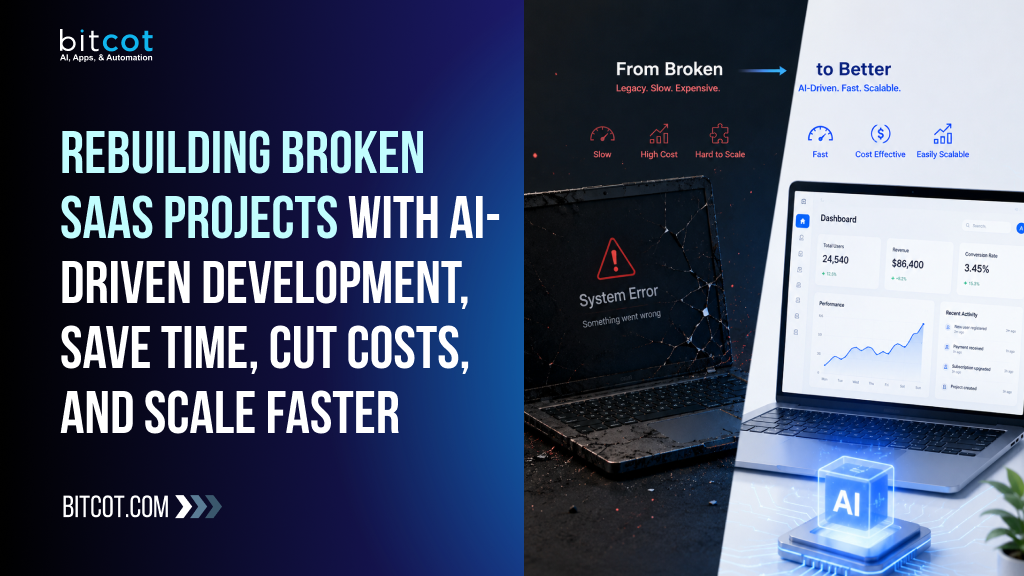
SaaS projects fail to scale because of three compounding technical failure modes that accumulate over time: a database schema designed for the MVP that cannot support multi-tenancy or the data model the scale product requires, a monolithic architecture that makes independent deployment impossible as the engineering team grows, and an integration layer built without a versioning strategy that becomes fragile as third-party dependencies change. Each of these problems is individually manageable early in a product’s life. They become collectively unmanageable when the business has grown to a point where fixing them requires modifying systems that have live customer data and must remain operational during the fix.
What is the difference between rebuilding a SaaS product vs. improving it?
Rebuilding a SaaS product is the right decision when the platform’s structural limitations are distributed across the system rather than isolated to specific modules, when the database schema requires changes affecting more than 40% of production tables to support the next major product requirement, and when three or more of the specific rebuild signal conditions are simultaneously present. Improving is the right decision when limitations are module-specific, the schema can support the next two product cycles, and the engineering velocity problems are concentrated rather than uniform. The most expensive mistake SaaS teams make is treating a rebuild problem as an improvement problem, spending months on improvement work that hits the same architectural ceiling.
How does AI-driven development speed up a SaaS rebuild?
AI-driven development speeds up a SaaS rebuild by compressing three phases that historically make rebuilds slower than expected: the codebase audit phase (AI analysis tools map dependencies and surface undocumented business logic in days rather than weeks), the test coverage phase (AI-assisted test generation produces a behavioral test suite for the existing system before migration begins), and the scaffolding phase (AI generates the boilerplate architecture for the new system in hours rather than days). These three phases together represent most of the calendar time in a traditional rebuild before any visible feature progress is made. Compressing them with AI tooling changes the rebuild from a six-month proposition to a significantly shorter one for most SaaS platforms.
How do SaaS startups in California approach software modernization?
SaaS startups in San Diego, San Francisco, and Los Angeles most commonly approach software modernization through one of three strategies, depending on their platform’s specific structural condition: microservices extraction for platforms where a small number of functions are responsible for most scaling pressure, database layer modernization for platforms where data-layer performance is the primary bottleneck, and AI-assisted legacy migration for platforms with significant business logic in older frameworks. California-based SaaS companies have access to a dense concentration of AI tooling and engineering talent, and the most successful modernization engagements are those that match the modernization strategy to the specific structural diagnosis rather than adopting a strategy based on general preference for microservices or cloud-native architecture.
Is rebuilding a broken SaaS platform worth the investment?
Rebuilding a broken SaaS platform is worth the investment when the cost of not rebuilding, measured in engineering velocity loss, customer churn from reliability issues, and the inability to ship features that would have retained or acquired customers, exceeds the cost and time of a rebuild. For platforms that have crossed the structural thresholds described in this article, the repair path consistently produces diminishing returns because each improvement requires navigating the same architectural constraints that created the original problem. The platforms that rebuild and regret it are those that rebuilt for the wrong reasons, specifically because the codebase felt difficult to work in rather than because it had crossed the structural signal thresholds that indicate fundamental incompatibility with the next product cycle.