- Most multi-layer software delays start at vendor handoffs, not hard code.
- BLS projects 10% growth in software developer jobs through 2035.
- Ask any partner to show the contract between each layer.
- San Diego healthcare and life sciences builds span every stack layer.
- Breadth only works when small teams own layers end to end.
A typical multi-vendor product looks fine on paper: a web agency builds the portal, a mobile shop builds the app, and a cloud consultant runs the infrastructure. Then one API field changes, the mobile app breaks for a week, and three companies spend that week proving it was not their fault. Full-stack software development exists to close that gap, and for San Diego companies building across web, mobile, AI, and cloud, it is often the most practical route.
Hiring your own specialists for every layer is getting harder, not easier. According to the U.S. Bureau of Labor Statistics, employment of software developers, quality assurance analysts, and testers is projected to grow 10% from 2025 to 2035, more than three times the 3% average for all occupations. Companies that need eight distinct skill sets compete for the same scarce talent.
This guide maps the eight technology layers a full-stack partner has to cover, explains the decision that matters most in each, and shows how to judge whether a vendor’s breadth is real. A long technology list proves nothing. What proves capability is a clear contract between every layer and a small team accountable for each one.
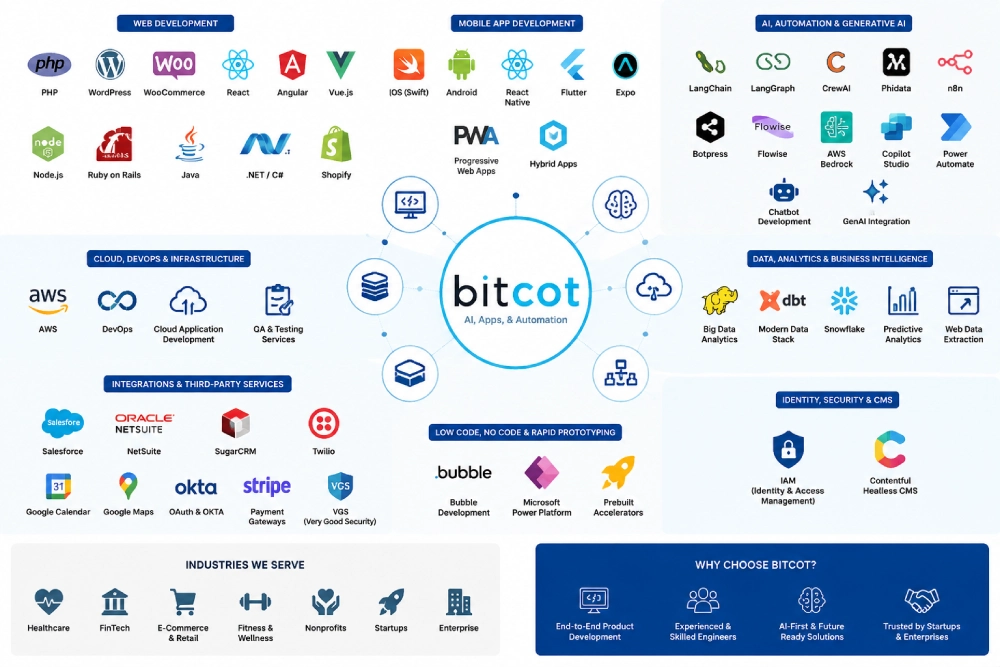
What Is Full-Stack Software Development at Company Scale?
Full-stack software development at company scale means one engineering organization designs, builds, and operates every layer of a product: the interface, the backend, the mobile apps, the AI features, the cloud infrastructure, the data pipeline, and the integrations that connect them. It differs from an individual full-stack developer, who covers frontend and backend code, because it spans disciplines no single person masters.
The value lies in who owns the decisions between layers. When the team designing a database schema also builds the mobile API that reads from it, a change in one place is planned against its effect everywhere else. The table below summarizes the eight layers and the single decision in each that most often shapes the rest of the product.
| Layer | What it covers | The decision that matters most |
|---|---|---|
| Web | PHP, WordPress, React, Angular, Vue.js, Node.js, Rails, Java, .NET | Framework fit for the product’s lifetime, not its launch |
| Mobile | Swift, Android, React Native, Flutter, Expo, PWA | Native access versus shared codebase |
| AI and automation | LangChain, LangGraph, CrewAI, AWS Bedrock, Copilot Studio, n8n | Stateless chain versus stateful agent |
| Cloud and DevOps | AWS, CI/CD, infrastructure as code, QA automation | How independently each service can deploy |
| Data and BI | Ingestion, warehousing, transformation, dashboards | A single source of truth for each metric |
| Integrations | Salesforce, NetSuite, Twilio, payment gateways, OAuth | Who owns each API contract |
| Low-code | Bubble, Power Apps, Power Automate, Power BI | When the platform ceiling will be reached |
| Identity and content | IAM, SSO, Okta, headless CMS such as Contentful | Role design before feature design |
Why Do Multi-Vendor Software Projects Stall at the Handoffs?
Multi-vendor software projects stall at the handoffs because every boundary between companies is also a boundary of context. The frontend team does not know what the backend team assumed, and neither knows what the infrastructure team provisioned, so defects surface only when the pieces meet in staging or production.
Research on delivery performance points to the same cause from a different angle. DORA, the long-running DevOps research program at Google Cloud, finds that teams deliver faster and more reliably when their architecture lets them test, deploy, and change systems without depending on other teams, which keeps the communication needed to get work done to a minimum.
That finding carries a warning for anyone buying full-stack services. A single vendor does not help if it runs one large, tangled team where every change needs a meeting. The model that works is several small, stream-aligned squads under one roof, each owning a layer end to end and connected by documented API contracts, so coordination happens by design rather than by escalation.
Web Development: Frameworks Chosen for the Product’s Lifetime
Web framework choices should be judged by what they cost in year three, not by how fast they ship in month one. Early choices about language, framework, and runtime compound into either an extensible codebase or technical debt that slows every future release.
PHP and WordPress still anchor a large share of content and commerce sites, and custom themes, plugins, multisite networks, and WooCommerce checkout logic call for different skills than a greenfield PHP application. On the JavaScript side, React suits interfaces with complex state shared across many screens, and Angular’s opinionated structure suits large enterprise teams that value consistency. Vue.js development is often the pragmatic middle path when delivery speed matters and the interaction model is contained.
Node.js lets a JavaScript team use one language across the frontend and backend, which reduces context switching in I/O-heavy applications. Ruby on Rails accelerates early product builds through its conventions, while Java and .NET remain the right choice when a client already runs Spring or Azure-based systems and a rewrite would add risk without adding value.
Mobile Apps: When Should You Choose Native, Flutter, React Native, or a PWA?
Choose native development when the product depends on platform features, a cross-platform framework when one codebase must serve both stores, and a progressive web app when speed to market outweighs app store presence. The choice made at kickoff determines what the app can do at launch and how hard it is to extend later.
Native Swift gives full access to HealthKit, Core ML, ARKit, and background processing, which health and fitness products often depend on. Teams that need those capabilities from day one are usually better served by dedicated iOS app development and a matching native Android build than by a shared-code abstraction.
Flutter’s advantage is visual consistency, because it draws its own pixels instead of mapping to each platform’s native components. The rendering engine behind that has changed: according to the official Flutter documentation, Impeller has been the default renderer on iOS and on Android API 29 and above since the 3.27 release, precompiling shaders at build time to avoid the stutter that runtime shader compilation used to cause.
That makes Flutter app development a strong fit when brand-exact visuals matter on both platforms. React Native, often paired with Expo, fits teams already fluent in JavaScript who want native UI components, and PWAs deliver installable, offline-capable experiences without store review cycles.
AI and Automation: Which Framework Fits Which Workflow?
The right AI framework depends on whether the workflow is linear or stateful, whether one agent or several are needed, and where the data is allowed to go. Choosing the wrong one produces an assistant that works in a demo and fails quietly at the edges in production.
LangChain handles retrieval-augmented generation, tool calling, and multi-step chains where the path is predictable. When an agent has to branch on intermediate results, loop, or carry context across many turns, LangGraph’s stateful orchestration is the better foundation, and our LangChain development work treats that choice as the first architectural decision rather than a later refactor.
Multi-agent frameworks such as CrewAI split complex tasks across specialized agents, one retrieving, one evaluating, and one responding. They earn their coordination overhead on research and content pipelines with high information complexity, but they are excessive for a simple FAQ assistant. Visual tools such as n8n and Flowise cover automation where the logic is clear and a no-code interface speeds up piloting.
Data boundaries often decide the platform. AWS Bedrock keeps model access inside a client’s existing AWS account, identity controls, and network boundaries, while Microsoft Copilot Studio does the same for organizations standardized on Microsoft 365. Both routes are common in generative AI integration projects for healthcare and fintech teams in San Diego and Los Angeles.

Cloud, DevOps, and Data: The Layers That Set the Ceiling
Cloud infrastructure sets the ceiling for performance, failure behavior, and release speed, which makes it a product decision rather than a deployment detail. Choices about compute, storage, and service boundaries made at the start determine whether the product can grow without a rebuild.
On AWS, that means matching EC2, Lambda, RDS, S3, CloudFront, and ECS to the application’s traffic pattern and data access model instead of defaulting to one of each. It also means deciding early how services are split, a tradeoff covered in depth in our guide to monolithic vs microservices architecture.

DevOps turns that architecture into reliable delivery through automated tests on every commit, deployment pipelines without manual steps, and infrastructure defined as code. QA embedded in each sprint catches defects while they are still cheap to fix, rather than at a final release gate.
The data layer answers a different question: can the business trust its own numbers? A modern pipeline ingests application and third-party data, transforms it in a warehouse, and serves dashboards from one definition of each metric. Predictive models for churn, demand, or fraud only deliver value once that foundation is consistent.
Integrations, Identity, and Content: Connecting Systems That Were Never Designed to Talk
Integrations decide how much manual work an application actually removes. A product that syncs cleanly with Salesforce, NetSuite, Twilio, and a payment gateway eliminates re-keying, while a product with fragile integrations simply moves the manual work somewhere less visible.
Payment integrations are the clearest example of hidden depth. Beyond the basic API call, a production build handles asynchronous webhook events, subscription billing logic, reconciliation for finance teams, and tokenization services such as VGS so the application never stores raw card data.
Identity and content round out the foundation. Role-based access control and single sign-on through Okta or Azure Active Directory should be designed before features, because retrofitting permissions is slow and error-prone. A headless CMS such as Contentful lets one content repository feed a website, a mobile app, and partner integrations from a single editorial interface.
Low-Code Platforms: When Speed Is the Real Constraint
Low-code platforms are the right choice when validating an idea or shipping an internal tool matters more than deep customization. The discipline lies in knowing, before the build starts, where the platform’s ceiling sits and what the exit path looks like.
Bubble app development delivers working web prototypes and internal tools on timelines custom code cannot match, though complex business logic and high-scale performance eventually push successful products toward a custom stack. Microsoft Power Apps, Power Automate, and Power BI serve organizations already invested in Microsoft 365, extending that investment into internal tools, workflows, and reporting without a separate platform.
Industries: Where Stack Breadth Meets Regulated Reality
Healthcare, fintech, and commerce are where full-stack breadth matters most, because each combines strict data requirements with products that span every layer. A generalist team without domain experience tends to discover those requirements mid-project, when they are most expensive to absorb.
Healthcare software shows the pattern clearly. According to HL7, the FHIR standard is built from modular components called Resources and is designed for use across mobile apps, cloud communications, and EHR-based data sharing. A single clinical data model therefore touches the mobile client, the backend, the cloud, and the analytics layer at once.
That is why telemedicine software development benefits from one team owning the full path from video session to patient record. HIPAA sets the regulatory context for that data, and meeting it depends on audit logging, access controls, and encryption decisions made across every layer rather than bolted onto one.
Fintech products such as lending platforms and fraud detection pipelines combine high transaction volume with strict data integrity. Commerce platforms need WooCommerce or Shopify depth, mobile capability, and payment expertise working together, a combination few single-specialty shops deliver end to end.
How to Evaluate a Full-Stack Software Development Partner
Evaluate a full-stack software development partner by testing how it manages the boundaries between layers, not by counting the technologies on its website. Five questions separate real breadth from a capabilities page.
- Show me an API contract. Ask for a sanitized example of how a past project documented the interface between its backend and mobile app. Teams that work across layers produce these by habit.
- Who owns each layer? Ask for the named lead for web, mobile, AI, cloud, and data on your project. If one person owns everything, the team is too small; if nobody owns a layer, it is outsourced.
- How does a change travel? Ask what happens when a database field changes. A strong answer describes versioned APIs, automated contract tests, and independent deployment for each service.
- What would you not build yourselves? Credible partners name platforms they would buy or configure instead of custom-building, such as a low-code tool for an internal dashboard.
- What broke on a past cross-layer project? A candid answer about a real failure and its fix shows more depth than a polished case study.
Partners that answer these well usually help with more than the build itself, including roadmap decisions that belong to broader digital transformation work, such as which legacy systems to retire first. That strategic view is often worth as much as the engineering itself.
Why San Diego’s Regulated Industries Reward Cross-Layer Teams
San Diego’s economy leans heavily on healthcare systems, life sciences, defense technology, and a growing fintech community, and those sectors rarely ship single-layer products. A clinical trial app, for example, needs a mobile client, a secure backend, cloud hosting with audit trails, and analytics for the research team, all released on the same schedule.
At Bitcot, our 200+ engineers are organized so each layer has a dedicated lead, but every project shares one architecture review where those leads sign off on the contracts between their layers. The recurring lesson from more than a decade of builds across California is that projects rarely stall on hard code; they stall when two teams interpret the same interface differently. A shared review before the first sprint removes most of that risk.

Conclusion
Full-stack software development pays off when breadth comes with structure. Covering web, mobile, AI, cloud, data, integrations, low-code, and identity under one roof removes the vendor handoffs where most multi-layer projects lose time, but only if each layer has a clear owner and every boundary has a documented contract.
When you evaluate partners, ask to see those contracts, meet the layer leads, and hear how a single change travels through the system. A team that answers those questions clearly will keep your architecture coherent as the product grows. If your next project spans more than two layers, that conversation is worth having before the first line of code.
Frequently Asked Questions
What is a full-stack software development company?
A full-stack software development company is an engineering organization that designs, builds, and operates every layer of a product, including web, mobile, AI, cloud, data, and integrations. The advantage is that decisions between layers, such as how a database change affects the mobile app, are planned by one accountable team instead of negotiated between vendors.
Is it better to hire one full-stack partner or several specialist vendors?
One full-stack partner is usually better when a product spans several layers that change together, because it removes handoffs between companies. Several specialists can work when layers are truly independent, and each vendor has a documented API contract with the others. In either model, the deciding factor is clear ownership of every interface.
How do I evaluate a full-stack software development partner?
Evaluate a partner by asking to see a real API contract, meeting the lead for each layer, and asking how a single database change travels through the system. Strong partners also name tools they would buy rather than build and speak candidly about past cross-layer failures and how they fixed them.
Why do San Diego companies look for full-stack software partners?
San Diego companies in healthcare, life sciences, defense technology, and fintech often build products that combine mobile apps, secure backends, cloud hosting, and analytics in one release. Those products depend on consistent decisions across every layer, and national demand for software developers makes hiring every specialist in-house difficult.
Is relying on one software partner for every layer risky?
Relying on one partner is low risk when that partner organizes small teams around each layer and documents the contracts between them. The real risk is a single large team without clear ownership, so ask who leads each layer, how services deploy independently, and how documentation would let another team take over if needed.