Key Takeaways
- Rebuild costs consistently exceed estimates once opportunity cost, scope expansion, and user disruption are factored in.
- AI-powered code analysis has made incremental modernization a viable alternative in scenarios that previously required a full rebuild.
- Four factors determine the right path: architecture health, embedded logic depth, team bandwidth, and user disruption tolerance.
- Choosing optimization over rebuild when the architecture is sound delivers faster results without freezing feature development.
- An objective codebase assessment before committing resources is the single highest-value step in this decision.
Introduction
The rebuild-versus-fix decision is one of the most expensive choices a SaaS team can make, and most teams are making it with the wrong cost framework. The stated estimate for a rebuild never reflects the full picture, opportunity cost, scope expansion, user disruption, and feature velocity loss all compound the real number significantly. At the same time, deferring the decision entirely carries its own hidden cost as technical debt silently erodes development speed quarter by quarter.
What changed this calculus is AI-driven development, which has made incremental modernization faster and more predictable than ever before. A codebase that would have required a full rebuild three years ago can now be audited, mapped, and improved using AI-powered tools in a fraction of the time. Teams still applying pre-AI cost assumptions are optimizing for a world that no longer exists.
What the True SaaS Development Cost of a Rebuild Actually Includes
The stated estimate for a SaaS rebuild covers engineering hours, infrastructure setup, and QA. What it rarely accounts for is the full cost picture that leadership discovers six months into the project. Understanding what that full picture includes is the starting point for any honest rebuild-versus-fix analysis.
Opportunity cost of frozen development. A team engaged in a rebuild cannot simultaneously ship new features on the existing product. Every sprint devoted to rebuilding infrastructure is a sprint not spent on the roadmap items that drive user acquisition and retention. For SaaS businesses operating in competitive markets, a twelve-month feature freeze has revenue consequences that do not appear on the initial project estimate.
Scope expansion risk. According to Gartner’s research on IT project delivery, scope expansion is the most common driver of cost overruns in large software projects. Rebuilds are particularly vulnerable because the team consistently underestimates the volume of edge cases and integrations embedded in the legacy system that were never formally documented. Each undiscovered dependency expands the scope and pushes the timeline out further.
User disruption and migration cost. Moving an active user base from a legacy system to a rebuilt one is an engineering and support effort that project estimates frequently undercount. Data migration, user re-onboarding, and the support load generated by behavioral changes in a new interface all carry real costs that extend well past the “go-live” date on the project timeline.
Team knowledge loss. Rebuilds frequently require bringing in new engineers with different specializations, which means the institutional knowledge embedded in the existing team gets diluted. Knowledge transfer itself consumes engineering time that does not appear in code output metrics but contributes meaningfully to the total project cost.

The Hidden Software Maintenance Cost That Makes “Doing Nothing” Dangerous
If the cost of rebuilding is higher than it appears, so is the cost of deferring the decision entirely. Software maintenance cost in a system with accumulating technical debt does not stay flat. It compounds, because each new feature added to a fragile codebase increases the surface area that future changes must work around.
According to Harvard Business Review’s coverage of technical debt in software organizations, engineering teams in high-debt systems spend the majority of their development time on maintenance and defect remediation rather than new feature work. The ratio worsens as the system ages. A team that was shipping three meaningful features per sprint two years ago may be shipping one today, not because the team got smaller, but because the maintenance burden got larger.
This is the cost of inaction: not a single large expense, but a gradual erosion of development velocity that is easy to rationalize quarter-by-quarter and difficult to reverse without deliberate intervention. The danger of framing the decision as “rebuild versus do nothing” is that “do nothing” has a cost too, it just arrives in smaller increments that are easier to absorb until they are not.
The relevant question is not whether to address the problem. It is whether AI-driven optimization or a full rebuild delivers the better outcome for the specific architecture and business context at hand.
How AI-Driven Development Changes the Software Rebuild vs Repair Equation
The traditional argument for choosing a rebuild over optimization was speed: it would take too long to untangle the legacy codebase incrementally, so starting fresh was the faster path to a maintainable system. That argument was reasonable before AI-powered code analysis became widely available. It is much harder to sustain today.
AI tools can now parse an entire legacy codebase, map dependency relationships, surface undocumented business logic, identify dead code, and generate a prioritized modernization plan in a fraction of the time that a manual audit previously required. What took a team of senior engineers weeks to reconstruct by reading source code now takes days with AI-assisted analysis. That shift dramatically changes the cost comparison between rebuild and repair for any system where the core architecture is structurally sound.
According to GitHub’s research on AI-assisted developer productivity, engineers using AI pair programmers complete coding tasks significantly faster, with the largest gains in the categories that dominate optimization work: documentation, test generation, and code refactoring. For teams investing in AI/ML development tooling, those productivity gains translate directly into a lower resource cost for optimization projects.
The more significant shift is in risk reduction. AI-generated dependency maps catch the undocumented integrations that cause rebuilds to expand in scope. When an optimization project begins with an AI-produced audit of what exists and what depends on what, the team can plan incremental improvements with far more confidence that each change is scoped correctly. Scope confidence is a cost driver: uncertain scope expands; confident scope stays bounded.
Cost Comparison: SaaS Rebuild vs AI-Driven Optimization
The following comparison covers the primary dimensions that determine which approach delivers better outcomes. No column represents a guarantee; each reflects the typical pattern observed across software teams that have executed both approaches.
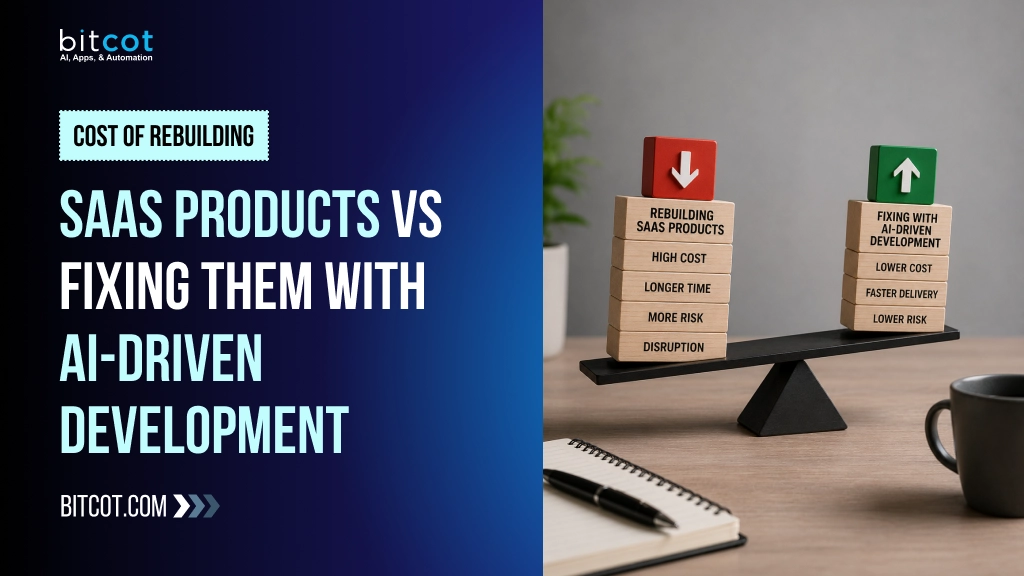
| Dimension | Full SaaS Rebuild | AI-Driven Optimization |
|---|---|---|
| Time to first production value | Typically, 6 to 18 months before users see a meaningful change | First improvements are often deployable within weeks of audit completion |
| Scope expansion risk | High — undocumented dependencies surface mid-project regularly | Lower — AI audit maps dependencies before work begins |
| Feature velocity during execution | Near zero — team is fully consumed by rebuild | Partial — some team capacity remains for roadmap work |
| User disruption | High — cutover events, migration friction, new UI learning curve | Low — changes deploy incrementally behind existing interfaces |
| The right approach when the architecture is sound | Overkill — introduces unnecessary risk to a viable foundation | Right-sized — improves the system without discarding its value |
| The right approach when the architecture is broken | Necessary — some foundations cannot be incrementally repaired | Insufficient — optimization cannot fix fundamental design failures |
| Long-term maintenance trajectory | Resets to a clean baseline — but only if the rebuild completes successfully | Improves incrementally with each AI-assisted optimization cycle |
The table makes the central point visible: neither approach is universally superior. The rebuild wins when the architecture is fundamentally broken, and there is no viable path to incremental improvement. AI-driven optimization wins in every other scenario, particularly for SaaS products with viable core logic that have accumulated technical debt through rapid growth or deferred refactoring.

When to Rebuild a SaaS Product vs Improve It: A Decision Framework
A practical decision framework for the rebuild-versus-fix question evaluates four factors in sequence. Working through them in order prevents the common mistake of deciding based on how painful the codebase feels to work with rather than what the architecture actually supports.
Factor 1: Is the core architecture structurally viable? A structurally viable architecture is one where the fundamental data model, the service boundaries, and the integration patterns can accommodate the product’s next phase of growth without requiring wholesale replacement. If the architecture is viable, AI-driven optimization is almost always the more efficient path. If the architecture is broken at the foundation level, meaning the data model cannot represent the business domain correctly, or the service design creates irreversible coupling, then a rebuild is the right call regardless of other factors.
Factor 2: How deep is the embedded business logic? Legacy systems accumulate undocumented business rules over years of operation. The deeper that logic is embedded in the existing codebase, the more valuable it is, and the more risk a rebuild introduces. Rebuilds that discard legacy logic without fully reconstructing it consistently produce systems that handle common cases correctly but fail on edge cases that were quietly handled by the old system. AI-powered code analysis reduces this risk by extracting and documenting embedded logic before any migration decisions are made.
Factor 3: What is the team’s realistic bandwidth? A rebuild requires total or near-total team focus for its duration. If the business cannot sustain a feature freeze for the time required, the rebuild will be interrupted, which is the worst possible outcome: partial rebuilds are more expensive than either a complete rebuild or a well-executed optimization, because they produce a system that is half old and half new with mismatched assumptions in both halves.
Factor 4: What level of user disruption can the business absorb? SaaS businesses with deeply embedded user workflows face significant churn risk during major platform transitions. If the user base is operationally dependent on specific behaviors in the current product, a rebuild that changes those behaviors at once is a retention risk. AI-driven optimization, which delivers changes incrementally and preserves existing interfaces during transition, is structurally lower-risk in these contexts. Custom software development that uses AI tooling to modernize incrementally keeps users on a stable product throughout.
How SaaS Teams in California Are Rethinking the Rebuild Decision
Across California’s SaaS ecosystem, the rebuild-versus-fix conversation has been shifting. In Los Angeles, SaaS companies serving the entertainment and media industries have moved away from big-bang rebuild projects after repeated experiences with scope expansion and delayed launches. The pattern that replaced it is an AI-powered codebase audit followed by prioritized optimization sprints: teams use AI analysis to identify the highest-friction components in the existing system and fix those first, rather than replacing the entire product at once.
In San Diego, the healthcare and fintech SaaS companies that have the clearest view of software rebuild vs repair decisions are the ones that have lived through both paths. The observation that comes up consistently in those conversations: the teams that chose rebuilds when their architecture was still viable did not get a better product. They got the same product rebuilt on newer infrastructure, at a higher cost, and after a longer wait. The teams that chose AI-driven optimization for viable architectures got improvements faster and maintained the ability to ship new features throughout the process.
The region’s digital transformation work has also pushed this conversation forward. As more organizations pursue modernization of their technology stack, the question of how to modernize efficiently has become central. AI-assisted approaches have repeatedly proven to be the more resource-efficient path when the underlying architecture supports incremental improvement.
Is AI-Driven Optimization Just Technical Debt Deferred, or Does It Actually Resolve It?
This is the objection worth taking seriously. There is a version of “AI-driven optimization” that applies surface-level fixes to a broken architecture and calls the work complete. That version does defer technical debt rather than resolve it, and it is a legitimate failure mode. Recognizing it requires distinguishing between optimization that addresses root causes and optimization that addresses symptoms.
Root-cause optimization changes the underlying architecture: it extracts tightly coupled services into independently deployable modules, replaces synchronous dependencies with event-driven patterns where appropriate, and rebuilds the components whose design prevents the system from scaling. AI-assisted development accelerates each of these changes by generating accurate code for the refactored components and producing test coverage that validates behavioral equivalence with the original.
Symptom-level optimization adds caching in front of slow queries without fixing the query structure, or adds error handling around integration failures without resolving why the integration fails. This is the version that defers technical debt, and it is easily confused with genuine modernization when the short-term symptoms disappear.
According to McKinsey’s analysis of technical debt in software organizations, the difference between these two approaches is visible in the trajectory: genuine modernization reduces the maintenance burden over subsequent quarters; symptom-level fixes hold the burden steady briefly before it returns. The right question to ask of any optimization plan is: “Does this change reduce the cost of future changes, or does it just make today’s problem disappear?”

What We’ve Seen Working on Real SaaS Projects
Working across healthcare and fintech software projects in San Diego and beyond, we encounter the rebuild-versus-fix question regularly. The pattern we observe most often: teams that choose to rebuild are frequently responding to developer frustration with the current codebase rather than to an objective architectural assessment. Developer frustration is real and worth addressing, but it is not the same signal as architectural failure. A codebase that is painful to work with and a codebase that cannot support the business are two different problems with different solutions.
The teams that consistently make the right call are the ones that separate the assessment from the sentiment. They use AI-powered code analysis to understand what the architecture actually supports, independent of how working with it feels. That objective view usually reveals that the architecture is more viable than the team’s experience suggests, and that the friction is coming from specific components that can be targeted rather than from the entire system. Our recommendation through AI consulting work is always: assess before you commit. The cost of a thorough assessment is a fraction of the cost of the wrong decision.

Conclusion
The SaaS development cost of a rebuild is almost always higher than the initial estimate, and the cost of AI-driven optimization is almost always lower than teams expect when they have not used AI tooling for modernization before. The gap between those two reality-adjusted figures is what makes the rebuild-versus-fix decision so consequential. Getting it wrong in either direction is expensive: choosing a rebuild when optimization would have worked wastes months and competitive position; choosing optimization when the architecture is genuinely broken just delays a necessary decision while adding cost.
The right framework is not “which option feels faster” or “which option feels less painful.” It is a structured assessment of architectural viability, embedded business logic value, team bandwidth, and user disruption tolerance, conducted with the help of tools that can give you an accurate picture of what you are actually working with. If your team is facing this decision, start with the assessment. The answer will become clear faster than you expect.
Frequently Asked Questions
What is SaaS development cost and what factors drive it?
SaaS development cost refers to the total resources required to build, maintain, or modernize a software-as-a-service product, including engineering time, infrastructure, QA, and the opportunity cost of work deferred during development cycles. As this article describes, the true cost of major development efforts like rebuilds regularly exceeds initial estimates due to scope expansion, undiscovered dependencies, and the feature velocity lost while the team is focused on the rebuild rather than the product roadmap. Understanding cost in these broader terms is essential to making an accurate rebuild-versus-fix comparison.
What is the difference between rebuilding and refactoring a SaaS product?
Rebuilding a SaaS product means discarding the existing codebase and constructing a replacement from scratch on new architecture, while refactoring or optimizing means improving the existing codebase incrementally without replacing it wholesale. The decision framework in this article identifies the key distinction: rebuilding is the right choice when the architecture is fundamentally broken and cannot support the business’s needs through incremental improvement; refactoring with AI-driven development is the right choice when the architecture is viable but has accumulated technical debt that is reducing development velocity. Most SaaS products fall into the second category.
How does AI-driven development reduce software maintenance cost?
AI-driven development reduces software maintenance cost primarily by compressing the time and resources required for the highest-friction maintenance tasks: code audits, dependency mapping, test generation, and refactoring. According to GitHub’s research on AI-assisted developer productivity, engineers using AI tools complete coding tasks significantly faster in exactly these categories. As this article explains, AI-powered codebase analysis also produces dependency maps that reduce scope expansion during optimization projects, which is one of the primary cost drivers in both maintenance and modernization work.
How are SaaS companies in San Diego approaching the software rebuild decision?
SaaS companies in San Diego, particularly those in healthcare and fintech, are increasingly using AI-powered code analysis to conduct objective architectural assessments before committing resources to either a rebuild or an optimization path. The pattern described in this article, separating the architectural assessment from developer sentiment about the current codebase, has become a more deliberate step in the decision process for teams that have experienced the cost of rebuild projects that overran their scope or timeline. The result is more rebuild decisions being reversed in favor of targeted AI-driven optimization once the architectural assessment reveals a viable foundation.
Is fixing legacy software with AI worth it, or should teams just rebuild from scratch?
Fixing legacy software with AI-driven development is worth it when the core architecture is structurally viable, meaning it can support the product’s next phase of growth without wholesale replacement. As this article’s decision framework outlines, AI-driven optimization is typically the better choice when embedded business logic is deep, when team bandwidth for a feature freeze is limited, or when user disruption from a cutover would create retention risk. A full rebuild makes sense only when the architecture itself is fundamentally broken in ways that cannot be resolved incrementally. For most SaaS products that have grown through rapid iteration, the architecture is viable and AI-driven optimization is the more resource-efficient path.