Key Takeaways
- Hospital-provided apps carry instant patient trust versus generic health apps.
- Auto-synced prescriptions eliminate manual medication entry errors.
- Video consults cut unnecessary travel, saving patients time and money.
- San Diego oncology teams report better adherence with prescribed movement alerts.
- Direct social worker connections inside the app solve financial barriers with one tap.
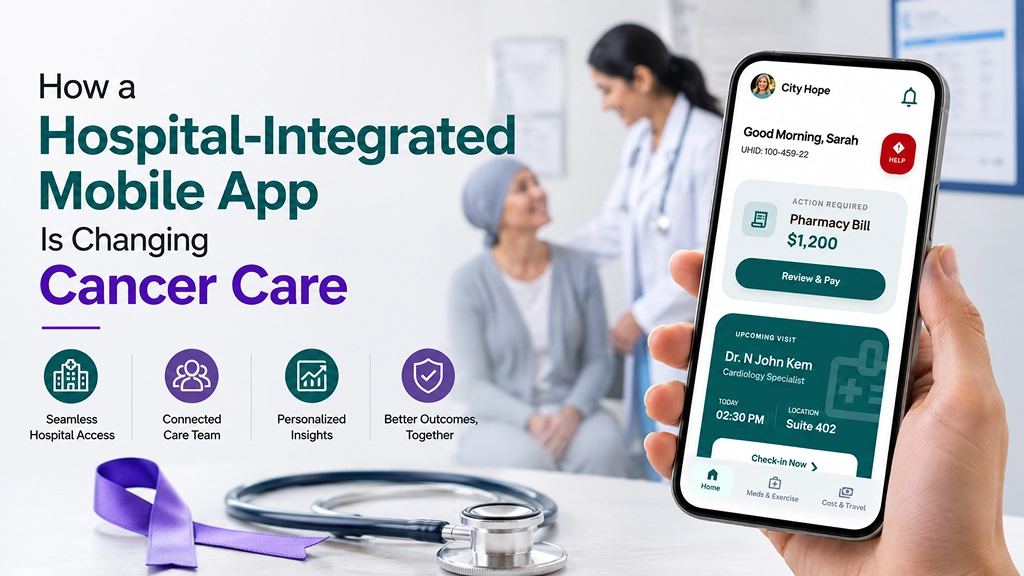
A cancer patient managing chemotherapy, follow-up appointments, and daily medication schedules carries a cognitive burden most people never experience. In healthcare, patient data is among the most sensitive information handled by any software system, requiring hospitals to ensure that any digital tool handling protected health information maintains strict access controls, encryption, and audit trails. That regulatory reality shapes every decision in how a hospital-integrated app should be built. When City Hope Health designed their oncology companion app, the engineering brief was not just “send reminders,” it was “connect directly to hospital records while keeping patient data protected at every layer.”
The result is a mobile experience that pulls prescription data directly from the EMR through the hospital’s own secure infrastructure, offers video consults as the default visit option, and connects patients to financial assistance without exposing sensitive records to third-party systems. Patients scan a QR code at discharge, enter their UHID, verify via OTP, and their full care plan loads automatically, with no manual entry, no external data brokers, and no risk of a patient entering the wrong dosage for a drug they cannot pronounce.
Why Generic Reminder Apps Fall Short for Cancer Patients
Generic medication apps ask patients to type in drug names, dosages, and schedules themselves. For a cancer patient managing oral chemotherapy like Capecitabine alongside multiple supportive medications, this creates real risk. A wrong dose entry or a missed update when the oncologist adjusts a regimen can have serious consequences.
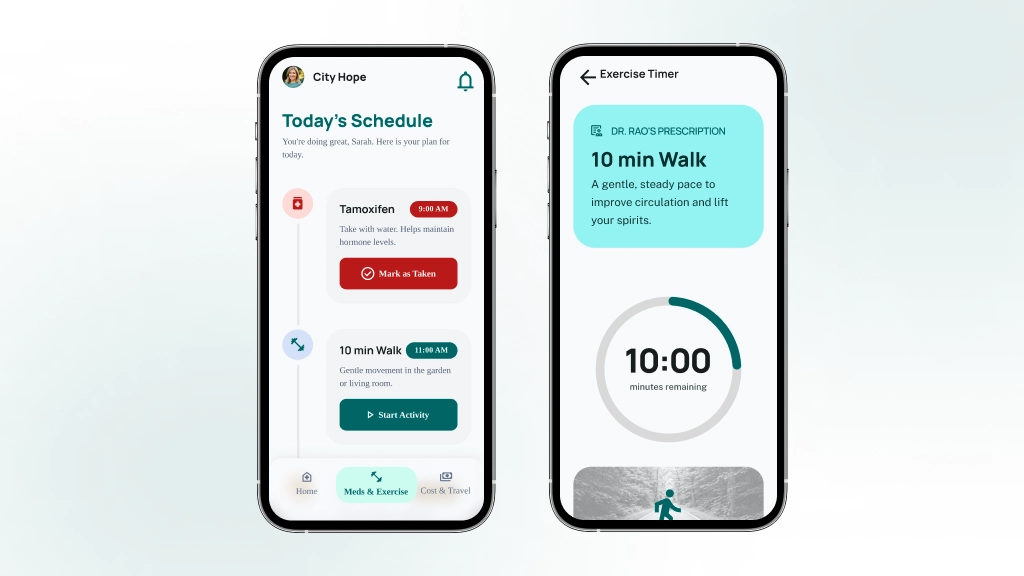
According to research published in the Journal of Clinical Oncology, non-adherence to oral anti-cancer therapy affects roughly 20–30% of patients, with the complexity of regimen cited as a primary driver. The City Hope app addresses this at the architecture level: when a doctor updates a prescription in the hospital EMR, the patient’s app reflects the change automatically. The reminder at 2:00 PM shows a photo of the actual pill, the correct dose, and preparation instructions. If three consecutive doses are skipped, the care team receives an alert.
Exercise compliance follows the same logic. Instead of a generic “stay active” notification, the app surfaces: “Dr. Rao prescribed: 10-min Walk 11:00 AM.” A built-in timer tracks completion and logs it back to the patient’s record.
Video Consults as a Default, Not an Afterthought
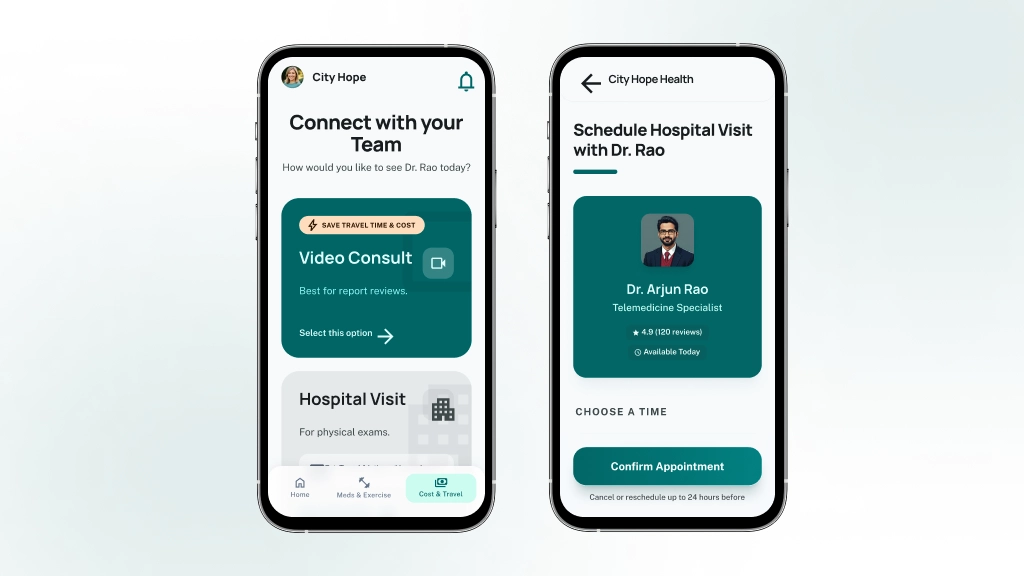
One of the most impactful design decisions in the City Hope app is how appointment booking is framed. When a patient needs to connect with their care team, the first option presented is Video Consult, labeled “Save Travel Time & Cost,” with the in-person hospital visit positioned as the secondary choice for cases requiring physical examination.
This matters enormously for patients in rural areas or those managing fatigue from treatment. The scheduling flow lets patients select from available slots with Dr. Rao, confirm the appointment, and receive session details via SMS, all in under two minutes. The booking confirmation screen reinforces what to expect: a secure, encrypted video link, no travel required, and a reminder that the physician has already reviewed their medical history before the call begins.
For healthcare software teams building similar flows, the key engineering consideration is session security. HIPAA requires that any electronic transmission of patient health information be encrypted and access-controlled. A telemedicine session discussing chemotherapy results and upcoming prescriptions is exactly that kind of transmission. The app displays “Secure Video Link Encrypted” not as a marketing badge but as contextual reassurance at the moment it matters most: right before the patient joins a call where their medical history will be discussed.
Solving the Financial and Travel Barrier Inside the App
Financial stress is one of the least-discussed side effects of cancer treatment. Patients in lower-income brackets often skip follow-ups not because they are unwilling, but because the cost of travel and lost wages makes each visit a difficult calculation.
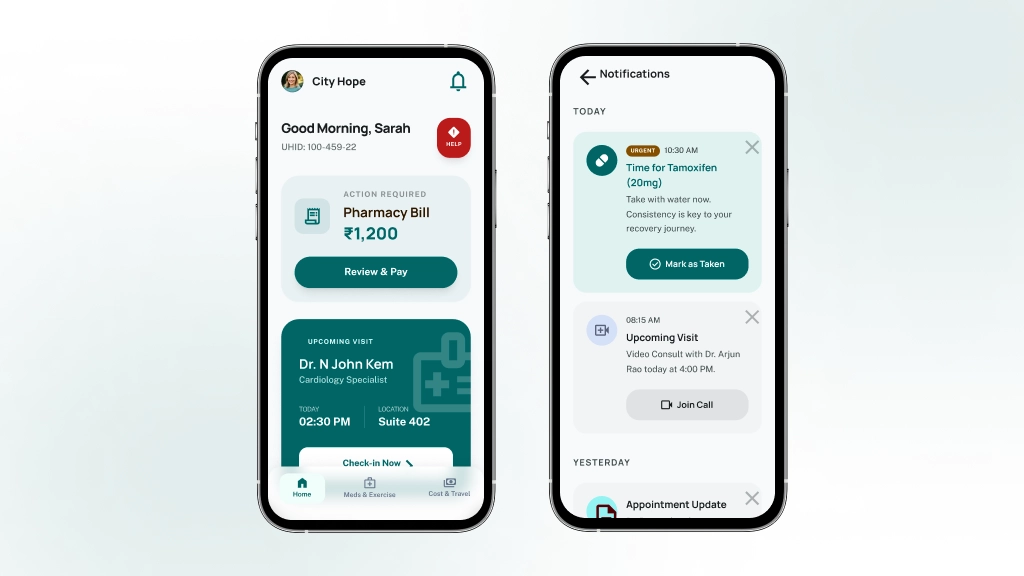
The City Hope app’s Cost & Travel section addresses this directly. A travel allowance voucher appears on the home dashboard with a single “Claim” button. The financial aid flow lets patients self-identify their status as BPL cardholders, income below a threshold, and the system matches them with available hospital grants and government schemes. The outcome screen does not bury them in paperwork; it shows the matched scheme and offers one action: “Request Call from Social Worker,” with a 24-hour callback commitment.
According to the Journal of Oncology Practice, financial toxicity affects quality of life and treatment adherence in a significant share of cancer patients, particularly those without comprehensive insurance. Building a direct social work connection into the clinical app rather than routing patients to a separate portal is a software architecture decision with real clinical impact. Our engineering team has found that reducing the number of steps between a patient’s need and the relevant resource is where the biggest compliance gains come from in healthcare app development.

What This Design Pattern Means for Healthcare Product Teams
The City Hope app succeeds because it is built around the hospital’s existing data infrastructure, not around what a standalone app can independently collect. The telemedicine software development decisions EMR sync at onboarding, auto-updating prescriptions, care-team alerts on missed doses, only work because the hospital owns both the clinical data and the patient relationship.
For product teams evaluating similar builds, the architecture question is not “what features should the app have” but “what hospital data can the app surface in the right context at the right moment.” The exercise timer is only useful because it references a specific doctor’s prescription. The financial aid flow works because it connects to real hospital programs. The video consult saves a real journey because it is integrated with the actual scheduling system, not a third-party booking widget bolted on afterward.
Healthcare custom software development in oncology requires this kind of tight integration thinking from the first design sprint. The screens are clean. The flows are short. But the engineering behind each interaction is what makes the difference between an app patients actually use and one they delete after their first appointment.
Conclusion
A hospital-integrated cancer app succeeds when the data layer is built correctly, with EMR sync, encrypted communications as HIPAA requires, and direct connections to real hospital programs rather than generic third-party tools. The City Hope design shows what that looks like in practice. For product teams planning a similar build, the architecture conversation needs to start well before the first mockup.
Frequently Asked Questions
What is a hospital-integrated cancer patient app?
A hospital-integrated cancer patient app is a mobile application that connects directly to a hospital’s electronic medical records system, pulling real prescription data, appointment schedules, and care plans automatically rather than relying on manual patient entry. This eliminates data entry errors and ensures patients always see the most current information from their care team.
How is this different from generic health reminder apps like Cancer.Net?
Generic health apps require patients to manually input every medication, dosage, and appointment. A hospital-integrated app like City Hope syncs this data directly from the EMR, so when a doctor updates a prescription, the patient’s app updates automatically. Generic apps also cannot offer features like care-team alerts on missed doses or direct social worker connections tied to real hospital programs.
How does the video consult feature reduce costs for cancer patients?
By presenting video consult as the default appointment option for follow-ups that do not require physical examination, the app eliminates travel time, transportation costs, and exposure risks for immunocompromised patients. Patients can review reports, discuss lab results, and receive prescription updates without leaving home.
Which patient populations benefit most from this type of app in a hospital setting?
Patients managing oral chemotherapy regimens, those living far from the treatment center, and lower-income patients who face financial barriers to in-person visits benefit the most. In San Diego and across California, oncology programs serving rural catchment areas have seen measurable improvements in appointment adherence when travel friction is reduced through integrated telemedicine options.
Is a custom hospital app worth the investment compared to off-the-shelf solutions?
For hospitals with existing EMR infrastructure, a custom-integrated app delivers value that off-the-shelf solutions cannot match automatic prescription sync, care-team alerting on missed doses, and direct financial aid workflows tied to the hospital’s own programs. The investment pays off in measurable adherence improvements and reduced care coordination overhead that generic apps never address.
Which cities does Bitcot serve for mobile app development?
Bitcot provides mobile app development services across major US cities, including San Diego, Los Angeles, Orange County, San Francisco, San Jose, Las Vegas, Denver, Chicago, and Miami. Whether you are a startup or an enterprise, our team delivers iOS, Android, and cross-platform apps tailored to your market.