Key Takeaways
- Agentic tools amplify whatever structure they are given. With deliberate standards, they amplify speed and consistency. Without them, they amplify inconsistency and risk just as fast.
- The bottleneck moves from implementation to judgment. Specifying, verifying, and governing become the high-value work.
- The durable advantage is a system, not a tool. Teams that encode their standards into a reusable harness compound their lead with every project.
For most of software’s history, the constraint was implementation. Skilled engineers turned intent into working code line by line, and that work was the bottleneck. Agentic tools remove much of that constraint, and when they do, the work does not vanish. It moves.
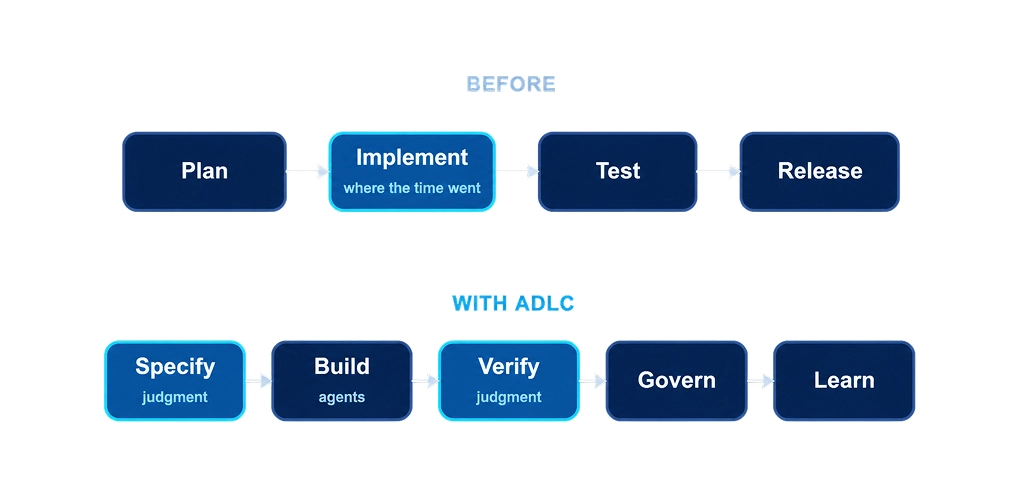
The shift: leverage moves from typing code to specifying intent and verifying output.
The new leverage lies in specifying intent precisely, proving output rigorously, and governing how agents operate. Software engineering is becoming less about producing code and more about directing and proving it. That single shift has consequences for cost, speed, quality, and risk, which is why it matters to the business as much as the engineering team.

01 The business case for the shift
For a business leader, the headline is not that AI writes code. Is it that a well-run agentic practice changes the economics of delivery? The effect shows up in several places at once.
Speed and throughput
Routine implementation, boilerplate, test scaffolding, refactors, and migrations compress from days to hours. Teams take on more in parallel because agents handle the repeatable layers while engineers focus on the parts that need judgment. The result is shorter cycle times and faster time to value, without simply adding headcount.
Cost structure and predictability
When standards are encoded and checks are automated, delivery becomes more predictable. Rework drops because output is validated before it reaches review. Cost variance narrows because the same harness produces consistent results across teams and projects, rather than depending on who happens to be staffed.
Quality and security as a default, not an afterthought
This is the part leaders most often miss. Raw agent output is not automatically safe or maintainable. Quality comes from the surrounding system: automated checks that scan for secrets, enforce tests and formatting, and block risky changes, plus acceptance gates that define what correct actually means. Encode your standards into software once, and every change inherits them.
Talent leverage and competitive moat
Your best engineers stop spending their time on repetitive work and start spending it on architecture, product judgment, and the standards that everyone else inherits. That is a force multiplier on the talent you already have. Over time, it becomes a moat, because a practice that improves with every project is very hard for a competitor to copy from the outside.
02 The technical foundation: harness and loop
Underneath the business outcomes is a concrete operating model. Two ideas carry most of the weight: the harness and the lifecycle that runs on it.
What a harness is
A harness is the connective tissue that makes an AI agent productive and safe inside a real codebase. It is not the model, and it is not the tool. It is the guardrails, process, domain context, and stack conventions that turn a capable but generic agent into one whose work is correct, secure, and idiomatic to how a team builds. A useful way to think about it: an agent on day one is a brilliant new engineer, fast and capable, but with no knowledge of your standards, your codebase, or what is off limits. The harness is everything you would give to hire to be trusted with real work, except that it is executable, so people and agents follow it automatically.
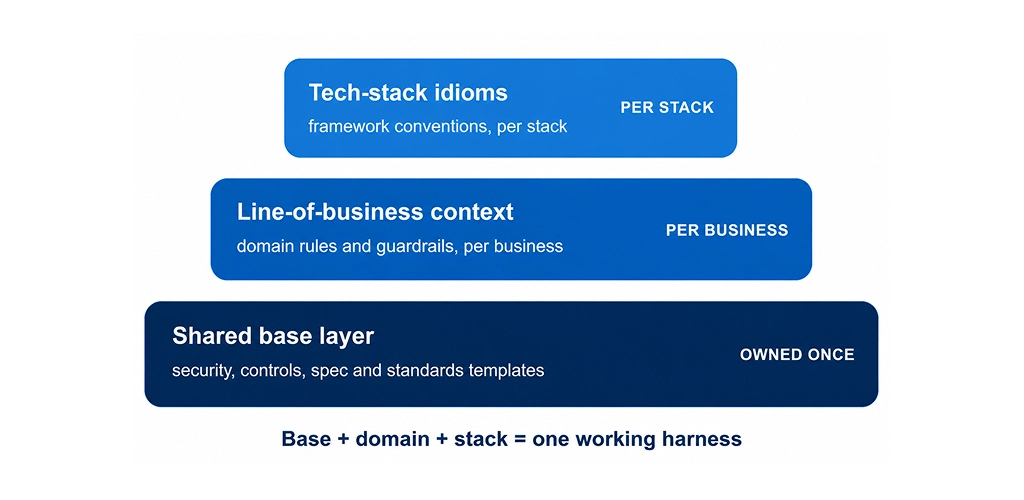
Anatomy of a harness: a shared base layer, reused everywhere, composes with per-business context and per-stack conventions.
The Agentic Development Lifecycle
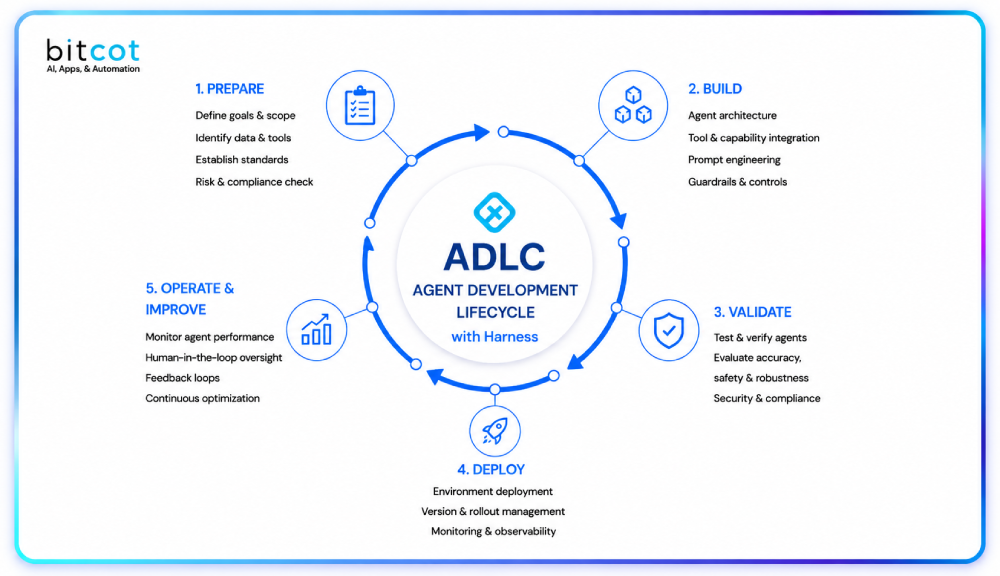
The harness is the foundation. The Agentic Development Lifecycle, or ADLC, is the loop that runs on it. Engineers direct, agents do the repeatable work, and every stage is governed by the harness, so the output is trustworthy by default.
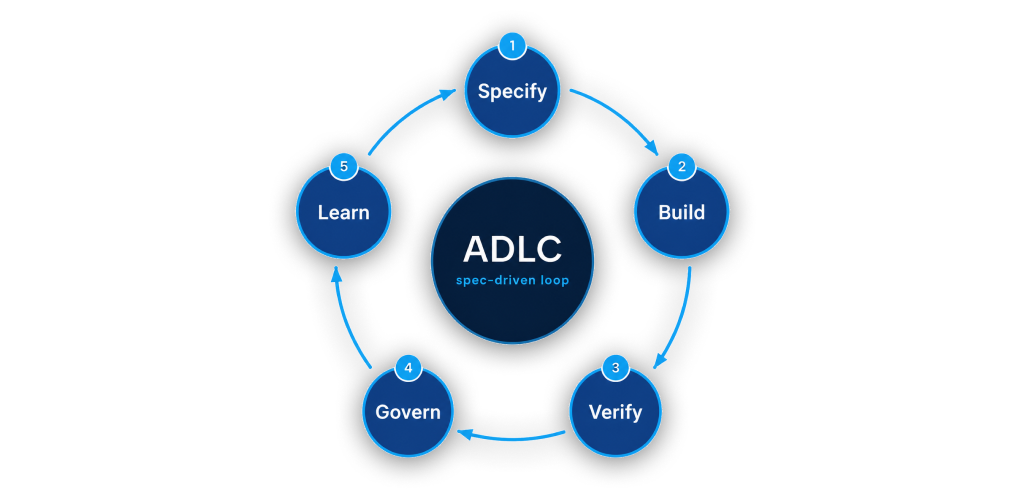
The ADLC loop. Five stages run continuously, each one running on the harness.
Specify. Intent becomes a spec, then a plan, then tasks, anchored by project-wide constraints that act as executable validation gates. Build. Discipline-specific agents write idiomatic code across each stack, guided by encoded conventions and a reusable skills library. Verify. Evals and golden scenarios act as acceptance gates, so done means measurably passes rather than looks finished. Govern and ship. Reviewer and security agents check the work, automated hooks enforce non-negotiables, and changes ship through connectors scoped with least privilege. Learn. Metrics and observability show what is working, and the harness is versioned and improved so the next cycle starts from a higher floor.

03 Why the advantage compounds
A harness is never finished in a single pass. Its components are versioned and backed by evals, and they improve with every project and every evaluation cycle. The first build carries the most effort because it establishes the shared base layer. Every build after that is cheaper, because it reuses the foundation and only adds the new domain or stack.
This is also the economic argument for centralizing the capability rather than letting each team reinvent it. Built ad hoc, every line of business times every tech stack becomes a separate bespoke harness, which fragments standards and guarantees drift. With a central base layer, each additional harness is a composition, not a rebuild.
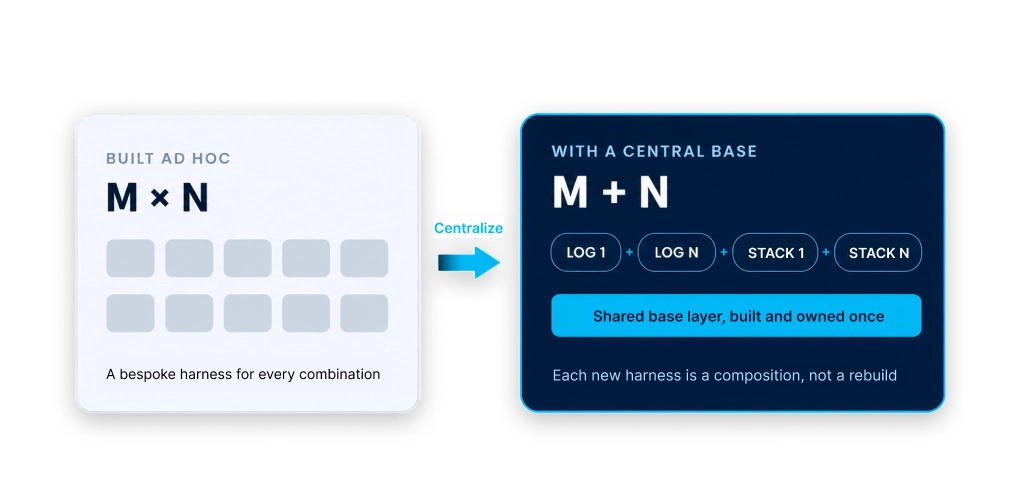
The economics: a shared base layer turns M times N bespoke builds into M plus N compositions.
The practical effect is that the practice gets safer, broader, and more autonomous over time, instead of being a fixed deliverable that ages. Value compounds, and the gap between a disciplined adopter and a casual one widens with every release.
04 What this means for your roadmap
The teams pulling ahead are not the ones with the most tools. They are the ones who treated agentic development as a standards program: a shared base layer of controls and conventions, proven on a small real slice with evals as the gate, then composed outward across teams and stacks. Start there, measure honestly, and let the foundation compound.
At Bitcot, this is how we build. We run an internal Agentic Development Lifecycle across our Python, Node, React, DevOps, PHP, and QA disciplines, and across our own operations, on a harness that improves with every engagement. We bring that same discipline to client work in healthcare, fintech, and enterprise software, where correctness, security, and auditability are not optional.
Frequently Asked Questions (FAQs)
What is the Agentic Development Lifecycle (ADLC)?
It is a delivery model in which AI agents perform much of the repeatable engineering work while engineers direct, verify, and govern it. It runs as a continuous loop: Specify, Build, Verify, Govern, Learn, on a shared foundation called a harness that encodes standards, context, and guardrails.
How is this different from an AI coding assistant?
An assistant suggests code inside your editor. Agentic development runs whole workflows: planning from a spec, writing and testing code, opening reviews, and shipping through governed pipelines. The value comes from the surrounding system of standards and checks, not from autocomplete.
Is AI generated code secure and maintainable?
It can be, when the agent operates inside a harness. Hooks scan for secrets and enforce tests and formatting, evals act as acceptance gates, and connectors run with least privilege. Quality comes from the guardrails, not from trusting raw output.
Will AI agents replace software engineers?
No. The work shifts rather than disappears. Engineers move up the value chain toward specifying intent, designing systems, defining what correct means, and governing how agents operate. Judgment becomes the scarce resource.
What exactly is a harness?
It is the connective tissue that makes an AI agent productive and safe inside a real codebase: the guardrails, process, domain context, and stack conventions that make output correct, secure, and idiomatic to how your team builds. It is not the model or the tool.
How do we adopt this without adding risk?
Start with a shared base layer of standards and controls, prove it on a small real slice with evals as acceptance gates, then compose additional teams and stacks onto the proven base. Treat it as a standards program, not a tooling rollout.