Enterprise leaders face a familiar dilemma: innovation demands speed, but traditional development cycles eat months. Your teams drown in manual tasks while competitors ship faster solutions.
What if you could build custom business applications in days, not quarters, without draining your IT budget?
Here’s the reality-manual processes are quietly bleeding your budget dry, and legacy systems are handcuffing your agility. While you wait for six-month development cycles, competitors are launching solutions in weeks using low-code platforms.
Microsoft Power Platform addresses this challenge head-on, empowering organizations to automate workflows, analyze data, and create tailored applications without extensive coding expertise.
For US-based founders, CTOs, product leaders, and operations heads, understanding how this unified suite drives measurable productivity gains isn’t just advantageous-it’s essential for maintaining competitive momentum in 2026.
This comprehensive guide explores ten concrete benefits that make Power Platform a strategic asset for enterprise acceleration, backed by real-world applications and implementation insights.
What Makes Microsoft Power Platform Different for Enterprises
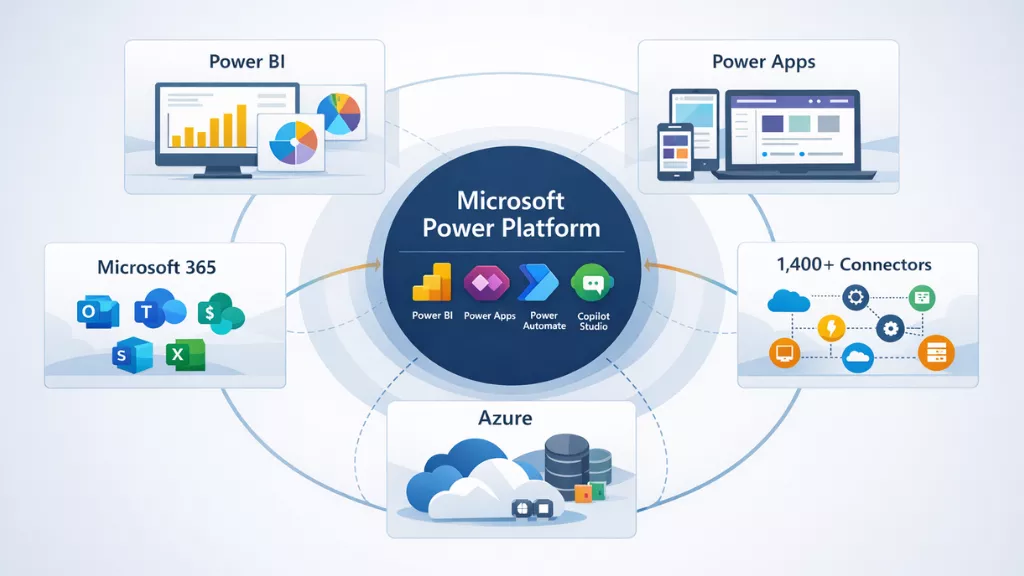
Microsoft Power Platform combines four core products-Power BI, Power Apps, Power Automate, and Microsoft Copilot Studio-into a cohesive low-code environment connected to your Microsoft 365 infrastructure and over 1,400 third-party data sources.
Can you build production-grade solutions without a full development team? Citizen developers create applications using visual tools and drag-and-drop interfaces, while professional developers extend capabilities through custom connectors and Azure integration when complexity demands it.
This balance is what makes the platform enterprise-ready. You need quick wins from departmental automation while maintaining governance for mission-critical systems. Power Platform delivers both through role-based security, centralized administration, and compliance frameworks.
What sets Power Platform apart in 2026 is its AI-native architecture built for workflow optimization at scale. According to Gartner, low-code platforms will account for 75% of new application development by 2026, with the global market reaching $44.5 billion.

This isn’t just a tool upgrade-it’s a fundamental shift in how enterprises build technology. But what does that shift actually look like inside your organization?
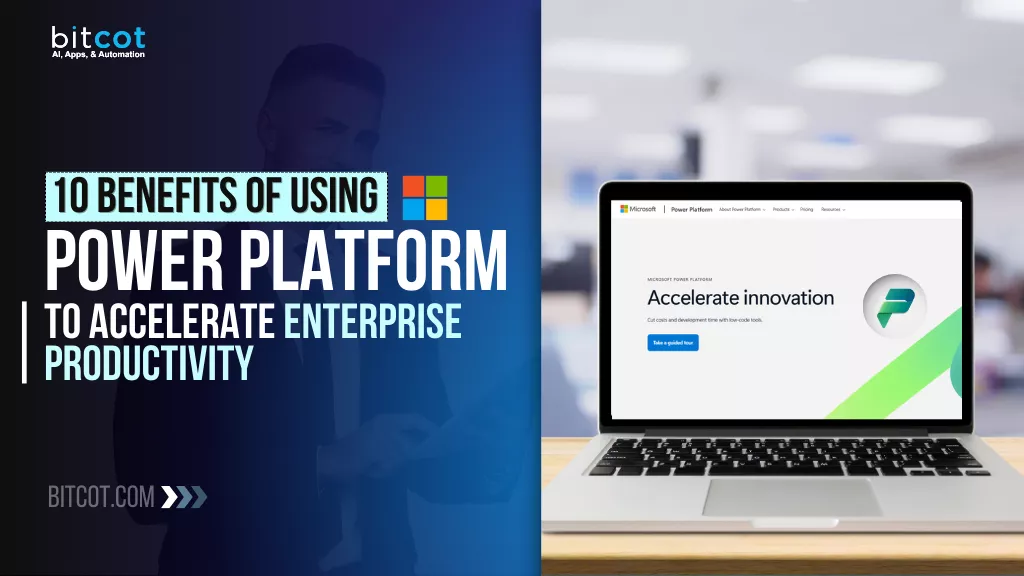
Top 10 Benefits of Microsoft Power Platform for Boosting Enterprise Productivity
The transformation Power Platform brings manifests through specific, measurable advantages impacting your bottom line. These benefits work synergistically-gains in one area amplify improvements in others.
Understanding these benefits helps you identify where Power Platform aligns with your current challenges. Here’s where the real value starts.
1. Accelerated Application Development Through Low-Code Capabilities
Traditional development timelines stretch 4-6 months for moderate-complexity projects. Power Apps compresses this through visual designers, pre-built templates, and drag-and-drop interfaces.
The 2024 Forrester Total Economic Impact study found development time drops by 50% for professional developers, effectively doubling team capacity.
Businesses report creating functional prototypes within hours and deploying production applications in 2-4 weeks-a 10x improvement over conventional approaches.
The component library includes ready-made UI elements, data forms, and business logic patterns. Teams assemble proven components while focusing energy on unique business requirements.
In 2026, AI-powered assistants accelerate development further. Developers using Copilot in Power Apps achieve a 60% higher success rate, while automations are created twice as fast with AI assistance.
This democratization enables both citizen developers and IT professionals to collaborate on enterprise application development without traditional skill barriers.
Consider expense approval workflows-a universal pain point. Department leads build apps that route requests, enforce policy rules, and integrate with ERP systems within days instead of months.
This speed advantage cascades throughout your organization, enabling rapid response to market opportunities. But speed only matters if the economics work.
2. Substantial Cost Reduction Across Development and Operations
Enterprise software costs add up fast-but how fast? Microsoft’s 2024 Forrester study reports an average 224% ROI within three years, with a net present value of $82 million and payback periods under six months.
Power Apps Premium costs $20 per user monthly (or $12 for 2,000+ users), while per-app plans start at $5 per user per app. Compare this to custom development averaging $50,000-$150,000 per solution.
Traditional development requires specialized developers at $120,000-$180,000 annually, plus project managers, QA teams, and DevOps engineers. The cost difference is transformational.
The Forrester study found organizations saved $61.4 million in direct development and IT costs over three years. Infrastructure expenses decrease with no separate hosting, database licensing, or security infrastructure needed.
Organizations implementing robotic process automation solutions report 40-60% reductions in maintenance workload, with tech stack expenses reduced by up to 80% within three years.
Shadow IT expenses vanish when business units gain approved tools for self-service development. Teams work within governed environments that IT can monitor and support.
Beyond direct savings, freed teams focus on high-value innovations. But cost savings stall if your systems can’t talk to each other.
3. Seamless Integration With Microsoft 365 and Enterprise Systems
Data silos kill productivity. Power Platform’s native integration means your SharePoint lists, Excel workbooks, Outlook calendars, and Teams channels become instant data sources.
Build an approval app in Power Apps, embed it in Teams, trigger notifications through Outlook, and store records in SharePoint-all without writing integration code.
The platform includes over 1,400 connectors spanning Salesforce, SAP, Oracle, AWS services, Google Workspace, and industry-specific applications. Premium connectors bridge cloud and legacy infrastructure through data gateways.
Organizations leveraging API integration services find that API-first architecture ensures future extensibility.
Power Platform adapts through custom connectors, Azure Functions, and webhook support rather than requiring architectural redesign. This flexibility becomes critical as enterprises adopt composable architecture strategies-a key 2026 trend.
Single sign-on through Azure Active Directory eliminates separate credential management. Your data flows freely where it’s needed without the integration headaches plaguing traditional deployments.
4. Enhanced Data Visibility Through Advanced Analytics
Your enterprise is sitting on terabytes of data. So why does decision-making still feel like guesswork? Power BI transforms raw data into interactive visualizations non-technical stakeholders can explore.
The platform processes billions of rows across multiple sources, applying AI-powered analytics that identify trends and patterns humans might overlook.
Natural language queries let executives ask “which product lines underperformed last quarter” and receive instant visual answers without understanding database structures.
Row-level security enforces data access policies at the visualization layer. Sales managers see their territories, finance sees approved metrics, executives access enterprise-wide views.
Real-time dashboards eliminate reporting delays inherent in batch processes. Power BI reports embed directly into Power Apps, SharePoint pages, and Teams channels.
Organizations leveraging business intelligence services create comprehensive data visualization ecosystems fueling strategic planning.
The Forrester study found $44.4 million in time savings over three years, with employees saving up to 25% of their time on key tasks. But insights are only half the equation-you also need to act on them faster.
5. Streamlined Business Processes With Intelligent Automation
Manual, repetitive tasks consume 40-60% of knowledge worker time. That’s half your workforce stuck on autopilot. Power Automate addresses this waste through low-code and no-code workflow automation across applications and approval chains.
The 2024 Forrester study found organizations achieved a 248% ROI with $39.85 million in net present value.
Cloud flows handle document routing, data synchronization, notifications, and scheduled tasks. Pre-built templates provide starting points for onboarding, invoice processing, and inventory alerts.
Advanced flows incorporate conditional branching, parallel processing, and error handling comparable to traditional code. AI Builder extracts data from invoices and forms automatically.
Desktop flows extend automation to legacy Windows applications through RPA capabilities. The result? One financial services firm reduced a six-week manual HR process to just one hour.
Organizations exploring RPA tools for enterprises find Power Automate provides seamless integration within the Microsoft ecosystem.
In 2026, autonomous agents make contextual decisions and optimize themselves-moving from basic business process automation to intelligent process optimization.
Businesses report 10-15 hours saved weekly per automated process, with error rates dropping 85-95%. Automation handles the execution-but what guides the decisions behind it?

6. Improved Decision-Making Through AI and Machine Learning Integration
Most enterprises treat AI as a future initiative. Power Platform makes it available today. AI Builder packages form processing, object detection, and sentiment analysis into consumable components.
Upload sample documents, label fields once, and AI Builder generates custom models. Business analysts handle most implementations without data science expertise.
Prediction models forecast customer churn, equipment failures, inventory needs, and lead quality based on historical patterns-integrating directly into Power Apps and Power Automate for real-time decision support.
Organizations pursuing AI development services can leverage both pre-built components and custom models through Azure Machine Learning.
Each Premium license includes 5,000 AI Builder credits monthly, though this transitions to consumption-based pricing November 2026.
Leaders reference AI-generated insights grounded in data analysis rather than hunches. Smarter decisions are powerful-but only if your organization can act on them quickly enough.
7. Increased Agility and Faster Time-to-Market for Solutions
Market conditions don’t wait for your development cycle. Power Platform’s iterative model supports rapid prototyping-build minimal viable applications, deploy to pilot groups, gather feedback, and scale in weeks.
Built-in testing environments and version control ensure quality without sacrificing speed. Solution packaging bundles applications for consistent deployment across environments.
This agility extends to business model experimentation-test new offerings through quickly-built applications rather than committing months to unproven concepts. Failed experiments cost days, not budgets.
This approach aligns with modern agile development methodologies that prioritize speed, adaptability, and continuous process optimization over rigid planning cycles.
Organizations report 60-70% reductions in time-to-market, with the platform contributing $15.4 million in additional revenue. The competitive advantage grows exponentially. But speed without coordination creates its own problems.
8. Better Collaboration Across Departments and Teams
What happens when every department builds in isolation? Silos. Duplicated efforts. Slow responses. Teams integration embeds Power Apps directly into collaboration channels where work actually happens.
Sales teams access customer applications without leaving Teams, operations review dashboards during meetings, and project teams trigger workflows from conversations-zero context switching.
Center of Excellence toolkits provide governance frameworks balancing enablement with control. Dataverse enables cross-functional applications drawing from common data, eliminating conflicting departmental spreadsheets.
Successful applications from one department extend to others facing similar challenges, multiplying ROI. By 2026, Gartner predicts 80% of low-code users will come from outside formal IT departments.
Organizations implementing low-code development strategies benefit from structured governance that empowers innovation while maintaining necessary standards and oversight.
9. Robust Security and Compliance for Enterprise Requirements
Security concerns kill more innovation projects than budgets do. Especially in regulated industries. Power Platform maintains certifications including SOC 1, SOC 2, ISO 27001, HIPAA, GDPR, and FINRA.
Azure Active Directory integration enforces multi-factor authentication and conditional access policies. Organizations requiring identity and access management solutions find this model aligns perfectly.
DLP policies prevent accidental exposure by restricting connector combinations. Role-based access control extends to individual features, data rows, and automation permissions.
Encryption protects data at rest and in transit using AES-256 and TLS 1.2+. Customer-managed keys provide additional control for sovereign key management.
Environment strategies separate development, testing, and production workloads with appropriate security boundaries.
Microsoft’s annual security investment-reportedly exceeding $1 billion-provides protection depth difficult for individual organizations to replicate. You can innovate rapidly without compromising compliance.
10. Scalability to Support Enterprise Growth and Expansion
Pilot projects succeed. Then what? Power Platform scales from small wins to enterprise-wide deployments without architectural redesign. Organizations pursuing cloud computing services benefit from this cloud-native architecture.
Applications serving dozens of users handle thousands without manual optimization. Performance distributes across Microsoft’s global datacenter network, maintaining response times regardless of location.
The platform operates across 60+ Azure regions worldwide. Multi-geo capabilities keep European data in EU datacenters, US data in US facilities, and Asian data in Asia simultaneously.
Start with limited licenses for pilot groups, then scale to enterprise agreements. Microsoft is transitioning to pay-as-you-go options providing flexible consumption-based alternatives (announced January 2026).
Organizations report supporting 10x user growth and 50x application portfolio expansion without performance degradation. With these ten benefits working together, Power Platform creates a virtuous cycle that compounds over time.
How Bitcot Helps Enterprises Maximize Power Platform ROI
Deploying Power Platform requires more than technical setup-it demands strategic planning, governance, and change management aligning technology with business objectives.
Bitcot brings specialized expertise in Power Platform consulting, helping organizations navigate from initial pilots to enterprise-wide adoption alongside CTOs and operations leaders.
We assess current processes, identify high-impact automation opportunities, and design scalable architectures balancing citizen developer enablement with IT governance.
Our team develops customized Center of Excellence frameworks with component libraries, development standards, security policies, and training programs that accelerate adoption.
For complex integration scenarios, Bitcot’s developers build connectors and Azure-based extensions extending Power Platform capabilities without compromising low-code advantages.
Through hands-on implementations and mentorship, we enable internal teams to become self-sufficient-reducing long-term dependency while building institutional knowledge.
Our experience spans enterprise software development, AI integration, and digital transformation-giving us perspective to help you avoid common pitfalls and accelerate results.
Whether you’re beginning your Power Platform journey or scaling existing implementations, Bitcot provides the expertise to maximize your return on investment.

Moving Forward With Power Platform for Enterprise Acceleration
Start with concrete business problems causing measurable pain. Target manual processes consuming significant time or reporting gaps preventing informed decisions. Early wins build momentum.
Establish governance frameworks before widespread adoption. Define who can build what, how solutions reach production, and what security standards apply.
Invest in capability building alongside deployment. Effective use requires training on visual development, workflow logic, data modeling, and governance compliance.
The question isn’t whether low-code platforms belong in modern strategies. Competitive pressures already answered that.
With the market projected to reach $44.5 billion by 2026 and 75% of new applications built using these technologies, the real question is how quickly you’ll adopt and how effectively you’ll implement.
Organizations moving decisively gain compounding advantages as automation expands and data-driven decision-making becomes embedded in operational culture.
Ready to accelerate your enterprise productivity with Microsoft Power Platform? Connect with Bitcot’s experts to assess your specific opportunities and design an implementation roadmap aligned with your business objectives.