Here’s the thing about running enterprise eCommerce in 2025: your platform probably can’t keep up with what your business needs anymore.
Maybe it takes three months to launch a simple feature that your competitor rolled out in two weeks. Maybe you’re stuck waiting for your vendor to build something that should’ve been standard years ago. Or maybe you’ve realized that the “complete solution” you bought isn’t actually complete; it’s just expensive and inflexible.
If you’re a CTO or VP of eCommerce dealing with a legacy platform, you already know this. The question isn’t whether something needs to change. It’s what comes next.
We keep hearing about headless commerce, API-first architecture, and microservices, but those are just pieces of a bigger shift. The real conversation happening in boardrooms right now is about composable commerce and MACH architecture, and why 2026 is looking like the year when staying on a monolith.ic platform stops being a viable option.
This isn’t another article explaining why “agility matters” or listing buzzwords. We’re going to break down exactly why the old way of building eCommerce is breaking down, what actually makes composable commerce different (not just theoretically, but in practice), and why the companies leading eCommerce in 2026 will be the ones who made this transition.
Let’s get into it.
The Monolithic Commerce Problem: Why Legacy Platforms Are Hitting a Wall
For years, traditional commerce systems tried to be everything in one place.
At first, that all-in-one approach felt convenient. You got your storefront, checkout, content tools, inventory, and plugins bundled together. But as digital buying habits shifted and customer expectations jumped, those all-or-nothing systems started showing their limits.
The biggest issue is speed. Adding new features or adjusting to a new market trend often requires touching the entire codebase. That slows teams down and turns even simple updates into long development cycles. Meanwhile, shoppers move fast. If a brand cannot keep up, customers notice.
Take a fashion retailer trying to roll out a new interactive lookbook tied to social shopping. On a modern setup, that kind of feature could be tested and launched quickly. On a monolithic platform, the team has to dig into a huge interconnected codebase just to introduce one experience.
A small creative idea suddenly turns into weeks of development, QA delays, and the risk of breaking unrelated parts of the site. By the time the update goes live, the trend may have already shifted.
That is the core problem. Even small changes require touching too much. Innovation slows down, and every adjustment becomes a production.
Flexibility is another pain point. Legacy platforms often lock companies into rigid templates and predefined workflows. When brands want to experiment with new channels, unique experiences, or advanced personalization, they find themselves wrestling with old architecture that was never built for modern eCommerce realities.
Cost becomes a problem, too. Maintaining, customizing, and scaling a monolithic system demands constant engineering work. Over time, those hours add up. What once looked like an all-in-one bargain becomes a resource drain.
In a world where innovation matters more than ever, monolithic platforms are showing their age. They struggle to support rapid change, limit creativity, and force brands into slow, expensive processes. That is the wall many businesses are hitting today.
What is Composable Commerce and How Does It Work?
Composable commerce is an architectural approach where eCommerce solutions are built by assembling multiple, independent, best-of-breed applications and services into a single, cohesive business ecosystem.
Instead of one massive system that does everything, you build your commerce stack from independent, specialized components that work together through APIs.
Think of it like this: a monolithic platform is like buying a house that’s already built. The kitchen is where it is, the bathroom layout is fixed, and if you want to change anything major, you’re talking about expensive renovations that might compromise the structure.
Composable commerce is more like having the land and choosing the best contractor for each part; one specialist for foundation, another for electrical, the best plumber you can find, and a kitchen designer who actually knows what they’re doing.
In the middle of that system, a few core building blocks make everything work:
- Packaged Business Capabilities: At the heart of composable commerce is something called Packaged Business Capabilities, or PBCs. These are self-contained services that handle one specific commerce function really well.
- The role of your frontend: A flexible presentation layer that pulls together data from multiple services and shapes the customer experience.
- The orchestration layer: The brain that coordinates how all those services talk to each other, so everything feels seamless for shoppers.
- Data flow in a composable system: Information moves between services through APIs, keeping each part updated without locking anything into a single platform.
At its core, composable commerce breaks the digital experience into independent parts. Checkout, product data, search, content, promotions, and more can all be powered by different best-in-class services. Because each component stands on its own, teams can update or replace pieces without touching the rest of the system.
Here is what that looks like in practice. Imagine a home goods brand that wants to upgrade its product discovery experience.
With a monolithic setup, that change might require rewriting templates, modifying backend logic, and waiting for platform-specific approvals. With a composable approach, the team can plug in a modern search and merchandising tool, hook it into their existing product data, and launch new capabilities without disturbing the rest of the site.
This model works because it is built on flexibility. Brands can add new channels, experiment with features, scale during peak seasons, or swap out outdated tools as better options emerge. Instead of being held back by a single system, they evolve at their own pace.
In simple terms, composable commerce gives businesses control. It lets them shape their digital ecosystem around what customers want today and what they will expect tomorrow.
Monolithic vs Headless vs Composable: Key Differences & Comparison
The shift in eCommerce isn’t just about new tools; it’s a fundamental change in how the technology stack is structured.
To appreciate the power of composable commerce, we must first clearly distinguish it from its predecessors.
1. Monolithic Commerce
A monolithic platform is exactly what it sounds like: one large, unified system where frontend, backend, database, and business logic are all tightly integrated into a single application.
Magento (Adobe Commerce), traditional Salesforce Commerce Cloud, SAP Commerce Cloud, and Oracle Commerce; these are monolithic platforms. Everything runs together, deploys together, and scales together.
- Structure: The front-end (the “head,” what the customer sees) and the back-end (the commerce logic and database) are tightly bound and live within the same application.
- Key Characteristic: Tight Coupling. If you update the back-end, you must test and redeploy the entire front-end, and vice versa.
- Pros: Easy to deploy initially; low upfront complexity.
- Cons: Extremely rigid; slow time-to-market for new features; high cost of scaling and maintenance; heavy vendor lock-in.
2. Headless Commerce (The Stepping Stone)
Headless was the first significant step away from the monolith. The insight was simple: separate the presentation layer (the “head”) from the backend commerce logic (the “body”).
Platforms like Shopify Plus (with Hydrogen), BigCommerce, and Salesforce Commerce Cloud (headless mode) offer headless capabilities. You’re still using their platform for commerce logic, but you’re free to build whatever frontend experience you want.
- Structure: The head (front-end) is completely separated (decoupled) from the body (back-end commerce logic). They communicate only via APIs.
- Key Characteristic: Decoupling. Developers can change the customer experience (the head) without touching the commerce engine (the body).
- Pros: High front-end flexibility; ability to deploy experiences across multiple channels (web, app, IoT); faster UI changes.
- Cons: While the head is decoupled, the back-end is often still a single, large piece of monolithic software. You still face vendor lock-in and inflexibility for back-end upgrades (e.g., changing the core pricing engine).
3. Composable Commerce (The Evolution)
Composable commerce takes the decoupling of Headless architecture and applies it to the entire back-end using MACH principles.
A company adopting composable commerce can keep their React frontend. They move product data to a specialized PIM like Akeneo. They implement Algolia for search. They use Stripe for payments. They add Contentful for content management. Magento might still handle cart and checkout, or they might replace that with commercetools.
- Structure: Everything is broken down: the front-end is decoupled (Headless), and the back-end is broken into independent services (Microservices).
- Key Characteristic: True Modularity. You use an API-first approach to connect best-of-breed services (like a separate CMS, separate PIM, and separate payment gateway) to build a custom stack.
- Pros: Ultimate flexibility and agility; rapid innovation; future-proof; no vendor lock-in; cost-effective scaling (scale only the service that needs it).
- Cons: Higher initial architectural complexity; requires a skilled development team to select, integrate, and maintain the various components.
| Feature | Monolithic | Headless | Composable |
| Front-end & Back-end | Tightly Bound | Decoupled | Decoupled (Headless) |
| Back-end Structure | Single, Interdependent Code | Single, Interdependent Code | Microservices (Independent PBCs) |
| Vendor Lock-in | High | High (for the back-end) | Low (Can swap components) |
| Time-to-Market | Slow (Months) | Medium (Weeks) | Fast (Days/Weeks) |
| Best For | Small, simple businesses | Businesses needing multi-channel front-end flexibility | Complex, scaling, high-innovation businesses |
MACH Architecture: The Backbone of Composable Commerce
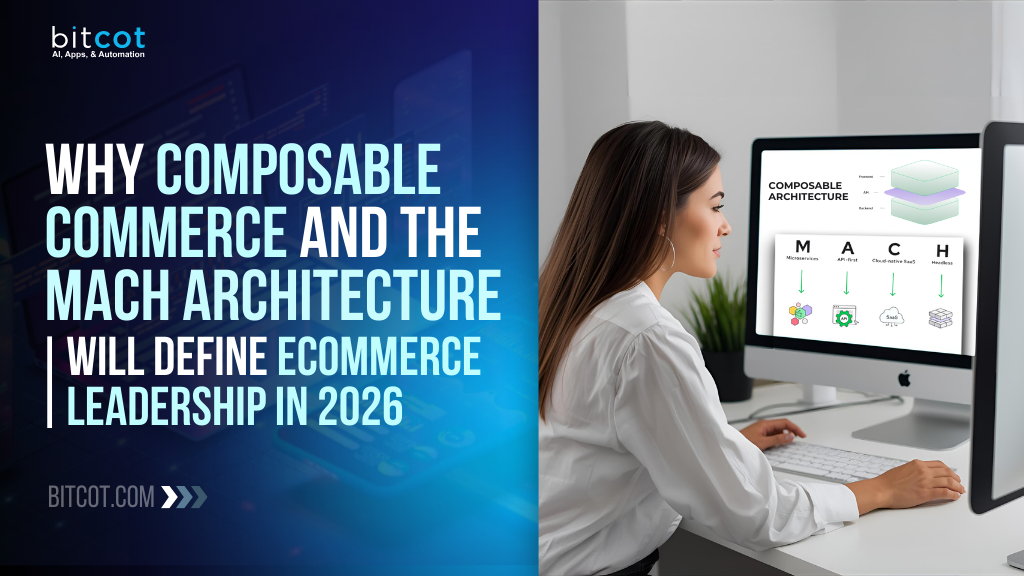
If composable commerce is the strategy, MACH architecture is the technical foundation that makes it real. It stands for Microservices, API-first, Cloud-native, and Headless.
These four principles work together to create systems that are flexible, scalable, and maintainable.
Microservices: Breaking Down the Monolith
Microservices means building your application as a collection of small, independent services instead of one large system. Each service handles a specific business capability and can be developed, deployed, and scaled on its own.
Your product catalog is one microservice. Your shopping cart is another. Inventory management, pricing engine, and order processing, each is its own service with their own codebase and database.
Here’s why this matters: when you need to update your pricing logic, you modify and deploy just the pricing service. Your checkout keeps running. Your product catalog isn’t affected. No risk that fixing one thing breaks something unrelated.
API-First: Communication as a Design Principle
API-first means you design the API before building the service, not as an afterthought, but as the primary interface that defines how the service works.
This is different from traditional development, where you build the application first and maybe add an API later. With API-first, the API contract is the specification; it defines what the service does, what data it accepts, what it returns, and how errors are handled. Then you build the service to fulfill that contract.
Why does this matter? Every service in your composable stack needs to talk to other services reliably. When checkout needs to verify inventory, it calls the inventory API. When your frontend needs product data, it calls the PIM API. When a customer places an order, that triggers API calls across payment, inventory, order management, and email services.
Cloud-Native: Built for Modern Infrastructure
Cloud-native doesn’t mean “hosted in the cloud.” Plenty of companies run monolithic apps in AWS; that’s just hosting. Cloud-native means the application is designed specifically to leverage what modern cloud infrastructure offers.
Your services run in containers. When traffic spikes during a sale, the infrastructure automatically spins up more instances. When traffic drops, it scales back down. You’re not manually provisioning servers or guessing at capacity.
If a container fails, the system detects it and automatically restarts or routes traffic around the problem. You build with the assumption that failures will happen, so the architecture handles them automatically.
Headless: Presentation Layer Freedom
Headless means your frontend is completely decoupled from backend business logic. Your backend provides data and functionality through APIs, but has no opinion about how that gets presented.
Your frontend is a separate application that consumes those APIs and renders the experience however you want. You can have a React website, a React Native mobile app, voice commerce through Alexa, and in-store kiosks, all using the same backend services.
Why headless completes MACH:
- Multiple frontends can use the same backend services
- Frontend technology choices don’t constrain backend architecture
- Marketing teams can iterate on experience without backend changes
- Every channel, such as web, mobile, kiosk, and voice, is a first-class citizen
- Performance optimizations happen independently
How MACH Principles Work Together
These four principles reinforce each other. Microservices create modular services. API-first ensures clean communication. Cloud-native provides efficient infrastructure. Headless keeps the presentation layer flexible.
When a customer adds a product to their cart, the frontend makes an API call to the cart microservice running in auto-scaling containers. That cart service calls the pricing microservice for the correct price and the inventory microservice to verify availability. Each service is independently deployed, scaled, and monitored.
If your inventory service gets hammered during a flash sale, just that service scales up. Need to update pricing logic? Just that microservice gets redeployed. Mobile app needs a different cart experience? Both frontends call the same API but render it differently.
| MACH Pillar | Acronym Meaning | What It Means | Why It Matters for Businesses |
| Microservices | M | Independent services for each commerce function | Faster updates, reduced risk, parallel team execution |
| API First | A | All components communicate through standardized APIs | Easier integrations, cleaner data flow, vendor flexibility |
| Cloud Native | C | Built to run and scale in the cloud | Better performance, lower infrastructure costs, automatic scaling |
| Headless | H | Frontend separated from backend systems | Faster experimentation, consistent multichannel experiences, stronger brand control |
Key Benefits and ROI of Composable Commerce and MACH Architecture
For executives weighing the impact of modernizing their digital commerce stack, the value of composable commerce paired with MACH architecture goes far beyond technical improvements. The gains show up in speed, revenue, scalability, and long-term cost efficiency.
Together, they create a business model that moves faster, adapts quicker, and delivers stronger returns year after year.
Here are the key benefits and the resulting ROI.
1. Accelerated Time-to-Market (TTM)
The greatest non-financial benefit of MACH is speed.
- Monolithic Systems: New feature rollouts typically take months or quarters. They require extensive regression testing of the entire codebase, leading to slow and risky release cycles.
- Composable/MACH Systems: New feature rollouts can take days or weeks. Developers deploy small, independent microservices without impacting the rest of the platform.
ROI Impact: The ability to capture new revenue streams faster (e.g., launching a new mobile app or integrating social commerce) and outpace competitors in feature delivery is significantly enhanced. Development times can be reduced by up to 80% in some instances, minimizing missed opportunities and accelerating growth.
2. Significant Reduction in Total Cost of Ownership (TCO)
While the initial setup requires strategic planning, the long-term cost benefits of MACH are compelling.
- Elimination of Version Upgrades: Traditional monolithic systems require expensive, mandatory, “Big Bang” version upgrades every few years, often risking customized code. MACH leverages Cloud-native SaaS platforms that handle updates automatically and continuously, shifting maintenance focus only to custom components.
- Pay-As-You-Go Scaling: Monoliths often require over-provisioning infrastructure to handle peak load (paying for unused capacity) or crash during traffic spikes. The cloud-native principle allows services (like checkout) to scale elastically and automatically on demand, reducing unnecessary overhead and guaranteeing performance.
- Best-of-Breed Selection: MACH eliminates costly vendor lock-in. Businesses can select best-in-class components for specific needs (e.g., dedicated PIM, specialized CMS), meaning they pay only for the high-value functionality they use, rather than expensive, bundled, and often sub-par tools.
3. Revenue Growth Through Enhanced Customer Experience (CX)
The Headless and API-first principles directly translate into superior customer experiences, which is the primary driver of eCommerce revenue.
- Conversion Rate Improvement: Headless freedom allows developers to build lightning-fast, highly optimized frontends, resulting in faster page load times and smoother checkout flows. Companies frequently report 15-30% increases in conversion rates after adopting a modern, composable frontend.
- Personalization at Scale: MACH enables easy integration of advanced, best-of-breed AI/ML personalization engines that traditional platforms struggle with. This allows for real-time, dynamic product recommendations and content, driving a higher Average Order Value (AOV) and repeat purchases.
- True Omnichannel Presence: The API-first approach ensures a consistent brand and commerce experience across all channels: website, mobile app, in-store kiosks, voice assistants, and IoT devices, all powered by the same single commerce logic.
Real-World ROI Snapshot: Case studies have shown businesses achieving a 295% ROI over three years following a composable adoption, primarily driven by drastically reduced development time and increased revenue per customer visit.
4. Risk Mitigation and Future-Proofing
Composable architecture fundamentally shifts risk from catastrophic failure to isolated, manageable issues.
- Fault Isolation (Microservices): If one service, like the product review engine, experiences a bug, the core functions (cart, checkout, payment) remain fully operational. This isolation ensures continuous sales and prevents costly, platform-wide downtime.
- Mitigated Replatforming Risk: Instead of high-stakes, multi-year, multi-million-dollar replatforming projects, MACH allows components to be swapped out individually using the “strangler pattern.” This minimizes business disruption and allows for continuous evolution rather than periodic, risky revolution.
- Talent Attraction & Retention: Developers generally prefer working with modern, agile, cloud-native technologies, making it easier to attract and retain top engineering talent, a crucial, often-overlooked source of competitive advantage.
In a nutshell, the transition to composable commerce and MACH architecture is a strategic move from a Capital Expenditure (CAPEX) model (large, infrequent, risky investments) to an Operational Expenditure (OPEX) model (smaller, continuous, low-risk investments), resulting in a platform that is more agile, cost-efficient, and powerfully geared for long-term revenue growth.
Why Composable Commerce and MACH Will Dominate eCommerce in 2026
The shift to composable commerce, powered by MACH architecture, is no longer a theoretical debate; it is the definitive strategy for digital survival and growth.
By 2026, industry projections confirm that this modular approach will not just be a choice for innovators but a mandatory blueprint for any serious eCommerce enterprise.
The dominance of MACH is driven by an unprecedented convergence of technological and market forces that monoliths simply cannot handle.
1. The AI and Personalization Imperative
The single most disruptive force shaping eCommerce in 2026 is artificial intelligence.
- Real-time, Deep Personalization: AI demands a massive, flexible data pipeline and the ability to integrate advanced, best-of-breed Machine Learning tools (for search, recommendations, and merchandising). Monolithic systems struggle to integrate these tools natively.
MACH’s API-first and Microservices foundations allow the quick integration of sophisticated AI engines, enabling real-time personalization that converts browsing into buying.
- AI-Native Storefronts and Agents: As AI Overviews change search engine result pages (SERPs) and AI-powered shopping agents make purchasing decisions, the front-end must be instantly adaptable. Headless architecture allows the commerce logic to power a traditional website, a voice assistant, or an AI agent’s purchase protocol simultaneously and consistently.
2. The Final Death of the “Big Bang” Upgrade
Legacy monolithic platforms require multi-year, costly, and disruptive “Big Bang” replatforming every few years. This risk is unacceptable in a market that evolves daily.
- Continuous Evolution: By 2026, continuous delivery is the norm. MACH’s cloud-native and microservices allow features to be deployed weekly or even daily, without taking the whole site down.
- Future-Proofing the Budget: Companies that adopt Composable Commerce eliminate the unpredictable CAPEX of huge replatforming projects, moving to a predictable, agile OPEX model. This resilience is key in facing an unpredictable global economy.
3. The Unstoppable Rise of Omnichannel and B2B Complexity
Customers expect seamless experiences everywhere, and the complexity of B2B eCommerce is driving modularity.
- Channel Proliferation: Whether it’s a smart mirror, a video shopping app, or a traditional website, the Headless approach ensures that the single source of truth (the commerce back-end) can power any touchpoint. Brands can rapidly launch new sales channels or “phygital” (physical + digital) experiences, giving them a crucial first-mover advantage.
- B2B Self-Service: B2B eCommerce is surging, demanding features like custom contract pricing, authenticated portals, and complex quoting logic. Migrating to a microservices architecture makes it possible to build and deploy these highly specific B2B features without cluttering the simpler Direct-to-Consumer (DTC) storefront.
4. MACH is Reaching Tipping Point Adoption
The architecture has moved beyond early adopters and into the mainstream.
- Proven ROI: The promise of MACH, 40% faster feature releases and significant TCO reductions, has been repeatedly validated by major global brands. This proven ROI makes the business case for migration undeniable to finance and executive teams.
- Vendor and Talent Maturity: The ecosystem of MACH vendors is robust and mature (Contentstack, commercetools, Algolia, etc.), providing best-of-breed options for every business need. Furthermore, developer talent is increasingly skilled and focused on modern, modular stacks, making integration and maintenance easier than ever.
By 2026, the enterprises that win will be the ones that can adapt instantly to new trends, be it a shift in AI search, a new social commerce channel, or evolving consumer behavior. Composable commerce, anchored by the technical might of MACH, is the only architecture built to deliver this required level of speed and agility.
The Shift from Monolithic to Composable: What This Means for Leaders
The migration from a monolithic (all-in-one, tightly-coupled) commerce platform to a composable commerce (MACH-based, best-of-breed) ecosystem is not simply an IT project; it is a fundamental reorganization of the business.
For leaders across technology, marketing, and finance, this transition demands a strategic shift in mindset, team structure, and governance.
1. The Strategic Shift: From Stability to Agility
Monolithic platforms offered simplicity and stability: one contract, one vendor, one codebase. Composable commerce offers agility and freedom. Leaders must embrace a vision where continuous change is the operating principle.
- Move from “Big Bang” Replatforming to Continuous Evolution: Leaders must abandon the mindset of risky, multi-year, all-or-nothing replatforming projects. The new strategy must be the “Strangler Pattern”, gradually replacing monolithic components with MACH services. This reduces risk and allows for an incremental, predictable investment model.
- Empowerment Over Control: The CEO and executive team must shift control from a centralized, vendor-dictated roadmap to decentralized, autonomous teams. They must trust their teams to select and integrate best-of-breed solutions to meet specific business needs, rather than accepting a single vendor’s “good enough” bundled features.
- Best-of-Suite / Best-of-Breed: The CTO and C-Suite must champion a strategy that prioritizes the best tool for every job, leading to a modular stack composed of multiple vendors (e.g., one for CMS, one for PIM, one for Commerce Logic).
2. Organizational Change: Team Structure and Culture
Composable architecture requires a team structure that mirrors its modularity.
- From Silos to Feature Teams (Microservices): In a monolith, teams are often organized by function (e.g., Frontend Team, Backend Team). In a MACH world, teams should be organized around Microservices or Packaged Business Capabilities (PBCs), such as a “Checkout Team” or a “Product Catalog Team.”
These cross-functional teams own their component end-to-end, accelerating development and deployment.
- Upskilling and Talent: The demand for highly specialized monolith developers decreases. The new premium is on Technical Generalists who are proficient in APIs, cloud-native practices (DevOps), and integrating diverse services. Leaders must invest in upskilling existing talent and attracting engineers comfortable with modern, decoupled tech stacks.
- Empowering the Business User (Headless): The Headless approach means business users (marketers, merchandisers, content creators) gain unprecedented control. They can manage the customer experience through a user-friendly CMS and personalization tools without constantly waiting for IT/developers.
Leaders must ensure these business teams are trained and given ownership of their new, powerful tools.
3. Governance and Financial Management
The modular nature of Composable commerce introduces new complexities in management and budgeting.
- Vendor and Contract Management: Managing a single monolithic contract is replaced by managing multiple, specialized vendor relationships. The procurement and legal teams must adapt to handling more contracts and ensuring seamless technical integration across different providers.
- Data Consistency and Monitoring: The CIO must ensure that with multiple services handling data (PIM, OMS, CRM), there is a robust strategy for data consistency and a unified view of the customer. Investment in observability tools (monitoring, logging, tracing) becomes critical to manage the health of the complex, distributed ecosystem.
- Budgeting / OPEX: Finance leaders must transition from large, infrequent CAPEX budgets for platform purchases to a continuous OPEX model for subscription-based, cloud-native services. This shift allows for more predictable costs and the ability to stop paying for underperforming components.
Ultimately, the shift to composable commerce and MACH architecture is a test of leadership courage. It requires abandoning the comfort of the familiar monolithic structure for the long-term competitive advantage of a flexible, adaptable, and innovation-ready business.
How to Implement Composable Commerce and MACH in 3 Phases
Implementing composable commerce, the business strategy, and its technical foundation, the MACH architecture, is a large-scale organizational transformation that goes beyond a simple platform migration.
The most successful approach is a controlled, incremental strategy that replaces the monolithic system piece by piece.
The recommended method is the “Strangler Pattern”, which involves wrapping the existing monolith with new, modern MACH services and gradually retiring the legacy components.
Phase 1: Preparation and Strategy (The “Why” and “What”)
This phase defines the business objectives and lays the architectural groundwork before any coding begins.
1. Define Business Goals and Use Cases:
- Identify Bottlenecks: What is your current platform failing at? (e.g., slow checkout, inability to launch a mobile app, costly feature development). Your goals should be measurable (e.g., “Reduce checkout time by 30%,” “Launch new geo-market in 6 weeks”).
▸ Vision: Document the desired end-state customer experience and business processes.
2. Audit the Current Architecture (Gap Analysis):
- Feature Audit: Create a complete inventory of all features in your monolithic platform. Identify features that are unused (“bloat”) and can be removed, and those that are critical and must be migrated.
- Identify Pain Points: Pinpoint the most tightly coupled components, performance bottlenecks, and systems with high maintenance costs.
3. Choose the Core Components (The “Best-of-Breed” Stack):
- Select your foundational MACH components. This often starts with the headless commerce engine (the core business logic) and a headless CMS.
- Minimum Viable Architecture (MVA): Define the minimum set of best-of-breed services needed for the first phase, such as PIM, Search, and Payment Gateway. API-first compatibility is the primary selection criterion for all tools.
Phase 2: Incremental Migration (The Strangler Pattern)
This is the execution phase where new MACH services are deployed around the old monolith.
1. Start with the Frontend (The Decoupling):
- Implement a Headless Frontend: Build a new user interface (using modern frameworks like React, Vue, or Next.js) that initially consumes data from the Monolith’s APIs. This is the first “strangle.”
- Reroute Traffic: Point a low-risk, non-core function (like the “My Account” page or a new micro-site) to the new headless frontend. This validates the Headless approach without risking core commerce functions.
2. Extract the First Microservice (The “Strangling”):
- Identify a Candidate: Choose a non-critical, high-value component that is easy to isolate, such as the product review engine, a loyalty program, or gift card management.
- Build and Deploy: Build this function as a new, independent microservice on a cloud-native platform (e.g., AWS, Azure).
- Reroute API Calls: Modify the monolith and the new headless frontend to route all traffic for this specific function to the new microservice via its API.
3. Iterate and Expand:
- Repeat the extraction process, moving up the risk/complexity chain. Common next steps include migrating the Product Information Management (PIM), followed by the core Cart and Checkout process.
- Data Migration: As each component is extracted (e.g., PIM), the relevant data must be cleaned, modeled, and migrated from the monolith’s database to the new service’s dedicated data store.
Phase 3: Post-Migration and Optimization
The monolith is now fully replaced, and the focus shifts to maximizing the agility of the new MACH ecosystem.
1. Establish New Governance and DevOps:
- Organize into Feature Teams (PBCs): Align your development teams with the Microservices they own (e.g., a “Search Team,” a “Payment Team”). This promotes accountability and speed.
- Automate Deployment: Fully embrace DevOps practices, including continuous integration and continuous deployment (CI/CD), to allow individual teams to deploy their Microservices independently and frequently.
2. Focus on Integration and Observability:
- Middleware: Implement an Integration Platform as a Service (iPaaS) to manage the complex data flows and communication between your growing number of services.
- Unified Monitoring: Invest in observability tools (logging, tracing) to monitor the entire distributed system from a single dashboard, ensuring seamless data synchronization and quickly identifying any performance issues across the ecosystem.
3. Innovate and Scale:
- With the Monolith gone, the business can now leverage the full potential of MACH: rapidly plug in new technologies (like AI personalization) or launch new channels (like a new mobile app or a smart kiosk interface) in weeks, not months, driving competitive advantage.
Successful MACH implementation requires leadership buy-in, an organizational commitment to agile methodology, and patience through the incremental phase of transition.
Common Pitfalls in Composable Commerce and How to Avoid Them
Composable commerce offers unparalleled agility, but the transition from a monolithic architecture introduces a new set of complexities.
Many projects fail or stall not because of the technology, but because of a misalignment in strategy, governance, and team structure.
Leaders must be aware of these common pitfalls and plan proactively to avoid them.
1. The Complexity Pitfall: Integration and Data Sprawl
Moving from a single vendor to a best-of-breed ecosystem means multiplying the number of required integrations and data sources.
- Pitfall: Brittle Point-to-Point Integrations
▸ Description: Connecting every new microservice directly to every other service creates a complex “spaghetti mess” of dependencies that is impossible to manage, debug, and scale.
▸ How to Avoid It: Adopt an integration layer. Implement an Integration Platform as a Service (iPaaS) or use Event-Driven Architecture (EDA) with message queues (e.g., Kafka) to decouple services. This ensures that one service failure doesn’t cause a cascading collapse. - Pitfall: Data Inconsistency
▸ Description: With multiple specialized data stores (PIM, CRM, OMS, Commerce), ensuring customer, product, and inventory data is synchronized and consistent across all services becomes a major headache.
▸ How to Avoid It: Establish a single source of truth. Designate one service (e.g., PIM for product data, OMS for inventory) as the System of Record for each data domain. Use asynchronous events to propagate changes, favoring eventual consistency over synchronous, low-performance calls.
For complex, high-scale enterprises, this is often formalized by adopting a composable data mesh approach, where data is treated as a reliable, discoverable product owned by the business domain (e.g., the “Product Catalog Team” owns the product data product).
2. The Organizational Pitfall: Structure and Talent
The architecture requires a new way of working, which often clashes with existing functional silos.
- Pitfall: Lacking Specialised Skills
▸ Description: In-house teams may lack expertise in cloud-native DevOps, microservices design, API governance, and managing multiple vendor APIs.
▸ How to Avoid It: Invest in training or a partnership. Either aggressively upskill existing developers in DevOps, API Security, and Cloud-Native practices, or partner with a System Integrator (SI) with proven MACH expertise to accelerate the initial implementation and knowledge transfer. - Pitfall: Retaining Monolithic Team Structure
▸ Description: Continuing to use functional teams (Frontend Team, Database Team) prevents the necessary agility. Deploying a new feature still requires coordination across multiple slow-moving silos.
▸ How to Avoid It: Shift to cross-functional feature teams. Organize small, autonomous teams around Packaged Business Capabilities (PBCs), where each team owns its microservice end-to-end (code, testing, deployment, and monitoring). This decentralizes decision-making and accelerates Time-to-Market (TTM).
3. The Management Pitfall: Governance and Monitoring
Decentralized components create a complex operational environment that requires robust oversight.
- Pitfall: The “MacHolith” Trap
▸ Description: Combining multiple best-of-breed components but failing to properly integrate them or allowing them to become too tightly coupled, resulting in a stack that is more complex and less flexible than the original monolith.
▸ How to Avoid It: Enforce strict API governance. Implement a centralized API Gateway to manage and secure all internal and external service communications. Strictly use Domain-Driven Design (DDD) to define clear, independent service boundaries to prevent accidental coupling. - Pitfall: Poor Observability
▸ Description: With dozens of microservices, it’s difficult to know where a failure occurred (e.g., is the delay in the CMS, the CDN, or the Pricing Service?). This makes debugging slow and expensive.
▸ How to Avoid It: Implement unified observability. Invest heavily in tools for Distributed Tracing (to track a request across all services), Centralized Logging, and Performance Monitoring. A unified dashboard is essential for managing the health of the entire distributed ecosystem. - Pitfall: Vendor Management Overload
▸ Description: Managing multiple contracts, support teams, and Service Level Agreements (SLAs) becomes a significant administrative burden.
▸ How to Avoid It: Streamline vendor relationships. Clearly define the roles and responsibilities of each vendor. Consider working with an integrator who offers a single point of contact and unified SLA monitoring for the core components, simplifying the operational overhead.
The key to a successful MACH journey is realizing that it’s a journey of organizational transformation, not just technological replacement. Proper planning for integration, team structure, and governance is more critical than the initial platform selection.
Cost Overview of Composable Commerce and MACH Architecture
When evaluating the financial implications of migrating to composable commerce and MACH architecture, it’s crucial to look beyond the initial purchase price.
While monolithic platforms may appear cheaper upfront, MACH’s distributed model offers a significantly lower Total Cost of Ownership (TCO) over the long term, driven by unparalleled flexibility and agility.
The Cost Paradox: Initial Investment vs. Long-Term TCO
The primary financial difference lies in the distribution of costs over the platform’s lifecycle.
| Cost Factor | Monolithic Platform | Composable/MACH Architecture |
| Initial Investment | Lower/Medium. One platform license fee, potentially lower integration complexity as components are pre-bundled. | Higher. Multiple individual license fees (CMS, PIM, Commerce, Search, etc.), higher initial cost for system integration, and specialized developer talent. |
| Long-Term TCO | Higher. Dominated by expensive, mandatory platform upgrades, high customization costs, and over-provisioned infrastructure. | Lower. Driven by continuous, low-risk component updates, targeted scaling, and the elimination of expensive replatforming. |
Breakdown of Costs in a MACH Ecosystem
A MACH stack replaces a single, bundled license fee with multiple subscription and labor costs, which must be budgeted transparently:
- Software Licensing (The “Best-of-Breed” Tax): This replaces the single platform fee with subscriptions for individual, best-in-class components.
▸ Core Services: Headless commerce engine (usually subscription-based, often priced on Gross Merchandise Volume (GMV) or order volume).
▸ Experience Layer: Headless CMS, headless search engine (e.g., Algolia, ElasticSearch), and personalization engine.
▸ Data Services: PIM, OMS, and Integration Platform as a Service (iPaaS) for connecting everything. - Implementation and Development (The Upfront Cost): This is the largest initial investment.
▸ Integration: Custom development time to connect the APIs of all best-of-breed components. This requires specialized developers familiar with microservices and API governance.
▸ Headless Frontend Build: Building the customized user experience from scratch on a modern framework (like React or Vue). This is a dedicated, custom project.
▸ Data Migration: Extracting and transforming complex data (customer, product, order history) from the monolithic database to the new, distributed services. - Operational Costs (The Continuous Investment):
▸ Cloud Infrastructure: Hosting fees (AWS, Azure, GCP) for the Microservices. This cost is highly optimized through cloud-native elasticity, meaning you only pay for resources when you use them, preventing over-provisioning.
▸ Talent: Ongoing investment in specialized developers (DevOps, microservices, front-end) to maintain and evolve the stack. While potentially higher salary costs, this talent also drives faster innovation and time-to-market.
▸ Observability Tools: Licensing for monitoring, logging, and tracing tools is essential for managing the health of the complex, distributed microservices environment.
The Most Expensive “Hidden” Cost: Cost of Innovation
The critical ROI factor that tips the scales in favor of MACH is the Cost of Innovation (or the Cost of Change), which is often excluded from traditional TCO calculations.
| Cost Component | Monolithic Platform | Composable/MACH Architecture |
| Cost of Customization | Extremely high developer hours required to customize an interconnected monolith. Changes risk system instability. | Lower developer hours needed; changes are isolated to a single microservice, leading to faster, cheaper feature releases. |
| Cost of Downtime | High risk of complete site failure during mandatory platform upgrades or a bug in a core, shared module. | Low risk; failures are isolated to a single microservice, ensuring the rest of the site (cart, checkout) remains operational. |
| Cost of Opportunity | High; lost revenue from the inability to launch new features (e.g., social commerce integrations) quickly due to slow, rigid release cycles. | Low; new sales channels and features can be launched rapidly, capturing revenue streams ahead of competitors. |
In essence, while the initial price tag for a MACH implementation is higher due to the need for custom integration and specialized talent, the architecture transforms the financial risk.
It shifts the model from large, infrequent, high-risk capital expenditures (CAPEX) to smaller, continuous, highly targeted operational expenditures (OPEX) that directly fund innovation and maintain a low, stable cost of change.
Partner with Bitcot to Build Your Custom Composable Commerce Solution
Adopting a composable approach is a significant step, and having the right partner makes the journey smoother and more effective.
At Bitcot, we help businesses break free from legacy limitations and move into a flexible, scalable, and future-ready eCommerce ecosystem built on MACH principles.
We tailor every solution to the needs of your business. Instead of forcing you into a rigid platform, we build an architecture that fits your goals, your customers, and the experiences you want to deliver.
Our team brings hands-on expertise across microservices, API integrations, modern frontend frameworks, and cloud native systems. Whether you are modernizing an existing setup or starting fresh, we guide each step with clarity and collaboration.
What you gain working with Bitcot:
- A solution designed around your business outcomes
- Modular components you can update or replace as your needs evolve
- Faster rollouts that keep you ahead of shifting market demands
- Access to top-tier services for search, content, checkout, and personalization
- A scalable foundation that reduces long-term technical debt
We work as an extension of your team, helping you plan, architect, implement, and continuously improve your composable ecosystem. The result is a commerce foundation that moves faster, performs better, and supports the innovative experiences your customers expect.
If you are ready to move past the limits of monolithic platforms and build a system designed for the future, Bitcot is ready to help you make it happen.
Final Thoughts
The truth is, most teams can feel when their old platform has hit its limit. Things take longer than they should. Small ideas turn into big projects. Marketing wants to move faster, engineering is stuck fighting fires, and customers expect more than the system can comfortably deliver.
If any of that sounds familiar, you are already inching toward the next stage.
Composable commerce and MACH give businesses room to breathe again. Instead of squeezing new ideas into a rigid setup, you get space to experiment, improve, and roll out changes without drama. It feels a bit like finally cleaning out a cluttered garage. Once everything is organized and flexible, you wonder how you ever operated the old way.
If you are thinking about a smarter path forward, this is a good moment to take that step. Bitcot can help you put together a setup that fits your business instead of fighting it, backed by custom eCommerce development services that align with where you want to go next.
When you are ready, reach out, and we will help you chart the path that actually works for you.