Choosing the right enterprise eCommerce platform often feels like trying to upgrade a jet engine while the plane is mid-flight.
You’re handling massive traffic, complex global supply chains, and customers who expect your site to be as fast and personal as their favorite social media app.
If you’ve been feeling the weight of “technical debt” or watching your conversion rates dip despite a high-performance marketing budget, you aren’t alone. In 2025, the gap between “good enough” and “enterprise-grade” has become a canyon.
Modern enterprise commerce is no longer just about having a shopping cart. It’s about managing “composable” architectures that let you swap out a search engine without breaking the checkout, or using AI to personalize thousands of B2B relationships at scale.
The stakes are higher than ever:
- Skyrocketing CAC: Customer Acquisition Costs have surged by over 200% in recent years, making retention the only sustainable path to profit.
- The Personalization Gap: A lot of retailers are struggling to turn their mountain of data into the tailored experiences shoppers now demand.
- Security & Compliance: With quantum-ready encryption and stricter global privacy laws on the horizon, “set it and forget it” is a recipe for disaster.
In this guide, we’re moving past the marketing gloss. We’ll dive deep into the specific pain points, like the “hidden costs” of custom builds and the friction of outdated search bars, and look at the proven solutions offered by the industry’s heavy hitters, from Shopify Plus and Adobe Commerce to headless innovators like VTEX.
Whether you’re looking to migrate from a legacy system or optimize your current stack, here is everything you need to know about the enterprise eCommerce landscape today.
What Are Enterprise eCommerce Platforms and Why Do They Matter?
At its core, an enterprise eCommerce platform is a high-performance software ecosystem designed to handle the scale, security, and complexity of a multi-million-dollar global business.
Unlike standard platforms that provide a simple storefront for small shops, enterprise solutions act as the central nervous system for a brand’s entire digital transformation operation.
These platforms are built to manage more than just a checkout button. They integrate deeply with your internal systems, like your ERP (Enterprise Resource Planning) and CRM (Customer Relationship Management), to ensure that inventory, pricing, and customer data are synced in real time across every touchpoint.
Why “Standard” Isn’t Enough for the Enterprise
Many brands start on entry-level platforms but eventually hit a “glass ceiling.” You know you’ve reached this point when your site slows down during high-traffic sales or when your team spends more time fixing bugs than launching new features.
Enterprise platforms matter because they solve four critical problems:
- Massive Scalability: They are architected to handle hundreds of thousands of concurrent users. Whether it’s a Black Friday surge or a viral product drop, an enterprise platform uses cloud-native infrastructure to scale up instantly without crashing.
- Global Architecture: Large businesses often need to run dozens of unique storefronts. These platforms allow you to manage multiple regions, languages, and currencies from a single backend, ensuring brand consistency while providing a localized experience for the shopper.
- Complex B2B and Hybrid Logic: For companies that sell both to consumers (B2C) and other businesses (B2B), enterprise software provides the logic for custom price lists, bulk ordering workflows, and quote management that simpler tools cannot handle.
- High-Level Security and Compliance: With global regulations like GDPR and PCI DSS becoming stricter, enterprise platforms offer built-in, bank-grade security and automated compliance updates, protecting both your brand’s reputation and your customers’ data.
In short, these platforms matter because they transform your eCommerce site from a simple “shop” into a resilient, automated engine capable of supporting unlimited growth.
Common Enterprise eCommerce Challenges & Pain Points
Moving to an enterprise-grade platform is rarely a proactive choice; it is usually a survival response to specific “growth pains” that smaller systems simply cannot soothe. In 2025, these pain points have become more expensive and more public.
If your current setup is causing any of the following friction points, you’ve likely outgrown your current “mid-market” solution.
1. The “Technical Debt” Innovation Trap
The biggest silent killer of enterprise growth is technical debt. This happens when your team relies on “quick fixes,” custom patches, and a web of third-party plugins to make an underpowered platform perform complex tasks.
- The Pain: Your developers spend 40% of their week just fixing broken code instead of building new features.
- The Result: You become “brittle.” Launching a simple landing page or a new payment method takes weeks instead of hours because the foundation is too unstable to touch.
2. The Omnichannel Inventory Nightmare
For enterprises, selling is no longer just “website-based.” You are likely managing sales across mobile apps, social commerce (TikTok Shop, Instagram), physical retail, and global marketplaces like Amazon or Tmall.
- The Pain: Inventory data is siloed. A customer buys the last item in-store, but the website still says it’s in stock.
- The Result: Overselling leads to cancelled orders, frustrated customers, and damaged brand reputation. Without a “single source of truth” for inventory, true omnichannel remains a myth.
3. Skyrocketing Customer Acquisition Costs (CAC)
In 2025, the cost to acquire a new customer has surged by over 200%. If your platform cannot provide a high-end experience, you are essentially pouring expensive traffic into a leaky bucket.
- The Pain: Standard platforms often have slow on-site search (lacking AI/Semantic capabilities) and generic product recommendations.
- The Result: Low conversion rates. If a shopper can’t find what they want within three seconds, or if the checkout process is clunky, they leave. At enterprise scale, a 1% drop in conversion can equal millions in lost revenue.
4. Escalating Security and Compliance Demands
With the rise of AI-powered fraud and stricter global laws (like PCI DSS v4.0 and the EU AI Act), security is no longer just an IT concern; it’s a legal one.
- The Pain: Managing sensitive customer data across different regions with varying privacy laws is a full-time job.
- The Result: A single data breach can lead to massive fines and an irreparable loss of trust. Many legacy or mid-market platforms force you to manage these security layers manually, leaving you vulnerable to human error.
5. The “Peak Load” Performance Anxiety
There is nothing more painful for an eCommerce leader than watching their site crash during the biggest sale of the year.
- The Pain: Many platforms use shared hosting or monolithic architectures that buckle under massive traffic spikes.
- The Result: Every minute of downtime during Black Friday or a viral product drop represents a direct, non-recoverable hit to the bottom line.
Even with the most powerful enterprise eCommerce platforms, organizations often face significant hurdles. Understanding these challenges is critical to implementing effective solutions and ensuring a seamless digital commerce experience.
Proven Solutions for Modern Enterprise Commerce
To overcome the hurdles of technical debt and skyrocketing acquisition costs, enterprise leaders are moving away from rigid, “all-in-one” systems.
The most successful brands are adopting modular architectures and AI-driven automation to stay agile.
Here are the three proven strategies currently defining the enterprise landscape.
Transitioning to Headless and Composable Commerce
For years, eCommerce was “monolithic,” meaning the frontend (what customers see) and the backend (inventory and checkout) were glued together. If you changed a font, you risked breaking the payment gateway.
The solution is headless commerce. By decoupling these layers, you gain total creative freedom.
- How it works: You use a robust backend engine like Shopify Plus or BigCommerce to handle the heavy lifting, but build a custom frontend using modern frameworks like React or Vue.
- The Benefit: You can push updates to your mobile app, website, and even smart devices simultaneously via APIs without touching the core business logic. This is the foundation of MACH Architecture (Microservices, API-first, Cloud-native, and Headless).
Implementing AI-Powered Operations (AIOps)
In 2026, “personalization” is no longer just about putting a customer’s name in an email. Enterprise solutions now use agentic AI and predictive modeling to optimize the entire value chain.
- Predictive Inventory: AI models analyze weather patterns, social trends, and historical data to forecast demand. Brands like Incu have seen 300% year-over-year growth by using AI to prevent stockouts and overstocking.
- Semantic Search: Standard keyword search is being replaced by Natural Language Processing (NLP). This allows your site to understand intent (e.g., “what should I wear to a winter wedding in Italy?”) rather than just matching words, significantly boosting conversion rates.
Consolidating the Tech Stack with “Open SaaS”
While custom-built platforms offer total control, they often lead to a “developer bottleneck.” The modern solution is Open SaaS, a hybrid approach that provides the reliability of a hosted platform with the flexibility of open APIs.
- The Solution: Platforms like BigCommerce allow you to “plug and play” with best-of-breed tools. Instead of building your own search or loyalty program, you integrate industry leaders like Algolia or Yotpo directly into your dashboard.
- The Benefit: This dramatically reduces your Total Cost of Ownership (TCO). You stop paying for maintenance and start paying for innovation.
These strategies enable enterprises to not just survive but thrive in a competitive digital commerce landscape, turning challenges into opportunities for growth and customer satisfaction.
Key Features of a Modern Enterprise eCommerce Platform
What separates a standard online store from an enterprise powerhouse? It isn’t just the number of products; it’s the underlying architecture. An enterprise platform must serve as a scalable, secure, and intelligent hub that connects every part of your business.
If you are evaluating platforms, these are the non-negotiable features that define a true enterprise-grade solution.
High-Performance Scalability and Uptime
Enterprise businesses don’t just have high traffic; they have unpredictable traffic. Whether it’s a global flash sale or a seasonal peak, your platform must handle hundreds of thousands of concurrent users without breaking a sweat.
- The Feature: Cloud-native, auto-scaling infrastructure (often built on AWS, Google Cloud, or Azure).
- Why it matters: Every second of downtime during a peak window can cost an enterprise millions. Look for platforms that offer a 99.99% uptime guarantee and rapid page load speeds (ideally under 2 seconds).
Advanced Multi-Store and Global Management
Large brands often operate across different regions, languages, and business models. Managing these as separate silos is an operational nightmare.
- The Feature: A centralized “Global Dashboard” that allows you to manage multiple storefronts, currencies, and localized tax rules from one place.
- Why it matters: It allows you to launch in a new country or spin up a B2B eCommerce portal in days rather than months, all while keeping your core inventory and data unified.
Deep System Integration (ERP, CRM, and PIM)
A modern enterprise platform shouldn’t be an island. It needs to “talk” to the software your company already uses to run its operations.
- The Feature: Robust, “high-rate” APIs and pre-built connectors for major ERPs (like SAP or NetSuite), CRMs (Salesforce), and PIMs (Akeneo or Pimberly).
- Why it matters: This ensures that when a product is sold in a physical store, your website’s inventory updates instantly, preventing overselling and manual data entry errors.
Hybrid B2B and B2C Capabilities
The line between selling to businesses and selling to consumers is blurring. Many enterprises now require a platform that can handle both under one roof.
- The Feature: Native B2B logic, including custom price lists, bulk ordering, “Quote-to-Cash” workflows, and restricted account permissions.
- Why it matters: It allows you to provide a sleek, “Amazon-like” experience for your B2C shoppers while offering the complex, contract-based terms your B2B clients demand.
AI-Driven Personalization and Search
In 2026, generic content is a conversion killer. Enterprise platforms are now embracing AI adoption and embedding AI directly into the core experience.
- The Feature: AI recommendation engines and Semantic Search (search that understands intent, not just keywords).
- Why it matters: By showing the right product to the right customer at the right time, enterprises can see a 15-30% lift in Average Order Value (AOV).
Bank-Grade Security and Global Compliance
As you scale, you become a bigger target for fraud and data breaches.
- The Feature: Level 1 PCI DSS compliance, ISO certifications, and built-in tools for GDPR/CCPA data privacy management.
- Why it matters: Beyond protecting customer data, these features automate the legal complexities of selling globally, shielding your brand from massive non-compliance fines.
Modern enterprise eCommerce platforms combine these features to support complex business needs, drive customer satisfaction, and fuel scalable growth. Selecting a platform with these capabilities ensures your enterprise is prepared for both current demands and future commerce innovations.
How We Selected the Best Enterprise eCommerce Platforms
With hundreds of vendors claiming to be “enterprise-ready,” we didn’t just look at feature checklists.
We developed a rigorous Selection Framework that prioritizes long-term business outcomes over short-term marketing hype.
To make this list, each platform had to prove its worth across five critical dimensions:
The TCO (Total Cost of Ownership) Test
We moved past the initial “sticker price” of licensing. Instead, we evaluated the 3-year cost of ownership, including:
- Implementation Fees: The cost of migration and agency development.
- Maintenance Overhead: How many full-time developers are required to keep the site running and secure?
- Transaction & Plugin Costs: Hidden fees that can erode margins as you scale.
- Verdict: Platforms that reduce technical debt scored higher.
Scalability Under Stress
A platform isn’t truly “enterprise” if it can’t handle a 1,000% traffic surge. We looked for platforms with cloud-native, auto-scaling architectures and verified uptime records during major global events like Black Friday and Cyber Monday.
- Key Metric: Consistent sub-2-second page loads even during peak concurrent user spikes.
Ecosystem and Integration Depth
An enterprise platform is only as good as its “connections.” We favored platforms with:
- High-Rate APIs: The ability to move massive amounts of data to ERPs (SAP, NetSuite) and CRMs (Salesforce) without hitting “rate limits.”
- Partner Network: A deep bench of certified global agencies and developers. If you can’t find a specialist to help you grow, the platform is a dead end.
Agility and “Time to Market”
In a fast-moving economy, waiting six months for a site update is unacceptable. We prioritized platforms that offer headless and composable options, allowing marketing teams to update the frontend without waiting for a backend deployment.
Future-Proofing (AI and Innovation)
We analyzed the roadmap of each provider. Is the platform natively integrating agentic AI for personalization and search? Is it ready for the next decade of data privacy laws and “cookieless” commerce?
- Selection Criteria: The platform must show active innovation in AI-driven search, automated logistics, and global compliance.
This methodology ensures that the platforms we highlight not only have the technical capabilities but also deliver measurable business impact for enterprise organizations navigating today’s complex digital commerce landscape.
Top 5 Enterprise eCommerce Platforms in 2026
Based on our evaluation framework and current market shifts, these five platforms represent the “best-in-class” for 2026.
Each excels in a specific area, from ease of use to radical architectural freedom.
1. Shopify Plus
Shopify continues to dominate the enterprise market by focusing on what matters most: conversion. In 2026, it is the clear leader for brands that want a high-performance, low-maintenance “Global Commerce Engine.”
- Best For: High-growth D2C brands and retailers moving toward “Unified Commerce” (selling everywhere from TikTok to physical pop-ups).
- Standout 2026 Feature: Shopify Magic & Sidekick. These native AI agents now handle everything from automated catalog generation to real-time customer sentiment analysis.
- The Pro: It offers the world’s highest-converting checkout (Shop Pay) and requires significantly fewer developers than its competitors.
2. BigCommerce Enterprise
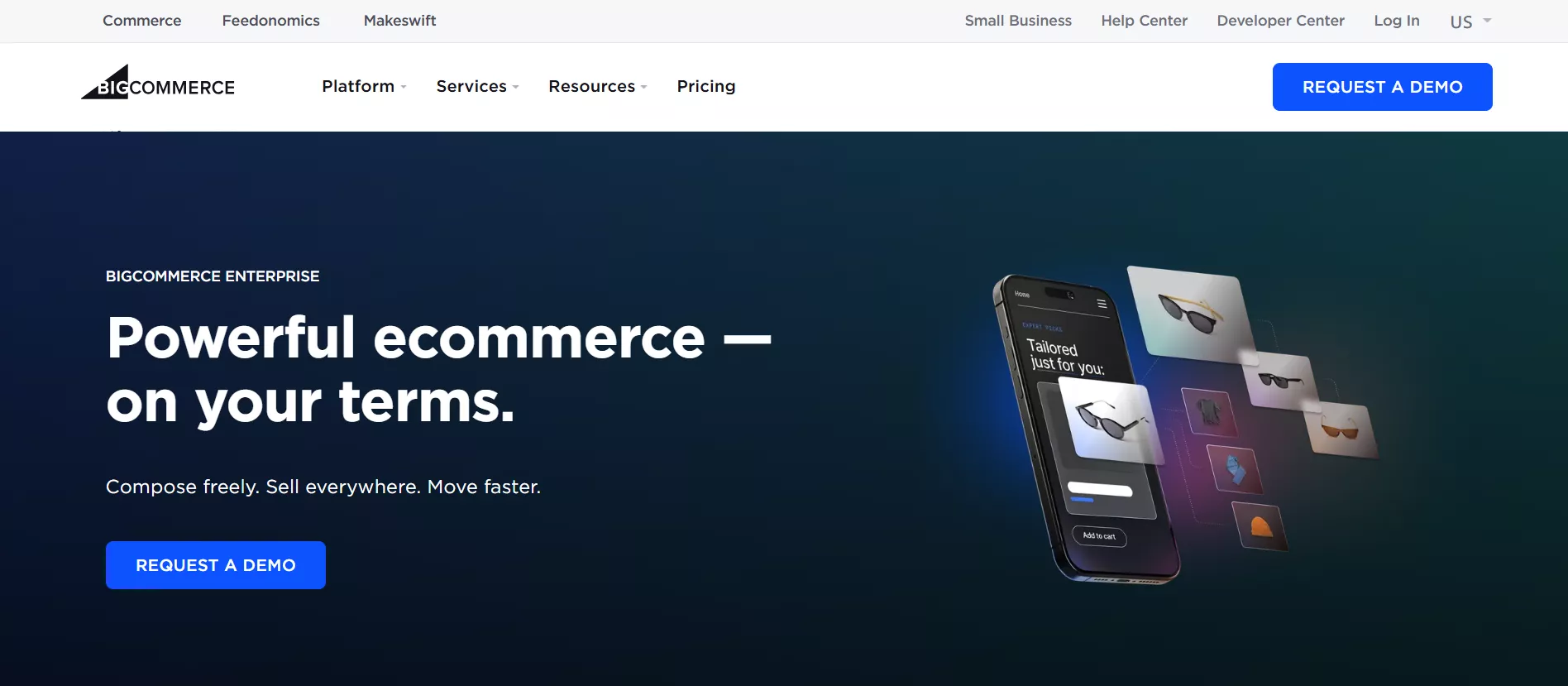
BigCommerce has carved out a massive niche as the “Open SaaS” leader. It offers the stability of a hosted platform but provides the flexibility of open APIs, making it perfect for complex business models.
- Best For: Enterprises managing multiple brands or hybrid B2B/B2C operations under one roof.
- Standout 2026 Feature: Multi-Storefront (MSF) for Headless. This allows you to run dozens of unique, high-speed storefronts, each with its own localized content, using a single backend login.
- The Pro: No transaction fees and a robust native B2B toolset that includes “Quote-to-Cash” and custom price lists.
3. VTEX
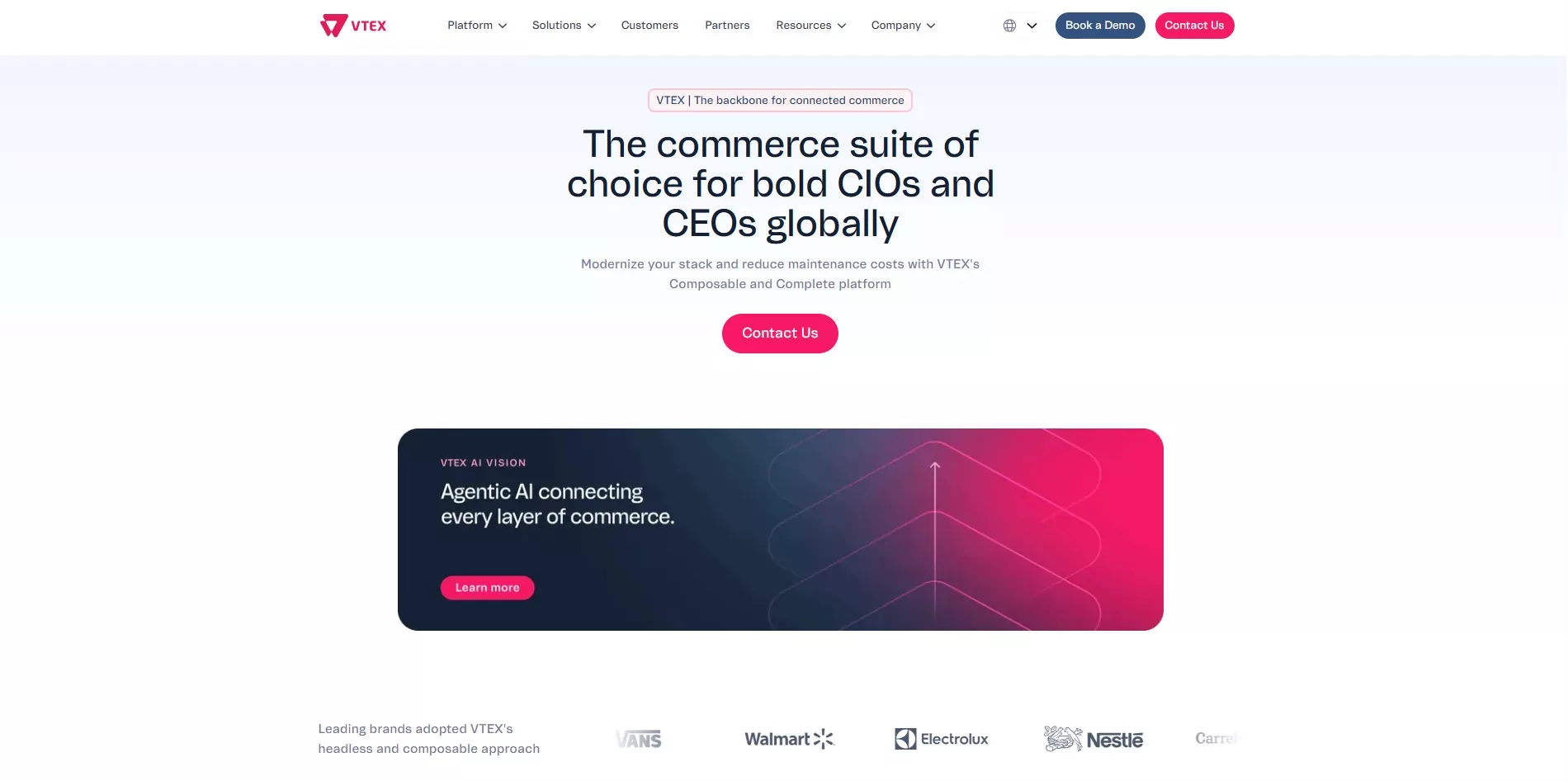
VTEX is the “pragmatic composability” leader, offering a unique “all-in-one” approach for enterprises that want marketplace capabilities and advanced order management out of the box.
- Best For: Large retailers and manufacturers wanting to launch their own marketplace or manage complex, multi-seller global operations.
- Standout 2026 Feature: Agentic Commerce AI. Intelligent agents that automate multi-seller inventory synchronization and localized cross-border logistics orchestration.
- The Pro: Includes a native Marketplace and OMS (Order Management System), allowing brands to sell third-party products seamlessly without separate software.
4. Adobe Commerce (powered by Magento)
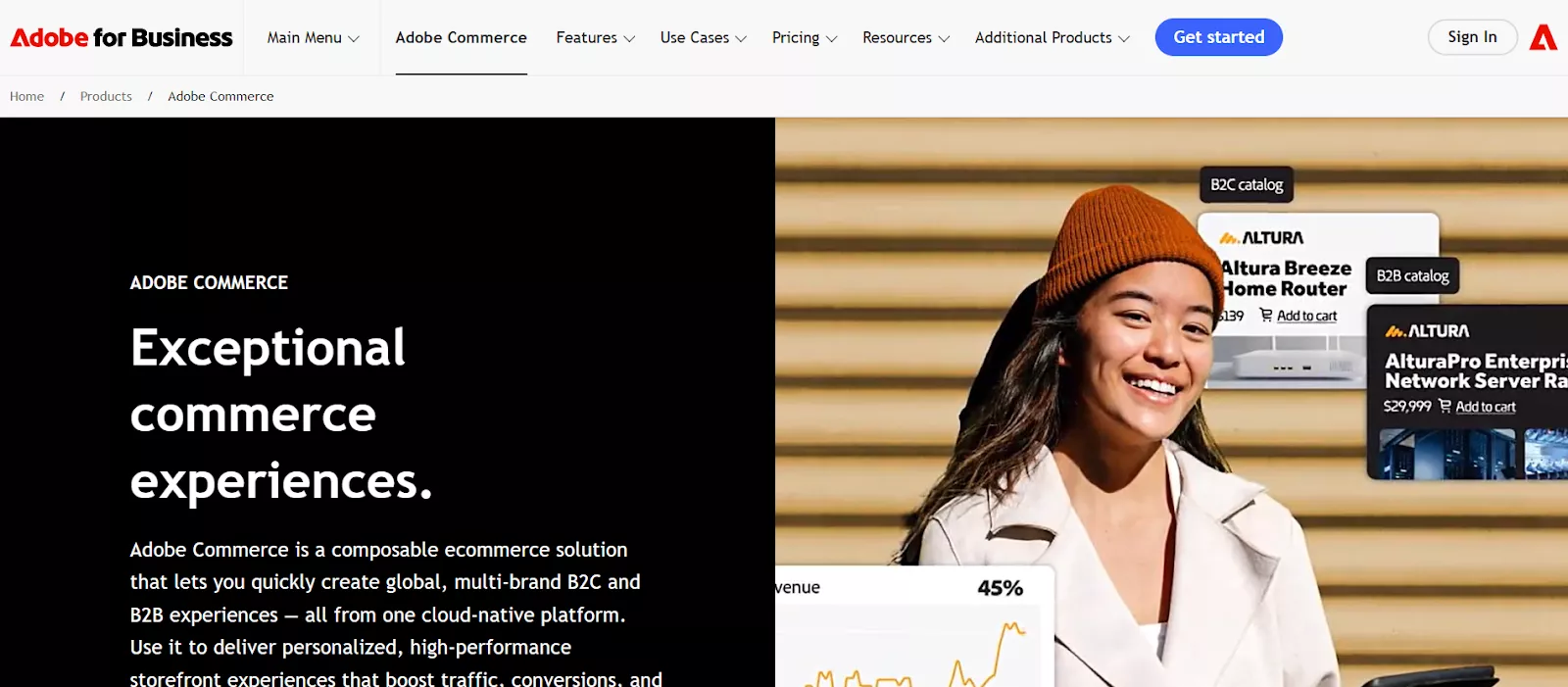
Adobe Commerce remains the heavyweight champion for businesses that require total control over their source code and deep integration with the creative world.
- Best For: Global enterprises with complex, custom workflows and those already heavily invested in the Adobe Creative/Experience Cloud.
- Standout 2026 Feature: Adobe Sensei GenAI Integration. Adobe has integrated its advanced AI to create hyper-personalized shopping journeys that change in real-time based on live user behavior.
- The Pro: Unrivaled flexibility. If your business model is so unique that “out-of-the-box” software won’t work, Adobe Commerce can be bent to your will.
5. Salesforce Agentforce Commerce
Salesforce Agentforce Commerce is more than a commerce platform; it is a data ecosystem. By connecting commerce directly to its world-leading CRM, it provides a 360-degree view of the customer that is hard to beat.
- Best For: Global corporations that prioritize customer relationship data and massive international scalability.
- Standout 2026 Feature: Einstein GPT for Commerce. This allows merchandising teams to use natural language to create promotions, segments, and localized descriptions across 50+ languages instantly.
- The Pro: Reliability. Salesforce is “rock solid” during peak traffic surges, making it a favorite for “Fortune 500” retail giants.
| Platform | Best For | Technical Complexity | Key Pro |
| Shopify Plus | Speed & Growth | Low | Best-converting checkout |
| BigCommerce | Multi-Brand B2B | Medium | No transaction fees |
| VTEX | Marketplace & OMS | High | Native multi-seller support |
| Adobe Commerce | Deep Customization | High | Unlimited control |
| Salesforce | CRM-Led Global | High | AI-powered data |
How to Choose the Right Enterprise eCommerce Platform
Selecting a platform isn’t just a technical decision; it’s a high-stakes strategic choice that will define your company’s agility for the next 5 to 10 years. In 2026, the “best” platform is the one that aligns with your specific operational model and growth trajectory.
Use this four-step framework to navigate the selection process.
Step 1: Determine Your Architecture: Headless vs. Monolithic
The first fork in the road is deciding how much control you need over your “head” (the frontend).
- Choose Monolithic (All-in-One) if you want a faster launch and lower technical overhead. Platforms like Shopify Plus (in its standard mode) provide a unified environment where everything “just works.”
- Choose Headless (Decoupled) if your brand requires a highly unique user experience that standard templates can’t handle. This is ideal if you want to deliver content to unconventional “heads” like VR headsets, IoT devices, or highly custom mobile apps.
Step 2: Calculate the True Total Cost of Ownership (TCO)
Don’t be fooled by low monthly licensing fees. Enterprise platforms often have “iceberg pricing”; the biggest costs are hidden beneath the surface. When comparing, build a 3-year cost model that includes:
- Implementation & Migration: The one-time cost to move your data and launch.
- Maintenance & Security: The salary cost of the developers needed to keep the site updated.
- Transaction & Integration Fees: The ongoing “tax” on every sale and the cost of syncing with your ERP.
Step 3: Assess Your Team’s “Technical Maturity”
Be honest about your internal resources.
- Low Technical Maturity: If your eCommerce team is primarily marketers and merchandisers, lean toward SaaS (Shopify/BigCommerce). You want a platform that lets you change a homepage banner without calling a developer.
- High Technical Maturity: If you have an in-house engineering squad, Custom-ready (Adobe Commerce) or Native Developer Platforms (VTEX) allow them to build proprietary features that can become a competitive advantage.
Step 4: Run the “Stress Test” RFP
When sending out a Request for Proposal (RFP), move past the generic feature lists. Ask vendors to prove how they handle your specific pain points:
- “How does your platform handle 500,000 concurrent users during a 10-minute flash sale?”
- “Can your API sync 1 million SKUs with our SAP ERP in under 15 minutes?”
- “What is your native solution for managing 12 different regional tax laws?”
The Final Verdict: Which One Should You Pick?
- Pick Shopify Plus if your goal is conversion and speed. It is the safest bet for most high-growth retail brands.
- Pick BigCommerce if you have complex B2B data but want to avoid the “maintenance nightmare” of open-source.
- Pick VTEX if you need a native marketplace and advanced OMS. It’s the powerhouse for global brands that want to unify multi-seller and multi-channel operations.
- Pick Adobe Commerce if you need unlimited customization and are already deep in the Adobe ecosystem.
- Pick Salesforce if your business is data-obsessed and you want your commerce to be an extension of your CRM.
The right enterprise eCommerce platform isn’t just the most popular one; it’s the one that best aligns with your business goals, technical ecosystem, and growth strategy. A thorough evaluation across scalability, flexibility, integrations, security, and cost ensures a sustainable and successful commerce foundation.
Partner with Bitcot to Build Your Custom Enterprise eCommerce Store
Navigating the transition to an enterprise-grade platform is a massive undertaking, but you don’t have to do it alone.
At Bitcot, we don’t just “build websites”; we architect scalable, future-proof digital commerce ecosystems tailored to your unique business DNA.
Whether you are looking to migrate from a legacy system, adopt a headless architecture, or integrate advanced Generative AI, our team provides the strategic and technical expertise needed to turn your vision into a high-performance reality.
- Headless & Composable Commerce: We decouple your frontend from the backend using technologies like React and Node.js, giving you total design freedom and lightning-fast performance across web, mobile, and IoT.
- Omnichannel Integration: We bridge the gap between your online store, physical retail, and global marketplaces. By unifying your ERP, CRM, and PIM, we create a single source of truth for inventory and customer data.
- Generative AI & Automation: We implement agentic AI to personalize customer journeys, automate complex B2B workflows, and provide predictive insights that boost AOV and reduce operational overhead.
- Platform Expertise: While we are platform-agnostic, we have deep specialization in leading enterprise engines, including Shopify Plus, BigCommerce, and VTEX.
With over 100 enterprise projects delivered, we understand that “one size fits all” is a recipe for stagnation. Our process is designed for transparency, speed, and measurable ROI.
Final Thoughts
Choosing an enterprise eCommerce platform can feel a bit like picking a life partner for your business.
It’s a long-term commitment that requires a deep understanding of where you are today and, more importantly, where you want to be in the next five years.
As we look toward 2026, the “best” platform isn’t the one with the flashiest marketing; it’s the one that removes the most friction from your daily operations. Whether you’re leaning toward the speed of Shopify Plus, the flexibility of BigCommerce, or the raw power of a composable architecture, remember that your technology should serve your strategy, not the other way around.
The digital landscape moves fast, but with the right foundation, your brand won’t just keep up; it will lead.
If you’re feeling overwhelmed by the technical “how-to” of migrating or scaling, you don’t have to do it alone. At Bitcot, we specialize in turning complex commerce challenges into seamless digital experiences.
From high-performance headless builds to deep ERP integrations, we provide the expertise you need to stay ahead of the curve.
Ready to transform your vision into a high-converting reality?
Explore our custom eCommerce development services for enterprises, and let’s build a platform that truly grows with you.
Get in touch with our team.
Frequently Asked Questions
How do enterprise platforms handle high-traffic events like Black Friday?
Top-tier platforms utilize cloud-native auto-scaling to manage massive surges from New York to Los Angeles. By distributing server loads across hubs in Chicago, Houston, and Phoenix, these systems ensure sub-second response times. This global infrastructure prevents site crashes during peak shopping minutes, whether your customers are browsing from Philadelphia or San Antonio.
Can I manage multiple international storefronts from a single dashboard?
Yes. Modern solutions allow you to control localized stores for San Diego, Dallas, and Jacksonville through one central interface. You can customize currency and content for a boutique in Fort Worth or a tech hub in San Jose, while maintaining unified inventory data across warehouses in Austin and Charlotte.
What is the benefit of integrating a CRM with my eCommerce engine?
Integrating your CRM provides a 360-degree customer view, helping you tailor marketing for users in Columbus, Indianapolis, and San Francisco. By syncing data, a customer’s journey in Denver can trigger personalized loyalty rewards for their next visit in Boston, creating a seamless brand experience that drives long-term retention.
Is headless commerce a good fit for brands with physical retail locations?
Absolutely. Headless architecture bridges the gap between digital and physical stores in cities like Seattle, Washington, D.C., and Nashville. It enables omnichannel features like “Buy Online, Pick Up In-Store” (BOPIS) for shoppers in Portland or Las Vegas, ensuring real-time stock accuracy across every brick-and-mortar touchpoint.
How do these platforms ensure data security and global compliance?
Enterprise platforms adhere to strict PCI and GDPR standards to protect transactions from Miami to Anchorage (Alaska). With robust data encryption and secure processing centers in Kansas City and Ashburn, your business stays compliant with local laws while shielding sensitive customer information from evolving cyber threats.