

Key Takeaways:
- Scalability is a business decision, not just a technical one. It directly impacts revenue, retention, and growth.
- Horizontal scaling offers near-unlimited growth potential, while vertical scaling hits hardware limits fast.
- 53% of mobile users leave if a page takes more than 3 seconds to load. Performance is non-negotiable.
- Microservices, caching, load balancing, and auto-scaling form the backbone of modern scalable architecture.
- Building for scale from day one costs far less than rebuilding a system that’s already breaking.
- Cloud infrastructure in 2026 scales with usage through pay-as-you-go models, making scalability accessible to startups and enterprises alike.
Most web applications don’t fail because of bad ideas. They fail because they can’t handle success.
Traffic spikes. Checkout crashes. Slow dashboards that bleed users. These are scalability problems, and they’re entirely preventable.
This guide will walk you through the key strategies for building a scalable, efficient, and user-friendly application, whether you’re a funded startup preparing for growth or an enterprise modernizing a platform that’s already under pressure.
So why settle for underwhelming performance when you can create a fast, efficient, and scalable application that users love?
Read on to discover how to build web applications that perform flawlessly, keeping customers engaged and your business thriving.

What is Scalability in Web Applications?
Scalability is the ability of a web application to handle increasing users, data, and workload without slowing down or breaking.
Think of it like a well-designed highway: whether there are 100 cars or 100,000, traffic flows smoothly because the system adapts to demand. Scalability ensures your application remains fast, reliable, and functional even as user numbers grow.
How does a scalable web application actually work? At its core, a scalable system distributes workloads, caches frequently requested data, balances traffic across servers, and breaks functionality into independent services that grow on their own.
When done right, users never notice the complexity behind the scenes. They just experience an app that works, fast, every time.
That sounds simple. The execution? That’s where most teams get stuck, especially without a clear product owner driving architecture decisions from day one.
But before diving into strategies, it helps to understand the two fundamental ways applications scale, and why choosing wrong early on costs more than most teams expect.
Vertical Scaling vs. Horizontal Scaling
Understanding how scaling works is critical before choosing a strategy. There are two primary approaches, and most modern applications end up using both.
Vertical Scaling (Scaling Up)
Vertical scaling means adding more power to your existing server – more CPU, RAM, or storage. It’s the simplest approach and works well for quick performance gains.
Example: An e-commerce platform upgrades its database server before a major product launch to handle the expected traffic spike.
Vertical scaling is ideal for quick improvements but has limits. Every server has a ceiling, and a single powerful machine is also a single point of failure.
Horizontal Scaling (Scaling Out)
Horizontal scaling means adding more servers to distribute the load across multiple machines. Instead of making one server more powerful, you add more servers working in parallel.
Example: An e-commerce platform adds extra servers during Black Friday to handle traffic spikes, then scales down after the rush.
Horizontal scaling is more sustainable for long-term growth. It offers near-unlimited capacity and better fault tolerance since no single server failure can bring down the entire system.
Hybrid Approach: Many modern web apps start with vertical scaling and transition to horizontal scaling as traffic increases. This lets teams move fast early on without overengineering, then expand capacity as real demand patterns emerge.
Here’s the real question though. Why does any of this matter if the app is working fine right now?
Because “working fine” and “ready for growth” are two very different things. The next section shows exactly why that gap costs more than most founders and CTOs realize.
Why is Scalability Important for Web Applications?
Scalability isn’t just a technical feature. It’s a business necessity. A well-scaled web application ensures smooth performance, keeps users happy, and supports long-term growth.
Here’s why it’s crucial:
Handles Growing Traffic
A growing user base means more traffic. Without scalability, your app could slow down or crash during peak hours.
In 2026, nearly 88% of internet users who have a bad experience on a website don’t return. Over 53% of mobile visitors leave a site if it takes more than three seconds to load. A one-second delay in page load time can reduce conversions by up to 20%.
Example: A scalable e-commerce website can handle holiday sale surges without checkout failures.
Reduces Long-Term Costs
Planning for scalability early prevents expensive rework and ensures smooth expansion as business needs evolve.
The global web development services market is valued at approximately $87.75 billion in 2026 and is projected to reach $134.17 billion by 2031, growing at a CAGR of 8.87%. Companies that build for growth from day one avoid costly rebuilds later, a lesson that product-led teams learn once and never forget.
Improves User Experience
A two-second delay in load time increases cart abandonment rates to 87%. When mobile load time goes from one to three seconds, bounce probability increases by 32%. Sites that load in one second have just a 7% bounce rate, compared to 38% for sites loading in five seconds.
The question isn’t “should we invest in scalability?” It’s “can we afford not to?”
“The companies that win long-term aren’t the ones that ship fastest. They’re the ones that build to last and scale without breaking.”
Supports Business Growth
Your application must be able to accommodate new features, integrations, and user segments without architectural overhauls. Scalability gives your development team the flexibility to ship faster and iterate without fear of breaking what already works.
For growth-stage companies and enterprises alike, this is what separates platforms that compound in value from products that plateau. In a market where digital transformation is reshaping every industry, scalability is no longer a nice-to-have. It’s the baseline.
Now that the business case is clear, what does a scalable application actually look like under the hood? Let’s break down the characteristics that separate apps built to last from apps built to break.
Key Characteristics of a Scalable Web Application
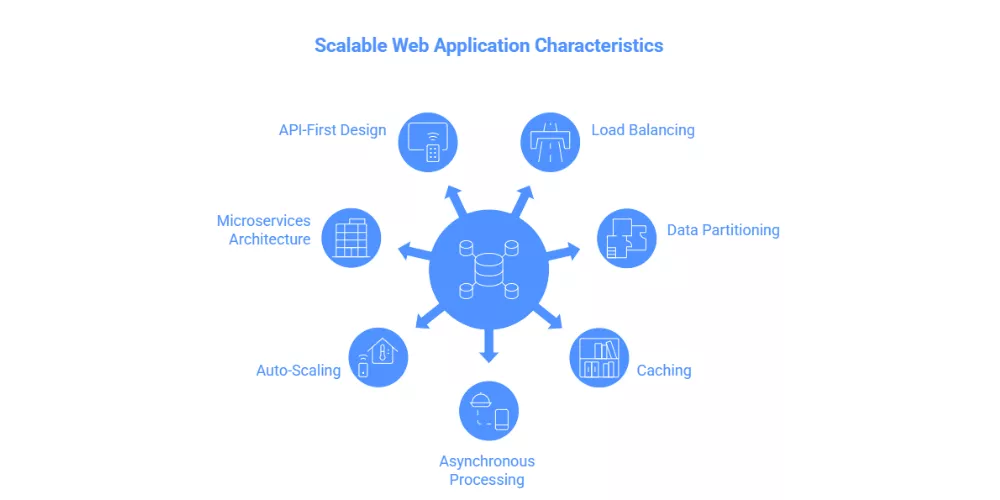
Here are the key characteristics that make an application scalable and future-proof:
Load Balancing
Distributes traffic across multiple servers to prevent overload.
Example: AWS Elastic Load Balancer routes users to the nearest available server, keeping response times consistent even during traffic spikes.
Data Partitioning (Sharding)
Splits data across multiple servers to prevent bottlenecks.
Example: Netflix uses Apache Cassandra to manage vast amounts of streaming data efficiently across distributed nodes.
Caching
Stores frequently accessed data closer to users, reducing database queries.
Example: News websites cache popular articles to enable instant loading, even during breaking news events that spike traffic by 10x or more.
Asynchronous Processing
Processes background tasks separately to prevent slow UI interactions.
Example: Ride-hailing apps process payments in the background while users book rides, ensuring the core experience stays fast and responsive.
Auto-Scaling
Cloud services like AWS Auto Scaling adjust resources dynamically, saving costs while ensuring high performance. In 2026, serverless-first architectures are rising at an 18.1% CAGR, cutting infrastructure costs by roughly 38% for small and medium enterprises.
Microservices Architecture
Divides applications into independent services, allowing individual scaling of components.
Example: An e-commerce site scales only its payment service during high transaction volumes instead of scaling the entire application.
Over 90% of organizations have adopted or plan to adopt microservices, making this the dominant approach for building applications that need to handle unpredictable growth.
API-First Design
Exposes application functionality through well-defined APIs, making it easier to integrate with third-party services, mobile apps, and partner platforms.
Example: A SaaS platform built API-first can onboard new integrations in days instead of months, without touching core application logic.
Understanding these characteristics is one thing. Building them into a real product, on time, with measurable outcomes, is another. The following best practices are what separate production-grade scalability from whiteboard theory.

Best Practices for Building a Scalable Web Application
Here are some of the top practices that we’ve compiled to help you build better web applications. Let’s have a look.
-
Understand Application Needs
Understand application needs, involve stakeholders, and plan for scalability from the start. Conduct thorough market research to review traffic patterns, identify potential growth areas, and determine the necessity of scalability before writing a single line of code.
How do I know if my app needs to scale? If you’re expecting user growth, seasonal traffic spikes, or expanding into new markets, scalability should be part of your architecture from day one. Vague requirements like “we just need an app” won’t get you there. Clear product goals and defined KPIs drive every scalability decision that follows.
-
Select the Right Technology Stack
Select frameworks and databases that support scalability, such as Node.js, Python, PostgreSQL, or MongoDB.
In 2026, JavaScript remains the foundation of over 95% of modern web applications, with 62.3% of developers still using it. React.js is the preferred front-end framework for 43% of developers. TypeScript has become the default for large-scale projects, adding type safety that reduces runtime errors.
On the backend, Node.js, Python (Django/FastAPI), and Go are leading choices for scalable systems. For databases, PostgreSQL, MongoDB, and cloud-native options like Amazon DynamoDB or Google Cloud Spanner handle large-scale workloads efficiently. Pairing the right stack with cloud-native development practices, including containers, declarative APIs, and managed services, is what separates apps that scale from apps that struggle.
Not sure where to start? This guide on choosing the right tech stack breaks down the decision by product type, team size, and growth stage.
-
Prioritize Security
Use firewalls, authentication, and encryption to protect user data.
The web application firewall market is projected to grow from approximately $7.07 billion in 2025 to $20.44 billion by 2033, reflecting how seriously businesses take application-layer security. Implement HTTPS everywhere, use token-based authentication (JWT), and conduct regular security audits.
-
Design for High Traffic
Design your application to handle high traffic without performance degradation. Implement caching with Redis or Memcached, use CDNs for static content delivery, and ensure your database can handle concurrent connections at scale.
Half of all eCommerce users have faced slow website performance during high-traffic events. Planning for peak load, not average load, is what separates resilient applications from fragile ones. Application performance optimization starts with understanding your traffic patterns and designing your infrastructure to absorb spikes without degradation.
-
Hire Skilled Developers
Ensure your developers have the expertise to create and maintain scalable solutions.
The global software developer population reached 28.7 million in 2025, yet organizations across all sizes report persistent talent shortages. Employment of web developers is expected to grow by 8% from 2023 to 2033. Investing in developers who understand cloud-native patterns, microservices, and modern DevOps is critical, whether you build an in-house team or partner with an experienced development firm.
-
Follow Coding Standards
Maintain clean, modular code following industry standards to ease future updates.
When an app scales effectively, developers can add new features, expand services, and manage higher traffic loads without destabilizing the system. Spaghetti code is one of the fastest ways to kill scalability before it starts. Pair clean code with DevOps automation – automated testing, CI/CD pipelines, and infrastructure as code – to catch issues before they reach production.
-
Focus on User Experience
Design with users in mind, ensuring smooth navigation and fast load times.
In 2026, about 67% of websites achieve a fast LCP (Largest Contentful Paint) score. Both Google and Bing use page speed as a ranking factor. A 0.1-second improvement in load speed can increase conversions by 8.4% for retail and 10.1% for travel sites.
Nearly 70% of consumers say page speed impacts their willingness to buy from an online retailer.
-
Use Microservices or Serverless Architecture
Opt for microservices or serverless architectures to enhance flexibility and scalability.
Technologies like Docker and Kubernetes make containerization and orchestration practical, breaking applications into portable units that can be deployed, scaled, and managed independently. In 2026, 23% of cloud budgets are directed toward cloud-native development, including containers, serverless computing, and microservices.
The right architecture choice depends on your product roadmap, not the latest trend. Adopting microservices without a clear use case creates more complexity than it solves.
-
Implement Caching Solutions
Use caching solutions like Redis or Memcached to reduce database queries and network load.
Caching is one of the simplest and most effective ways to keep things running smoothly. Instead of recalculating or fetching data from the database every time, the app retrieves it from the cache, significantly speeding things up.
Key caching layers include:
- Memory (RAM): Extremely fast, ideal for high-priority data like API calls and sessions
- Dedicated cache services: Tools like Redis or Memcached handle large volumes of cached data efficiently
- Browser cache: Static files (images, scripts) are saved directly in the user’s browser, speeding up page reloads
- CDN cache: Distributes content through a global server network, reducing latency for users worldwide
Best practices only go so far without proof. So how have the companies that scaled successfully actually done it, and what patterns do their architectures share?
What Do Scalable Web Applications Look Like in Practice?
Real-world scalability is not theoretical. Here’s how leading companies have built systems that handle massive traffic reliably.
Amazon
Amazon’s architecture scales horizontally, allowing it to handle millions of simultaneous transactions with minimal latency. The company pioneered the microservices approach. Its famous “two-pizza team” model reflects the principle that each service should be small enough for a single team to own.
Amazon found that every 100ms improvement in page load time increased revenue by 1%. That insight shaped how the entire company thinks about performance.
“Everything fails all the time. The time to build a system is minuscule compared to the time you’ll run it, so investing in manageability up front is crucial.”
– Werner Vogels, CTO, Amazon
Netflix
Uses cloud-based infrastructure and CDNs to ensure smooth streaming, even during peak hours. Netflix migrated to a microservices architecture after a single missing semicolon nearly took their entire system down. Today, they run hundreds of independent microservices and pioneered Chaos Engineering, deliberately introducing failures to ensure the system handles them gracefully.
Airbnb
Manages millions of listings and bookings with a scalable backend that adapts to user demand. Their platform handles seasonal surges across global markets, ensuring consistent performance whether a user is booking in Tokyo or Toronto.
Each of these companies invested in scalability early, and it became a core competitive advantage, not just a technical checkbox. Whether running multi-tenant architecture for millions of users or handling real-time data across global regions, the pattern is the same: scalability was treated as a product decision, not an infrastructure afterthought.
The common thread? Strong product leadership that treated scalability as a strategic priority, not a developer afterthought.
That raises the next practical question: “What’s this actually going to cost?” The answer depends on a few key variables.
How Much Does It Cost to Build a Scalable Web Application?
The cost varies based on complexity, technology, and infrastructure needs. Here’s what drives the budget:
Features & Complexity: More features = higher cost. A simple CRUD application and a real-time collaborative platform have very different scalability requirements.
Infrastructure Needs: Cloud hosting, auto-scaling, and load balancing increase expenses. However, consumption-based pricing models (pay only for what you use) make it more predictable than traditional infrastructure.
Technology Stack: Open-source tools (PostgreSQL, Redis, Node.js) are cheaper than proprietary ones (SQL Server, Oracle). In 2026, the vast majority of scalable applications are built on open-source foundations.
Development Expertise: Hiring skilled engineers ensures scalability but costs more upfront. The investment pays off in reduced technical debt and fewer costly rebuilds later.
Ongoing Maintenance: Continuous monitoring and updates are necessary for long-term success. Budget for monitoring tools, security patches, and infrastructure optimization.
| Application Type | Estimated Cost Range | Key Considerations |
| Simple scalable web app | $30,000 – $75,000 | Basic features, cloud deployment, CI/CD |
| Medium complexity | $75,000 – $250,000 | Microservices, caching layers, monitoring |
| Enterprise-grade | $250,000 – $1,000,000+ | Multi-region, advanced security, 24/7 ops |
Cloud infrastructure costs scale with usage. With 60% of IT budgets in 2026 allocated to cloud-based services, businesses are increasingly comfortable with consumption-based pricing models.
One note worth making: teams that approach scalability as a long-term investment consistently outperform those shopping for the lowest build price. Cheap architecture is expensive architecture. You just pay for it later in rewrites, downtime, and lost users.
With costs covered, what’s coming next matters just as much. The teams that adopt these trends early won’t just scale. They’ll outpace the competition entirely.
What Trends Are Shaping Scalable Web Development in 2026?
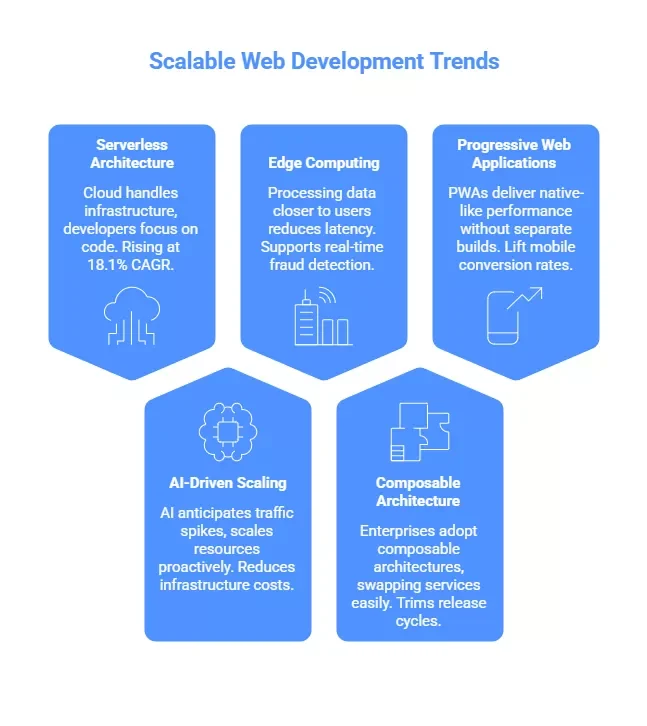
Let’s explore some of the most impactful trends shaping the future of scalable web applications:
Serverless Architecture
Serverless architecture is transforming the way applications scale effortlessly. With AWS Lambda, Google Cloud Functions, and Azure Functions, developers focus on code while the cloud handles infrastructure automatically. Serverless architectures are rising at an 18.1% CAGR and cut infrastructure costs by roughly 38% for SMEs.
AI-Driven Scaling and Operations
AI and machine learning services in the cloud are projected to exceed $47 billion. AI is now embedded in predictive autoscaling, where cloud platforms use ML to anticipate traffic spikes and scale resources proactively rather than reactively. This eliminates the lag between demand spikes and infrastructure response.
The key here isn’t chasing AI as a buzzword. It’s applying it where it creates measurable operational gains, like reducing infrastructure costs or eliminating manual scaling decisions.
Edge Computing
Processing data closer to users reduces latency dramatically. Hyperscalers like AWS, Azure, and Google Cloud are rapidly expanding multi-access edge computing (MEC) offerings, supporting use cases from real-time fraud detection to automated retail systems.
Composable Architecture
Leading enterprises are adopting composable architectures, swapping individual services like search, cart, and payments without disrupting the core system. This approach trims release cycles from weeks to days and represents the next evolution beyond traditional microservices.
Progressive Web Applications (PWAs)
PWAs are leading growth at a 13.45% CAGR because they deliver native-like performance without the cost of separate iOS and Android builds. Retail case studies show that well-designed PWAs can lift mobile conversion rates fourfold.

Also Read: How to Build a Serverless Application Using AWS Services
How Bitcot Can Help
If you’re looking for expert guidance on building a scalable, high-performance web application, we’re here to help.
“Scalability isn’t something you bolt on after launch. The best architectures are designed for growth before the first user ever logs in.”
– Raj Sanghvi, Founder & CEO, Bitcot
At Bitcot, we specialize in custom web app development, ensuring that your product is built for growth, efficiency, and long-term success. From architecture planning and technology selection to cloud infrastructure and ongoing optimization.
Our team brings over 10+ years of experience building scalable solutions for businesses and hundreds of growth-stage startups. See how we’ve applied these principles across industries in our case studies.
What does working with Bitcot look like?
- Detailed discovery and architecture planning tailored to your growth goals
- Technology stack selection based on your specific scalability requirements
- Cloud-native development with autoscaling, load balancing, and CI/CD built in
- Ongoing performance monitoring and optimization post-launch
- Microservices and serverless architecture expertise
We work best with teams that have clear product ownership, defined outcomes, and the budget to build something that lasts, whether that’s a Series A startup scaling its core platform or an enterprise modernizing a legacy system under load.
Whether you’re launching a new product or modernizing a system that’s hitting its limits, scalability shouldn’t be an afterthought. It should be baked into every decision from day one.
Also Read: Migrating from Monolithic to Microservices Architecture
Conclusion
Building a scalable web application in 2026 isn’t optional. It’s the foundation for any business that wants to compete in the digital economy.
With the web development market approaching $88 billion, the cloud computing market exceeding $900 billion, and users who won’t tolerate even a one-second delay, scalability determines whether your application becomes a growth engine or a growth bottleneck.
The good news? With the right architecture decisions, technology stack, and development partner, scalability is entirely achievable, regardless of where you’re starting from.
One of the best ways to improve your application’s performance is to collaborate with experienced developers who share the same goal. Learning from real-world patterns and proven infrastructure decisions helps you avoid pitfalls and make smarter technical choices.
By putting the user experience first, you’ll be able to prioritize optimizations that truly matter, ensuring that your investment has the biggest impact.
Have questions? Need a consultation? Let’s discuss how we can help bring your vision to life. Your success is our priority, and we’re ready to help you scale.
Frequently Asked Questions (FAQs)
What is a scalable web application?
A scalable web application can handle increasing users, data, and workload without degrading in performance. This is achieved through thoughtful architecture (microservices, serverless), cloud infrastructure with autoscaling, caching, load balancing, optimized databases, and clean modular code.
What is the difference between vertical and horizontal scaling?
Vertical scaling adds more resources (CPU, RAM) to a single server. It’s simple but limited by hardware capacity. Horizontal scaling adds more servers to distribute the load. It’s more complex but offers nearly unlimited growth potential. Most modern scalable applications rely primarily on horizontal scaling.
Which cloud platform is best for scalable web applications?
AWS leads with the broadest service portfolio and roughly 30% global cloud infrastructure market share. Azure is strong for Microsoft-centric enterprises at around 22%. Google Cloud excels in data analytics and Kubernetes at approximately 12%. Many enterprises now use multi-cloud strategies, and by 2027, Gartner predicts 90% of organizations will adopt a hybrid cloud approach.
How much does it cost to build a scalable web application?
Costs range from $30,000 for simple applications to over $1 million for enterprise-grade systems. Cloud infrastructure costs scale with usage through pay-as-you-go models. The investment in scalability upfront is far less than the cost of rebuilding a system that can’t handle growth.
What technologies are best for building scalable web apps in 2026?
Popular choices include Node.js, Python (Django/FastAPI), and Go for backend development. React.js and TypeScript dominate frontend development. PostgreSQL and MongoDB lead in databases. Redis handles caching. Docker and Kubernetes manage containerization. AWS, Azure, and Google Cloud provide the underlying infrastructure. For a deeper breakdown, explore this 2026 tech stack guide.
Do I need microservices from day one?
Not necessarily. For early-stage products, a well-structured monolith is often the better choice. It’s simpler to build, deploy, and debug. The key is writing clean, modular code that can be decomposed into microservices when you need to scale individual components independently.
How do I know when it's time to scale my web application?
Monitor your application’s performance metrics closely. Warning signs include increasing response times, rising error rates during peak traffic, database query times creeping up, and users reporting slowness. Regular load testing helps you understand your limits before you hit them in production.