Key Takeaways
- AI personalization quality depends on the data pipeline architecture, not just the model.
- According to Statista, 74% of users feel frustrated when website content is not personalized.
- Real-time adaptation requires event-driven backend design, not periodic batch processing.
- San Diego product teams increasingly treat behavioral data as a first-class engineering asset.
- Privacy-respecting personalization starts with consent-aware data collection at the API layer.
Introduction
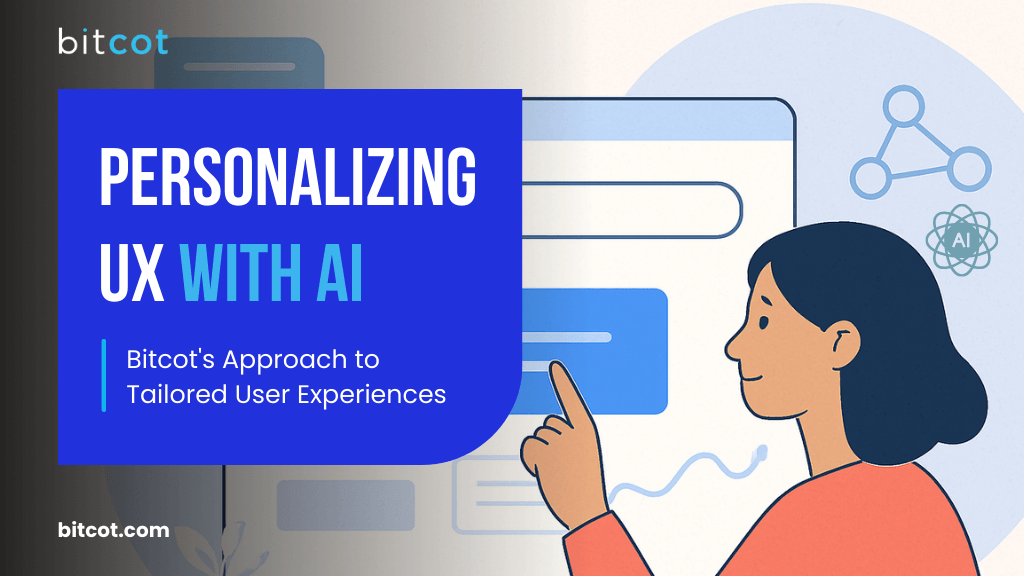
According to Statista, 74% of users feel frustrated when they land on a digital product that does not recognize their preferences or context. That frustration is not a design problem, it is an engineering problem. The gap between a generic interface and a genuinely personalized one comes down to how the software collecting, processing, and acting on behavioral data is actually built. AI-driven personalization is the mechanism that closes this gap, but only when the underlying architecture supports it.
Most discussions about personalized UX design focus on the surface layer: better recommendations, smarter content feeds, adaptive layouts. What rarely gets examined is the software design behind those outcomes. The model’s accuracy is a product of the data pipeline feeding it. The interface’s responsiveness is a product of how the rendering layer is wired to the inference layer. These are engineering decisions, and they determine whether personalization actually works at scale.
Our engineering team has built AI-driven interfaces for healthcare and fintech products where user context directly affects clinical workflows and financial decisions. What follows is what we have learned about the architecture and tradeoffs that separate personalization that performs from personalization that merely ships.
What is AI-Driven Personalization in UX Design?
AI-driven personalization in UX design is the practice of using machine learning models and behavioral data signals to adapt a digital product’s interface, content, and recommendations to each user in real time. It is distinct from rule-based personalization, where a developer writes explicit “if user did X, show Y” logic because the system learns patterns across user cohorts and applies those patterns to individuals without hard-coded rules.
The key components are a behavioral event stream (what the user does), a feature store (structured representations of user attributes and history), a model that scores or ranks options based on those features, and an interface layer that receives and renders model output. When these components are loosely coupled and low-latency, personalization happens in milliseconds. When they are tightly coupled or batch-oriented, the experience degrades into something that feels delayed or stale.
For product teams building on this stack, the practical question is not whether to use AI personalization, but where in the data-to-interface pipeline the bottleneck lives. Identifying that bottleneck early determines which architectural investment will produce the most visible UX improvement.
The Role of Data Architecture in Powering Personalization
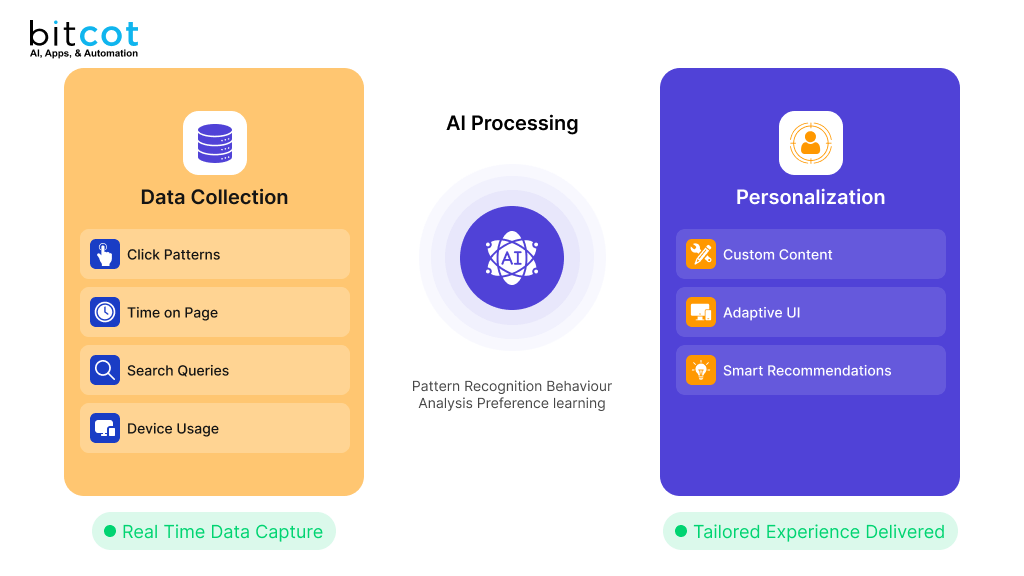
Data is the operational foundation of any personalization system, but raw event data is not useful on its own. The structure matters as much as the volume. A Harvard Business Review analysis found that companies consistently overinvest in data collection and underinvest in data readiness, the transformation layer that turns raw signals into model-ready features. The result is personalization systems trained on incomplete or misrepresented user profiles.
In practice, this means building a feature store that captures not just what a user clicked, but how long they lingered, what they skipped, and what they returned to after leaving. These behavioral signals carry more predictive weight for personalization than explicit preference selections because they reflect actual intent rather than stated intent. For products like healthcare web application development contexts, where user behavior reflects clinical priorities, not consumer whims, this distinction directly affects the quality of interface adaptation.
Event schema design is the most underappreciated part of this work. Poorly modeled events create inconsistencies downstream that no amount of model tuning can correct. Before any ML component enters the picture, the data team needs a consistent event taxonomy, a clear entity resolution strategy, and a defined retention policy that respects user consent settings from the point of collection.
How Does Real-Time Adaptation Work in Software UX?
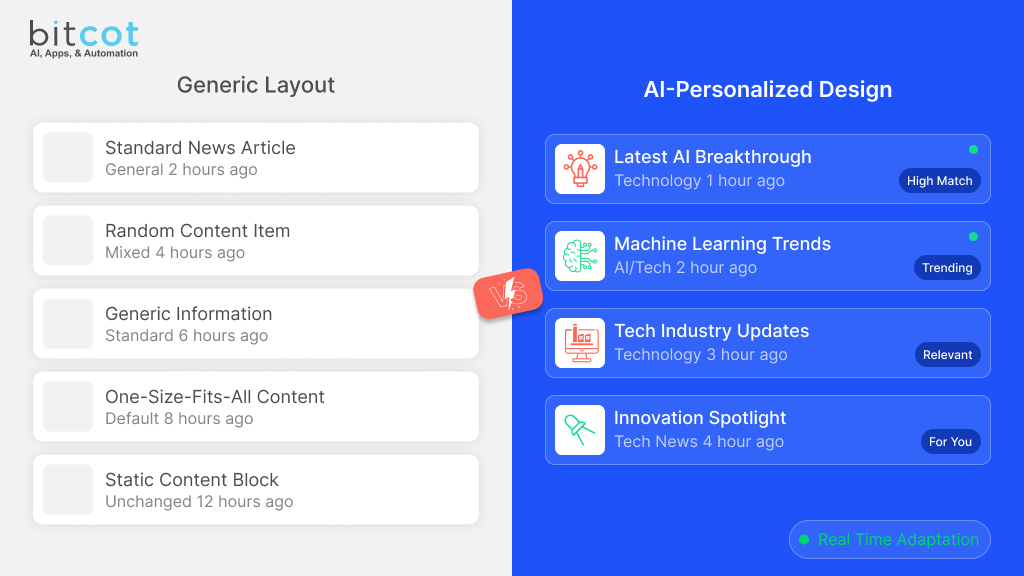
Real-time adaptation in software UX means the interface updates based on user behavior within the current session, not on the basis of a profile computed overnight. Achieving this requires an event-driven backend architecture where user actions publish to a message queue, model inference runs as a subscribing service, and updated recommendations or content rankings are pushed to the interface layer before the user navigates to the next screen.
The architectural split that makes or breaks real-time personalization is the choice between batch inference and online inference. Batch inference computes personalization scores on a schedule and stores them for lookup. Online inference computes scores on demand when the user triggers an action. Batch approaches are cheaper and easier to build, but they cannot respond to in-session context shifts. A user who starts a session looking at one category and shifts to another will receive recommendations that lag the shift by hours. Online inference handles this correctly but demands a model serving layer with sub-50ms latency under load, which has meaningful infrastructure implications.
For teams building AI workflow automation into their product UX, the practical path is often a hybrid: batch-computed baseline features combined with a lightweight online re-ranking model that adjusts the ordering of results based on the current session’s signals. This architecture delivers meaningful real-time adaptation without requiring the full infrastructure cost of end-to-end online inference.
Enhancing Engagement Through Personalized Interface Design
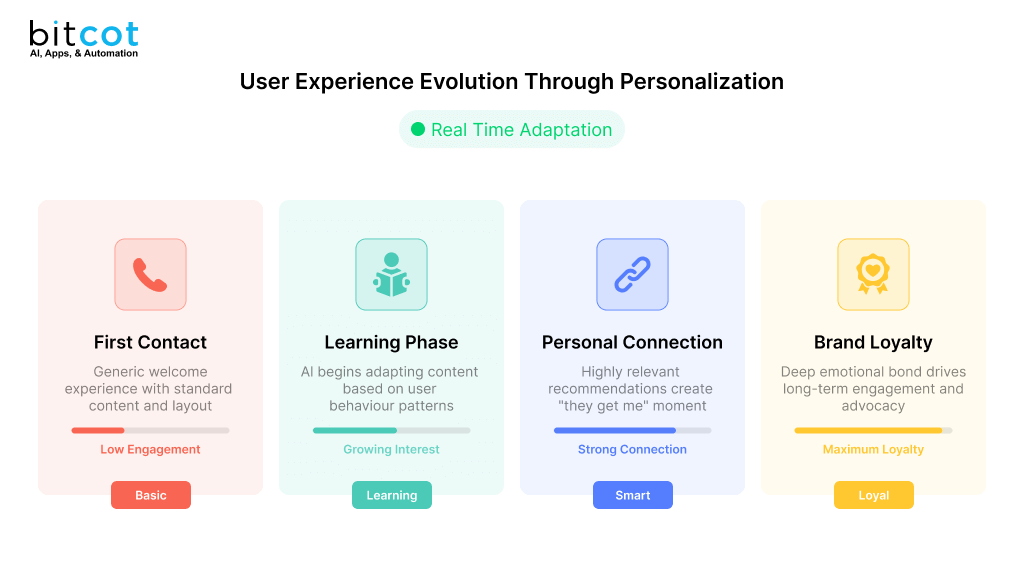
Personalization improves engagement not because it shows users what they want, but because it reduces the cognitive work required to get there. A user who sees a dashboard pre-configured around their most-used features, or a content feed ordered by their demonstrated reading patterns, spends less effort navigating and more time on the task they came to complete. According to Forbes, personalized digital experiences drive a measurable lift in session depth and return visit frequency, not because users are manipulated, but because they experience less friction.
The interface design challenge is deciding which elements should adapt and which should remain stable. Over-personalization, where the layout, navigation structure, and content all shift simultaneously, disorients users and erodes trust in the product. The most effective personalization applies to content selection and ranking, not to core navigation patterns or structural UI components. Users benefit from a consistent spatial memory of where controls are located, even as the content those controls surface adapts to their context.
For fintech products, where fintech software development teams are increasingly asked to surface personalized financial insights alongside account data, this principle is especially important. Adaptive content within a stable shell is the pattern that converts engagement improvements into actual product satisfaction.

Privacy and Personalization: How the Architecture Determines the Outcome
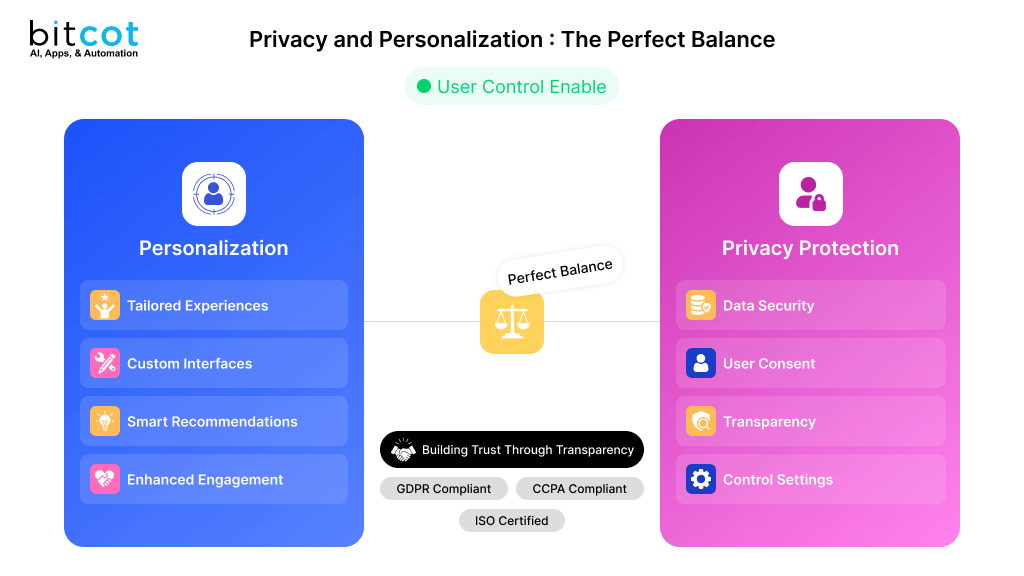
Privacy in AI-driven personalization is not primarily a policy question; it is an architectural one. A system designed to collect the minimum data required to personalize effectively will handle privacy correctly by default. A system designed to collect everything and filter later will create privacy exposure regardless of what the privacy policy says. This distinction matters practically: data minimization reduces the surface area of risk, simplifies consent management, and lowers the cost of compliance with frameworks like the California Consumer Privacy Act.
Consent-aware data collection means the collection layer knows, at the point of event capture, what the user has consented to and stores only what falls within that scope. This requires the consent state to be a first-class attribute in the event schema, not a flag checked after the fact in a downstream process. When consent is embedded in the data model from the start, opting a user out of personalization is a clean operation that does not require retroactive data deletion from multiple systems.
For AI-native app development teams working in healthcare and fintech, this architecture also supports the auditability requirement: every data point used to drive a personalized decision can be traced back to a specific consent event, which matters when regulatory questions arise about how user data informed a consequential outcome.
What Does the Future of AI-Driven UX Personalization Look Like?
The next generation of AI-driven personalization will extend beyond behavioral signals captured within a single product session. Contextual signals, time of day, device type, location, and eventually inferred cognitive state will feed into personalization models that adapt not just what content surfaces, but how the interface itself behaves. An interface that simplifies when a user is navigating quickly under time pressure, and expands detail when they are in a research mode, requires models that read intent from interaction velocity and dwell time rather than just explicit actions.
Multimodal inputs are also entering the picture. As voice and gesture inputs become standard in enterprise and healthcare products, the personalization model needs to reconcile signals from multiple modalities into a coherent user context. The software challenge here is model fusion: combining signals that arrive at different latencies and carry different reliability characteristics into a single decision surface. This is tractable with careful architecture, but it requires treating AI-powered data pipelines as a product in their own right, with the same engineering rigor applied to the data layer as to the interface layer.
The teams that will build this well are the ones currently investing in a clean feature store, a consent-native data model, and an inference architecture that separates batch and online concerns cleanly. Those foundational decisions made today determine what personalization capabilities become available in two years.
Why Choosing the Right Software Partner Changes the Personalization Outcome
AI personalization systems fail most often not because the model is wrong, but because the surrounding software, the event pipeline, the feature store, the consent layer, and the model serving infrastructure were built without a clear architecture in mind. A team that has designed and shipped these systems before knows which decisions are reversible and which ones create expensive rework later.
For product teams in San Diego, Los Angeles, and the broader California technology market, the practical question is whether to build this infrastructure in-house or to partner with an engineering team that has already solved these problems in production. The answer depends on how central personalization is to the product’s core value proposition and how quickly the team needs to iterate on the model. When personalization is a differentiating feature, not a commodity, it warrants a partner with deep experience in AI/ML development and the patience to get the data architecture right before rushing to the model.
Our team has seen the downstream cost of skipping the data architecture phase: feature stores built on inconsistent event schemas, consent models bolted on after collection was already live, and inference layers that cannot scale past a few thousand concurrent users. Starting with a clean architecture takes longer upfront, but the resulting system is easier to improve, easier to audit, and easier to maintain as the product grows.
Teams exploring generative AI integration for their UX layers also benefit from this foundation, since generative outputs fed into an interface without a structured behavioral context layer produce inconsistent and often counterproductive personalization. The feature store is what keeps generative personalization grounded in actual user signals rather than statistical noise.
What We Observe in AI UX Builds Across California Product Teams
Across the product builds our engineering team has worked on in San Diego and Los Angeles, a consistent pattern emerges: organizations that treat AI transformation strategy as a UX initiative rather than a data infrastructure initiative tend to ship personalization features that work in demos but degrade in production. The interface adaptation looks correct in a controlled test with synthetic user profiles, but under real traffic with noisy behavioral signals and inconsistent consent states, the model starts surfacing irrelevant or redundant content.
The shift that produces durable results is reframing personalization as a systems problem rather than a design problem. The UX designer’s job is to define what adaptation should feel like for the user. The engineer’s job is to build the data and inference infrastructure that makes that adaptation possible at the latency and accuracy the experience requires. When both sides of that collaboration are in sync from the start of the project, the outcome is substantially better than when design leads, and engineering follows.
For healthcare products, where the consequences of a poorly personalized interface can affect clinical decision-making, this rigor is not optional. For fintech products, where we build scalable web applications, standards apply to both the financial data layer and the personalization layer; the same discipline holds. The products that personalize well are the products whose teams decided early that the data infrastructure was as important as the interface design.

Conclusion
AI-driven personalization delivers genuine UX improvement when the software architecture underneath it is built to support it. A behavioral event pipeline that captures intent accurately, a feature store that makes those signals model-ready, and an inference layer that resolves decisions at the latency a real-time interface requires; these are the engineering foundations that determine whether personalization works as designed or degrades under load. The interface outcomes that users experience are a direct product of these upstream decisions.
For product teams in San Diego and across California looking to move from generic digital experiences to genuinely adaptive ones, the starting point is not the model selection. It is a clear-eyed audit of the data and infrastructure layer. The design possibilities open up once the engineering foundation is solid. If your team is at the stage of making those foundational decisions, getting the architecture right at the start is the highest-leverage investment available. Connect with our team to discuss what that would look like for your specific product context.
Frequently Asked Questions
What is AI-driven personalization in UX design?
AI-driven personalization in UX design is the use of machine learning models and real-time behavioral signals to adapt a product’s interface, content, and recommendations to each user without requiring hard-coded rules. Unlike rule-based personalization, AI systems learn patterns across user cohorts and apply them dynamically, enabling the product to respond to context shifts within a session rather than on a fixed schedule.
What is the difference between batch and real-time personalization in software?
Batch personalization computes user preference scores on a schedule — often overnight — and stores them for lookup when the user next visits. Real-time personalization runs inference on demand, updating recommendations in response to actions the user takes within the current session. Batch approaches are cheaper to operate but cannot respond to in-session context shifts; real-time approaches require a low-latency model serving layer but produce more accurate and timely adaptation.
How does a feature store improve AI personalization quality?
A feature store improves personalization quality by providing the model with clean, consistent, and pre-computed representations of user behavior rather than raw event logs. When features are standardized in a shared store, the same user attributes can feed multiple models without duplication or inconsistency. Without a feature store, teams often retrain models on differently processed versions of the same data, which produces inconsistent personalization outcomes across product surfaces.
How is AI-driven personalization used in healthcare and fintech software in San Diego?
Healthcare software teams in San Diego use AI personalization to adapt clinical workflow interfaces based on a provider’s specialty, patient panel, and documentation history reducing the time providers spend navigating to the information they need most. Fintech teams apply similar techniques to surface personalized financial insights and transaction summaries based on a user’s account behavior, reducing the cognitive load of interpreting financial data. In both cases, the personalization layer operates within a consent-aware data model that keeps adaptation within the bounds of what the user has authorized.
Is AI-driven personalization worth the engineering investment for a mid-size product team?
Yes, when personalization is a differentiating feature of the product rather than a commodity expectation. The investment threshold drops significantly when a team starts with a clean event schema and a consent-native data model rather than retrofitting personalization onto an existing collection architecture. For teams already considering a data infrastructure upgrade, adding personalization capability at that stage costs a fraction of what it would cost to add it later to a system that was not designed with it in mind.