
You’ve spent thousands building a beautiful online store. Your products are top-notch. Your prices are competitive.
But here’s the problem: A customer types “blue running shoes” into your search bar and gets red sneakers, formal dress shoes, and a random phone case.
They’re gone in seconds. That’s another sale you’ll never see.
What if a single feature could double your conversion rates overnight?
It’s not a new marketing campaign or flashy redesign – it’s the search bar sitting quietly at the top of your site.
This frustrating experience happens countless times daily across eCommerce websites.
Research reveals that approximately 30% of eCommerce site visitors use the site search feature. These searchers demonstrate conversion rates 2-3 times higher than casual browsers.
Yet roughly 72% of online stores fail to meet basic search functionality requirements.
The implications are substantial.
Global eCommerce sales are forecasted to reach $6.88 trillion in 2026, accounting for 21.1% of total retail transactions worldwide. With intensifying competition, search capabilities can determine business success or failure.
An inadequate search experience doesn’t merely irritate customers – it redirects them toward competitors.
Consider typical online shopping patterns. When a search feature disappoints, do shoppers persist and manually explore hundreds of items?
Not really.
Research indicates that 12% of users navigate to a competitor’s platform following an unsatisfactory search interaction, while many others abandon their shopping journey entirely.
The encouraging news?
Contemporary eCommerce search platforms have progressed far beyond simple keyword matching.
Today’s search solutions leverage artificial intelligence, natural language processing, and machine learning to comprehend intent, anticipate shopper needs, and deliver personalized results within milliseconds.
This comprehensive guide examines the leading 10 eCommerce search tools revolutionizing product discovery and customer experience.
These aren’t merely search bars – they’re revenue-generating systems engineered to transform browsers into buyers.
How We Selected the Best eCommerce Search Solutions
Finding the right search platform requires evaluating real performance against business needs.
We focused on solutions that address real eCommerce challenges, not just flashy features. Our evaluation framework included:
-
Search Accuracy and Relevance: Handles typos, synonyms, and natural language queries
-
AI and Machine Learning Capabilities: Learns from user behavior and optimizes results over time
-
Speed and Performance: Sub-second response times even under heavy traffic
-
Personalization Features: Adapts results based on history, location, and preferences
-
Visual Search and Advanced Filters: Supports image uploads and faceted navigation
-
Integration Capabilities: Works with Shopify, Magento, BigCommerce, or custom platforms
-
Analytics and Insights: Provides actionable intelligence for optimizing product discovery
-
Pricing and ROI: Delivers measurable results within budget for businesses of all sizes
After analyzing performance data, customer reviews, and hands-on testing, we identified the platforms consistently delivering superior product discovery experiences.
Top 10 eCommerce Search Solutions for 2026
We’ve tested and ranked the platforms that are transforming product discovery in 2026.
1. Algolia

Algolia is known in the eCommerce search space for its focus on speed and performance.
The company has built its reputation on delivering lightning-fast search results and serves various businesses across different industries. Their infrastructure is designed to handle high-volume queries with advanced search algorithms, and they offer API-based integration options for developers.
Algolia provides features like typo tolerance, synonym recognition, faceted filtering capabilities, and comprehensive analytics dashboards. The company’s search-as-a-service model works with businesses ranging from small startups to larger enterprises across multiple sectors, delivering relevant search results with exceptional speed.
Their autocomplete functionality and instant search features significantly improve user experience and conversion rates.
2. Searchspring
Searchspring provides eCommerce search with an emphasis on merchandising capabilities and product ranking.
They offer various features for businesses looking to manage and optimize their product discovery experience. The company provides tools for manual ranking adjustments, campaign management, and search result customization that give merchandising teams full control.
Their platform includes advanced filtering options, search analytics, A/B testing capabilities, and integration capabilities with common eCommerce systems and shopping cart platforms. Searchspring works with retailers who have substantial product catalogs and need detailed control over search results relevance.
The platform excels in visual merchandising and provides robust business rules for promotional campaigns and seasonal adjustments.
3. Constructor.io
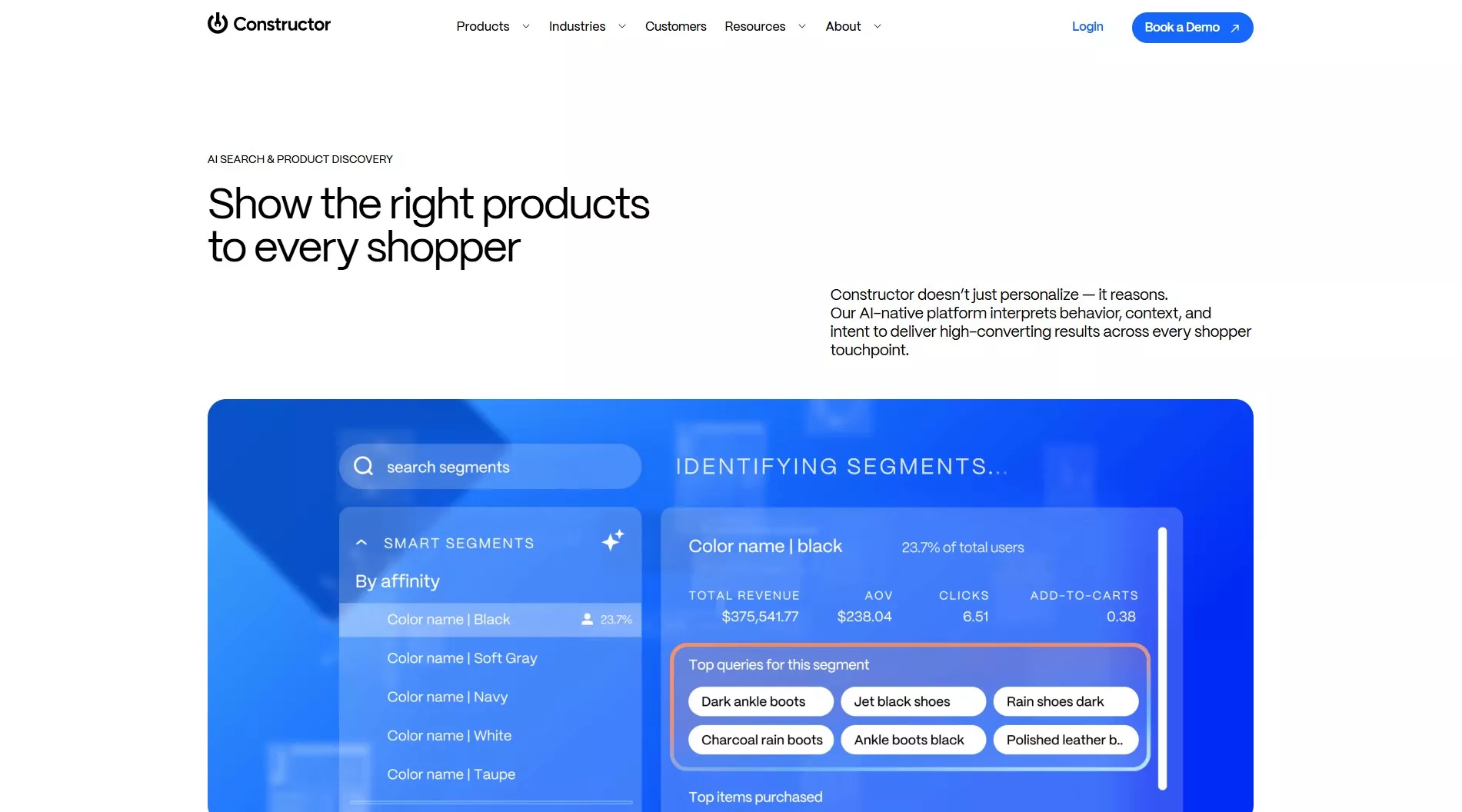
Constructor.io operates in the eCommerce search market with a focus on business outcomes and revenue optimization.
They provide search functionality aimed at helping businesses improve their online sales performance. The company uses machine learning algorithms to optimize search results based on conversion data, revenue metrics, and actual purchase behavior.
Constructor.io offers features including personalization, A/B testing capabilities, predictive search, and comprehensive performance analytics. Their approach emphasizes measuring the direct impact of site search on business metrics rather than just technical performance indicators.
The platform’s AI-powered recommendations and dynamic reranking continuously improve based on real-time user interactions and shopping patterns.
4. Bloomreach

Bloomreach offers a broader commerce experience approach that includes intelligent search as part of its offerings.
The company provides integrated capabilities across multiple aspects of the eCommerce experience, combining site search, merchandising, content management, and customer data features in its comprehensive suite.
Their platform includes personalization capabilities, AI-driven recommendations, product discovery tools, and analytics tools for measuring search performance. Bloomreach positions itself as an end-to-end solution for businesses looking to unify multiple commerce functions under one system.
The platform leverages natural language processing and semantic understanding to deliver contextually relevant results while supporting omnichannel commerce experiences.
5. Experro

Experro provides a Gen AI-native eCommerce search and discovery platform designed for enterprise brands seeking cutting-edge technology.
Experro delivers multimodal search capabilities that understand both text and images, combined with advanced personalization and merchandising features. Their platform is built on generative AI technologies to deliver autonomous, self-optimizing shopping experiences.
The company focuses on helping retailers achieve measurable business outcomes through AI-driven product discovery, real-time personalization, and intelligent merchandising. Experro serves B2C, B2B, and DTC brands looking for a composable, API-first solution that integrates seamlessly with existing tech stacks.
Their visual search and conversational search capabilities represent the next generation of product finding technology, while predictive analytics help optimize search relevance continuously.
6. Nosto
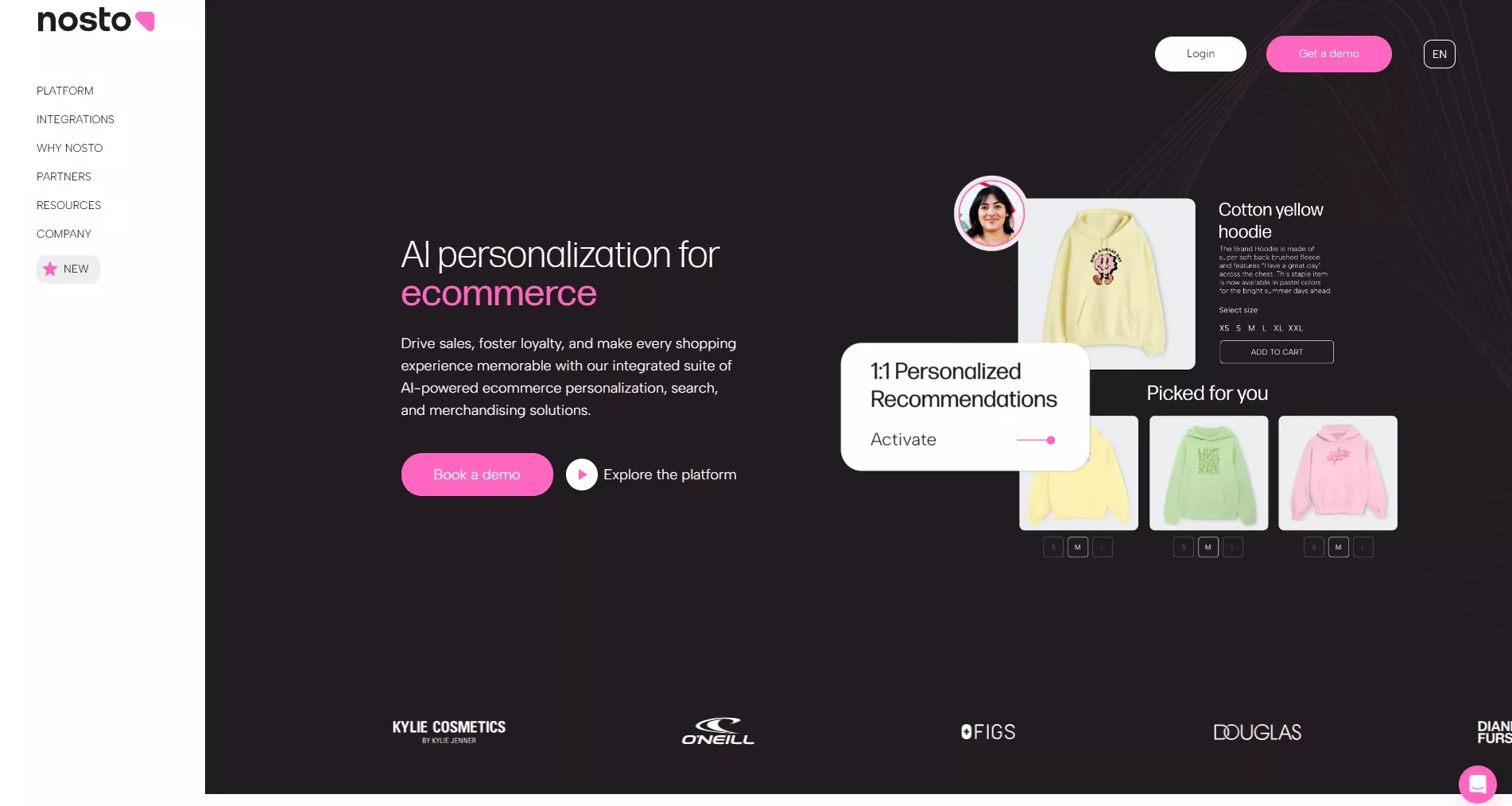
Nosto provides an AI-driven commerce experience platform with strong personalization capabilities and dynamic search.
Nosto offers personalized search, product recommendations, category merchandising, and content personalization in a unified platform.
Nosto focuses on creating tailored shopping experiences that adapt to individual customer behavior and preferences. Their platform is designed for mid-market to enterprise retailers seeking to deliver personalized commerce experiences at scale with real-time optimization.
The solution includes behavioral targeting, session-based personalization, and cross-sell recommendations that work in harmony with site search to maximize average order value and conversion rates.
7. Lucidworks

Lucidworks delivers AI-powered search and discovery solutions for enterprise eCommerce operations and complex catalogs.
It specializes in helping large-scale retailers and B2B businesses implement intelligent search experiences. Lucidworks combines machine learning, natural language processing, and deep learning to understand customer intent and deliver relevant results.
Their platform is designed for organizations with complex product catalogs, multiple data sources, and sophisticated search requirements. Lucidworks serves industries including retail, manufacturing, and healthcare with enterprise-grade search capabilities and advanced query processing.
The solution excels in federated search, semantic search, and query understanding while providing powerful tools for search relevance tuning and merchandising rules.
8. Elastic
Elastic offers a comprehensive search and analytics platform that powers eCommerce experiences for businesses of all sizes with flexible infrastructure.
Elastic provides the underlying search infrastructure used by many online retailers. Their Elasticsearch technology enables fast, relevant search at scale with powerful analytics and machine learning capabilities.
Elastic’s solutions are particularly strong for businesses that need flexible, developer-friendly search infrastructure that can be customized to specific requirements. The platform supports real-time data indexing, complex queries, full-text search, and advanced analytics for comprehensive search optimization.
The open-source foundation provides transparency and control, while cloud-native architecture ensures scalability for growing product catalogs and increasing search traffic.
9. AddSearch

AddSearch provides straightforward site search solutions designed for fast deployment and ease of use.
It offers hassle-free search implementation for businesses that need reliable search functionality without extensive development resources. AddSearch delivers features like customizable search filters, search analytics, autocomplete suggestions, and typo correction.
Their approach emphasizes ease of use and quick setup, making it accessible for small to mid-sized businesses looking to improve their site search without significant technical overhead. The platform integrates with common eCommerce platforms and content management systems seamlessly.
AddSearch provides instant indexing, mobile-optimized search, and visual customization options that allow non-technical teams to manage search results effectively while maintaining good search performance and user experience.
10. Swiftype
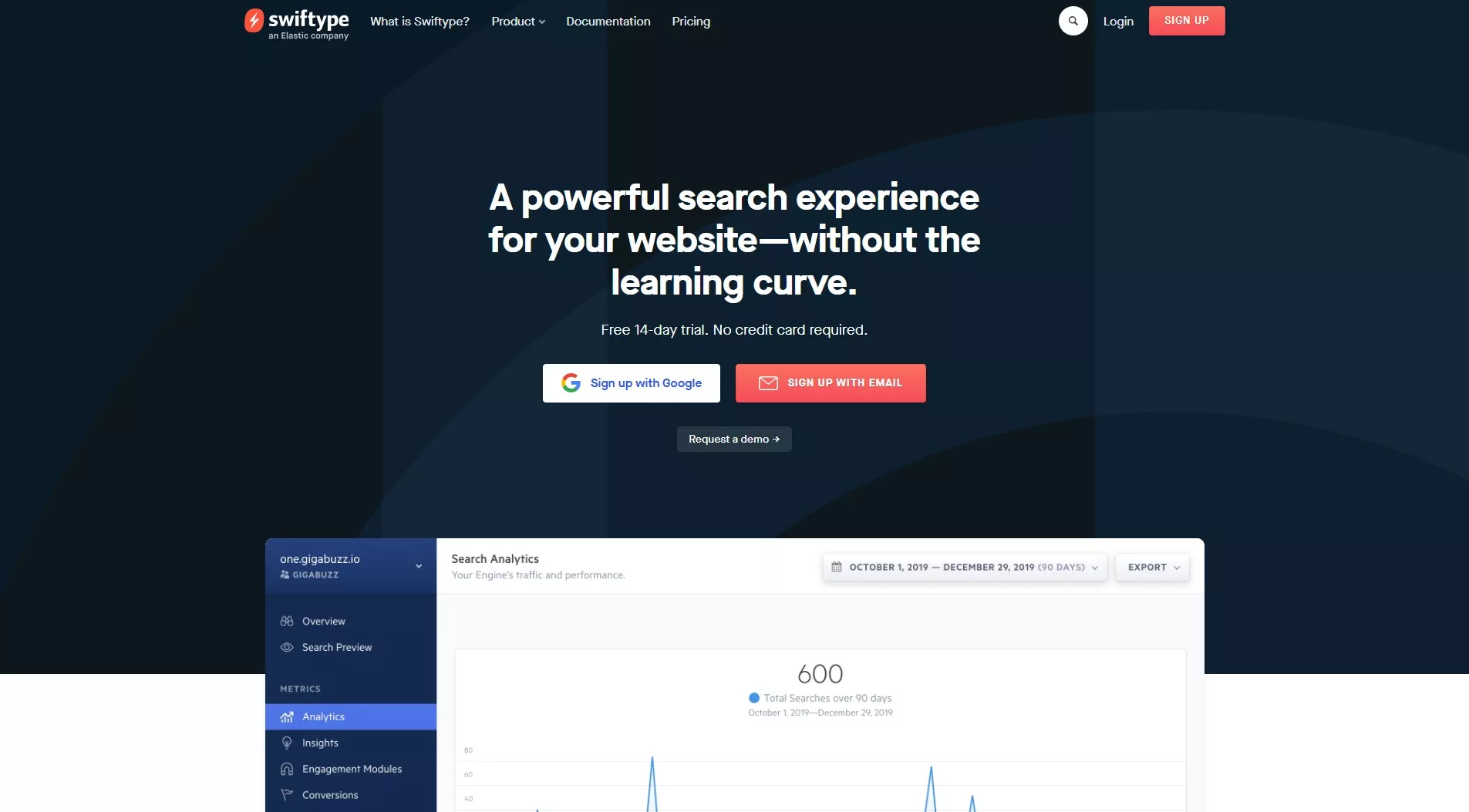
Swiftype is a leading USA-based eCommerce search solution headquartered in San Francisco that specializes in delivering powerful search experiences for websites and applications.
The company, now part of Elastic, provides SaaS-based site search and enterprise search products designed to fully customize the search experience on eCommerce platforms. Swiftype’s platform is built to help organizations increase conversions, boost sales, and drive return visits through superior product discovery.
Their solution includes faceted search, full-text search, real-time search, and concept search capabilities. Swiftype offers drag-and-drop result customization, real-time analytics, and adjustable weights for fine-tuning search relevance.
The platform excels in delivering relevant search results with features like typo tolerance, synonym recognition, and AI-powered query interpretation. Swiftype integrates seamlessly with popular eCommerce platforms and provides API access for custom data sources, making it suitable for businesses ranging from small retailers to large enterprises seeking comprehensive search functionality and analytics tools to optimize their search performance.
Key Features of Modern eCommerce Search Solutions
Understanding the essential capabilities that drive search performance helps you make informed decisions.
Before diving into specific providers, it’s crucial to understand what separates modern eCommerce search solutions from basic keyword matching systems. Today’s intelligent search platforms incorporate advanced technologies that fundamentally transform how customers discover products.
AI-Powered Search Intelligence
Artificial intelligence and machine learning power modern eCommerce search by learning from user behavior and improving relevance automatically. These systems understand search intent rather than relying only on exact keywords.
Natural language processing allows platforms to interpret queries like “running shoes for flat feet under $100,” reducing zero-result searches and improving user experience.
Personalization and Behavioral Targeting
Personalized search adapts results based on customer preferences, browsing behavior, and purchase history. AI driven personalization can significantly improve conversion rates by showing the most relevant products to each shopper. By tracking clicks and interactions, search platforms continuously refine results so different users searching the same term may see different products.
Faceted search lets shoppers narrow results using filters such as price, brand, size, color, and ratings. These filters make large product catalogs easier to explore. Dynamic facets update based on available results, preventing shoppers from selecting filters that lead to empty pages.
Visual and Voice Search Capabilities
Visual search allows users to upload images to find similar products, while voice search supports natural language queries for hands-free shopping. These features are especially useful for mobile commerce. Image recognition technology makes visual search valuable for fashion, home decor, and lifestyle products where appearance strongly influences buying decisions.
Typo Tolerance and Synonym Recognition
Typo tolerance ensures misspelled searches still return relevant products. Synonym recognition connects related terms such as “sofa” and “couch” or “mobile” and “smartphone.” These features reduce search frustration and help customers find what they want even when wording is imperfect.
Real-Time Analytics and Insights
Search analytics reveal customer behavior, popular queries, zero-result searches, and performance trends. These insights help merchants optimize catalogs and merchandising strategies. Real-time reporting allows quick action when issues or new trends appear.
Autocomplete and Instant Search
Autocomplete suggests products as users type, speeding up discovery and exposing shoppers to more options. Instant search updates results in real time, helping users find products quickly without reloading pages.
Multi-Language and International Support
Multi-language search is essential for global businesses. Effective localization understands regional terms, cultural preferences, and local product naming. Search platforms must support different scripts, layouts, and regional attributes while maintaining consistent performance.
Mobile-First Search Experience
With most online shopping happening on mobile devices, search must be optimized for small screens and touch interactions. Features like voice input, smart suggestions, and visual search reduce typing and improve usability. Mobile search should offer the same powerful functionality as desktop.
Seamless Platform Integration
API based integration allows search tools to connect with eCommerce platforms, inventory systems, and analytics tools. Pre-built integrations for Shopify, Magento, and BigCommerce simplify setup. Real-time data syncing ensures search results always reflect accurate pricing, stock, and availability.
eCommerce Search: Key Performance Metrics
These metrics reveal the direct connection between search quality and revenue growth.
Understanding how search impacts business outcomes helps justify investment in superior solutions.
Here are the critical metrics demonstrating search’s value:
| Metric | Impact on Revenue | Average Performance |
| Search User Conversion Rate | 150-200% increase in sales from search traffic | 2-3x higher than non-searchers |
| Average Order Value (Search Users) | Significant revenue increase per transaction | 20-30% higher than browsers |
| Zero-Result Search Rate | Each zero-result search = lost sale opportunity | 15-30% (industry average) |
| Return Rate After Poor Search | Long-term customer retention impact | 68% won’t return after bad experience |
| Search-to-Purchase Time | Higher customer satisfaction and repeat purchases | 40% faster than browse-to-purchase |
| Mobile Search Adoption | Critical for mobile commerce success | 60-74% of all eCommerce searches |
Custom eCommerce Search vs Third-Party Tools
Choosing between custom development and SaaS solutions depends on your specific business requirements and long-term goals.
When evaluating eCommerce search solutions, one fundamental decision stands out: should you invest in custom-built search functionality or implement a third-party search platform?
Both approaches offer distinct advantages, and the right choice depends on your business model, technical resources, budget, and unique requirements.
Detailed Comparison
| Aspect | Custom Development | SaaS Tools |
| Initial Investment | $50K to $250K+ upfront development costs | $500 to $10K+ per month based on usage |
| Ongoing Costs | Predictable hosting and maintenance with controlled infrastructure | Subscriptions plus overage charges, costs increase as usage grows |
| Timeline | 8 to 16 weeks for a full solution | 1 to 4 weeks for standard implementation |
| Technical Expertise | Requires a development team for building and ongoing maintenance | Minimal expertise for setup, IT support needed for advanced changes |
| Customization | Unlimited customization based on your business model | Limited to platform features and APIs |
| Data Ownership | Full ownership of data, algorithms, and insights | Platform controls the technology, limited data access |
| Integration | Deep native integrations and custom connectors | Pre-built integrations, workarounds for complex systems |
| Scalability | Scales without usage-based pricing increases | Tiered pricing increases as traffic and catalog grow |
| Performance | Optimized specifically for your products and users | Generalized performance for broad use cases |
| Feature Development | Features built when needed, based on business goals | Dependent on vendor roadmap |
| Business Rules | Supports complex pricing, permissions, and workflows | Limited for advanced B2B and custom rules |
| Industry Features | Built specifically for industries like B2B or manufacturing | Mostly generic retail functionality |
| Competitive Advantage | Unique, proprietary capabilities | Same tools may be used by competitors |
| Migration & Control | Full control without vendor dependency | Vendor switching involves risk and re-implementation |
Understanding the differences between custom and third-party solutions is crucial, but knowing when to make the shift is equally important.
When to Invest in a Custom eCommerce Search Solution
Consider custom search if:
-
Your business model is unique (complex B2B or multi-vendor setups)
-
Search is a core competitive advantage
-
SaaS costs escalate with growth
-
You need deep integrations or specialized features
-
Data privacy and ownership are critical
-
You process millions of searches monthly
Custom solutions provide sub-second search performance, complete control, and predictive capabilities aligned with your business goals.
Why eCommerce Search Optimization Matters
Search optimization directly impacts conversions, revenue, and customer retention.
-
Search users convert 2–3x higher and generate 4–5x more revenue per session than non-search users.
-
Poor search drives customers away. Nearly 68% of shoppers won’t return after a bad search experience.
-
Modern shoppers expect intelligent search that understands intent, handles typos, supports synonyms, and delivers relevant results.
-
Search data reveals buying intent, product demand, and catalog gaps, helping optimize inventory and marketing decisions.
-
Personalized search boosts revenue. Tailored results can increase revenue per visitor by 20–40%.
-
Mobile-first search is essential, with over 60% of eCommerce sales coming from mobile devices.
Optimizing search turns a basic navigation feature into a high-performing revenue channel.
Mobile Search Statistics for 2026:
| Mobile Search Metric | Business Impact | 2026 Data |
| Mobile Commerce Share | $2.5 trillion in transactions | 60% of total online sales |
| Mobile Conversion Gap | Critical need for mobile-optimized search | 2-3x lower than desktop without optimization |
| Mobile Search Traffic | Majority of search interactions | 75-78% of all searches |
| Voice Search Growth | Rising importance of conversational search | 40%+ of searches include voice |
| Smartphone Shoppers | Massive audience relying on mobile | 1.65 billion globally |
Understanding why search matters sets the foundation for identifying the features you actually need.
How to Select the Right eCommerce Search Solution
Follow this framework to match platform capabilities with your specific business requirements.
Selecting the perfect search platform depends on specific circumstances, goals, and constraints.
Here’s a framework to guide decision-making:
Assess Current Search Performance
Start by understanding the baseline.
Analyze metrics like search usage rate, zero-result search percentage, search-to-purchase conversion rate, and time from search to purchase.
Identify the biggest pain points and prioritization opportunities.
Define Business Requirements
Different businesses have different needs.
A fashion retailer needs visual merchandising tools. A B2B wholesaler needs complex pricing and bulk ordering. A marketplace needs multi-vendor search.
List must-have features before evaluating platforms.
Consider Catalog Size and Complexity
Small catalogs with straightforward products have different needs than massive catalogs with millions of SKUs and complex variants.
Choose a solution built to handle current scale and future growth.
Evaluate Technical Resources
Some platforms require significant technical expertise to implement and maintain. Others are plug-and-play.
Honest assessment of team capabilities helps choose a solution that matches technical comfort levels.
Calculate Total Cost of Ownership
Look beyond monthly subscription fees.
Consider implementation costs, ongoing maintenance, required integrations, and the time teams will spend managing the platform.
The cheapest option often isn’t the best value.
Test Before Committing
Most platforms offer trials or demos.
Test them with real queries from the business. See how they handle specific products, categories, and customer language.
Nothing beats hands-on experience.
Plan for Future Growth
Choose a platform that can scale with the business.
Switching search solutions every time a new milestone is reached isn’t ideal. Consider where the business will be in 2-3 years and ensure the chosen platform can support that growth.
If you need more than off-the-shelf solutions, custom development might be your answer.
Why Choose Bitcot for eCommerce Search Solutions
Standard tools often fall short for businesses with unique product catalogs or complex workflows. Bitcot specializes in custom eCommerce development, delivering tailored search solutions as part of fully optimized platforms.
-
Custom Implementation & Integration: Works seamlessly with Shopify, Magento, WooCommerce, or custom platforms
-
Tailored User Experiences: Handles unique product taxonomies, categories, and filters
-
AI & Personalization Ready: Supports predictive search, autocomplete, and behavior-based recommendations
-
Performance & Scalability: Fast, reliable search even under heavy traffic
-
Analytics & Insight Integration: Provides dashboards to optimize search performance continuously
With Bitcot, search becomes a strategic tool for discovery, engagement, and revenue growth.
Common eCommerce Search Challenges and Solutions
Recognizing these pitfalls early helps you avoid costly mistakes and lost revenue.
Understanding common pitfalls helps avoid costly mistakes and choose solutions that address real problems.
Challenge: High Zero-Result Search Rates
When 20-30% of searches return no results, significant revenue is lost.
This usually happens because search engines rely too heavily on exact keyword matching.
Solution: Implement AI-powered search with typo tolerance, synonym recognition, and query expansion. Platforms like Algolia and Klevu excel at reducing zero-result searches through intelligent query interpretation.
Challenge: Irrelevant Search Results
Customers search for “blue dress” and get blue shirts, blue shoes, and blue accessories.
Poor relevance destroys trust and increases bounce rates.
Solution: Choose platforms with advanced relevance tuning, machine learning-based ranking, and the ability to train search algorithms on specific catalogs and customer behavior.
Challenge: Slow Search Performance
Every second of delay reduces conversion rates by 7%.
Slow search is particularly problematic on mobile devices.
Solution: Prioritize platforms built for speed. Algolia, Constructor.io, and other top-tier solutions deliver sub-second search results even under heavy load.
Challenge: Lack of Mobile Optimization
Desktop search might work great, but mobile experiences often fall short.
Cramped interfaces, slow load times, and difficult filtering frustrate mobile shoppers.
Solution: Choose mobile-first platforms with responsive design, touch-optimized interfaces, and voice search capabilities. Test mobile performance thoroughly before committing.
Challenge: Poor Merchandising Control
Marketing teams want to promote specific products or create seasonal campaigns, but they need developers to make changes.
This creates bottlenecks and missed opportunities.
Solution: Select platforms with visual merchandising tools that give non-technical teams control. Searchspring, Attraqt, and Klevu offer excellent merchandising interfaces.
Challenge: Lack of Personalization
Every customer sees identical search results regardless of their history, preferences, or behavior.
This one-size-fits-all approach leaves money on the table.
Solution: Implement search platforms with built-in personalization engines. Bloomreach, Constructor.io, and Klevu deliver individualized experiences that drive higher conversion rates.
These challenges are evolving as new technologies reshape the search landscape.
The Future of eCommerce Search Technology
Emerging technologies are transforming how customers discover and interact with products online.
The search landscape continues evolving rapidly.
Understanding emerging trends helps choose future-proof solutions.
Voice Search Integration
With smart speakers and voice assistants becoming ubiquitous, voice search is growing.
eCommerce search platforms now support conversational queries and natural language understanding optimized for voice interaction.
Industry projections indicate that by 2026, approximately 30% of mobile users are expected to use voice assistants for shopping-related actions such as search, reordering, or tracking purchases.
Visual and Image-Based Search
Customers increasingly prefer to search using images rather than text.
Visual search technology identifies products from uploaded photos or screenshots, making product discovery more intuitive.
According to Gartner, brands that have implemented visual search see a 30% increase in digital commerce revenue.
Augmented Reality Integration
AR-powered search lets customers visualize products in their space before purchasing.
Furniture retailers and home decor brands are leading this trend, but applications span multiple industries.
Predictive Search and Intent Detection
Advanced AI doesn’t just react to queries; it predicts what customers want before they finish typing.
Predictive search surfaces relevant products based on partial queries and historical behavior patterns.
Omnichannel Search Experiences
Modern shoppers move fluidly between mobile, desktop, in-store, and social commerce.
Leading search platforms deliver consistent experiences across all touchpoints, maintaining context as customers switch channels.
Ethical AI and Transparency
As AI-driven search becomes more sophisticated, customers and regulators demand transparency about how algorithms make decisions.
Future platforms will need to balance personalization with privacy and explain ranking decisions.
With these future trends in mind, it’s time to make your move toward better search.
Final Thoughts
Smart search isn’t just a feature – it’s the difference between thriving and surviving in modern eCommerce.
Search bars might be the smallest elements on websites, but they’re often the most powerful tools in conversion arsenals.
In a landscape where 2.86 billion people shop online and eCommerce sales continue their explosive growth, product discovery can’t be left to chance.
The difference between a customer finding exactly what they need in seconds versus bouncing to a competitor often comes down to search quality.
The platforms covered represent the best eCommerce search solutions available in 2026.
Each brings unique strengths to the table. Bitcot delivers custom-built search integrated into comprehensive eCommerce solutions.
The right choice depends on specific needs, budget, technical resources, and growth trajectory.
A small Shopify store has different requirements than a multi-million dollar enterprise operation. A fashion brand prioritizes different features than a B2B distributor.
Start by honestly assessing where current search falls short.
Calculate the revenue being left on the table due to failed searches, poor relevance, and lack of personalization. That number often justifies significant investment in better search technology.
Don’t get paralyzed by options.
Most platforms offer free trials or demos. Test them with real queries from the business. See how they handle unique catalogs, customer language, and edge cases.
The best search solution is the one that actually solves specific problems.
Remember, search optimization isn’t a one-time project.
It’s an ongoing process of refinement, learning, and improvement. Choose a platform that grows with the business, provides actionable analytics, and supports continuous optimization.
The eCommerce businesses winning in 2026 aren’t just selling products – they’re creating seamless discovery experiences that make shopping effortless.
With the right search solution, any business can join them.
Ready to transform your search experience? Let’s talk about building a solution that actually fits your business.
Frequently Asked Questions
What is an eCommerce search solution?
An eCommerce search solution is a specialized software platform that powers the search functionality on online stores.
Unlike basic keyword matching, modern search solutions use artificial intelligence, natural language processing, and machine learning to understand customer intent and deliver relevant product results.
These platforms handle typos, synonyms, and conversational queries while providing features like autocomplete, filtering, personalization, and analytics.
How long does it take to implement an eCommerce search solution?
Implementation timelines vary based on complexity and platform choice.
Simple plug-and-play solutions can be operational in 1-2 days. Mid-complexity implementations requiring custom configurations typically take 2-4 weeks.
Enterprise deployments with extensive customization, AI training, and complex integrations can take 2-3 months.
Custom-built search solutions from Bitcot typically require 8-16 weeks depending on feature requirements and integration complexity.
Do I need technical expertise to manage an eCommerce search platform?
This depends on the platform chosen.
User-friendly solutions offer visual dashboards for merchandising, ranking adjustments, and synonym management – no coding required.
These are suitable for marketing teams without technical backgrounds. However, advanced features like custom AI training, complex API integrations, and deep customization require technical expertise.
Custom-built solutions typically require developer involvement initially but can include intuitive management interfaces for day-to-day operations.
Can eCommerce search solutions handle multiple languages?
Yes, leading search platforms support multi-language functionality, but implementation quality varies.
Look for solutions with native language support (not just translation), language-specific AI models that understand nuances and synonyms in each language, separate relevance tuning per language, and right-to-left text support for languages like Arabic and Hebrew.
For complex international operations, custom development ensures optimal handling of specific language requirements.
What security considerations should I be aware of?
When implementing search solutions, prioritize:
Data encryption for search queries and customer data in transit and at rest, compliance with GDPR, CCPA, and other privacy regulations, secure API authentication and rate limiting to prevent abuse, PCI compliance if search data includes payment information, regular security audits and penetration testing, and clear data retention policies for search history.
Cloud-based solutions should be hosted on secure infrastructure (AWS, Google Cloud, Azure) with SOC 2 Type II certification.
Custom solutions should undergo security reviews before deployment.
How does search impact mobile commerce specifically?
Mobile search is critical since 60% of eCommerce happens on mobile devices.
Mobile-optimized search requires fast load times (under 200ms) since mobile users are less patient, touch-optimized interfaces with large tap targets and easy filtering, voice search integration for hands-free shopping, simplified search results layouts for smaller screens, and minimal typing through predictive autocomplete.
Poor mobile search experiences cause bounce rates 3x higher than desktop.
Custom mobile-first solutions specifically address these challenges to capture mobile revenue effectively.
What happens to my search solution if I change eCommerce platforms?
This depends on your search solution architecture.
SaaS platforms are platform-agnostic and can migrate with you – you’ll need to reinstall integrations and reconfigure settings, but your search data and configurations typically transfer.
However, platform-specific solutions require complete replacement when switching platforms.
Custom-built search solutions offer maximum portability since they’re designed to integrate with any platform via APIs.
When selecting a search solution, consider future platform flexibility to avoid costly rebuilds during migrations.