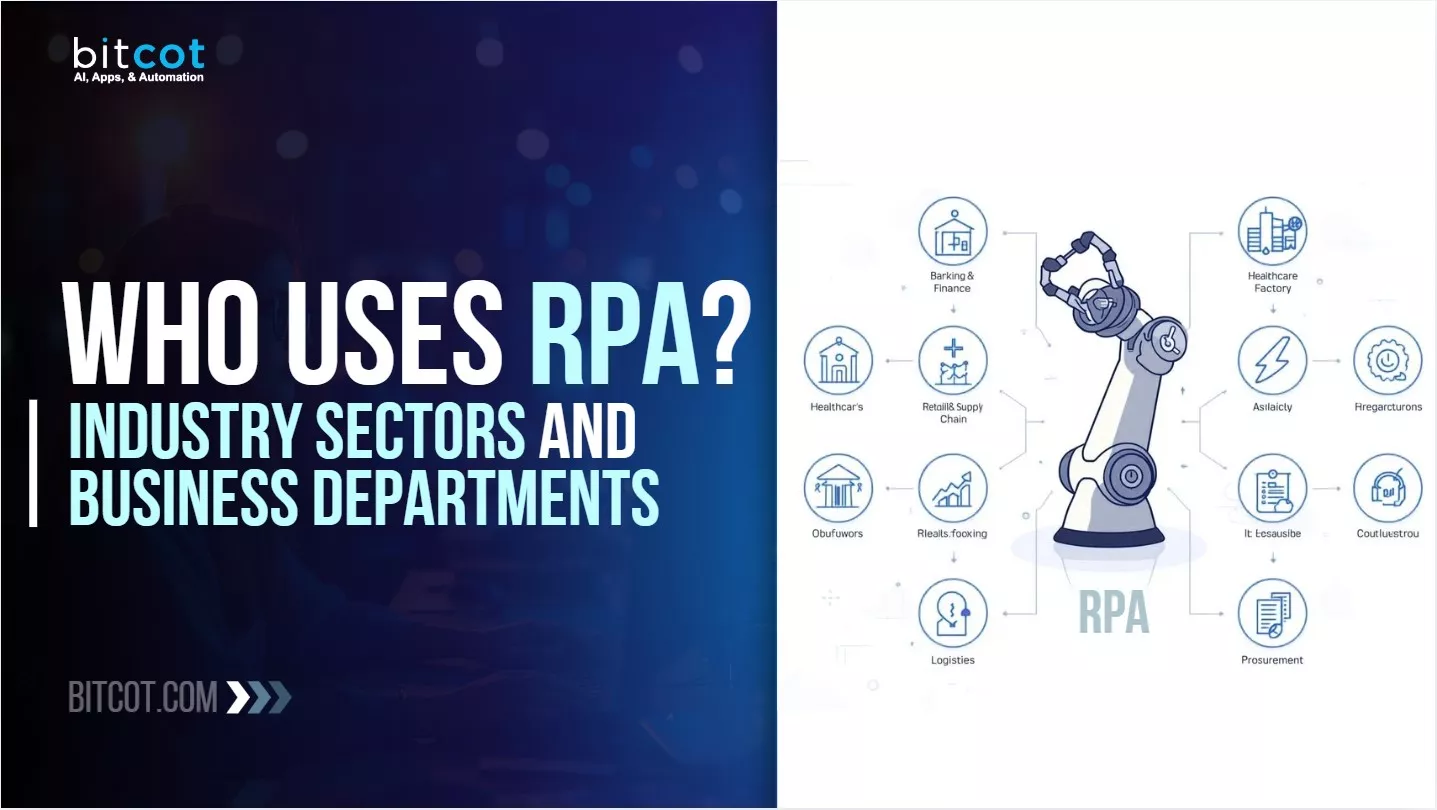
From banking giants to healthcare providers, manufacturing plants to retail chains, RPA adoption is happening across every major industry.
The adoption numbers are striking: 80% of finance leaders have implemented or are planning to implement RPA, while 78% of companies are actively pursuing it. Manufacturing leads at 35%, technology follows at 31%, and even traditionally slower-adopting sectors like healthcare are rapidly catching up.
Whether you’re in banking, retail, or any other industry, robotic process automation is reshaping how departments operate. As a leading RPA solution provider, Bitcot works with businesses across all these sectors.
So, who exactly is using RPA technology? Let’s explore which industries and departments are leading this transformation and discover where your organization stands in this automation landscape.
RPA Use Cases in Banking and Financial Services
When it comes to RPA adoption, the banking and financial services sector is absolutely crushing it. The BFSI sector accounted for 28.89% revenue share, the largest among other industries implementing RPA solutions. If you’re a financial services leader, your competitors are likely already reaping these benefits.
Why do banks love automation technology so much? Because they deal with massive amounts of repetitive, high-stakes tasks every single day, and mistakes in financial services can be costly, both in dollars and reputation.
In the US, major banks are using RPA software to transform customer onboarding. What used to take days now happens in minutes. Know Your Customer (KYC) verification, which involves checking and validating customer data, becomes significantly faster and more accurate with RPA tools.
Loan processing is another area where RPA implementation shines. The mortgage loan or credit card approval process requires numerous verification steps. RPA technology helps automate various business processes in this sector, including account opening, customer onboarding, KYC, and anti-money laundering procedures.
Real-world example? Automation saved HBL approximately 341,000 working hours annually, driving the bank’s wider digital transformation and improving service quality for its 37 million customers. That’s the power of intelligent automation in action.
Financial institutions also use RPA platforms for fraud detection. By analyzing patterns in transaction data, bots can flag suspicious activities faster than any human analyst could.
According to the Institute of Robotic Process Automation, adoption of RPA reduces operating costs by 25-50%. For banks operating on thin margins, those savings add up quickly.
While banking leads in adoption, another sector is quietly revolutionizing its operations with RPA.
RPA in Manufacturing
Here’s a stat that might surprise you: Manufacturing leads RPA adoption at 35% due to its focus on optimizing production processes. If you’re running a manufacturing business, this should catch your attention.
When you think about it, this makes perfect sense. Manufacturing has always been about efficiency, precision, and consistency, and RPA delivers on all three fronts while cutting costs significantly.
The bill of materials (BOM) is crucial in manufacturing. Errors in the BOM can derail entire production cycles. RPA can automate Bill of Material processing with OCR and data extraction technologies, ensuring accuracy and saving countless hours.
Inventory management gets a serious upgrade with RPA bots. These digital workers can monitor stock levels in real time, automatically trigger reorders when supplies run low, and keep track of materials across multiple locations. No more surprise shortages or overstocked warehouses.
Quality control is another area where RPA use cases excel. Bots can analyze production data, identify defects, and even predict potential quality issues before they occur.
Robotic process automation has made manufacturing companies shift their production units to automated software bots, with assembling of products, quality checking, packaging, and back-end processes obtaining a 40% savings in operational costs via automation.
Bitcot help manufacturers implement tailored RPA solutions that seamlessly integrate with existing systems, ensuring smooth digital transformation across production lines.
Beyond manufacturing floors, RPA is making waves in an industry where accuracy can literally save lives.
RPA Adoption in Healthcare
While healthcare might show a current RPA adoption rate of around 10%, don’t let that fool you. Pharmaceutical and healthcare industries are the second largest RPA adopters due to the rising demand for automating hospital management.
The potential for RPA technology in healthcare is absolutely massive, especially in the USA where administrative costs are notoriously high. Imagine redirecting those administrative dollars toward patient care and facility improvements instead.
Patient appointment scheduling might not sound exciting, but it’s a logistical nightmare. Matching patient requests with doctor availability, considering medical specialties, and managing cancellations requires constant attention. RPA bots handle this effortlessly.
Medical records management is where intelligent automation really shines. Hospitals generate enormous amounts of patient data daily. Bots can update records, transfer information between systems, and ensure everything stays organized and compliant with HIPAA regulations.
Claims processing is another huge win. Insurance claims involve multiple verification steps, document reviews, and approvals. With the growing volume of patients, healthcare industries are prioritizing cost reduction and efficiency as two major benefits of RPA implementation.
The beauty of RPA in healthcare? It frees up medical professionals to focus on what they do best: caring for patients. Less time on paperwork means more time for human connection and quality care.
From healthcare to the high-speed world of retail, RPA is transforming customer experiences everywhere.
RPA in Retail and E-Commerce
80% of retailers expect intelligent automation to become mainstream, and many are already there. If you’re running a retail business, here’s the reality: The retail landscape is fiercely competitive, and RPA platforms give businesses the edge they need to survive and thrive.
Your customers expect fast, accurate service, and RPA helps you deliver it consistently while controlling costs.
Inventory monitoring is critical in retail. Enhanced with ML models, RPA bots help monitor store inventory. They track stock levels across multiple locations, predict demand based on sales patterns, and automatically reorder products.
Price monitoring and adjustment is where RPA software gets really interesting. Bots can scan competitor websites, track price changes, and adjust your pricing strategy in real time.
Customer service automation is transforming how retailers interact with shoppers. Chatbots powered by RPA can efficiently handle up to 80% of customer inquiries, freeing human representatives for complex issues.
Order processing becomes lightning-fast with RPA tools. From receiving orders to updating inventory and triggering shipping, everything happens automatically. This speed translates directly into customer satisfaction.
Foodstuffs, New Zealand’s biggest grocery distributor, implemented an RPA solution across 200 stores, successfully automating 11 processes and saving 9,000 hours of manual tasks.
Refer to these published insights on RPA in eCommerce use cases and benefits that show how automation accelerates processing, enhances scalability, and improves data quality for online businesses.
RPA in Technology & IT
It might seem meta, but the technology sector itself is a huge RPA user. The technology sector boasts a 31% adoption rate of RPA.
Tech companies use automation technology for everything from software testing to system monitoring. Software deployment and updates can be automated end-to-end. Instead of IT staff manually installing patches and updates across hundreds or thousands of machines, RPA bots handle it overnight.
System monitoring is perfect for robotic process automation. Bots continuously check system health, track performance metrics, and alert IT teams to potential issues before they become major problems.
Help desk operations get significantly more efficient with RPA implementation. Intelligent automation has successfully eliminated over 40% of service desk engagements, with bots handling password resets, access requests, and common troubleshooting tasks instantly.
RPA in Telecommunications
Telecom companies are embracing RPA solutions in a big way. 60% of telco companies consider automation a critical driver for digital transformation over the coming years.
Why? Because telecom operates at massive scale with millions of customer interactions daily.
Customer onboarding in telecom involves multiple systems, credit checks, and service activation. RPA tools can complete this entire process in minutes instead of hours, dramatically improving customer experience.
Bill processing and payment handling are perfect for automation technology. Bots generate bills, process payments, reconcile accounts, and handle discrepancies without human intervention.
Network monitoring and maintenance benefit from intelligent automation. Bots analyze network performance data, identify potential issues, and even trigger corrective actions automatically.
Implementing RPA technology is projected to reduce the time of human intervention by 40% in the near future, and 87% of telecom and tech leaders have defined automation as their top business priority.
RPA in Insurance
The insurance industry deals with incredibly complex, document-heavy processes. That makes it perfect territory for RPA adoption.
Claims processing is the holy grail of insurance RPA implementation. Evaluating claims requires gathering information from multiple sources, verifying details, and making coverage decisions. What used to take days can now happen in hours or even minutes.
Policy administration gets much simpler with RPA bots. From issuing new policies to handling renewals and modifications, automation ensures accuracy and speed.
Underwriting processes involve analyzing risk factors and determining premium rates. RPA platforms can gather all necessary information, perform calculations, and even make preliminary underwriting decisions for straightforward cases.
These industry examples show RPA’s versatility, but let’s compare them side-by-side for clarity.
Industry Sectors: RPA Adoption Overview
Let’s look at a comprehensive comparison of adoption rates and key benefits:
| Industry Sector | Adoption Rate | Primary RPA Use Cases | Key Benefits |
| Manufacturing | 35% | BOM processing, inventory management, quality control | 40% operational cost savings |
| Retail & E-Commerce | Growing rapidly | Inventory monitoring, price adjustment, order processing | 80% of customer inquiries automated |
| Technology & IT | 31% | Software deployment, system monitoring, help desk | 40%+ reduction in service desk engagements |
| Healthcare | 10% (rapidly growing) | Appointment scheduling, medical records, claims processing | Reduced administrative costs, improved patient care |
| BFSI (Banking, Financial Services, Insurance) | 28.89% | KYC verification, loan processing, claims processing | 25-50% cost reduction |
| Telecommunications | 60% planning adoption | Customer onboarding, bill processing, network monitoring | 40% reduction in manual intervention by 2027 |
Business Departments Leveraging RPA
While entire industries are adopting RPA, it’s the individual business departments within these organizations that are seeing the most immediate impact. Let’s explore how different departments across all industries are using RPA to transform their operations:
HR Automation with RPA
HR departments across industries are discovering the benefits of RPA technology. From recruitment to retirement, there’s hardly an HR process that can’t benefit from automation.
Recruitment and onboarding involve tons of repetitive tasks. Posting job listings, screening resumes, scheduling interviews, and processing new hire paperwork all become faster with RPA tools. This lets recruiters focus on the human side of hiring: building relationships and evaluating cultural fit.
Payroll processing is another natural fit for robotic process automation. Calculating hours, applying deductions, processing payments, and generating pay stubs happen automatically and accurately every pay period.
Employee data management becomes effortless. When employees change addresses, update benefits, or request time off, RPA bots update all relevant systems simultaneously.
Finance & Accounting RPA Applications
While we talked about banking earlier, finance and accounting departments in all industries are major RPA users. Around 80% of finance leaders have implemented or are planning to implement RPA.
Accounts payable automation eliminates the tedious work of processing invoices. RPA software can receive invoices, match them to purchase orders, verify amounts, and even process payments automatically.
Accounts receivable processes get similarly streamlined. Bots send invoices, track payments, send reminders, and reconcile accounts without human oversight.
Financial reporting becomes faster and more accurate. Instead of finance teams spending days gathering data and creating reports, RPA tools compile information from multiple sources and generate reports instantly.
Month-end and year-end closing processes that used to take weeks now happen in days. Intelligent automation handles the repetitive tasks, letting accountants focus on analysis and strategic planning.
Customer Service Automation with RPA
Customer service departments across all industries are leveraging RPA platforms to improve response times and customer satisfaction.
First-level support can be handled entirely by RPA bots. Password resets, account information updates, and common questions get resolved instantly without customers waiting for a human agent.
Ticket routing and prioritization happen automatically. When customers submit support requests, RPA software categorizes them, assigns priority levels, and routes them to the appropriate team members.
Data gathering during customer interactions speeds up dramatically. Instead of agents manually looking up customer history across multiple systems, RPA tools instantly compile all relevant information and present it in one view.
Supply Chain RPA Applications
Supply chain management is complex, involving countless moving parts across different companies and countries. RPA implementation brings order to this chaos.
Order processing from start to finish can be automated. From receiving customer orders to checking inventory, generating pick lists, and triggering shipping, RPA bots keep everything moving smoothly.
Shipment tracking and updates happen in real time. Bots monitor carrier systems, update customers on delivery status, and flag any delays or issues.
Vendor management becomes more efficient. RPA tools can monitor vendor performance, process invoices, and even automatically reorder from preferred suppliers when inventory runs low.
Marketing Automation with RPA
Marketing departments are discovering that RPA solutions can handle many tedious tasks, freeing marketers for creative and strategic work.
Campaign management becomes more efficient when RPA bots handle repetitive tasks like scheduling social media posts, sending email campaigns, and updating campaign tracking spreadsheets.
Lead scoring and routing happen automatically. When potential customers interact with your content, RPA software evaluates their actions, assigns scores, and routes qualified leads to sales teams.
Report generation that used to consume hours each week now happens instantly. RPA tools compile data from various marketing platforms and create comprehensive performance reports.
RPA in Procurement
Procurement teams in manufacturing, retail, and other industries use RPA technology to optimize purchasing processes.
Purchase order creation and processing become lightning-fast. When inventory drops below threshold levels, RPA bots automatically generate purchase orders and send them to approved vendors.
Invoice matching is tedious but critical. Bots compare purchase orders, delivery receipts, and invoices to ensure everything matches before approving payment.
Spend analysis helps organizations understand where money goes. RPA tools compile purchasing data and generate insights about spending patterns and opportunities for savings.
Business Departments: RPA Implementation Summary
Here’s a comprehensive overview of how different business departments are leveraging RPA across industries:
| Business Department | Key RPA Applications | Impact & Results | Adoption Level |
| Finance & Accounting | Accounts payable/receivable, financial reporting, expense management | Month-end closing reduced from weeks to days | 80% of finance leaders implemented or planning |
| IT Department | Software deployment, system monitoring, help desk operations, backup processes | 40%+ reduction in service desk workload | 31% adoption in tech sector |
| Human Resources | Recruitment, payroll processing, employee data management, compliance tracking | Faster onboarding, error-free payroll | High adoption across enterprises |
| Customer Service | First-level support, ticket routing, data gathering, follow-up communications | Instant resolution of common queries | Widespread implementation |
| Marketing | Campaign management, lead scoring, report generation, competitor monitoring | Instant reporting, automated lead routing | Increasing implementation |
| Supply Chain & Logistics | Order processing, shipment tracking, vendor management, demand forecasting | Real-time visibility and reduced delays | Critical for manufacturing and retail |
| Procurement | Purchase order creation, vendor onboarding, invoice matching, spend analysis | Lightning-fast order processing | Essential for manufacturing and retail |
How Bitcot Helps Businesses Implement RPA Successfully
At Bitcot, we help organizations implement every step of their automation journey to ensure real results. Our Adjoin RPA project is a prime example. We helped automate their data mapping and e‑billing processes, which were consuming significant time and resources. The results were clear. Manual work dropped, data accuracy improved, and processes ran on time.
The challenge was simple. Teams were spending hours on repetitive tasks, making mistakes, and struggling to meet deadlines. Bitcot built an RPA solution that took over these tasks, validated data automatically, and ensured bills were processed on schedule, all without disrupting existing systems.
Our approach begins with understanding workflows to identify high-impact, rule-based processes. We design and deploy secure, scalable automation solutions and provide ongoing support so operations continue smoothly as your business grows.
With Bitcot’s RPA expertise, organizations achieve faster processing, fewer errors, accurate data, and measurable efficiency gains, helping them scale confidently and stay competitive.
Conclusion
So, who uses RPA? Pretty much everyone who wants to stay competitive.
The sectors leading RPA adoption include manufacturing at 35%, technology at 31%, and BFSI accounting for nearly 29% of the market. But really, any department dealing with repetitive, rule-based tasks can benefit from RPA implementation.
The numbers don’t lie, and they matter to your bottom line. 92% of businesses reported improved compliance with RPA, and 89% of employees feel more satisfied with their jobs due to automation. When technology makes work better for both companies and employees, everybody wins.
As RPA technology continues evolving and integrating with AI, we’ll see even more innovative applications across industries. The question isn’t really who uses RPA anymore. It’s who doesn’t, and for how much longer can they afford not to?
If you’re ready to explore how RPA can transform your business operations, partnering with Bitcot can help you navigate your automation journey successfully.
Ready to transform your business with RPA? Let’s talk about how we can help you automate processes, reduce costs, and scale efficiently. Your competitors are already moving, don’t get left behind.
Frequently Asked Questions (FAQs)
What industries use RPA the most?
Manufacturing leads with 35% adoption, followed by technology at 31% and BFSI (banking, financial services, insurance) at nearly 29%. However, RPA is being adopted across virtually all industries including healthcare, retail, telecommunications, and government.
Is RPA only for large enterprises?
Not at all! While large enterprises were early adopters, cloud-based RPA solutions have made the technology accessible and affordable for small and medium-sized businesses. The scalability of modern RPA platforms means companies of any size can benefit.
What business departments use RPA?
Nearly every department can benefit from RPA. Common users include finance and accounting, human resources, customer service, IT, procurement, marketing, legal, and supply chain departments. Any department handling repetitive, rule-based tasks is a good candidate.
How much can companies save with RPA?
The ROI varies, but it’s typically substantial. Companies report operational cost savings of 25-50%, with top performers earning nearly 4X their RPA investment. Some organizations report saving hundreds of thousands of working hours annually.
What's the difference between RPA and AI?
RPA handles rule-based, repetitive tasks by following predefined rules. AI can learn, make decisions, and handle unstructured data. Many modern solutions combine both (called intelligent automation) to handle increasingly complex processes.
How long does RPA implementation take?
Implementation timelines vary based on process complexity and organizational readiness. Simple processes might be automated in weeks, while enterprise-wide implementations can take several months. However, 63% of organizations report that implementation takes longer than initially expected.
Is RPA secure?
When properly implemented, RPA can actually improve security by reducing human error and ensuring consistent compliance. Bots can maintain detailed audit trails and follow security protocols perfectly every time. However, organizations must ensure proper access controls and security measures.
What's the future of RPA?
The future is bright! The global RPA market is projected to reach over $30 billion by 2030. Integration with AI, machine learning, and cloud computing will enable even more sophisticated automation. Expect to see RPA become a standard business tool across all industries.