Key Takeaways
- Manufacturing leads RPA adoption globally at 35%.
- BFSI accounts for nearly 29% of the total RPA market.
- Finance departments: 80% have implemented or plan to.
- Telecom: 60% view automation as a top digital priority.
- RPA reduces operating costs by 25–50% in financial services.
Introduction
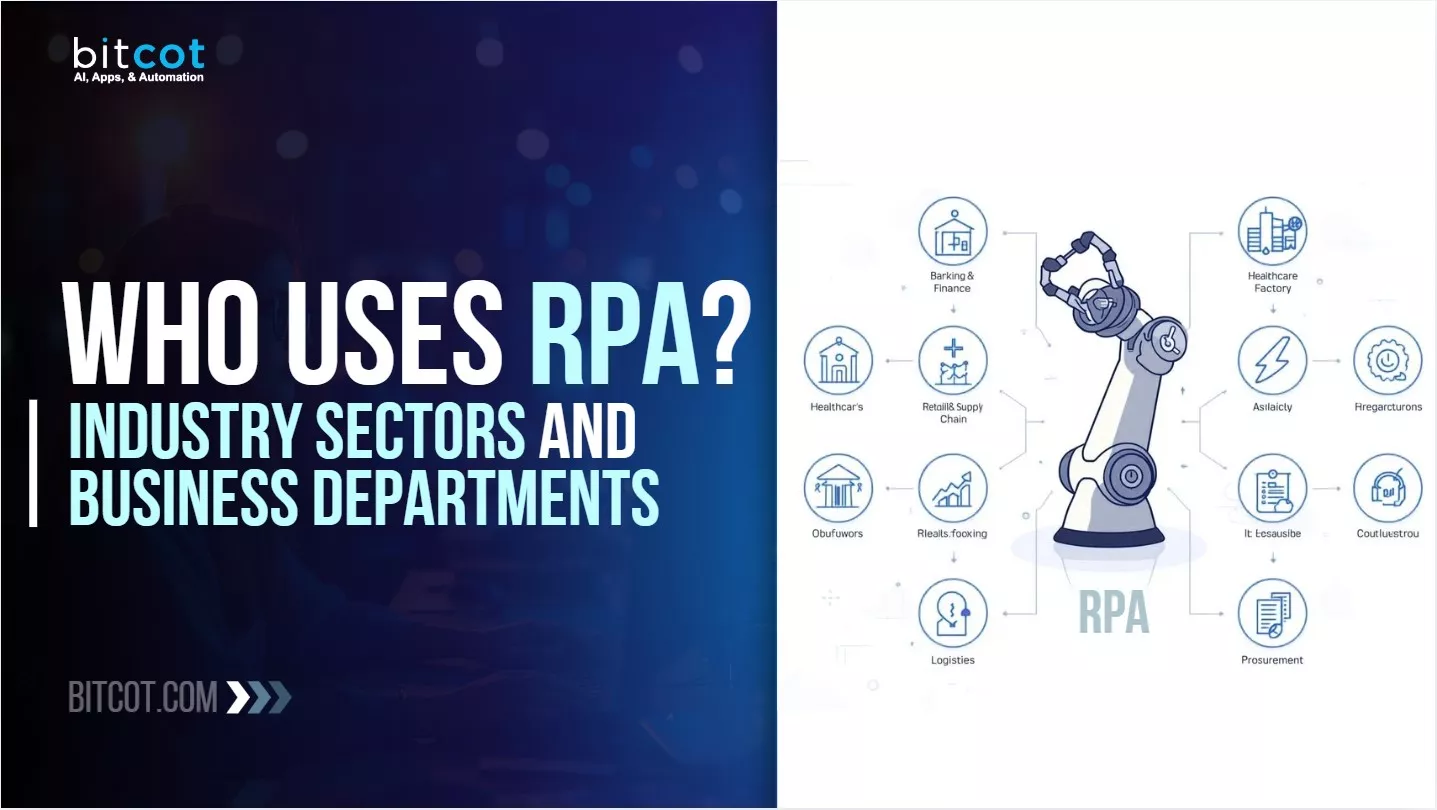
According to Grand View Research, manufacturing leads global RPA adoption at 35%, followed by technology at 31% and banking at nearly 29% of market revenue share. Yet when businesses in San Diego ask us where to start their automation journey, the answer rarely begins with the industry — it begins with the department.
The difference matters. A healthcare company and a retail chain may sit in entirely different industries, but their finance departments face nearly identical pain points: manual invoice matching, error-prone reconciliation, and month-end closings that drag on for weeks. RPA solves those problems at the departmental level regardless of sector.
This post maps both dimensions. We cover the industries where robotic process automation has the deepest penetration and the specific departments, across every sector, where adoption is accelerating fastest. If you are evaluating automation for your organization, understanding both layers is what separates a targeted implementation from a scattered one.
RPA Use Cases in Banking and Financial Services
Banking and financial services account for the largest revenue share in the global RPA market at 28.89%, according to Grand View Research. The reason is structural: financial institutions run on high-volume, rule-based workflows where a single data error can trigger regulatory consequences or customer losses at scale.
Know Your Customer verification is the most widely automated process in this sector. Banks collect identity documents, cross-reference them against watchlists, and validate hundreds of data fields, work that once required days of analyst time. With AI automation for business layered onto RPA, that same process runs in minutes with documented audit trails.
Loan processing follows a similar pattern. Mortgage and credit card approvals require coordinating data from credit bureaus, income verification systems, and internal risk models. RPA bots pull from each source simultaneously, apply decision rules, and flag exceptions for human review rather than handling every record manually.
HBL, one of Pakistan’s largest banks, used RPA to reclaim approximately 341,000 working hours annually while improving service quality across 37 million customer accounts. That outcome is not unusual. According to the Institute for Robotic Process Automation and Artificial Intelligence, RPA reduces operating costs in financial services by 25–50%, figures that compound significantly in institutions processing millions of transactions monthly.

RPA in Manufacturing: The Sector Leading Adoption
Manufacturing holds the highest RPA adoption rate of any sector globally at 35%, a figure that reflects the industry’s long-standing emphasis on process precision and waste elimination. The shift from physical automation on assembly lines to software-based automation in back-office and operations workflows is a natural extension of that same discipline.
Bill of Materials processing is where many manufacturers first encounter the value of RPA. BOM errors, mismatched part numbers, incorrect quantities, and wrong supplier codes can halt production lines and trigger costly delays. RPA combined with optical character recognition extracts and validates BOM data across supplier documents and internal systems, catching discrepancies before they reach the floor.
Inventory management is another high-impact use case. Bots monitor stock levels across multiple warehouses in real time, trigger reorders when thresholds are crossed, and reconcile purchase orders against delivery receipts without manual input. According to published industry analysis, manufacturers that have shifted back-office processes to RPA bots report a 40% reduction in operational costs across packaging, quality checking, and administrative functions.
Our team at Bitcot has worked with manufacturing operations where procurement teams were spending 15 to 20 hours per week on purchase order matching alone. Automating that single process freed those teams to focus on vendor negotiations and supplier relationship management, work that requires human judgment and cannot be delegated to a bot.

RPA Adoption in Healthcare
Healthcare currently shows an RPA adoption rate of approximately 10%, but the pharmaceutical and hospital management sectors are ranked as the second largest adopters by growth trajectory. The gap between current adoption and potential reflects the complexity of healthcare IT environments, not a lack of suitable use cases.
Patient appointment scheduling is a chronic administrative bottleneck. Coordinating provider availability, specialty requirements, insurance pre-authorizations, and patient preferences across disparate systems consumes hours of staff time that could be redirected to patient-facing care. RPA bots handle the logic layer of that coordination automatically. Our published analysis on RPA in healthcare details how this plays out across different facility types.
Medical records management is another area where automation delivers a measurable impact. Hospitals generate substantial volumes of patient data daily across EHR platforms, lab systems, billing software, and pharmacy databases. Bots that update records, transfer structured data between systems, and flag missing fields can reduce documentation backlogs without adding staff. Our team’s work on healthcare automation solutions consistently shows that administrative time savings translate directly into improved care capacity.
Insurance claims processing in healthcare involves verifying patient eligibility, matching procedure codes, reviewing documentation completeness, and routing claims through multiple approval stages. With growing patient volumes and static staffing budgets, healthcare organizations increasingly view RPA as a structural solution rather than a supplemental tool.
RPA in Retail and E-Commerce
According to industry research, 80% of retailers expect intelligent automation to become mainstream within their operations, and many have already passed that threshold. Retail margins are thin, customer expectations for speed and accuracy are high, and the volume of transactional data that must be processed daily is enormous. RPA is built for exactly that combination of pressures.
Inventory monitoring is the foundation of retail automation. Bots track stock levels across physical locations and digital channels, predict demand using sales pattern data, and automatically generate replenishment orders before shortages affect sales. Retailers that add machine learning models to this layer can further refine forecasting accuracy over time.
Price monitoring gives retailers a meaningful competitive edge. Bots scan competitor product pages, track price changes in near real time, and feed that data into pricing systems that can adjust rates dynamically. What once required a dedicated team and significant manual effort runs continuously in the background.
Foodstuffs, New Zealand’s largest grocery distributor, implemented RPA across 200 store locations, automating 11 distinct processes and recovering 9,000 hours of manual labor. Our published work on business process automation covers how similar results translate across retail formats and regional markets. For online businesses specifically, the detailed breakdown of RPA in e-commerce use cases shows where automation produces the clearest scalability gains.
RPA in Technology and Telecommunications
The technology sector itself reports a 31% RPA adoption rate, a statistic that underscores how software companies and IT organizations recognize the operational value of automation beyond their product development work. Internal IT operations, help desk functions, and infrastructure management are all high-frequency, rule-based environments that benefit directly from RPA.
Software deployment is one example. Pushing patches and updates across large fleets of systems manually creates inconsistency, scheduling conflicts, and documentation gaps. RPA bots handle deployment queuing, logging, and verification overnight without human oversight. According to Forrester Research, intelligent automation has eliminated more than 40% of service desk engagements, with bots resolving password resets, access provisioning, and standard troubleshooting requests without routing to human agents.
Telecommunications operates at even larger scale. With millions of customer interactions processed daily, telco companies face automation pressure across billing, onboarding, and network operations simultaneously. According to industry analysis, 60% of telecom companies consider automation a critical driver for digital transformation, and the sector projects a 40% reduction in manual intervention through RPA by the late 2020s.
Customer onboarding in telecom, which requires credit checks, identity verification, service activation across multiple platforms, and contract generation, is now being compressed from hours to minutes in organizations that have deployed full-cycle RPA. AI workflow automation adds a layer by handling exceptions and edge cases that pure rules-based bots would otherwise escalate.
Business Departments Driving RPA Adoption Across All Sectors
Industry-level adoption rates tell part of the story. The other part is departmental. Certain functions, regardless of which sector they operate in, consistently lead internal RPA demand because they run on exactly the type of structured, repeatable work that automation handles best.
Finance and Accounting
According to industry surveys, 80% of finance leaders have implemented or are actively planning to implement RPA. Accounts payable automation, accounts receivable management, and financial reporting are the three most common entry points. Month-end and year-end closings that previously required weeks of manual data gathering and reconciliation are now complete in days. The reduction in cycle time is meaningful for cash flow visibility, audit preparation, and leadership reporting. Our broader coverage of AI transformation strategy explains how RPA in finance typically serves as the first step toward broader digital transformation.
Human Resources
HR departments benefit from automation at nearly every stage of the employee lifecycle. Recruitment workflows, including job posting, resume screening, and interview scheduling, contain dozens of repetitive steps that bots can execute faster and more consistently than manual processes. Payroll processing, benefits enrollment, and employee data updates across multiple systems are strong secondary automation candidates. The measurable outcome is faster onboarding, more consistent compliance tracking, and fewer payroll errors.
Customer Service
First-level customer support is highly automatable. Password resets, account information requests, order status inquiries, and standard troubleshooting queries follow predictable decision trees that RPA bots execute instantly. Ticket routing and prioritization, when automated, ensure that complex issues reach the right human agents without delay. Data retrieval during customer interactions, pulling account history from multiple systems simultaneously, is another area where automation directly reduces handle time and improves customer experience.
Supply Chain and Procurement
Supply chain management involves constant coordination across vendors, logistics providers, inventory systems, and financial platforms. RPA bots that automate order processing, shipment tracking updates, and vendor invoice matching reduce the manual overhead that supply chain teams carry daily. Procurement specifically benefits from automated purchase order generation triggered by inventory thresholds, three-way invoice matching, and spend analysis reporting. For manufacturing and retail organizations, these two departments are often the highest-ROI automation targets. AI-powered data pipelines can extend this further by connecting procurement data to forecasting models.
Marketing
Marketing departments have historically been slower RPA adopters, but that is shifting. Social media scheduling, email campaign deployment, lead scoring, and campaign performance reporting all contain repetitive execution steps that automation handles well. When RPA routes qualified leads to sales teams based on behavioral scoring, the handoff happens faster and with better context than manual processes allow. Report generation that previously consumed several hours per week now runs on a scheduled basis without staff involvement, freeing marketers for strategy and creative work.
Industry Sectors: RPA Adoption Overview
| Industry Sector | Adoption Rate | Primary RPA Use Cases | Key Outcome |
|---|---|---|---|
| Manufacturing | 35% | BOM processing, inventory management, quality control | 40% operational cost reduction |
| Technology & IT | 31% | Software deployment, system monitoring, and help desk | 40%+ reduction in service desk engagements |
| BFSI | 28.89% | KYC verification, loan processing, fraud detection | 25–50% operating cost reduction |
| Retail & E-Commerce | Rapidly growing | Inventory monitoring, price adjustment, and order processing | Up to 80% of inquiries are automated |
| Telecommunications | 60% planning adoption | Customer onboarding, billing, and network monitoring | 40% reduction in manual intervention projected |
| Healthcare | 10% (rapidly growing) | Appointment scheduling, records management, and claims | Reduced administrative costs, improved care capacity |
Business Departments: RPA Implementation Summary
| Business Department | Key RPA Applications | Adoption Level |
|---|---|---|
| Finance & Accounting | Accounts payable/receivable, financial reporting, expense management | 80% of finance leaders have implemented or are planning |
| IT Department | Software deployment, system monitoring, help desk, backup processes | 31% adoption in the tech sector |
| Human Resources | Recruitment, payroll processing, and employee data management | High adoption across enterprises |
| Customer Service | First-level support, ticket routing, and data gathering | Widespread implementation |
| Marketing | Campaign management, lead scoring, and report generation | Increasing adoption |
| Supply Chain & Procurement | Order processing, shipment tracking, vendor management, and invoice matching | Critical for manufacturing and retail |
Our Perspective
Working with organizations across Los Angeles, San Diego, and San Francisco, we consistently observe the same pattern: the companies that get the most from RPA are not the ones with the largest automation budgets. They are the ones that start with a single department, a single high-friction workflow, and build the operational case from there.
A regional healthcare administration group we worked with had a billing team spending roughly 30 hours per week on insurance eligibility verification across five different payer portals. No single portal required more than a few minutes per check, but the aggregate volume made manual processing untenable. Automating that one workflow with a purpose-built robotic process automation solution reclaimed those hours and reduced error rates to near zero within the first month of deployment.
The same logic applies across sectors. In manufacturing, the highest-value starting point is usually inventory reconciliation or purchase order matching. In financial services, it is KYC verification or accounts payable processing. In retail, it is order fulfillment status updates or pricing data aggregation. The industry sets the context; the department sets the scope.
RPA that is scoped well from the start scales cleanly. RPA that is deployed across too many workflows simultaneously, without clear ownership or exception handling, creates as much complexity as it resolves. Our approach with every engagement is to map workflows before recommending automation, identify the rule-based steps that bots can own completely, and define the handoff points where human judgment is genuinely required. That framework, rather than any particular platform or technology stack, is what drives durable outcomes. Explore our thinking further in our overview of AI readiness assessment and AI transformation strategy.

Conclusion
The answer to “who uses RPA” is every sector dealing with high-volume, rule-based processes, and within those sectors, every department that runs on repetitive data workflows. Manufacturing leads adoption at 35%, but finance departments across every industry are close behind with 80% either already implementing or actively planning to. The gap between early adopters and the rest is narrowing quickly, and the organizations that will feel that gap most acutely are those still evaluating whether automation applies to them.
It does. The more useful question is where to start. For most organizations, the highest-impact first deployment is not the most sophisticated one. It is the workflow that consumes the most manual hours with the least variation: invoice matching, eligibility verification, purchase order creation, or report generation. Start there, validate the model, then expand with the confidence that comes from a documented outcome.
If your team is ready to identify those workflows and build the case for automation investment, the team behind these implementations is available to help.
Frequently Asked Questions
What is robotic process automation and who uses it?
Robotic process automation (RPA) is software that mimics rule-based human actions across digital systems, such as extracting data, filling forms, and triggering downstream workflows, without modifying existing applications. It is used across manufacturing, banking, healthcare, retail, technology, and telecommunications, as well as within finance, HR, customer service, and supply chain departments inside organizations of all sizes.
What is the difference between RPA adoption in manufacturing versus healthcare?
Manufacturing currently leads global RPA adoption at 35% due to its long-standing focus on process precision and operational efficiency, with primary use cases in inventory management, BOM processing, and quality control. Healthcare adoption sits at approximately 10% but is growing rapidly, driven by administrative workflows like appointment scheduling, medical records management, and insurance claims processing where automation reduces overhead without requiring changes to clinical systems.
How does RPA work in a finance or accounting department?
In finance and accounting, RPA bots connect to invoicing systems, ERP platforms, and banking portals to execute repetitive tasks automatically: matching purchase orders to invoices, reconciling accounts, generating financial reports, and processing payments on schedule. The result is faster month-end closings, fewer manual errors, and finance teams that can focus on analysis and forecasting rather than data entry.
How are businesses in San Diego and California using RPA?
Organizations across San Diego, Los Angeles, and San Francisco are implementing RPA primarily in healthcare administration, financial services, and technology operations, sectors that are heavily represented in California’s business landscape. Common starting points include billing and eligibility workflows in healthcare, accounts payable automation in financial services, and IT help desk automation in tech companies, all areas where high transaction volumes create strong ROI cases for automation.
Is RPA worth implementing if my team is small or my processes are not that complex?
RPA delivers value at smaller scale when the target workflow is genuinely repetitive and rule-based, because the hours recovered per week compound quickly even in smaller operations. The key is scoping the first implementation tightly: one workflow, clear inputs and outputs, documented exception handling. Organizations that start narrow and validate outcomes before expanding consistently achieve better results than those that attempt broad automation deployments from the start.