Key Takeaways
- Convenience now decides loyalty: customers stay with businesses that reach them on their preferred channel, at the right moment, with context.
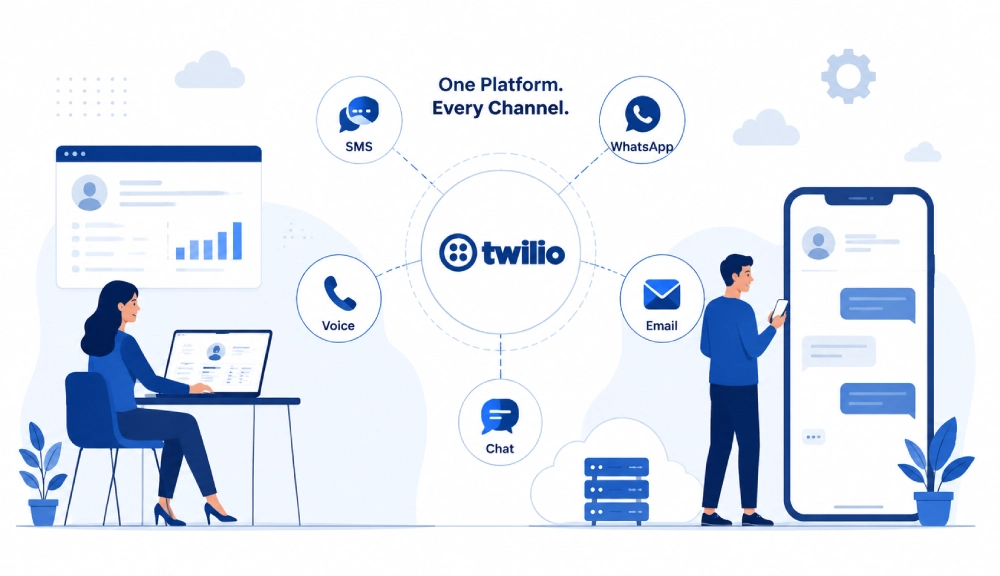
- Twilio makes SMS, voice, WhatsApp, email, and chat programmable from one API, so you can add channels without replacing your existing systems.
- The biggest CX gains come from event-driven messages (order updates, reminders, verification) triggered by what happens in your app, not from broadcast campaigns.
- Delivery tracking matters as much as sending: status callbacks tell you which messages failed so you can retry or switch channels.
- Most teams get the fastest return by fixing one high-friction workflow first, then expanding.
Introduction
According to PwC’s Future of Customer Experience report, 73% of consumers say experience is a key factor in their purchasing decisions. Yet many businesses still run customer communication through disconnected tools that don’t share context.
The result is familiar: a delivery update that never arrives, a support agent who asks for details the customer already gave, a promo text for a product bought ten minutes ago. Each one adds friction, and friction is what drives customers away.
Twilio gives developers a programmable communications layer that connects any application to SMS, voice, WhatsApp, email, and chat. This guide covers six practical ways to use it to improve customer experience. It also includes a working code example, a reference architecture, and what we have learned from building these integrations for clients.
What Is the Difference Between Customer Engagement and Customer Experience?
Customer engagement is what a business does to interact with customers: messages, calls, notifications, surveys. Customer experience is how the customer feels about all of those interactions combined. Engagement is the input; experience is the result.
The difference matters because retention is cheaper than acquisition. Harvard Business Review reports that acquiring a new customer costs 5 to 25 times more than keeping an existing one. So every engagement touchpoint either protects that value or puts it at risk.
Good engagement today spans many channels at once: SMS, email, push notifications, WhatsApp, live chat, and voice. The challenge is keeping them consistent and connected, which is where Twilio fits.
Why Twilio Works Well for Customer Engagement
Twilio is a cloud communications platform (CPaaS) that exposes messaging, voice, email, and video through REST APIs. Twilio’s company overview lists hundreds of thousands of businesses on the platform.
Three things make it a practical choice for customer experience work:
- API-first design. Messages are triggered from your own code, so they can react to real events in your app, such as a payment, a shipment, or a failed login.
- One platform, many channels. SMS, WhatsApp, voice, and email share the same account, SDKs, and logging. You don’t manage a separate vendor for each channel.
- Building blocks for common flows. Verify handles one-time codes, Studio builds call and message flows visually, Conversations keeps multi-channel threads together, and Flex powers contact centers.
Twilio also fits into existing stacks. It works alongside a Salesforce integration, custom enterprise web app development, or AI/ML development without a platform migration.
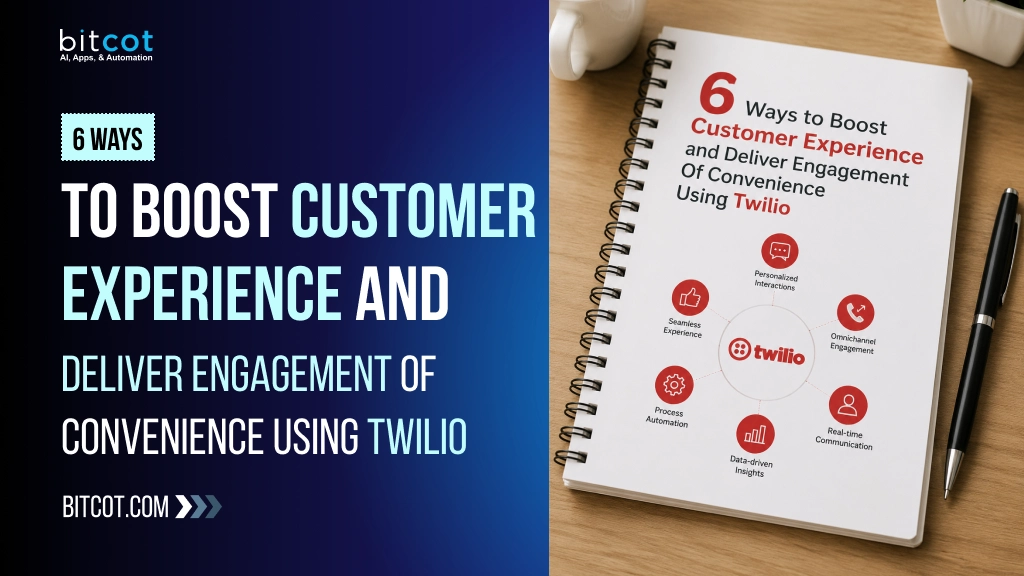
6 Ways to Boost Customer Experience Using Twilio
Send Event-Driven Updates Instead of Making Customers Check
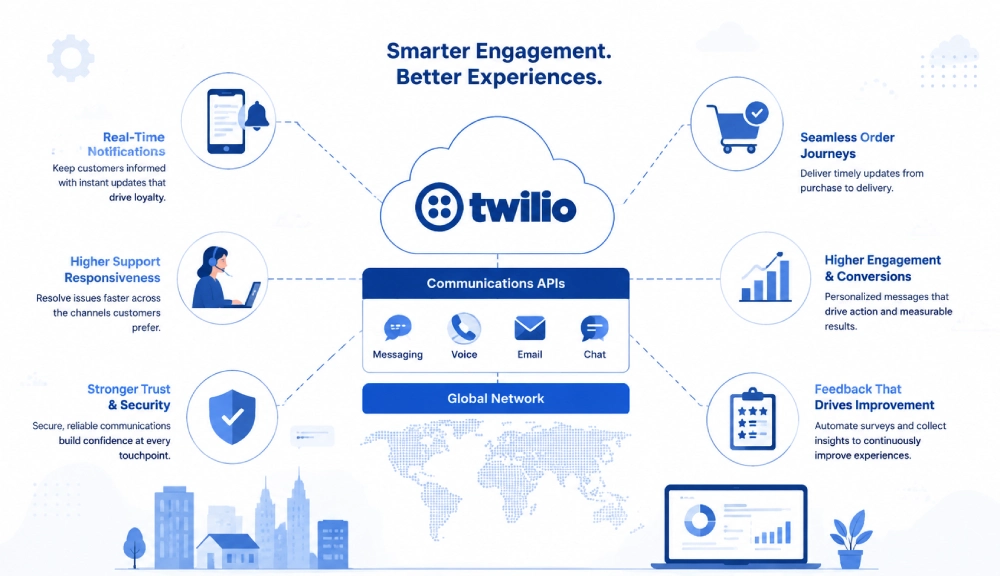
The simplest CX win is telling customers what is happening before they have to ask. Order confirmations, shipping milestones, appointment reminders, and “your driver is 5 minutes away” alerts all remove a reason to call support.
With Twilio, these messages fire from events your app already records: an order status change, a calendar booking, a dispatch update. Because each message is tied to an event, you can measure which ones reduce inbound support volume.
Keep Every Channel in One Conversation
Customers switch channels freely. They might start on web chat, continue by SMS, and finish with a phone call. If each channel lives in a separate tool, the agent loses context, and the customer repeats themselves.
Twilio Conversations keeps SMS, WhatsApp, and chat messages in a single thread per customer, and Flex gives agents that full history in one screen. A Harvard Business Review study of 46,000 shoppers found omnichannel customers spent 4% more in-store and 10% more online than single-channel customers.
For the integration side, see our Twilio API integration services.

Verify Users Without Adding Friction
Sign-up, login, and payment steps are where many customers drop off. Twilio Verify sends one-time codes by SMS, voice, WhatsApp, or email, and handles code generation, expiry, and rate limiting for you.
This matters most in fintech and healthcare, where security is required but every extra step costs conversions. A fast, reliable code delivered on the customer’s preferred channel keeps the flow short.
Route Calls and Messages to the Right Person First Time
Few things frustrate customers more than being transferred between departments. Twilio Studio can look up the caller’s number in your CRM and route them straight to their account manager, their open support ticket, or the right queue.
The same logic works for messages. An inbound SMS containing an order number can be matched to that order and answered automatically, or sent to an agent with the order details already attached. For broader automation, Microsoft Power Automate consulting can extend these flows into back-office systems.
Personalize Messages With Real Customer Data
A message that says “Your order has shipped” is useful. One that includes the customer’s name, the item, the delivery window, and a tracking link is far more valuable. McKinsey found that 71% of consumers expect personalized interactions, and 76% get frustrated when they don’t receive them.
Personalization depends on data, not on Twilio itself. Connect message templates to your CRM or customer data platform so each message pulls current details at send time.
Collect Feedback While the Experience Is Fresh
Most unhappy customers don’t complain; they just leave. A one-question SMS survey sent shortly after a delivery or support call makes it easy for them to tell you first.
Feed responses back into your CRM. Low scores can open a task automatically through TaskRouter, so a human follows up before the customer churns.
Example: Sending an Order Status SMS With Twilio (Node.js)
Here is a minimal version of pattern #1. When an order ships, the app sends a personalized SMS and asks Twilio to report delivery status to a webhook.
// npm install twilio express
const twilio = require('twilio');
const express = require('express');

const client = twilio(process.env.TWILIO_ACCOUNT_SID, process.env.TWILIO_AUTH_TOKEN);

// Called by your order service when status changes to "shipped"
async function sendShippingUpdate(order) {
  return client.messages.create({
    from: process.env.TWILIO_PHONE_NUMBER,
    to: order.customerPhone,
    body: `Hi ${order.firstName}, your ${order.itemName} (order #${order.id}) has shipped. ` +
          `Expected ${order.deliveryWindow}. Track it: ${order.trackingUrl}`,
    statusCallback: `${process.env.APP_URL}/twilio/status?orderId=${order.id}`,
  });
}

// Twilio posts delivery status here
const app = express();
app.use(express.urlencoded({ extended: false }));

app.post('/twilio/status', twilio.webhook(), (req, res) => {
  const { MessageSid, MessageStatus, ErrorCode } = req.body;

  if (MessageStatus === 'failed' || MessageStatus === 'undelivered') {
    // Fall back to email or queue a retry
    console.warn(`Order ${req.query.orderId}: SMS ${MessageSid} ${MessageStatus} (${ErrorCode})`);
  }
  res.sendStatus(204);
});

app.listen(3000);
Two details make this production-ready rather than a demo:
twilio.webhook()validates the request signature, so only Twilio can call your status endpoint.- The status callback closes the loop. Without it, you don’t know which customers never got the update. With it, you can retry or switch to email automatically.
The same approach works in PHP, Python, Ruby, Java, and C# using Twilio’s official SDKs. For U.S. traffic, register your sending number for A2P 10DLC or toll-free verification first, or carriers may filter your messages.
Reference Architecture: Connecting Twilio to Your App
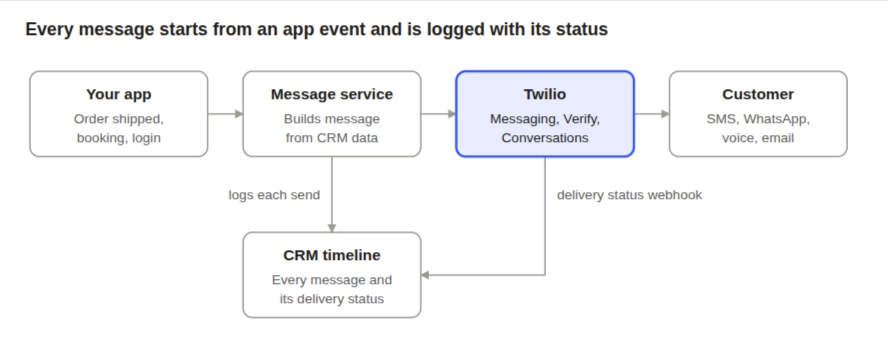
Your app emits an event, a message service builds the message from CRM data and sends it through Twilio, and Twilio’s status webhook writes the delivery result back to the customer’s timeline. That loop is what makes retries, fallbacks, and reporting possible.
How Does Twilio Compare to Other Communication Platforms?
Twilio is the most established CPaaS provider, but not the only one. Vonage (now part of Ericsson), Bandwidth, and Bird (formerly MessageBird) are the common alternatives.
| Factor | Where Twilio stands |
|---|---|
| Developer experience | Mature docs, SDKs in most major languages, large community (building since 2008) |
| Channel breadth | SMS, MMS, voice, WhatsApp, email (SendGrid), video, verification |
| Customer data | Segment gives it a first-party customer data platform for personalization |
| Cost | Often higher per message than carrier-owned providers like Bandwidth at very high volume |
The right choice depends on your volume, regions, and stack. For high-volume workloads, pilot your busiest workflow on two providers and compare deliverability and cost before committing.
Our Perspective
Across the customer-facing apps we build, the problem is rarely too few channels. It is that the channels don’t talk to each other. A business may run SMS through one vendor, email through another, and chat through a third, with no shared customer record.
So when we integrate Twilio into an existing web or mobile app, our first deliverable is usually a single customer timeline. Every message, call, and notification is logged against the customer record, along with its delivery status. Personalization and automation only work reliably once that foundation exists.
Project example: For a [FILL: industry, e.g. healthcare scheduling] client, we replaced [FILL: number] separate messaging tools with Twilio Programmable Messaging and Conversations, connected to their [FILL: CRM/EHR]. Within [FILL: time period], [FILL: metric, e.g. appointment no-shows] dropped from [FILL: X%] to [FILL: Y%], and inbound “where is my…” calls fell by [FILL: Z%].
The lesson we see repeatedly: start with one high-friction workflow, instrument it with delivery callbacks, prove the improvement, then expand.
Conclusion
Better customer experience with Twilio comes from a few specific habits: send updates triggered by real events, keep channels in one conversation, verify users without friction, route people correctly, personalize with real data, and ask for feedback while it matters.
You don’t need to rebuild your communication stack to start. Pick the workflow that generates the most support calls or drop-offs, connect it to Twilio with delivery tracking, and measure the change. If you want help mapping that first workflow, our team builds these integrations across web, mobile, and enterprise platforms.
Frequently Asked Questions
What is Twilio and how does it improve customer experience?
Twilio is a cloud communications platform that provides APIs for SMS, voice, WhatsApp, email, and chat. It improves customer experience by letting businesses send timely, personalized messages triggered by real events, such as orders, appointments, or logins, on the channel each customer prefers.
How is Twilio different from email or SMS marketing tools?
Marketing tools send campaigns to lists on a schedule. Twilio is event-driven: your application sends a message when something specific happens. That makes it better suited to transactional and real-time communication than broadcast marketing.
How do I integrate Twilio into an existing app?
Create a Twilio account, buy or register a sender (phone number, WhatsApp sender, or email domain), and call the Messaging or Voice API from your app’s existing event handlers using an official SDK. Add a status callback webhook to track delivery. Twilio Studio offers a visual builder for flows that don’t need custom code.
Do I need to register my number to send SMS in the U.S.?
Yes. Application-to-person SMS on U.S. 10-digit numbers requires A2P 10DLC brand and campaign registration, and toll-free numbers require toll-free verification. Unregistered traffic is likely to be filtered or blocked by carriers.
Do we have to replace our existing communication vendors?
No. Twilio can run alongside your current tools. Most teams start with one workflow, prove the improvement, and migrate other channels gradually, or not at all if the existing tools work well.