Key Takeaways
- Convenience has become the number-one deciding factor for customers: businesses that make engagement frictionless retain more buyers and generate stronger loyalty.
- Twilio’s communication APIs let companies reach customers across SMS, voice, WhatsApp, email, and chat from a single platform, without rebuilding core infrastructure.
- Digital engagement strategies such as mobile notifications, order journey updates, and automated surveys consistently outperform physical-only outreach in measurable opt-in rates.
- Businesses in California and across the U.S. that integrate Twilio into their web and mobile applications see faster response cycles and higher customer satisfaction scores.
- Streamlining workflows with Twilio reduces friction across the entire customer journey, from first contact to post-purchase follow-up.
Introduction
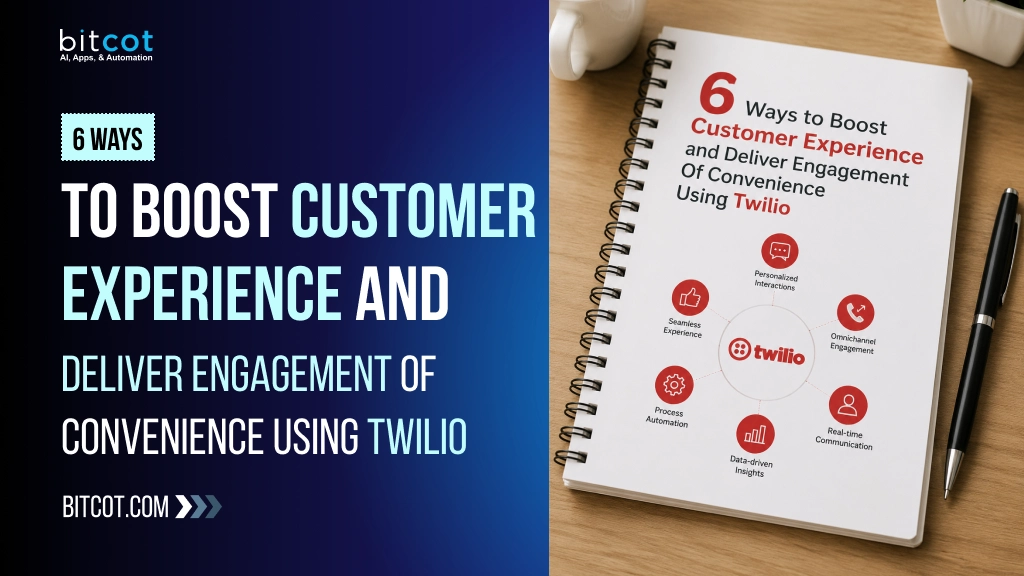
According to PwC’s Future of Customer Experience report, 73% of consumers say experience is a key factor in their purchasing decisions, yet only 49% say today’s companies deliver a good one. That gap is exactly where customer experience strategy and Twilio’s communication platform meet. In the post-pandemic era, convenience has replaced proximity as the primary driver of brand loyalty: customers now expect to interact with businesses on their terms, through the channels they already use, and in real time. For companies looking to close the experience gap, Twilio provides a programmable communications layer that connects any application to SMS, voice, WhatsApp, email, and chat without replacing existing systems. This article breaks down six specific ways to boost customer experience and deliver engagement of convenience using Twilio, drawing on practical patterns seen across digital transformation engagements from San Diego to New York.
What Is the Difference Between Customer Engagement and Customer Experience?
Customer engagement is the set of interactions a brand initiates to build an ongoing relationship with its audience. Customer experience, by contrast, is the cumulative perception a person forms across every touchpoint with that brand. They are related but distinct: engagement is what you do, experience is what the customer feels as a result.
According to Harvard Business Review, acquiring a new customer costs 5 to 25 times more than retaining an existing one, which means the quality of every engagement interaction carries a direct financial consequence. One poor experience, whether it is an unanswered support request or a delayed order notification, can erase months of earned goodwill.
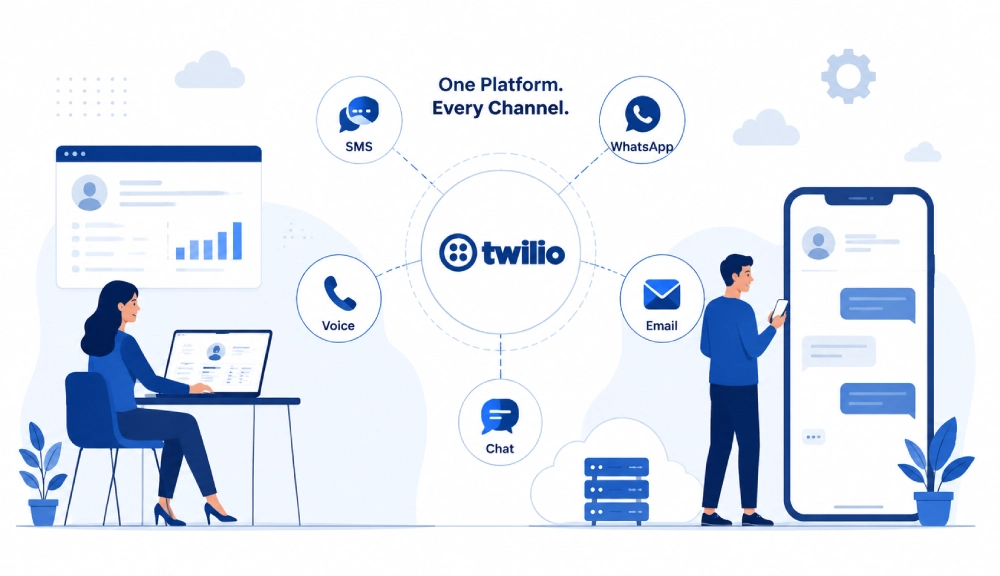
The most effective engagement strategies today operate across multiple channels simultaneously: email, SMS, app push notifications, WhatsApp, live chat, and voice. Twilio is the infrastructure layer that makes all of those channels programmable from a single API surface. More than 300,000 businesses use Twilio’s platform, according to Twilio’s company overview, precisely because it eliminates the need to manage separate vendor contracts for each communication channel.
Why Twilio Is the Platform Behind Modern Customer Engagement
Twilio is a cloud communications platform that exposes voice, messaging, email, and video capabilities through RESTful APIs. Developers can integrate Twilio into any existing application with a few lines of code, which is why it has become the default infrastructure choice for startups and enterprises alike when building customer-facing communication features.
What sets Twilio apart from traditional communication middleware is its API-first architecture. Rather than locking businesses into a proprietary interface, Twilio sits between an application and the global telecommunications network, translating business logic into real-time messages, calls, and notifications. According to Gartner’s cloud communications research, CPaaS (Communications Platform as a Service) platforms like Twilio are projected to become the dominant delivery model for enterprise customer communications through 2026 because of their flexibility and speed of integration.
For businesses working with Salesforce integration, AI/ML development, or custom enterprise web app development, Twilio integrates cleanly into existing tech stacks without requiring a platform migration.
6 Ways to Boost Customer Experience and Deliver Engagement of Convenience Using Twilio
1. Replace Physical-Only Touchpoints with Digital Engagement
Digital engagement consistently delivers higher measurable ROI than physical-only outreach because it is trackable, scalable, and faster to iterate. Businesses investing in physical store promotions often have no reliable way to attribute customer behavior to a specific campaign. Digital channels, by contrast, generate event data at every step.
Practical Twilio-powered digital engagement implementations include mobile order notifications, bookable timeslots sent by SMS, click-and-collect confirmations, and delivery status updates pushed directly to a customer’s preferred channel. According to McKinsey’s personalization research, companies that excel at personalized digital communication generate 40% more revenue from those activities than average players. The opt-in rates for SMS and app notifications consistently outperform email open rates, making them the highest-leverage channels for real-time engagement.
2. Build Consistent, Omnichannel Customer Experiences
Customers expect the same level of service quality whether they contact a business through a mobile app, a web chat widget, Facebook Messenger, or a phone call. Inconsistency across channels is one of the leading causes of customer churn, because it signals that a company does not have a unified view of who the customer is.
Twilio’s Conversations API and Flex contact center platform allow businesses to consolidate all of these channels into a single thread, so a support agent or automated bot always has full context regardless of how the customer initially reached out. Building this kind of consistent omnichannel experience is no longer optional for businesses with a national or digital-first customer base. According to a Harvard Business Review study of 46,000 shoppers, omnichannel customers spend an average of 4% more on every shopping occasion in-store and 10% more online compared to single-channel customers.
Custom Twilio API integration within a web or mobile application enables businesses to set up these multi-channel communication flows without needing to manage separate vendor relationships for SMS, voice, and chat.

3. Optimize Connectivity Operations at Scale
One of the practical advantages of a cloud-based communications platform is speed of deployment. A team can provision a new phone number, configure a WhatsApp Business sender, or launch an SMS campaign in minutes using Twilio’s dashboard or API, without waiting for telecoms contracts or hardware provisioning cycles.
This operational agility matters especially for businesses launching in new markets or responding to sudden demand spikes. For example, a fintech company onboarding a large cohort of new users can use Twilio’s Verify API to send identity verification codes at volume without building or maintaining the underlying carrier relationships. A healthcare application can trigger appointment reminders across SMS and voice simultaneously without duplicating logic across two separate systems. The result is leaner operations and faster time-to-market for new communication features.
Teams building on Node.js, Python, or PHP can use Twilio’s official SDKs to integrate these capabilities directly into production applications. For businesses pursuing robotic process automation or AI consulting initiatives, Twilio’s programmable layer fits naturally into automated workflow architectures.
4. Streamline Workflows to Eliminate Customer Friction
Friction in the customer journey takes many forms: a call that routes to the wrong department, an order confirmation that never arrives, a support ticket that goes unanswered for 48 hours. Each friction point is a measurable drop in satisfaction and a risk of losing the customer entirely.
Twilio-powered workflow automation addresses friction at specific handoff points. A customer who calls a business number can be identified by their phone number and routed directly to their account manager using Twilio Studio, without going through a generic IVR tree. A contactless delivery workflow can trigger a real-time SMS when a driver is five minutes away, eliminating the need for the customer to track a separate app. A self-checkout confirmation can be sent via WhatsApp immediately after a transaction is recorded.
According to Forrester’s research on customer experience business impact, companies that lead in customer experience outperform laggards on revenue growth by a factor of 1.7x. Workflow streamlining is one of the highest-leverage levers available because it directly reduces the effort a customer must exert to complete a transaction.
For organizations exploring broader automation strategies, Microsoft Power Automate consulting and generative AI integration services can extend Twilio-driven workflows further into back-office operations.
5. Build Customer Trust Through Proactive, Personalized Communication
Trust is built incrementally, one interaction at a time. Businesses that proactively reach out to customers with relevant, timely information consistently earn higher loyalty scores than those that communicate only when a problem arises.
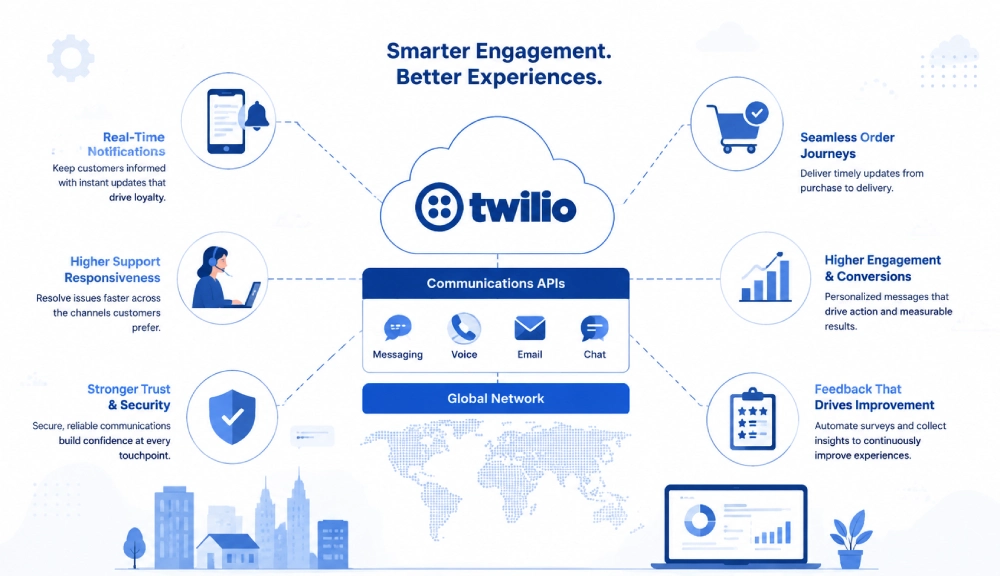
Proactive communication patterns that Twilio enables include: shipping status updates sent at each logistics milestone, personalized re-engagement messages triggered by browsing or purchase history, appointment reminders with a one-tap confirmation reply, and fraud alerts that notify users of account activity in real time. Each of these patterns signals to the customer that the business is paying attention and acting in their interest.
Personalization depth matters here. A generic “Your order has shipped” SMS is useful. A message that includes the customer’s name, the specific item ordered, the expected delivery window, and a tracking link is meaningfully more valuable. Twilio’s integration with CRM systems and customer data platforms allows this level of personalization to be automated at scale. According to McKinsey, 71% of consumers now expect personalized interactions, and 76% report frustration when personalization is absent.
6. Automate Feedback Collection to Close the Experience Loop
Most customers who have a poor experience do not complain directly: they simply leave. Automated feedback collection via Twilio SMS, WhatsApp, or email surveys closes this loop by making it effortless for customers to share how they feel immediately after an interaction, while the experience is still fresh.
Effective feedback automation patterns include: a short post-purchase SMS survey with a single-question NPS prompt, an opt-in subscription confirmation that doubles as a satisfaction check, an identity verification touchpoint that also collects a satisfaction rating, and an auto-replenishment reminder that prompts a quick product review. The key is timing: feedback collected within 24 hours of an interaction is significantly more accurate and actionable than feedback collected days later.
Survey response data fed back into a CRM or analytics platform creates a continuous improvement loop. Negative responses can trigger an automatic escalation to a human agent via Twilio’s task routing, turning a potential churn event into a retention opportunity.
How Does Twilio Compare to Other Customer Communication Platforms?
Twilio is not the only CPaaS provider on the market. Competitors include Vonage (now part of Ericsson), Bandwidth, and MessageBird (now Bird). The meaningful differences come down to developer experience, global carrier coverage, and the breadth of available APIs.
Twilio’s advantage lies in its ecosystem maturity: it has been building developer-facing communication tools since 2008, which means its documentation, SDKs, and community resources are significantly more extensive than most alternatives. Its Segment acquisition also gives Twilio access to a first-party customer data platform, which enables deeper personalization than pure communication-only platforms can achieve. For teams already using Salesforce, HubSpot, or a custom CRM, Twilio’s pre-built integrations reduce the time required to connect communication events to customer records.
That said, the right platform depends on the specific use case, existing tech stack, and scale requirements. Teams evaluating options should pilot their highest-volume communication workflow on at least two platforms before committing to an infrastructure choice.
Our Perspective
Across the customer-facing application projects our team in San Diego has worked on, the most common pattern we see is not a lack of communication channels: it is a lack of coordination between them. A business might already have SMS through one vendor, email through another, and live chat through a third, but none of these systems share customer context. The result is that a customer who just placed an order still receives a promotional SMS for a product they bought ten minutes ago, or a support agent asks them to repeat information they already submitted via chat.
Twilio’s value in these situations is not just the API surface. It is the ability to consolidate disparate communication events into a single customer timeline that any system in the stack can read and write to. When we integrate Twilio into an existing web or mobile application, the first deliverable is almost always that unified view: every message, every call, every notification, attributed to a specific customer record. That foundation is what makes personalization and workflow automation actually work in practice, rather than in a product demo.

Conclusion
Customer experience has become the primary competitive differentiator in almost every industry, and convenience is the dimension customers weigh most heavily when choosing whether to return to a brand. Twilio provides the programmable communications infrastructure to make that convenience real: faster notifications, more relevant messages, seamless channel switching, and automated feedback loops that surface problems before they become churn events. The six approaches outlined here represent the highest-leverage patterns available to businesses ready to move from reactive to proactive customer engagement. The starting point is usually smaller than organizations expect: a single workflow, one channel, one friction point removed. If you are ready to identify where your customer journey loses momentum, a conversation with a team that has built these integrations across web, mobile, and enterprise platforms is the clearest next step.
Frequently Asked Questions
What is Twilio and what does it do for customer experience?
Twilio is a cloud Communications Platform as a Service (CPaaS) that provides programmable APIs for SMS, voice, WhatsApp, email, and chat. For customer experience, it allows businesses to automate and personalize communication across every channel a customer uses, from order notifications to support interactions, without replacing existing application infrastructure.
How is Twilio different from traditional email or SMS marketing tools?
Traditional marketing tools are campaign-focused: they send messages to lists on a schedule. Twilio is event-driven: it sends messages triggered by specific actions in your application, such as a completed purchase, a delivery status change, or a failed login attempt. This makes Twilio more suitable for real-time, transactional, and personalized communication rather than broadcast marketing.
How do I integrate Twilio into an existing web or mobile application?
Twilio provides REST APIs and official SDKs for Node.js, Python, PHP, Ruby, Java, and C#. Integration typically involves creating a Twilio account, provisioning a phone number or sender, and calling the Messaging or Voice API from within your application’s existing event handlers. For complex workflows, Twilio Studio provides a visual drag-and-drop flow builder that does not require code.
Is Twilio a good fit for businesses in California or across the U.S.?
Yes. Twilio has full carrier coverage across the United States and supports local number provisioning in all 50 states. For businesses in California handling high-volume SMS, Twilio’s 10DLC (10-Digit Long Code) registration and toll-free verification processes align with current U.S. carrier requirements, ensuring message deliverability at scale.
What if we already use multiple communication vendors? Do we have to migrate everything to Twilio?
No. Twilio is designed to integrate alongside existing systems rather than replace them outright. A common approach is to start with the highest-friction communication workflow, integrate Twilio for that specific channel, validate the improvement in customer satisfaction metrics, and then expand incrementally. Full migrations are possible but rarely necessary as a first step.