Key Takeaways
- There’s no single best framework. The right choice depends on your goals, your stack, and how far you need to scale, not benchmarks.
- The 2026 leaders: React, Next.js, Angular, Vue, and Svelte for frontend; Django, Laravel, Express, Rails, ASP.NET Core, FastAPI, and Spring Boot for backend.
- React is still the most-used frontend library (44.7%, Stack Overflow 2025), while FastAPI is the fastest-growing, driven by AI demand.
- Match the framework to your priority: Rails or Django for MVPs, Next.js for SEO, Angular for enterprise, FastAPI for Python and AI.
- The framework rarely sinks a project. Hidden costs include weak architecture, maintenance, and longevity. Validate the architecture before you build.
Introduction
Most teams do not find out they picked the wrong web application framework until they have already spent six figures discovering it. The rebuild is expensive. The lost market window is worse.
Here is the uncomfortable truth: choosing a web application framework used to be a decision handed off to developers. Not anymore. In 2026, it is a strategic call that shapes your go-to-market speed, your hiring costs, your security posture, and how far you can scale before something breaks.
There are dozens of frameworks out there. They all promise performance, flexibility, and innovation. The hard part is knowing which one will actually move the needle for your business, and which one will quietly become a liability 18 months from now.
That is what this guide is for. We work with companies across the United States, from first-time founders to enterprise engineering teams, and we help them make this exact decision without gambling on it. Below, we break down the 15 best web application development frameworks in 2026, ranked and compared, through both a technical lens and a business one. Whether you are a CEO setting the vision, a CTO choosing the stack, or a non-technical founder trying to avoid a costly misstep, you will leave with the clarity to make a smarter call.
Let’s get into it.
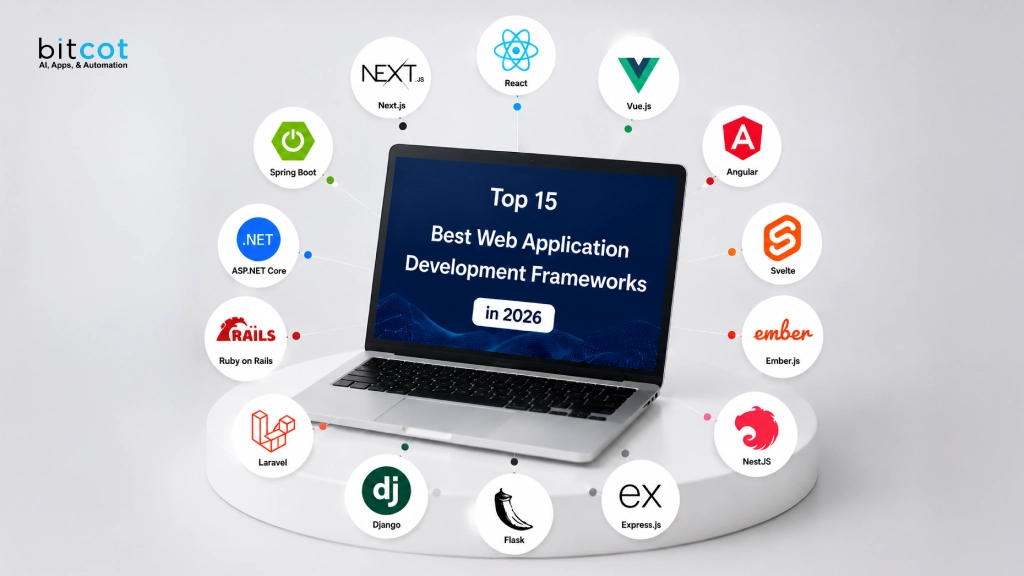
Quick Overview: Top 15 Web Application Frameworks at a Glance
Before we go deep on each one, here is the full list in a single scannable view. Use it to shortlist, then read the sections that matter to your project.
| No. | Framework | Language | Type | Best For | 2026 Version |
|---|---|---|---|---|---|
| 1 | React | JavaScript | Frontend | SPAs, dashboards, and e-commerce UIs | 19.2 |
| 2 | Next.js | JavaScript / TypeScript | Full-stack (React) | SEO-driven websites and e-commerce applications | 16 |
| 3 | Angular | TypeScript | Frontend | Large enterprise applications | 21 |
| 4 | Vue.js | JavaScript | Frontend | Progressive adoption and gradual modernization | 3.5 |
| 5 | Nuxt | JavaScript | Full-stack (Vue) | Vue applications requiring SSR and SEO | 3 |
| 6 | Svelte / SvelteKit | JavaScript | Frontend / Full-stack | Performance-first web applications | 5 |
| 7 | Ruby on Rails | Ruby | Full-stack | Startup MVPs and rapid product validation | 8 |
| 8 | Express.js | JavaScript | Backend | REST APIs and microservices | 5 |
| 9 | Django | Python | Full-stack | Secure, data-intensive Python applications | 6 |
| 10 | Flask | Python | Backend | Lightweight Python APIs | 3 |
| 11 | Laravel | PHP | Full-stack | Modern PHP web applications | 13 |
| 12 | ASP.NET Core | C# | Full-stack | Microsoft ecosystem enterprise applications | .NET 10 |
| 13 | FastAPI | Python | Backend | High-performance APIs and AI/ML services | 0.1x |
| 14 | Spring Boot | Java | Backend | Enterprise Java applications | 3.x |
| 15 | Blazor | C# | Full-stack | C# web applications without JavaScript | .NET 10 |
Rankings here reflect a blend of adoption, community strength, performance, hiring availability, and how well each framework holds up as a business scales. Popularity is one input, not the whole answer.
Why Your Framework Choice Is a Business Decision

Before the technical comparisons, let’s talk about what is really at stake.
Choosing the wrong web application framework is not a small misstep. It is a decision that can drain your budget, delay your launch, frustrate your users, and derail your entire digital roadmap. And the damage rarely shows up in the code review. It shows up months later, in ways that are hard to reverse.
Here is where the wrong framework usually costs you:
- Scaling hits a wall. What worked for 100 users can buckle at 10,000, and by then, you are refactoring under pressure.
- Hiring gets expensive. Obscure or niche frameworks shrink your talent pool and drive up what you pay to fill roles.
- Maintenance turns into a money pit. Poorly supported tools lead to patchwork fixes and mounting technical debt.
- Performance tanks. Slow load times quietly kill conversions and retention.
- Security becomes a liability. Aging frameworks open the door to vulnerabilities and compliance headaches.
None of that is a tech problem in isolation. It is a business risk.
Why does it happen so often? Because the framework gets picked on developer preference alone, without asking where the business needs to be in 6, 12, or 24 months. We have seen this pattern repeat across projects in SaaS, healthcare, FinTech, and e-commerce, and the fix is almost always the same: treat the decision as strategic from day one.
Here is the reframe most teams miss. The “best” framework is not the one with the best benchmarks. It is the one that aligns with your business goals, your team’s skill set, and your growth plan. When technology and business strategy point in the same direction, you are not just shipping an app. You are building a durable advantage.
That is exactly the decision this guide is built to help you make. So how do you tell a good framework from a great one for your situation? Start by understanding the categories.
Types of Web Application Frameworks: Frontend, Backend, and Full-Stack
Not every framework does the same job. Grouping them by role is the fastest way to narrow your options before you compare individual tools.
Frontend Frameworks
Frontend frameworks handle everything the user sees and interacts with: layout, buttons, forms, animations, and real-time updates in the browser. If your priority is a fast, polished, interactive interface, this is your category. React, Angular, Vue.js, and Svelte lead here in 2026.
Backend Frameworks
Backend frameworks run on the server. They manage business logic, databases, authentication, and the APIs that power your app behind the scenes. When performance, data handling, and security are the priority, this is where the real work happens. Express.js, Flask, FastAPI, and Spring Boot are the standouts.
Full-Stack Frameworks
Full-stack frameworks cover both sides in one integrated package, which cuts down on the tooling you have to stitch together yourself. They are ideal when you want speed-to-market and consistency across the whole application. Next.js, Nuxt, Ruby on Rails, Django, Laravel, ASP.NET Core, and Blazor fit here.
With the categories clear, here is our ranked breakdown of the 15 best web application development frameworks in 2026, each with a straight answer on what it is best for and where it falls short.
The 15 Best Web Application Development Frameworks in 2026
React (v19.2) – Best for SPAs, dashboards, and e-commerce UIs
If one name comes up in every conversation about frontend development, it is React. And for good reason.
Originally built by Meta, React has become the foundation for some of the most complex, high-performing web apps in the world. In the Stack Overflow 2025 Developer Survey, it remained the most-used frontend library at 44.7% adoption, which tells you two things: the talent pool is enormous, and the ecosystem is deep. React 19.2 pushes this further with a compiler that trims unnecessary re-renders, so apps stay fast with less manual tuning.
For a business, that combination means faster hiring, faster onboarding, and thousands of pre-built components that shorten development cycles.
Best For: Dynamic, interactive applications such as dashboards, SaaS platforms, and e-commerce front ends where developer availability matters.
Pros:
- The largest frontend talent pool of any framework, which makes hiring easier and cheaper.
- A massive ecosystem of pre-built components that reduces build time.
- Backed by Meta and used in production by Netflix, Airbnb, and Dropbox.
Cons:
- It is a library, not a full framework, so you assemble routing, state, and data fetching yourself.
- The sheer number of choices can slow down teams without a clear architecture.
Next.js (v16) – Best for SEO-driven apps and e-commerce
If React is the engine, Next.js is the full car around it.
Built on React by Vercel, Next.js has grown into a complete full-stack framework. It solves three of the biggest pain points React leaves open: performance, SEO, and scalability. With server-side rendering and static generation built in, your pages load fast and rank well, which is why content-heavy and commerce sites gravitate to it. Next.js 16 made Turbopack the default bundler, meaning faster builds out of the box.
Best For: SEO-driven applications, e-commerce, and content platforms already using React that need better performance and search visibility.
Pros:
- Built-in server-side rendering and static generation improve SEO and Core Web Vitals.
- Full-stack features (routing, API routes, middleware) reduce the tooling you manage.
- Used by teams at TikTok, Notion, and Hulu, with strong enterprise support from Vercel.
Cons:
- It imposes framework-level rules on rendering and caching that you should adopt deliberately.
- Overkill for a simple static site that does not need dynamic rendering.
Angular (v21) – Best for large enterprise apps
 Some frameworks give you flexibility. Angular gives you structure, which large organizations cannot function without.
Backed by Google, Angular is a complete, batteries-included framework. Routing, forms, state management, HTTP, and testing are all built in, so there is nothing to stitch together. At 18.2% adoption in the Stack Overflow 2025 survey, it holds a steady enterprise following. Angular 21 continues its move to Signals and a zoneless architecture, which reduces change-detection overhead and makes performance more predictable.
Best For: Large-scale, enterprise-level applications built by multiple teams that need consistency over years of maintenance.
Pros:
- An opinionated structure that keeps big teams aligned and codebases consistent.
- Enterprise-ready tooling and TypeScript-first design that catches bugs early.
- Long-term stability and continuity backed by Google, used by Microsoft, Forbes, and IBM.
Cons:
- A steeper learning curve than React or Vue.
- The rigid structure can feel heavy for small apps or quick prototypes.
Vue.js (v3.5) – Best for progressive adoption
If you want a framework that is flexible, fast to learn, and easy to introduce gradually, Vue.js checks every box.
Unlike frameworks that demand a full rewrite, Vue lets you start small and scale at your own pace. That is why it is a favorite for teams modernizing legacy apps without the disruption of a rebuild. At 17.6% adoption in the 2025 Stack Overflow survey, it sits just behind Angular and continues to grow. Vue 3.5 brings faster reactivity and smaller bundles.
Best For: Products that need to evolve, and teams refreshing an older stack without a complete rewrite.
Pros:
- The gentlest learning curve of the major frontend frameworks, which speeds onboarding.
- Progressive adoption lets you modernize legacy apps incrementally.
- Clean, well-documented, and high-performing with minimal setup, used by Alibaba, GitLab, and Nintendo.
Cons:
- A smaller corporate backing than React or Angular.
- A smaller US enterprise talent pool than React.
Nuxt (v3) – Best for Vue apps needing SSR and SEO
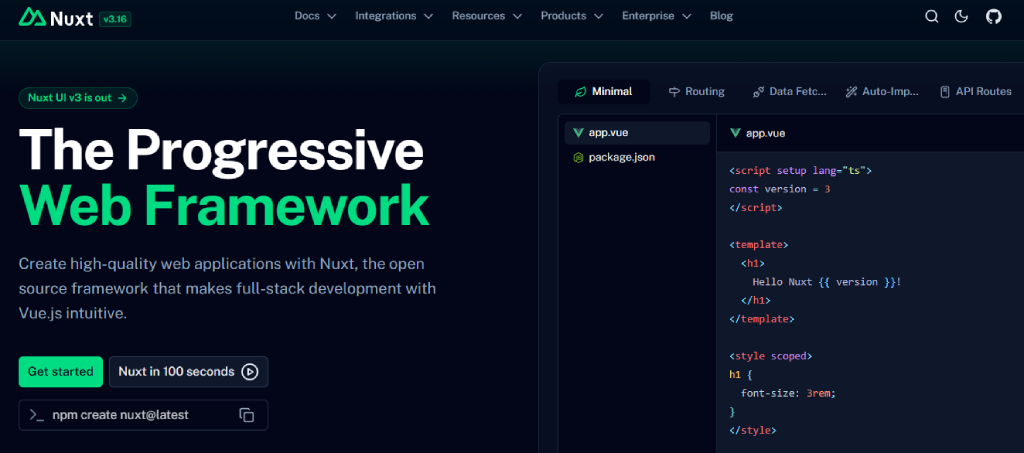
Vue is elegant on its own. But when your business grows, simplicity alone is not enough. You need structure, server-side rendering, and SEO. That is where Nuxt comes in.
Nuxt is to Vue what Next.js is to React. It turns Vue into a full-featured, production-ready platform with automated routing, server-side rendering, and sensible defaults. For scaling teams, it provides guardrails without killing flexibility.
Best For: Teams building on Vue that need SSR, better SEO, and a scalable structure for multiple developers.
Pros:
- Server-side rendering and fast page loads that improve SEO and Core Web Vitals.
- Built-in best practices that keep growing teams aligned.
- Flexible deployment across static, server, and hybrid rendering.
Cons:
- It inherits Vue’s smaller ecosystem compared to the React world.
- Added abstraction can be unnecessary for simple Vue projects.
Svelte / SvelteKit (v5) – Best for performance-first apps
In a world where milliseconds move revenue, Svelte is less a framework and more a competitive edge.
Instead of shipping a heavy runtime to the browser, Svelte compiles your code into lean, efficient JavaScript at build time. The result is faster load times and smoother interactions, especially on mobile. Developers clearly respect it: Svelte was the most-admired web framework in the Stack Overflow 2025 survey at 62.4%. SvelteKit adds full-stack capabilities on top.
Best For: Performance-sensitive apps, mobile-heavy audiences, and startups that want to ship fast without a bloated codebase.
Pros:
- Among the fastest initial render and smallest bundles of any major framework.
- Less boilerplate means smaller codebases and easier maintenance.
- Simple, built-in state management with no heavy external libraries.
Cons:
- A smaller ecosystem and fewer ready-made integrations than React or Vue.
- A shallower hiring pool, which can slow team scaling.
Ruby on Rails (v8) – Best for startup MVPs
In a landscape flooded with shiny new tools, Ruby on Rails keeps proving one thing: speed to market still wins.
Rails may not be the trendiest name in 2026, but it is battle-tested, and it has evolved. Rails 8 shipped built-in tools for background jobs, caching, and deployment that used to require third-party services. Its “convention over configuration” philosophy means fewer decisions and faster builds, which is exactly what early-stage teams need.
Best For: Startups and founders who need to build, test, and launch an MVP fast.
Pros:
- Rapid prototyping that gets an MVP live in weeks, not months.
- Conventions reduce decision fatigue and keep small teams productive.
- Proven at scale, used by GitHub, Shopify, and Basecamp.
Cons:
- A shrinking hiring pool compared to JavaScript and Python.
- Raw performance requires more infrastructure to scale under heavy load.
Express.js (v5) – Best for APIs and microservices
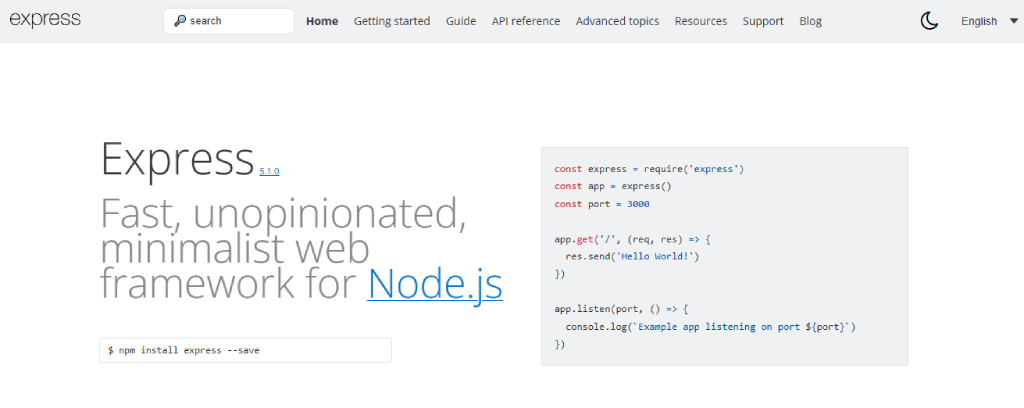
When it comes to building fast, flexible backends, Express.js is still the default choice for many developers, and for good reason.
Built on Node.js, Express is minimalist by design. No bloat, no hand-holding, just performance and total control over how your backend behaves. For businesses building APIs, microservices, or real-time apps, that flexibility is exactly the point. It remains one of the most-downloaded backend frameworks on npm, with tens of millions of weekly installs.
Best For: API-driven apps, real-time services like chat and live dashboards, and microservices architectures.
Pros:
- A unified JavaScript stack across frontend and backend reduces context switching.
- Lean and fast, ideal for high-concurrency, I/O-heavy workloads.
- Total architectural freedom is used in production by teams at IBM and Accenture.
Cons:
- Minimalism means you build structure, security, and conventions yourself.
- Less guidance can lead to inconsistency across larger teams.
Django (v6) – Best for secure, data-heavy Python apps
If your business handles sensitive data or complex workflows and cannot compromise on security, Django is the framework that checks every box.
Known as the “batteries-included” framework for Python, Django ships with authentication, an admin panel, and database management out of the box, saving teams months of custom work. Django 6 continues to improve async support for higher-concurrency workloads. Its built-in protections against common vulnerabilities make it a strong fit for regulated industries.
Best For: Data-intensive platforms, apps needing robust user management, and security-critical projects in finance, healthcare, and education.
Pros:
- Pre-built tools and admin panels accelerate development.
- Strong security defaults against SQL injection, XSS, and CSRF.
- A powerful ORM and clean structure, used by Instagram, Spotify, and Pinterest.
Cons:
- More configuration-heavy than Rails or Laravel for plain CRUD apps.
- Its monolithic nature can feel heavy for a simple API.
Flask (v3) – Best for lightweight Python APIs
When a project does not need every bell and whistle, just speed, flexibility, and control, Flask is the go-to Python framework.
Unlike Django, Flask takes a minimalist approach. It gives your team enough to start, then gets out of the way. No rigid structure, no forced patterns, just clean code and the freedom to build exactly what you need. That makes it a strong fit for microservices, prototypes, and API-first projects.
Best For: Small-to-medium apps, microservices, fast prototypes, and specialized APIs.
Pros:
- Minimal footprint means fast deployments and light server loads.
- Full flexibility to choose your own libraries and architecture.
- A gentle learning curve for Python teams.
Cons:
- Common features like an ORM or admin require manual setup or extensions.
- That freedom can lead to inconsistency without disciplined conventions.
Laravel (v13) – Best for PHP applications
If your team works in PHP or you are modernizing a legacy stack, Laravel brings that ecosystem into the modern era.
Laravel is the most popular PHP framework by a wide margin, used by roughly 64% of PHP developers per JetBrains’ State of PHP 2025 report. It pairs an elegant developer experience with practical deployment, since PHP hosting is available almost everywhere. Laravel 13 keeps refining its Eloquent ORM, Blade templating, and queue tooling.
Best For: Teams with existing PHP skills building CRUD-heavy web apps that want batteries-included productivity.
Pros:
- Low, universally available hosting keeps infrastructure costs down.
- Built-in authentication, routing, and migrations speed development.
- Top-tier documentation that shortens onboarding.
Cons:
- The senior PHP talent pool is shrinking outside specific markets.
- For a fresh start without a PHP team, Python or JavaScript may be a safer long-term bet.
ASP.NET Core (.NET 10) – Best for Microsoft-first enterprise
If your business runs on Microsoft, and most enterprises do, ASP.NET Core belongs on your shortlist.
ASP.NET Core has fully shed its legacy image. It is fast, cross-platform, and optimized for everything from microservices to large-scale enterprise apps. Its real advantage is how cleanly it fits the Microsoft stack: Azure, Active Directory, and SQL Server all work together without duct tape. The .NET 10 release, a long-term-support version, brings further performance gains.
Best For: Companies in a Microsoft-first environment that need high throughput, security, and long-term maintainability.
Pros:
- Seamless integration with the Microsoft tools your IT team already runs.
- Exceptional performance under heavy traffic and complex processing.
- Enterprise-grade security and a microservices-friendly design.
Cons:
- Best value comes when you are already in the Microsoft ecosystem.
- Licensing and tooling costs can be higher for smaller teams.
FastAPI (v0.1x) – Best for high-performance and AI/ML APIs
FastAPI is the framework Python teams reach for when they want speed without giving up the Python ecosystem.
It is async-first, ships automatic OpenAPI documentation, and uses modern type hints for cleaner, safer code. It is also the fastest-growing web framework in the space: the Stack Overflow 2025 survey called its jump one of the most significant shifts in the web framework category, driven by demand for high-performance APIs and AI and machine learning backends.
Best For: High-performance APIs, microservices behind a modern frontend, and AI/ML services.
Pros:
- Async performance that rivals Node and Go for I/O-heavy workloads.
- Automatic, interactive API documentation out of the box.
- Strong typing and validation that reduce bugs, popular for AI/ML integrations.
Cons:
- No built-in admin, ORM, or auth, so full web apps require assembly.
- A younger ecosystem than Django for large monolithic applications.
Spring Boot (v3.x) – Best for Java enterprise systems
For Java teams building serious enterprise systems, Spring Boot is the standard, and it has been for years.
Spring Boot brings decades of operational maturity to the table. It is the framework of choice for banking, financial services, and large regulated systems where reliability and a deep talent pool matter more than novelty. It simplifies the traditionally heavy Java setup while keeping the power that enterprises depend on.
Best For: Java enterprise applications, banking and financial systems, and large-scale, high-reliability backends.
Pros:
- Battle-tested reliability with a huge, stable enterprise talent pool.
- A vast ecosystem of integrations for complex enterprise needs.
- Strong support for microservices and distributed systems.
Cons:
- Heavier and more verbose than lightweight Python or Node options.
- More infrastructure and configuration overhead for small projects.
Blazor (.NET 10) – Best for C# web development
Blazor is Microsoft’s answer for teams that want to build interactive web UIs without switching to JavaScript.
With Blazor, C# and .NET developers can build full web front ends in the language they already know, sharing code across client and server. For organizations already invested in .NET, that means fewer context switches and a smaller stack to maintain. The .NET 10 release continues to sharpen its performance and tooling.
Best For: C# and .NET teams building interactive web UIs who want to avoid a separate JavaScript stack.
Pros:
- Write full web front ends in C#, reusing skills and code across the stack.
- Tight integration with the broader .NET and Azure ecosystem.
- A single language and toolchain simplifies hiring and maintenance for .NET shops.
Cons:
- A smaller ecosystem and community than the established JavaScript frameworks.
- Certain hosting models carry larger initial download sizes.
Also read: Top Mobile App Development Frameworks
Web Application Framework Comparison: Side by Side (2026)
Reading 15 sections is useful, but sometimes you just need to see the tradeoffs in one place. This table compares the leading frameworks on the factors that most often decide a project.
| Framework | Type | Language | Best For | Learning Curve | Enterprise Ready | 2026 Version |
|---|---|---|---|---|---|---|
| React | Frontend | JavaScript | Interactive UIs | Moderate | Yes | 19.2 |
| Next.js | Full-stack | JavaScript / TypeScript | SEO and e-commerce | Moderate | Yes | 16 |
| Angular | Frontend | TypeScript | Large enterprise applications | Steep | Yes | 21 |
| Vue.js | Frontend | JavaScript | Gradual adoption | Gentle | Yes | 3.5 |
| Svelte | Frontend | JavaScript | Performance-first applications | Gentle | Growing | 5 |
| Ruby on Rails | Full-stack | Ruby | Startup MVPs | Moderate | Yes | 8 |
| Express.js | Backend | JavaScript | APIs and microservices | Gentle | Yes | 5 |
| Django | Full-stack | Python | Secure, data-intensive applications | Moderate | Yes | 6 |
| Laravel | Full-stack | PHP | Modern PHP web applications | Moderate | Yes | 13 |
| ASP.NET Core | Full-stack | C# | Microsoft enterprise applications | Moderate | Yes | .NET 10 |
| FastAPI | Backend | Python | High-performance APIs | Gentle | Growing | 0.1x |
| Spring Boot | Backend | Java | Enterprise Java applications | Steep | Yes | 3.x |
Notice the pattern. There is no single winner. The right choice depends on your language, your team, and what the application actually has to do.
Most Popular Web Application Frameworks in 2026, By the Numbers
Adoption data is not the whole story, but it does signal where the talent, tooling, and long-term support are heading. Here is what the most recent, credible surveys show.
| Framework | Adoption Signal | Source |
|---|---|---|
| Node.js | 48.7% developer usage | Stack Overflow Developer Survey 2025 |
| React | 44.7% developer usage | Stack Overflow Developer Survey 2025 |
| Angular | 18.2% developer usage | Stack Overflow Developer Survey 2025 |
| Vue.js | 17.6% developer usage | Stack Overflow Developer Survey 2025 |
| Svelte | 62.4% most-admired framework | Stack Overflow Developer Survey 2025 |
| Laravel | ~64% of PHP developers | JetBrains Developer Ecosystem Survey 2025 |
| FastAPI | Fastest-growing web framework | Stack Overflow Developer Survey 2025 |
Two trends stand out for 2026. First, Python’s momentum is real: the Stack Overflow 2025 survey noted a 7-point jump in Python adoption, and FastAPI is riding that wave for AI and API workloads. Second, the market is consolidating. The frameworks above are the ones with the hiring pools and ecosystems to bet a multi-year roadmap on. For US teams specifically, hiring availability tracks closely with these adoption numbers, which is why React and Python roles are among the easiest technical positions to fill across most American markets. For the full dataset, the Statista most-used web frameworks report is a useful reference.
What Most Framework Guides Won’t Tell You
Here is the part the ranking lists skip: in 2026, “pick one framework” is partly the wrong question.
The most effective teams we work with rarely run a single framework end-to-end. They pair the right frontend with the right backend for the job. Next.js on the front with a FastAPI service handling AI features. A React interface on top of a Django or Rails core. The old instinct to keep everything in one language for the sake of consistency is fading, because teams now optimize for what each layer of the app actually needs. So the real decision is usually not “React or Django.” It is “what does the user-facing layer need, and what does the data-and-logic layer need,” then choosing the best tool for each.
There is a second thing benchmarks hide. The framework itself rarely sinks a project. The hidden costs do. Can you hire for it in your market? Will it still be well supported in three to five years? Can your team maintain it under real pressure? A framework that runs 15% faster on paper is worthless if you cannot staff it or keep it patched. That is why, when we shortlist a stack for a client, we weigh hiring pool and maintenance horizon as heavily as raw performance.
Keep that lens on as you work through the decision guidance below.
How to Choose the Best Web Application Framework for Your Project
More options should make choosing easier. In practice, they make it harder. So how do you cut through the noise?
Here is the honest answer: match the framework to your priority, not to the trend cycle. This table maps common business priorities to the frameworks that tend to fit them best.
| If Your Priority Is | Best Framework Choice |
|---|---|
| Fast startup MVP | Ruby on Rails or Django |
| Best SEO and organic traffic | Next.js or Nuxt |
| Large enterprise team consistency | Angular or ASP.NET Core |
| Python data or AI backend | FastAPI or Django |
| Maximum frontend performance | Svelte / SvelteKit |
| Existing PHP codebase | Laravel |
| Java enterprise system | Spring Boot |
| Microsoft or C# team | ASP.NET Core or Blazor |
| API-first microservices | Express.js or FastAPI |
| Progressive, flexible adoption | Vue.js |
| Security-critical platform | Django or ASP.NET Core |
The priority matrix tells you where to look. But three practical realities decide more projects than benchmarks ever do: how fast you can get a first version to market, how far the framework scales as you grow, and what it costs to run. Here is how the leading options compare.
| Framework | Time to Market | Ideal Scale | Cost Profile |
|---|---|---|---|
| Ruby on Rails | Fast | MVP to growth | Low to medium |
| Django | Fast | MVP to enterprise | Low to medium |
| Laravel | Fast | SMB to grow | Low |
| Vue.js | Fast | Startup to growth | Low to medium |
| FastAPI | Fast | Growth to enterprise | Low to medium |
| React | Moderate | Startup to enterprise | Medium |
| Next.js | Moderate | Growth to enterprise | Medium |
| Express.js | Moderate | Startup to growth | Low to medium |
| Svelte | Moderate | Startup to growth | Low to medium |
| Angular | Slower | Enterprise | Medium |
| ASP.NET Core | Moderate | Enterprise | Medium to high |
| Spring Boot | Slower | Enterprise | Medium to high |
These are general patterns, not guarantees. Your real timeline and costs shift with app complexity and how the system is architected. If two frameworks fit your use case equally well, the one that gets you to market faster usually wins.
Use the tables above as a starting point, then pressure-test your shortlist against five questions:
- Start with your business goals: Are you racing to launch, integrating with enterprise systems, or pushing performance to the limit? Your top priority should drive everything else.
- Audit your talent landscape: The best framework is the one your team can execute with speed and confidence, and the one you can hire for in your market.
- Get specific about technical needs: Real-time features, advanced security, cross-platform reach. Define these early so you do not hit walls later.
- Look ahead at your growth plan: Think 12 to 24 months out, not just where you are today. Will this scale with your user base?
- Map your integration needs: ERP, CRM, payments, third-party APIs. Your framework should support seamless connectivity, not fight it.
Here is the actionable version: before your next build, write down your single biggest priority and your hardest integration requirement in plain language. If you cannot name them clearly, that gap is your first task, and it is exactly what a proper discovery process is for.
5 Mistakes Teams Make When Choosing a Framework
We see the same avoidable missteps derail framework decisions across America, from seed-stage startups to enterprise teams. Watch for these five.
- Choosing on developer preference alone: The framework your lead engineer loves is not automatically the one your business can hire for, scale, or maintain. Preference is one input, not the whole decision.
- Ignoring the hiring market: A framework you cannot staff in your region becomes a bottleneck the moment you need to grow the team. Check the local and remote talent pool before you commit, not after.
- Optimizing for launch day instead of 18 months out: The stack that ships your MVP fastest is not always the one that scales to 100,000 users. Decide with your growth plan in view.
- Forcing one language across the whole stack: Consistency is convenient, but it is not worth using the wrong tool for a critical layer. Let the frontend and backend each use what fits.
- Skipping architecture validation: Most expensive rebuilds trace back to a scoping and architecture gap, not a bad framework. The decision that actually protects you happens before the first line of code is written.
That last one is the mistake teams underestimate most, and it is exactly where we start every engagement.

How Bitcot Turns a Framework Choice Into a Product That Scales
Picking the framework is one decision. Turning it into a product that ships on time, scales cleanly, and holds up under real users is a much bigger one. That is where we come in.
We start every engagement with discovery, not code. We map your business goals, audit what you already have, surface the risks, and validate the architecture before a single line is written. That is how we keep clients from the expensive rebuild 18 months in. Our teams are senior-only, so the people scoping your architecture are the same caliber as the ones building it. And because we work as a long-term partner rather than a project vendor, we make technology decisions tied to your business outcomes, not to whatever is trending.
We have guided companies across America, from early-stage startups to enterprise teams, through exactly this decision. The pattern we see again and again is simple: the right framework, paired with disciplined execution, becomes a lasting competitive edge. The wrong one becomes a tax you pay every sprint.
Ready to Choose the Right Framework?
If you are weighing a framework decision for a new build or a modernization, we would be glad to think it through with you. We partner with startups, SMEs, and enterprise teams across the United States, and in a short discovery call, we will map your goals, constraints, and integration needs, then point you toward the stack that actually fits your business and technical requirements.
Start your discovery call with Bitcot, or explore our web app development services to see how we work. You can also read client stories to see the outcomes.
Frequently Asked Questions(FAQs): Web Application Development Frameworks
What are the top web application development frameworks in 2026?
The top web application development frameworks in 2026 include React, Next.js, Angular, Vue.js, and Svelte for the frontend, and Django, Laravel, Express.js, Ruby on Rails, ASP.NET Core, FastAPI, and Spring Boot for the backend and full-stack work. The best one for you depends on your language, team, and project goals.
Which is the most popular web application framework?
By raw developer usage, Node.js and React lead, with React at roughly 44.7% adoption in the Stack Overflow 2025 survey. Node.js paired with Express is the most widely used backend combination, while React dominates the frontend.
What is the best web application framework in 2026?
There is no single best framework. Next.js is a strong default for full-stack JavaScript and SEO-driven apps, Django for secure Python backends, Laravel for PHP, and Spring Boot for Java enterprise systems. The best choice aligns with your team’s skills and your growth plan.
Which web application framework is best for enterprise applications?
Angular, ASP.NET Core, and Spring Boot are the most common enterprise choices. Angular offers structure for large frontend teams, ASP.NET Core fits Microsoft-first organizations, and Spring Boot is the standard for Java-based, high-reliability systems.
Which framework is best for startups and MVPs?
Ruby on Rails and Django are the fastest paths to a working MVP because both are batteries-included and reduce early decision-making. Next.js is also strong when SEO and a public-facing product matter from day one.
What is the fastest web application framework?
For frontend rendering, Svelte is among the fastest because it compiles away its runtime. For high-performance backends and APIs, FastAPI and Express.js lead. Actual speed depends heavily on architecture and how the app is built.
What is the difference between frontend and backend web frameworks?
Frontend frameworks like React and Vue handle what users see and interact with in the browser. Backend frameworks like Express and Django run on the server and manage business logic, databases, and APIs. Full-stack frameworks such as Next.js and Rails cover both.
Which is the best web framework for a Python application?
Django is best for full-featured, secure web apps and admin-heavy platforms. FastAPI is best for high-performance APIs and AI or machine learning backends. Flask is best when you want a lightweight, flexible starting point.