The Therapy Gap Is Real. AI Is Closing It Faster Than Anyone Expected.
Someone is searching for a therapist right now and being told the next available appointment is 11 weeks out. That is not an edge case. Over 50 million adults in the U.S. experience a mental health condition every year. 56% of them receive no treatment at all. Waitlists stretch for months. The shortage of licensed therapists keeps getting worse.
That is the gap AI-powered mental health apps are built to fill. These platforms deliver on-demand emotional support, automated cognitive behavioral therapy (CBT), intelligent mood tracking, and clinician-assisted care from a smartphone. For millions of people, an AI therapy app is the first point of contact with mental health support they have ever had.
If you are a founder asking “how much does it cost to build a mental health app?” or a CTO evaluating “what tech stack should I use for an AI therapy app?” – this guide covers everything. You will get exact numbers, recommended tools, and a step-by-step roadmap for building a mental health application that scales.
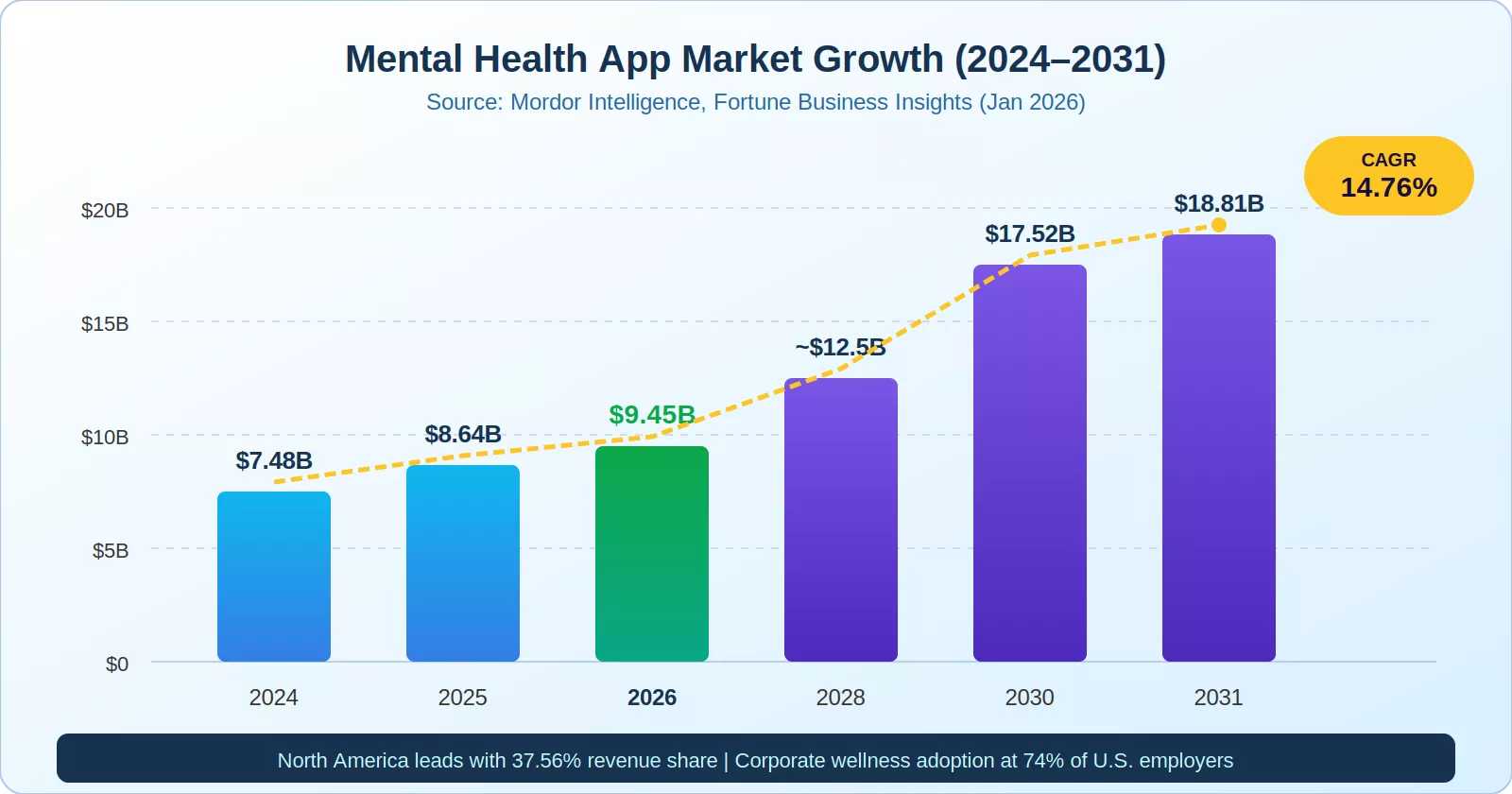
The mental health app market is estimated at $9.45 billion in 2026 and is expected to reach $18.81 billion by 2031, growing at a CAGR of 14.76% (Mordor Intelligence, Jan 2026). North America accounts for over 37% of global revenue. The broader digital mental health market grew to $24.44 billion in 2025 and is projected to reach $82.76 billion by 2032. The opportunity is massive. The window to build is right now.
Let’s break down every critical decision involved in building an AI mental health app. Some of what follows will confirm what you already suspect. A few parts might reshape your entire product roadmap.
Why AI-Powered Mental Health Apps Are Gaining Traction in 2026
This is not a single trend. It is a convergence. Several powerful forces are pushing AI mental health apps into one of the fastest-growing verticals in digital health.
Therapist Shortages and Access Barriers
More than 8,000 regions in the U.S. lack adequate mental health professionals, leaving roughly 167 million residents underserved. Rural communities and minority populations face the steepest barriers. Traditional in-person therapy cannot scale fast enough. AI-powered apps offer 24/7 access without geographic restrictions, income barriers, or appointment waitlists that stretch weeks or months.
This is the problem that keeps founders up at night: “How do I build something that actually helps people at scale?” AI mental health apps answer that by combining clinical frameworks with technology that serves thousands of users simultaneously. And increasingly, someone else is willing to pay for it.

Employer-Sponsored Wellness Programs
74% of U.S. employers offered meditation or mindfulness apps in 2024, up from 52% in 2020. Companies like Spring Health now cover over 10 million lives through per-employee contracts at $2 to $6 per person per month. The corporate wellness segment is expected to grow at the fastest CAGR through 2033 as employers use digital channels to reduce absenteeism and boost productivity.
This B2B2C model is reshaping mental health app revenue. Instead of relying solely on consumer subscriptions, apps can secure enterprise contracts that guarantee recurring revenue and lower customer acquisition costs.
“Over a billion people live with a mental disorder, and treatment gaps remain wide. Digital tools are no longer optional – they are essential to scaling access.”
– World Health Organization (WHO), Mental Health Report
“Over a billion people live with a mental disorder, and treatment gaps remain wide. Digital tools are no longer optional – they are essential to scaling access.”
– World Health Organization (WHO), Mental Health Report
Insurance Reimbursement and Payer Adoption
Closing that treatment gap requires funding, and payers are responding. Medicare Advantage began reimbursing app-based therapy sessions in 2025 at $15 to $45 per session. CMS introduced new reimbursement codes for FDA-cleared digital mental health applications. Payers are directing members to lower-cost digital channels first, trimming claims by up to 30%.
For founders evaluating the business case, this validation from the largest payer in the U.S. is an inflection point. “Will insurance cover AI therapy apps?” Increasingly, yes. But payers do not write checks on hype alone. They follow the clinical evidence.
Clinical Evidence for AI-Driven Interventions
The clinical data backing AI mental health tools has strengthened considerably. Woebot’s 2024 trial showed a 22% drop in PHQ-9 depression scores within four weeks and 83% adherence. Wysa achieved a 30% GAD-7 anxiety score reduction across trials in India and the U.K. Youper deployed large language models in 2025 to produce more empathetic exchanges, increasing average session time significantly.
These results give regulators, investors, and enterprise buyers growing confidence in digital therapeutics as legitimate clinical interventions. Not wellness accessories. Bitcot’s guide to building AI mental health chatbots covers the NLP architecture and safety protocols in depth. But knowing the market is real is only half the equation. The harder question is what kind of app to build.
Types of AI-Powered Mental Health Apps You Can Build
Before jumping into development, understand the categories of mental health apps and where the market opportunity is strongest. What type of mental health app should I build? The answer depends on your target users, clinical goals, monetization strategy, and competitive landscape.
| App Type | Core Function | Examples |
| AI Chatbot Therapy | CBT-based conversational support using NLP | Woebot, Wysa, Youper |
| Mood and Symptom Tracking | Daily journaling, PHQ-9/GAD-7 assessments | Daylio, Bearable, MoodKit |
| Meditation and Mindfulness | Guided sessions, breathing exercises, sleep aids | Calm, Headspace, Insight Timer |
| Teletherapy Platforms | Video sessions with licensed therapists | BetterHelp, Talkspace, Cerebral |
| Self-Help / Psychoeducation | Structured programs for anxiety, PTSD, OCD | Sanvello, NOCD, Happify |
| Hybrid (AI + Human Therapist) | AI handles triage and between-session support | Spring Health, Lyra Health |
Many successful products combine multiple categories. A hybrid behavioral health platform using AI for daily engagement and human therapists for complex cases often delivers the strongest clinical outcomes and retention metrics. Depression and anxiety apps captured 30% of market share in 2025, while digital wellness and stress management apps are growing at a 16.34% CAGR as employers bundle mindfulness tools into benefits.
The key strategic question is not just what to build but how to stand apart. Over 10,000 mental health apps sit on app stores right now. Most will fail. Clinical credibility, personalization depth, and a clearly defined audience separate products that survive from those that vanish. The next decision, feature scope, determines whether you ship something users trust or something they delete after day three.
Essential Features for an AI Mental Health App
Feature decisions make or break a mental health app. Build too little and users leave. Build too much and you delay launch while inflating cost. What features do I need in a mental health app? Here is a breakdown organized by priority for your MVP and growth roadmap.
Core Features (MVP)
These are non-negotiable for launch. Without them, the app will not pass clinical credibility or meet user expectations in 2026.
- AI-Powered Chatbot: A conversational AI agent trained on CBT, DBT, or ACT frameworks using advanced NLP. This is the backbone of most AI therapy apps. The chatbot handles mood check-ins, guided exercises, psychoeducation, clinical decision support, and crisis detection. Building a custom AI chatbot with therapeutic intelligence requires specialized NLP expertise.
- Mood Tracking and Journaling: Let users log emotions, triggers, and daily patterns. Use sentiment analysis to detect shifts over time. Visual dashboards showing mood trends over weeks and months increase engagement and self-awareness.
- Personalized Content Delivery: Adaptive algorithms that recommend exercises, articles, or guided sessions based on user history and current emotional state. Personalization is the single biggest driver of retention in mental health apps.
- Crisis Detection and Safety Protocols: Real-time monitoring for suicidal ideation or self-harm language, with automated escalation to crisis hotlines (988 Suicide and Crisis Lifeline) or emergency contacts. This is both a clinical necessity and a legal safeguard.
- User Onboarding and Assessment: Clinically validated intake questionnaires (PHQ-9, GAD-7) to establish baseline mental health status and personalize the experience from the very first session.
- Secure Authentication: Login with multi-factor authentication and biometric options, built following HIPAA guidelines. Users sharing sensitive mental health data need to trust that their information is protected.
Advanced Features (Growth Stage)
Once the MVP gains traction and validates product-market fit, these features drive deeper engagement, stronger retention, and new monetization channels.
- Teletherapy Integration: Video and audio sessions with licensed counselors, complete with scheduling, billing, EHR integration, session notes, and encrypted communication channels.
- Wearable Device Integration: Sync with Apple Watch, Fitbit, or Garmin to pull heart rate variability, sleep quality, and activity data for remote patient monitoring and holistic mental health assessments.
- Community and Peer Support: Moderated forums or group sessions that reduce isolation while maintaining strict privacy standards and content moderation.
- Gamification and Progress Dashboards: Streaks, badges, milestone celebrations, and visual progress reports that reinforce positive mental health habits and drive long-term patient engagement.
- Multi-Language and Cultural Adaptation: Expanding beyond English with culturally sensitive therapeutic content. 61% of developers are now integrating AI-driven localization tools into mental health platforms.
- Provider Dashboard and Analytics: For B2B models, give employers and clinicians visibility into population-level mental health trends with anonymized, aggregate reporting.

Recommended Tech Stack for AI Mental Health App Development
With the feature roadmap defined, the next question is what to build it with. Your technology stack impacts everything from development speed to long-term scalability and maintenance costs. What is the best tech stack for building a mental health app? Here is what leading teams are using in 2026 and why.
| Layer | Technology Options | Why It Works |
| Frontend (Mobile) | React Native, Flutter, Swift, Kotlin | Cross-platform efficiency with native performance |
| Frontend (Web) | React.js, Next.js, Angular | Fast rendering, SEO support, component reuse |
| Backend | Python (Django/FastAPI), Node.js, PHP (Laravel) | Python for AI/ML; Node.js for real-time features |
| AI/ML Engine | OpenAI API, Google Vertex AI, Hugging Face, PyTorch | LLM chatbots, sentiment analysis, predictive modeling |
| NLP Framework | spaCy, LangChain, Rasa, NLTK | Intent recognition, emotion detection, conversation flow |
| Database | PostgreSQL, MongoDB, Redis | Secure relational storage with fast caching |
| Cloud | AWS (HIPAA-eligible), Google Cloud, Azure | Scalable hosting with BAA support |
| Video/Comms | Twilio, Agora, WebRTC, ZEGOCLOUD | Encrypted teletherapy video and messaging |
| Security | AES-256, OAuth 2.0, JWT, SSL/TLS | End-to-end encryption for PHI protection |
| DevOps | Docker, Kubernetes, GitHub Actions, Terraform | Automated deployments, environment consistency |
For most teams, a Python backend paired with React Native on the frontend offers the best balance of AI capability and cross-platform reach. Python dominates machine learning and NLP, while React Native keeps mobile costs manageable by sharing code across iOS and Android.
Cloud-based solutions dominated the mental health software market with 65% share in 2025 due to low upfront costs, rapid scalability, and seamless integration with healthcare IT systems. When choosing a cloud provider, confirm they offer HIPAA-eligible services and will sign a Business Associate Agreement (BAA). But here is what catches most teams off guard: the technology is the straightforward part. Compliance is where promising products quietly stall.
Compliance is not optional in healthcare – it is foundational to everything you build. Does my mental health app need to follow HIPAA guidelines? If the app collects, stores, or transmits protected health information (PHI), the answer is absolutely yes. And even if your app falls outside strict HIPAA requirements, following those guidelines builds trust and positions you for enterprise and payer partnerships.
HIPAA (Health Insurance Portability and Accountability Act)
HIPAA sets the standard for protecting sensitive patient data. Here are the key requirements your development team needs to address from day one.
- Encrypt all data at rest (AES-256) and in transit (TLS 1.2+). No exceptions.
- Sign Business Associate Agreements (BAAs) with every cloud vendor, analytics tool, and third-party service that touches PHI.
- Implement role-based access controls (RBAC) and maintain detailed audit logs for all data access events.
- Conduct regular risk assessments, vulnerability scans, and penetration testing on a quarterly or semi-annual cycle.
- Train all team members who interact with PHI on HIPAA policies and incident response procedures.
An important distinction: a development partner builds your application following HIPAA guidelines – meaning the architecture, encryption, access controls, and audit logging all meet HIPAA standards. However, formal HIPAA compliance certification requires a separate audit by a respected third-party firm. Your development partner builds the foundation. The audit validates it.
FDA Considerations
HIPAA covers data protection, but it is not the only regulatory layer. If the app provides clinical diagnoses or treatment recommendations, it may fall under FDA regulation as a Software as a Medical Device (SaMD). Wellness content, meditation, or mood tracking apps typically fall outside FDA purview.
However, the line is not always clear. “Does my mental health app need FDA approval?” Consult a regulatory advisor early to determine your classification. FDA 510(k) clearances for digital mental health tools like Sleepio and Daylight are setting new precedents.
GDPR and State-Level Privacy Laws
Beyond federal regulation, privacy laws at the state and international level add another compliance layer. For apps serving European users, GDPR compliance is mandatory. In the U.S., state-level privacy laws like CCPA (California) and SHIELD Act (New York) add additional obligations around data consent, deletion rights, and breach notification.
Build privacy-by-design into the architecture from day one. Users with data security concerns represent 52% of potential adopters who hesitate to use mental health apps. Privacy is a competitive advantage. With the regulatory picture clear, the question becomes: how do you actually build this thing, step by step?
Step-by-Step Development Process for a Mental Health App
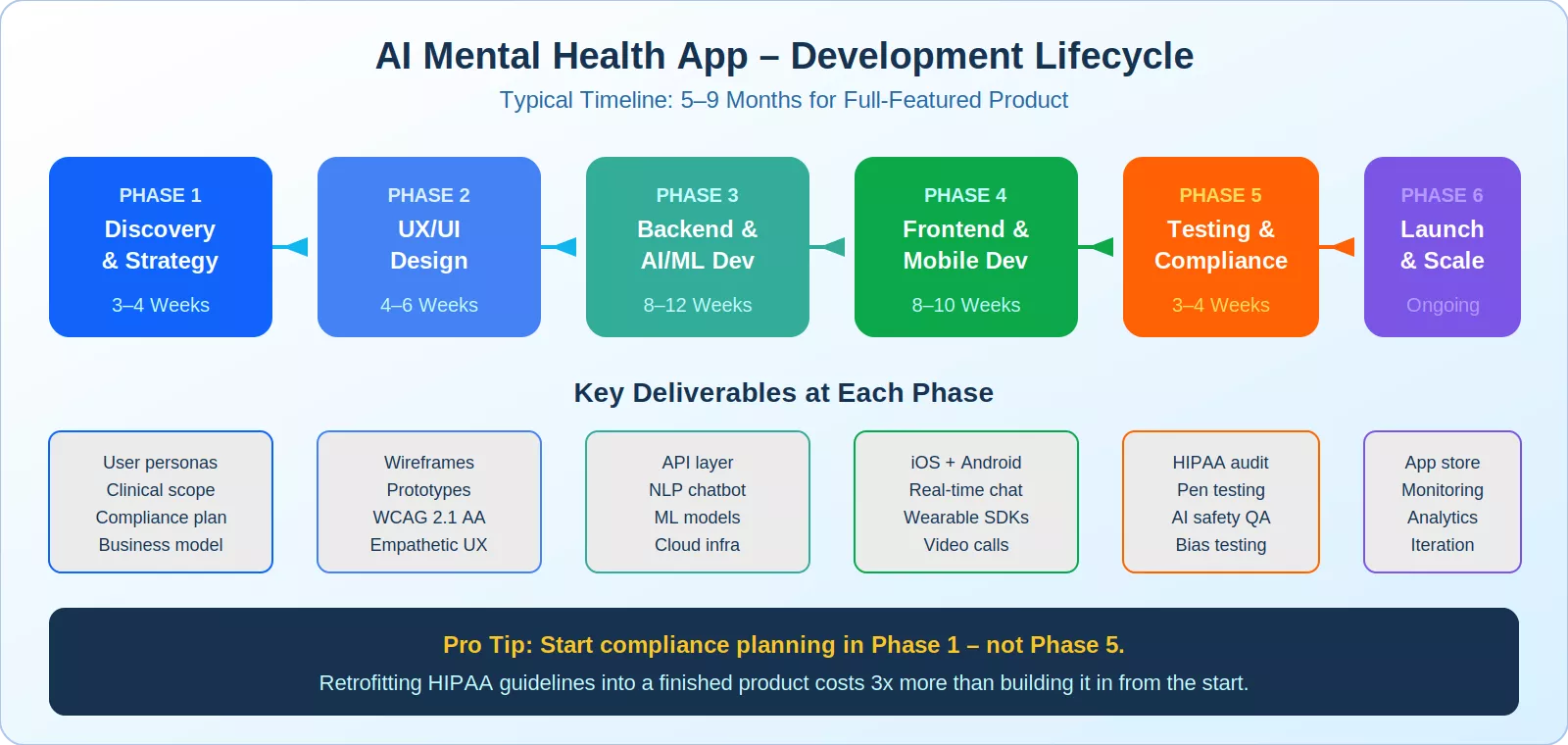
Building an AI-powered mental health application is not a weekend project. It demands careful planning, clinical input, and iterative development. How long does it take to build a mental health app? For a full-featured product, expect 5 to 9 months depending on complexity. Here is the typical development roadmap that successful teams follow.
Phase 1: Discovery and Strategy
Define the target audience, clinical scope, and business model. Conduct competitive analysis across the 10,000+ existing mental health apps. Map user personas and clinical workflows. Identify compliance requirements early. Include licensed clinicians to guide the therapeutic framework.
Phase 2: UX/UI Design and Prototyping
Design empathetic, accessible interfaces. Mental health apps demand a calm, non-clinical aesthetic that reduces friction and encourages consistent use. Build interactive prototypes and validate with usability testing. Accessibility (WCAG 2.1 AA) should be baked into every screen.
Phase 3: Backend and AI Development
Build the API layer, database schema, and authentication system. Train or integrate AI/ML models for the chatbot, sentiment analysis, and personalization engine. Set up cloud infrastructure following HIPAA guidelines. This is the longest and most resource-intensive phase, requiring close collaboration between AI engineers, backend developers, and clinical advisors.
Phase 4: Frontend and Mobile Development
Develop iOS and Android apps using React Native or Flutter, or build separate native apps. Integrate with backend APIs, implement real-time messaging for chat and teletherapy, and connect wearable device SDKs.
Phase 5: Testing, QA, and Compliance Audits
Run functional, regression, security, and performance testing across devices. Conduct audits aligned with HIPAA guidelines. Test AI chatbot responses for clinical safety, bias, and edge cases around crisis detection. This phase should never be rushed.
Phase 6: Launch, Monitoring, and Iteration (Ongoing)
Deploy to the App Store and Google Play. Monitor engagement, retention, session length, and clinical outcome metrics. Iterate based on analytics and user feedback. Budget for ongoing AI model retraining as user data grows.
“In healthcare, the technology you choose has to earn trust every single day. We build because it gives our clients the security and flexibility to deliver care without compromise.”
– Raj Sanghvi, Founder and CEO, Bitcot
How Much Does It Cost to Build an AI Mental Health App?
Earning that trust takes real investment. Cost is the first question every founder and CTO asks. What is the cost of developing a mental health app with AI? The answer varies based on features, platform choice, AI complexity, team structure, and whether you are building for consumer or enterprise markets.
| App Complexity | Estimated Cost Range | Timeline |
| Basic MVP (chatbot + mood tracker) | $40,000 – $80,000 | 3-4 months |
| Mid-Range (AI chatbot + teletherapy + wearables) | $80,000 – $175,000 | 5-7 months |
| Enterprise-Grade (hybrid AI + human therapy, analytics) | $175,000 – $350,000+ | 8-12 months |
Key Cost Drivers to Plan For
- AI/ML Model Complexity: Custom-trained NLP models cost significantly more than API integrations with GPT-4 or Claude. Fine-tuning on clinical datasets adds another layer of cost but dramatically improves safety and accuracy.
- Platform Choice: Building for both iOS and Android with React Native or Flutter reduces cost by 30-40% compared to maintaining separate native codebases.
- Compliance: Building following HIPAA guidelines adds 15-25% to development costs for infrastructure hardening, security architecture, documentation, and team training. Formal HIPAA compliance certification requires a separate audit by a third-party firm, which is an additional client-side investment.
- Third-Party Integrations: EHR systems (Epic, Cerner via HL7/FHIR), payment gateways, and video conferencing APIs each add complexity and licensing costs.
- Ongoing Maintenance: Budget 15-20% of initial development cost annually for updates, server costs, AI model retraining, and app store compliance.
Many founders ask, “Should I outsource mental health app development or build in-house?” Outsourcing to a specialized partner typically reduces costs by 30-50% compared to a fully in-house team, especially when the partner brings healthcare compliance and AI expertise. The right partner eliminates the learning curve that costs in-house teams months of rework. Of course, knowing the cost is only useful if you know how to make the money back.
Monetization Strategies That Work for Mental Health Apps
Revenue model choice affects everything from user acquisition cost to long-term viability. Get it wrong and growth stalls. Here are the models generating real revenue in 2026.
- Freemium with Premium Subscriptions: Offer basic features free. Charge $9.99 to $29.99/month for advanced AI coaching, teletherapy access, and detailed analytics. Freemium plans command 31% of market share, making this the most common model.
- B2B Employer Contracts: Per-employee pricing ($2-$6/employee/month) for corporate wellness programs. Higher retention, lower acquisition costs, and predictable recurring revenue.
- Insurance Reimbursement: Partner with payers to get reimbursed for app-based sessions at $15-$45 per session. Requires clinical validation and often FDA clearance.
- Pay-Per-Session (Teletherapy): Charge per video session with a licensed therapist, typically $60-$120 per session. Talkspace shifted to insurance-first and saw significant user growth.
- White-Label Licensing: License your platform to healthcare systems, universities, or government agencies under their own branding. This model works well for platforms with strong clinical validation.
Common Mistakes to Avoid When Building a Mental Health App
The revenue potential is clear. But so are the risks that can unravel it. Building in the mental health space comes with pitfalls that most product guides gloss over. Clinical, regulatory, ethical. These are the mistakes that sink otherwise promising products. Every one of them is avoidable.
- Skipping clinical validation: Launching without a clinical advisory board or evidence-based protocols erodes trust with users, payers, and regulators. Engage licensed therapists from day one.
- Underestimating compliance costs: HIPAA is not a checkbox exercise. Following the guidelines properly requires ongoing audits, staff training, infrastructure investment, and incident response planning.
- Ignoring crisis protocols: An AI chatbot that fails to detect and escalate suicidal ideation creates serious liability and ethical concerns. Test crisis detection exhaustively before launch.
- Over-relying on AI without human oversight: AI should augment – not replace – licensed clinicians for moderate to severe conditions. The most successful apps use a hybrid model with clear escalation paths.
- Poor onboarding and engagement design: Mental health apps see high churn rates. Invest in onboarding flows, push notification strategy, gamification, and personalized content to keep users engaged beyond the first week.
- Treating data privacy as an afterthought: 52% of potential users cite data security concerns as a barrier to adoption. A single breach in a mental health app can destroy brand trust permanently. Encrypt everything. Audit constantly.
“The best mental health apps do not try to replace therapists. They extend the reach of care to the millions who would otherwise have no access at all.”
– Dr. Tom Insel, Former Director, National Institute of Mental Health

Why Choose Bitcot for AI-Powered Mental Health App Development
Extending that reach takes more than technical skill. Building a mental health app demands deep understanding of healthcare workflows, regulatory landscapes, and clinical sensitivity. Most development agencies lack this combination. The wrong partner can cost you months of rework and critical compliance gaps.
Bitcot has completed 3,000+ Projects across healthcare, wellness, and enterprise verticals. The team brings hands-on experience with HIPAA-guided architecture, AI/ML integration, and telehealth development.
We follow HIPAA guidelines across all healthcare projects, building applications with the encryption, access controls, and audit logging required to meet HIPAA standards. This saves clients significant cost by getting the architecture right from day one. Formal HIPAA compliance certification requires a separate audit with a respected third-party firm and Bitcot’s HIPAA-ready foundation makes that process faster and smoother.
Case in point: Bitcot developed the SaludNow telehealth platform, a mobile app connecting users with healthcare providers remotely to reduce access barriers. The team also built a Deep Breathing wellness app that delivered measurable engagement results, demonstrating the ability to build clinically-aware digital products that users stick with.
From discovery through UX design, agile development, and post-launch support, Our healthcare development services cover the full product lifecycle. The approach starts with clinical workflow mapping that ensures every feature aligns with real user needs and regulatory requirements before a single line of code is written.
Whether you are building an MVP to validate a concept or scaling an enterprise platform, Our healthcare mobile app development team brings the technical depth and domain expertise to move fast without cutting corners on compliance.
Conclusion: The Time to Build Is Now
The mental health crisis is not waiting. Neither should the solutions. With a market at $9.45 billion in 2026 and projected to exceed $18 billion by 2031, backed by employer adoption, insurance reimbursement, and strong clinical evidence, AI-powered mental health apps represent one of the most impactful opportunities in digital health today.
Success requires the right features, a solid tech stack, proper compliance, and a development partner who understands the stakes. Skip the shortcuts. Invest in clinical validation. The founders who move decisively in this window will define the next generation of mental healthcare.
Ready to build your AI-powered mental health app? Schedule a free discovery consultation with Bitcot to get a custom technical roadmap, cost estimate, and compliance plan tailored to your vision. The first step is a conversation – and it starts today.
Frequently Asked Questions (FAQs)
1. How much does it cost to develop an AI mental health app?
Costs range from $40,000 for a basic MVP to $350,000+ for an enterprise-grade platform with teletherapy, wearable integration, and advanced AI. The final cost depends on feature scope, platform choice, AI complexity, and compliance requirements. Budget 15-20% annually for maintenance.
2. What tech stack is best for building a mental health app in 2026?
A Python backend (Django or FastAPI) handles AI/ML workloads effectively. React Native or Flutter works well for cross-platform mobile development, reducing cost by 30-40% compared to separate native builds. For cloud infrastructure, AWS or Google Cloud with HIPAA-eligible services provides the security and scalability mental health apps require.
3. Does my mental health app need to follow HIPAA guidelines?
If the app collects, stores, or transmits protected health information (PHI), following HIPAA guidelines is essential. A development partner builds the application with HIPAA-ready architecture, encryption, and access controls to save cost. However, formal HIPAA compliance certification must be obtained through an independent audit by a respected third-party firm. Even wellness-focused apps benefit from HIPAA-level security to build trust and position for enterprise partnerships.
4. How long does it take to build a mental health app?
A basic MVP takes 3 to 4 months. A mid-range app with AI chatbot, teletherapy, and wearable integration takes 5 to 7 months. Enterprise platforms with advanced analytics, provider dashboards, and multi-language support can take 8 to 12 months. The discovery and compliance planning phases should never be compressed.
5. Can AI replace human therapists in mental health apps?
AI is not a replacement for licensed therapists. It is a powerful complement. AI chatbots handle daily check-ins, psychoeducation, and mild-to-moderate symptom management effectively. For complex or severe conditions, human therapists remain essential. The most successful apps use a hybrid model where AI handles routine interactions and escalates to humans when needed.
6. What AI models are used in mental health chatbots?
Most mental health chatbots use NLP models for intent recognition and sentiment analysis. Popular options include OpenAI GPT, Google Vertex AI, and open-source frameworks like Rasa and Hugging Face. Custom fine-tuning on clinical datasets improves safety, accuracy, and crisis language detection.