Key Takeaways
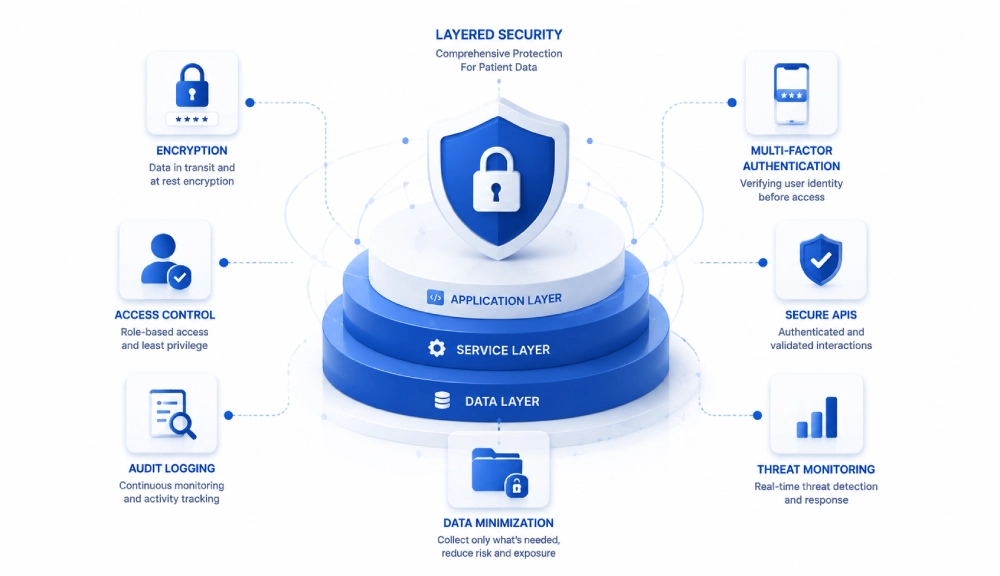
- Healthcare apps protect patient data through layered security: AES-256 encryption, role-based access control, multi-factor authentication, and continuous audit monitoring working in combination.
- Encryption in healthcare apps operates at two levels: TLS 1.3 for data in transit and AES-256 for data at rest, with optional field-level encryption for the most sensitive record types.
- Misconfigured APIs are one of the most common sources of patient data exposure; every endpoint that touches patient records must enforce authentication, authorization, and output filtering.
- Healthcare organizations in California and across the U.S. are increasingly adopting zero-trust architecture to address the expanded attack surface created by mobile health platforms and cloud-based records systems.
- Data minimization and tokenization limit breach impact by ensuring that even a compromised database yields no actionable patient information to an attacker.
Introduction
Healthcare apps now store and transmit some of the most sensitive information a person can share: diagnoses, prescriptions, mental health records, lab results, and insurance data. According to the IBM Cost of a Data Breach Report 2025, the healthcare industry has recorded the highest average data breach cost of any sector for the thirteenth consecutive year, far exceeding the average across all other industries. For health technology teams in San Diego, California, and across the United States, that reality has made patient data security a core engineering discipline rather than a feature added at the end of a development cycle.
The question is no longer whether to secure healthcare application data, but exactly how. What encryption methods work at scale? How do you design access controls that protect patient records without blocking clinical workflows? What does a secure architecture look like for a modern mobile health app or patient portal? This guide breaks down the technical and architectural decisions that determine how healthcare apps protect patient data, covering encryption standards, access management, API security, audit logging, and data minimization practices that the most trusted platforms have in common.
Why Patient Data Security Is a Critical Priority in Digital Health
Healthcare data is uniquely valuable to attackers. Unlike a stolen credit card number, which a financial institution can cancel within minutes, a patient’s medical history, social security number, and insurance details cannot be changed or reissued. According to the Verizon Data Breach Investigations Report, the healthcare sector consistently ranks among the top three most-targeted industries globally, with ransomware and credential-based attacks accounting for the majority of confirmed incidents each year.
The volume of sensitive data processed by healthcare applications has grown substantially with the expansion of telemedicine software development, remote patient monitoring platforms, wearable devices, and patient-facing portals. A single platform may handle diagnostic imaging files, lab results, prescription records, and billing data simultaneously, often across multiple devices, care settings, and geographic regions.
For development teams building these platforms, the risks are direct and concrete: a single misconfigured API, an unencrypted database field, or a weak authentication flow can expose thousands of patient records in a single incident. Building security into the application architecture from the first sprint is consistently more effective and significantly less expensive than retrofitting it after deployment. The following sections detail exactly how to do that.
How Do Healthcare Apps Protect Patient Data?
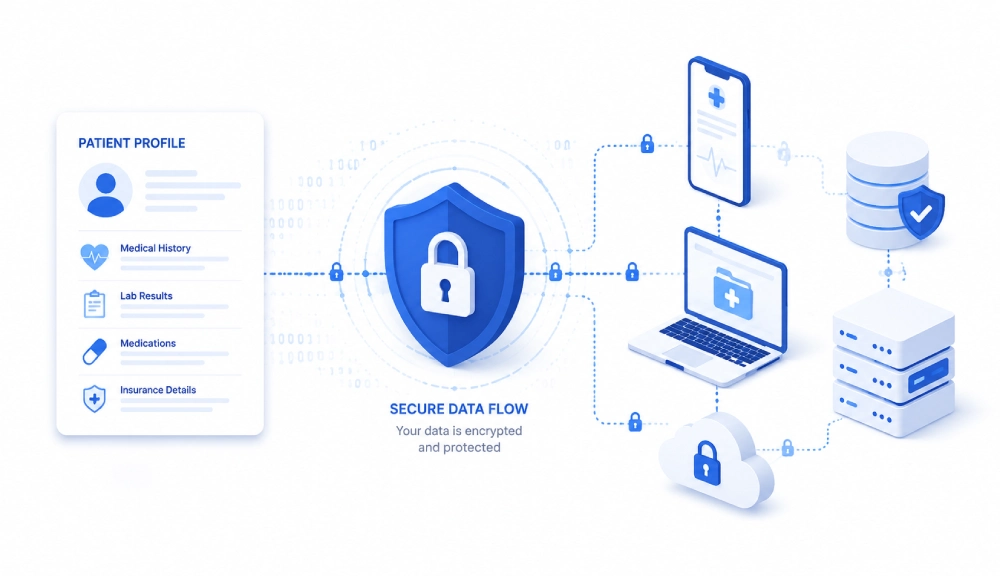
Healthcare apps protect patient data through a layered security architecture that combines strong encryption, strict access controls, secure authentication, and continuous monitoring. No single method is sufficient on its own; effective protection requires all these layers working together across every component of the application.
End-to-End Encryption
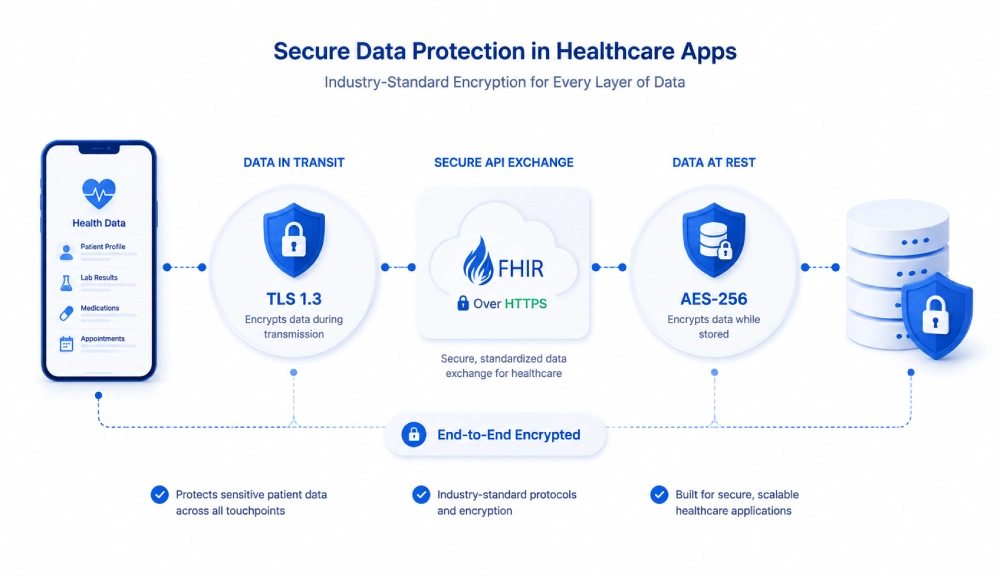
Encryption is the foundation of patient data security in any healthcare application. Modern healthcare platforms implement encryption at two distinct levels: data in transit and data at rest.
For data in transit, healthcare apps use Transport Layer Security (TLS) 1.3 to encrypt all communications between clients (mobile apps and web browsers) and servers. This prevents interception of sensitive information as it travels across networks, including public internet connections and shared Wi-Fi environments common in clinical settings. For data at rest, databases storing patient records should use AES-256 encryption, the standard recommended by the National Institute of Standards and Technology (NIST). Field-level encryption adds a further layer for especially sensitive data points, such as social security numbers or diagnostic codes, ensuring that even a fully compromised database exposes no readable patient information to an attacker.
Role-Based Access Control (RBAC)
Healthcare applications serve multiple distinct user types: patients, physicians, nurses, administrators, billing staff, and external specialists. Each role requires a different level of access to patient records, and granting uniform access across all roles creates unnecessary risk throughout the system.
Role-Based Access Control (RBAC) assigns data access permissions based on a user’s defined role rather than individual identity. A billing administrator needs access to insurance and payment data, but should never see clinical notes or diagnostic images. A referring physician may need read access to specific records, but should have no write permissions outside their active patient relationships. Well-designed RBAC frameworks enforce the principle of least privilege: users access only the data their role requires to perform their specific duties. Combined with Attribute-Based Access Control (ABAC), which factors in contextual signals such as the user’s current location, device security posture, or active session type, these systems can apply granular access rules that adapt to complex clinical workflows without creating friction for legitimate users.
Multi-Factor Authentication (MFA)
Credential compromise is one of the most common entry points in healthcare application breaches. Multi-factor authentication (MFA) requires users to verify their identity through at least two independent factors: something they know (a password), something they have (a registered mobile device or hardware token), or something they are (biometric verification such as fingerprint or facial recognition).
According to Microsoft Security research, MFA blocks more than 99.9% of account compromise attacks. For healthcare applications managing sensitive patient records, MFA is not optional; it is a baseline security requirement for any production system that provides access to patient data, whether that system is a clinician portal, a patient mobile app, or an internal administrative dashboard.
What Encryption Standards Are Used in Healthcare Apps?
Healthcare apps rely on established cryptographic standards for protecting patient data at every stage of its lifecycle. The most widely implemented standards include the following.
- AES-256 (Advanced Encryption Standard): The gold-standard symmetric encryption algorithm for securing data at rest. AES-256 is used to encrypt database records, file storage systems, and backup archives across healthcare platforms of every scale.
- TLS 1.3: The current recommended protocol for encrypting data in transit. TLS 1.3 offers improved performance and stronger security compared to earlier versions, with perfect forward secrecy built in by default so that a compromised session key cannot decrypt past communications.
- RSA and Elliptic Curve Cryptography (ECC): Used for asymmetric key exchange and digital signatures during authentication flows and secure session establishment between systems and services.
- FHIR over HTTPS: The Fast Healthcare Interoperability Resources (FHIR) standard, developed by HL7 International, is the dominant format for structured health data exchange between clinical systems. When FHIR resources are transmitted between platforms, they must be secured over HTTPS with validated certificates and properly scoped OAuth 2.0 authorization tokens to prevent unauthorized data access at the integration layer.
According to NIST’s Cybersecurity Framework, organizations handling sensitive data should apply cryptographic protections across all data states. For healthcare applications, this means treating encryption as a continuous engineering responsibility rather than a one-time configuration step applied at initial deployment.
How to Prevent Data Leaks in Healthcare Applications
Preventing data leaks in healthcare apps requires addressing every layer of the application stack, not just the database. Common leak vectors include misconfigured APIs, insecure third-party integrations, inadequate logging, and poor secrets management. Each of these warrants specific, deliberate attention during both the design phase and ongoing operations.
Secure API Design
APIs are the primary attack surface in modern healthcare applications. RESTful and GraphQL APIs that expose patient data must enforce authentication on every endpoint, validate all input parameters, and apply strict output filtering to prevent over-exposure of sensitive fields in responses.
Common API security failures in healthcare platforms include: returning full patient objects when only a subset of fields is needed for the requesting operation; failing to validate authorization on nested resource endpoints; exposing internal database identifiers in API responses that could be used for enumeration attacks; and using long-lived API tokens without rotation policies. Adopting the OWASP API Security Top 10 as a development checklist provides a practical, structured approach to catching these issues before they reach production systems where patient data is at risk.
Continuous Monitoring and Audit Logs
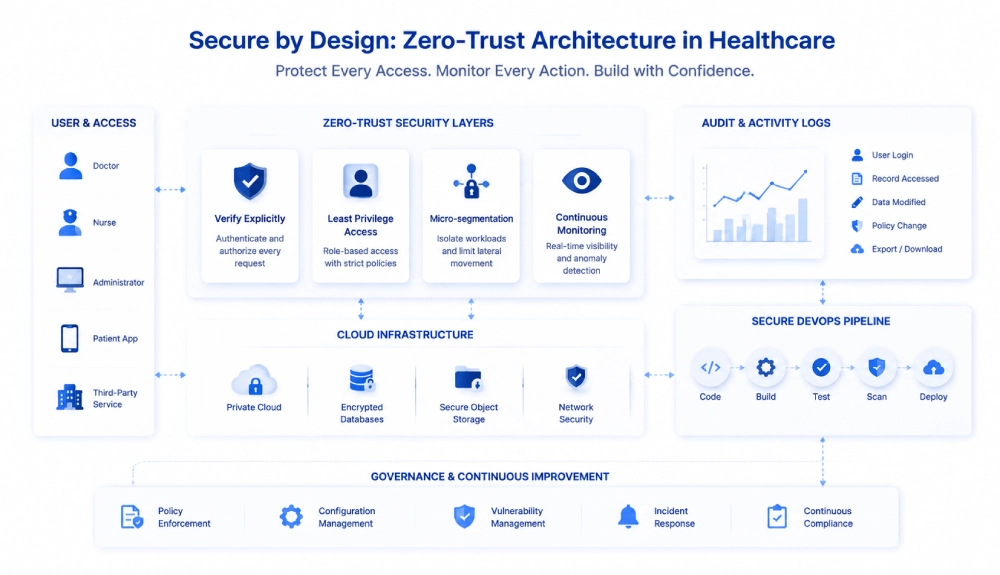
An audit log is a time-stamped, tamper-resistant record of every access and modification to patient data. Effective audit logging captures who accessed which record, from which device and location, at what time, and what specific action was performed. These logs serve two critical functions: enabling real-time detection of unauthorized access and providing forensic evidence after an incident has occurred.
In production healthcare systems, logs should be aggregated into a centralized Security Information and Event Management (SIEM) platform, with automated alerts configured for anomalous patterns. Suspicious signals include high-volume record exports outside normal workflows, access occurring outside regular operating hours, repeated failed authentication attempts, and access to records that have no relationship to a user’s current patient assignments. Increasingly, AI/ML development is being applied to anomaly detection in healthcare security monitoring, enabling platforms to learn baseline access patterns and surface deviations in near real time rather than relying on static rule-based alerts alone.
Data Minimization and Tokenization
Collecting and storing only the data that is strictly necessary for a given operation reduces exposure in the event of a breach. Data minimization principles dictate that healthcare apps should not retain information beyond their operational lifespan and should tokenize or pseudonymize patient identifiers wherever full data is not required for the task being performed.
Tokenization replaces a sensitive value, such as a patient ID or social security number, with a non-sensitive placeholder called a token. The mapping between the token and the real value is stored in a separate, highly secured token vault that is isolated from the main application database. Even if an attacker gains access to the application database, tokenized fields yield no actionable patient information. This approach substantially limits the impact of any breach and is a standard practice in well-architected healthcare platforms handling large volumes of patient records.

Building a Secure Medical Records System: Key Architecture Decisions
A secure medical records system is not a single feature or configuration; it is an architectural posture that must be established early in the design process. Development teams face several consequential decisions at the beginning of a build that determine the long-term security resilience of the platform.
Zero-Trust Architecture: Traditional security models assumed that traffic inside a network perimeter was inherently trustworthy. Zero-trust architecture assumes breach by default: every request, from every user, device, or service, must be authenticated and authorized regardless of network origin or prior session state. For healthcare platforms spanning cloud environments, mobile devices, third-party integrations, and remote clinical staff, zero-trust is the more appropriate and defensible starting model.
Cloud Infrastructure and Key Management: Major cloud platforms, including AWS, Microsoft Azure, and Google Cloud, offer healthcare-specific infrastructure services with built-in encryption key management, private networking options, and audit capabilities. Using a cloud Key Management Service (KMS) to control encryption keys, rather than embedding them in application code or configuration files, is a critical architectural decision that significantly reduces risk exposure. Envelope encryption, where a data encryption key is itself encrypted by a master key held in the KMS, is the recommended pattern for healthcare data stores that handle large volumes of structured patient records.
Secure DevOps Practices: Security should be integrated into the development pipeline through DevSecOps practices: static code analysis during active development, dependency vulnerability scanning in CI/CD pipelines, and penetration testing before each major release cycle. Secrets such as API keys, database credentials, and TLS certificates should never be committed to source code repositories under any circumstances. Use secrets management tools such as HashiCorp Vault or cloud-native equivalents to inject secrets into running services at deployment time. According to HIMSS, organizations that integrate security practices into the software development lifecycle report fewer critical vulnerabilities reaching production and a faster mean time to remediation when vulnerabilities are discovered.
Teams undertaking secure web app development for healthcare environments should treat threat modeling as a mandatory activity before any major feature is designed. Identifying the assets being protected, the likely adversaries, and the specific attack paths that need to be mitigated before writing a line of code produces significantly better security outcomes than addressing these questions after the system is built.
Our Perspective
Across the healthcare software projects our team has built in San Diego, and for clients throughout California and New York, one pattern stands out consistently: the security incidents that surface in post-mortems were rarely the result of sophisticated attacks. They were the result of small decisions made early in the build that were never revisited. An API endpoint that skipped authorization because it seemed low-risk at the time. A database field was left unencrypted to simplify a query during prototyping. An audit log that was scoped for a later sprint and never shipped.
The teams that build the most secure healthcare platforms are not the ones with the largest security budgets. They are the ones who treat security decisions as architecture decisions rather than afterthoughts. That means running threat modeling sessions before features are designed, not after they are built. It means making encryption, access control, and audit logging structural properties of the platform rather than configurable options. For custom software development in healthcare, that discipline is what separates platforms that hold up under scrutiny from those that do not.
Conclusion
Patient data security in healthcare applications is not a compliance obligation or a feature to be added before launch; it is an engineering commitment that must be embedded into every layer of the application stack. The platforms that protect patient data most effectively share a common approach: encryption applied across all data states, access controls built around the principle of least privilege, APIs designed with security as a first-class constraint, and continuous monitoring that treats every access event as a meaningful signal worth reviewing.
For health technology teams building platforms in San Diego, across California, or serving patients nationwide, the decisions made during the architecture phase have the longest-lasting security impact. Starting with a secure foundation, applying proven cryptographic standards, and integrating security into the development pipeline are the practices that produce healthcare applications people can trust with their most sensitive information. If your team is designing or scaling a healthcare platform and wants an honest assessment of your current security architecture, the right time to have that conversation is before you deploy, not after.
Frequently Asked Questions
What is healthcare data security?
Healthcare data security refers to the set of technical controls, policies, and architectural practices used to protect sensitive patient information from unauthorized access, disclosure, alteration, or loss within healthcare software systems. It encompasses encryption, access control, secure authentication, audit logging, and secure API design applied across all layers of a healthcare application and its supporting infrastructure.
How do healthcare apps protect patient data?
Healthcare apps protect patient data through a combination of layered security controls: AES-256 encryption for data at rest, TLS 1.3 for data in transit, role-based access control to enforce least-privilege access, multi-factor authentication to block credential-based attacks, and continuous audit logging to detect and investigate unauthorized access. Secure API design and data minimization practices reduce the risk of exposure further by limiting what data is accessible and what data is stored at all.
What encryption is used in healthcare applications?
Healthcare applications primarily use AES-256 for encrypting data at rest, including database records, file storage, and backup archives, and TLS 1.3 for encrypting all data in transit between clients and servers. Asymmetric encryption using RSA or Elliptic Curve Cryptography (ECC) is used for key exchange and digital signatures in authentication flows. FHIR-based data exchanges between systems are transmitted over HTTPS with OAuth 2.0 authorization tokens scoped to the minimum required permissions.
How do you prevent data leaks in healthcare apps?
Preventing data leaks in healthcare apps requires a full-stack approach: securing every API endpoint with authentication, authorization checks, and output field filtering; implementing tamper-resistant audit logs aggregated into a SIEM platform with automated anomaly alerts; applying data minimization and tokenization so that a compromised database contains no directly readable patient information; and scanning all third-party dependencies and infrastructure configurations as part of an integrated DevSecOps pipeline before every release.
What makes a medical records system secure?
A secure medical records system is built on a zero-trust architecture that treats every request as untrusted by default, uses cloud-managed key services rather than application-embedded encryption keys, enforces role-based access control for all user types and integration endpoints, and integrates security testing into every phase of the development lifecycle. Threat modeling before feature design and penetration testing before major releases are the practices that distinguish security-mature platforms from those that address vulnerabilities reactively after incidents occur.
Is healthcare data security different for mobile apps versus web apps?
Healthcare data security shares core principles across mobile and web platforms, but mobile apps introduce additional considerations. These include device-level storage security for locally cached patient data, certificate pinning to prevent man-in-the-middle attacks on mobile network connections, and secure handling of biometric authentication tokens. Mobile healthcare apps must also account for offline scenarios where locally cached records must be encrypted with device-specific keys rather than relying solely on server-side or network-level protections that are unavailable when the device is offline.
How do healthcare apps in California handle patient data security?
Healthcare apps serving patients in California operate under a combination of federal health data frameworks and California-specific data protection standards, making security architecture decisions especially consequential for teams in this region. Development teams in San Diego, Los Angeles, and San Francisco increasingly adopt zero-trust architectures, cloud-native key management services, and DevSecOps pipelines to meet the expectations of both enterprise healthcare clients and individual patients who have grown more aware of data privacy risks in digital health products.