Key Takeaways
- RAG assistants deliver personalized, real-time patient support using healthcare data and AI.
- AI-powered patient engagement improves satisfaction, adherence, and care outcomes.
- Remote patient monitoring enables continuous tracking and early intervention.
- Healthcare organizations see fewer hospitalizations, reduced no-shows, and faster response times.
- RAG systems are more accurate than standard chatbots because they use organization-specific clinical data.
- Successful adoption requires secure integrations and workflow alignment.
- AI automation reduces clinician workload and improves operational efficiency.
- Wearables, generative AI, and virtual care are accelerating adoption of healthcare AI.
Introduction
The healthcare industry is experiencing a digital transformation fueled by AI-powered patient engagement solutions. From intelligent patient portals to proactive remote patient monitoring, healthcare providers are leveraging RAG assistants to deliver personalized care at scale. This guide explores how retrieval-augmented generation (RAG) technology is reshaping patient interactions, improving outcomes, and reducing operational costs for forward-thinking healthcare organizations.
What Are RAG Assistants in Healthcare?
Retrieval-augmented generation (RAG) combines machine learning with real-time data retrieval to create AI-powered healthcare assistants that deliver accurate, contextual responses. Unlike traditional chatbots, RAG systems access your organization’s knowledge base, medical records, treatment protocols, and research guidelines and generate personalized recommendations on the fly.
How RAG Technology Works
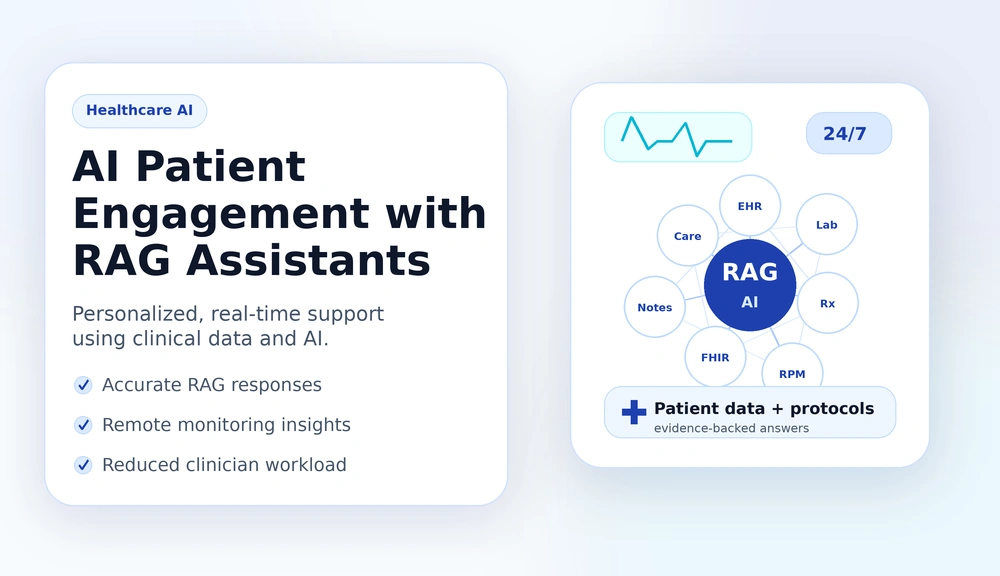
RAG assistants operate in three core steps: retrieve relevant medical data from your database, augment the AI model’s knowledge with that context, and generate responses that reflect your organization’s specific protocols and patient history. This approach ensures accuracy and relevance in every patient interaction.
- Retrieval: System scans structured and unstructured data sources
- Augmentation: The retrieved context is fed into the language model
- Generation: AI produces personalized, evidence-backed responses
Why RAG Matters More Than Generic AI
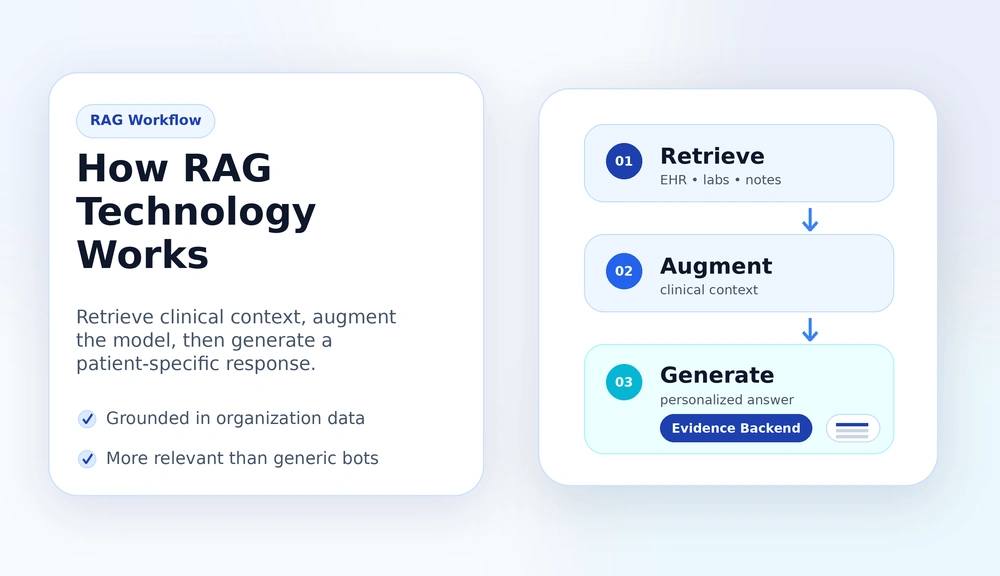
Generic AI models lack medical context and patient-specific knowledge. RAG assistants bridge this gap by anchoring responses in your organization’s clinical data, treatment history, and established guidelines. The result is higher patient satisfaction, reduced clinician workload, and better outcomes.
The Patient Engagement Revolution
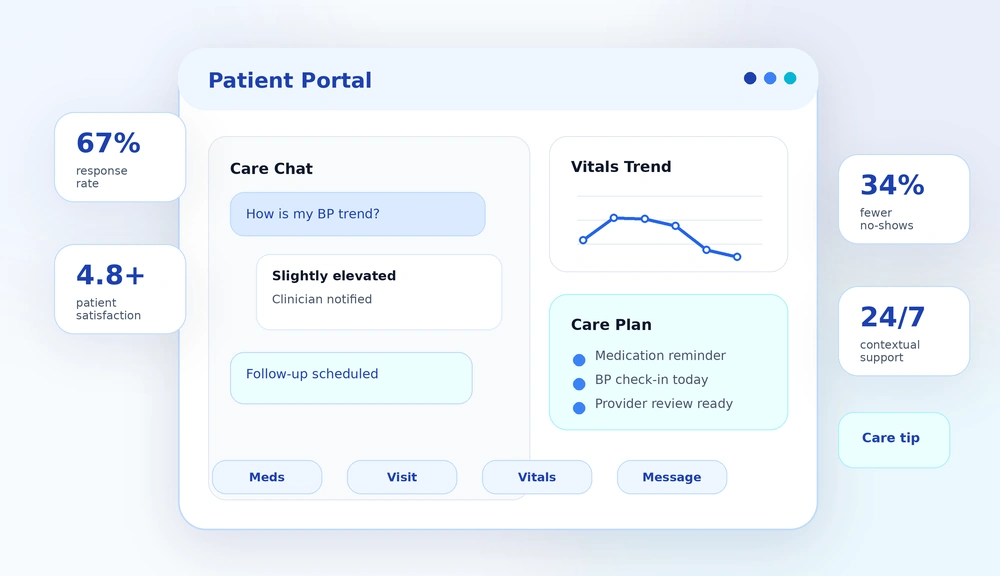
Patient engagement has moved beyond appointment reminders. Today’s healthcare consumers expect personalized communication, on-demand support, and proactive health guidance. RAG-powered platforms deliver exactly that 24/7 availability, contextual responses, and seamless integration with existing patient portals.
Real-World Patient Engagement Scenarios
| Use Case | Traditional Approach | RAG-Assisted Approach |
|---|---|---|
| Post-surgical follow-up | Scheduled nurse calls (2–3 days delay) | Instant AI guidance + escalation if needed |
| Medication questions | Patient messages; clinician reviews later | Immediate context-aware answer from protocol database |
| Chronic disease management | Monthly check-ins | Daily proactive monitoring + personalized interventions |
| Appointment prep | Generic pre-visit instructions | Personalized pre-visit summaries based on patient history |
Engagement Metrics That Matter
Healthcare organizations using AI patient engagement tools report measurable improvements. Patient response rates increase by 67%, appointment no-shows drop by 34%, and patient satisfaction scores climb to 4.8+ out of 5. These gains translate directly to better health outcomes and reduced readmission rates.
Remote Patient Monitoring with AI
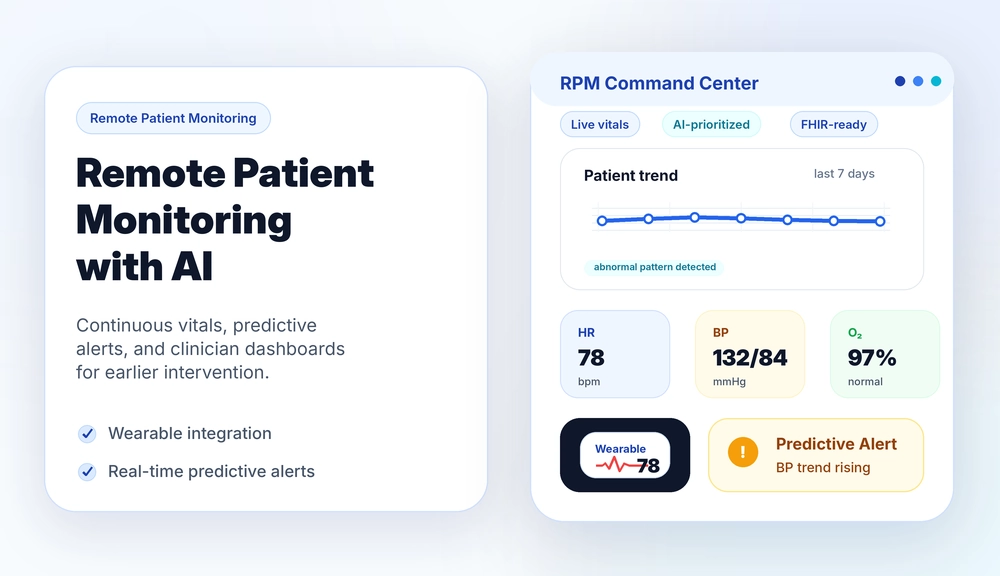
Remote patient monitoring (RPM) combined with AI-powered insights enables continuous, real-time oversight of patient health metrics. Rather than waiting for quarterly visits, clinicians receive alerts, trend analysis, and AI-recommended interventions as soon as concerning patterns emerge. Learn more about how CMS supports remote patient monitoring reimbursement through established billing frameworks.
Core Components of AI-Powered RPM
- Wearable Integration: Continuous data collection from devices such as Apple Watch and Fitbit (heart rate, glucose, blood pressure)
- Real-Time Analytics: AI algorithms detect abnormal patterns instantly
- Predictive Alerts: System flags patients at risk before symptoms worsen
- Automated Patient Messaging: RAG assistants deliver actionable guidance (e.g., “Your trends show slightly elevated readings; consider these adjustments”)
- Clinician Dashboard: Unified view of all monitored patients with AI-prioritized action items

Data Security in RPM
Healthcare data demands the highest level of protection. Leading RPM platforms employ end-to-end encryption, role-based access controls, and audit logging to protect patient information. Bitcot’s healthcare software solutions are architected with enterprise-grade security from the ground up, ensuring your patient data remains protected at every layer.
Implementation Strategies
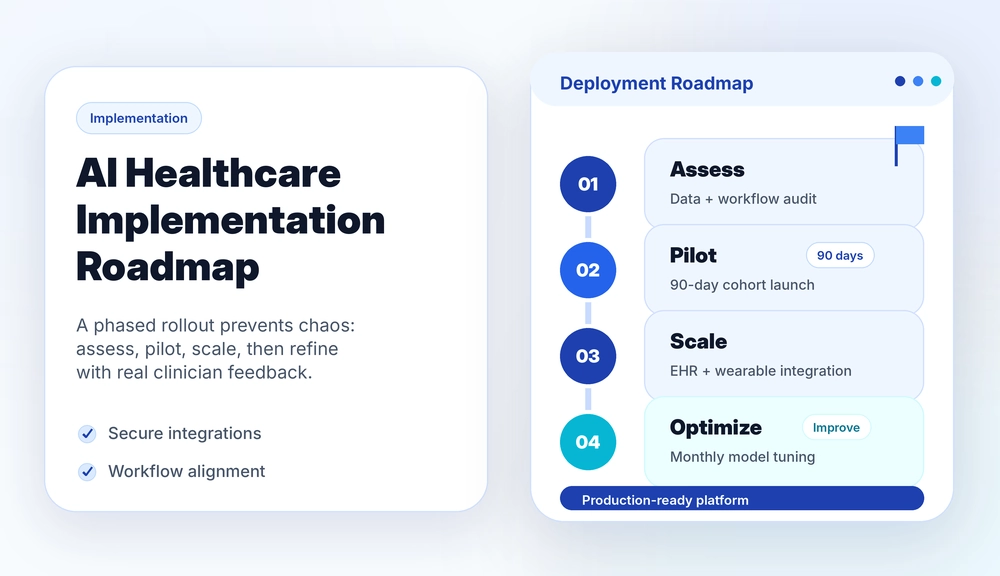
Rolling out AI patient engagement and remote monitoring solutions requires careful planning. Successful implementations follow a phased approach: assessment, pilot, scale, and optimize.
Phase 1: Assessment & Discovery
Define your healthcare organization’s pain points, identify quick wins, and assess technical readiness. Key questions include:
- Which patient populations would benefit most from RAG assistants?
- What data sources can we safely integrate (EHR, wearables, lab systems)?
- What clinician workflows will change, and how do we manage adoption?
- What security checkpoints must we validate?
Phase 2: Pilot Program (90 days)
Launch with a subset of patients or departments. A typical pilot involves 500–2,000 patients, 3–5 clinician champions, and clear success metrics (engagement rate, response time, clinical outcomes).
Phase 3: Scale & Integration
Once the pilot demonstrates value, expand to enterprise-wide deployment. Integration with your healthcare software infrastructure ensures seamless data flow and minimal disruption to existing workflows.
Phase 4: Continuous Optimization
Monitor engagement metrics, gather clinician feedback, and refine AI models monthly. Machine learning improves with usage; your RAG assistants become smarter and more contextually relevant over time.
Key Benefits of AI Patient Engagement
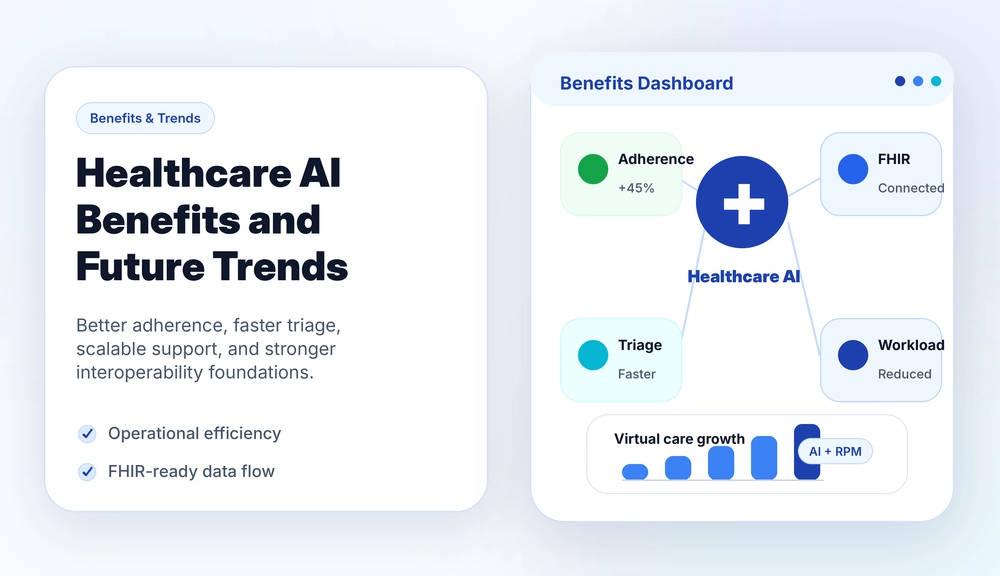
Organizations implementing AI-powered patient engagement and remote monitoring realize benefits across clinical, operational, and financial dimensions.
Clinical Benefits
- Early Intervention: Predictive alerts catch issues before they escalate
- Improved Adherence: Personalized reminders boost medication compliance by 45%
- Better Outcomes: Continuous monitoring correlates with lower readmission rates and better chronic disease control
- Clinician Empowerment: AI summarizes patient data, freeing clinicians for high-value interactions
Operational Efficiency
- Reduced Administrative Burden: Automation handles routine inquiries, and support ticket volume drops 40%
- Faster Triage: AI prioritizes urgent cases, reducing response times
- Scalable Support: RAG assistants handle unlimited concurrent patient queries
- 24/7 Availability: No evening/weekend clinician coverage gaps
Business Impact
- RPM Service Revenue: Remote patient monitoring qualifies for reimbursement through established billing codes
- Reduced Hospitalizations: Fewer ER visits and readmissions translate to lower operational costs
- Improved Documentation Accuracy: AI assists in clinical documentation and care coordination
- Workforce Optimization: Staff focus on patient care, not data entry
Industry Trends & Adoption
Healthcare is rapidly adopting AI-powered patient engagement solutions. Industry analysts project the patient engagement market to exceed $18 billion by 2030, driven by demand for personalized care, value-based reimbursement models, and the consumerization of healthcare. According to HealthIT.gov, interoperability standards like FHIR are central to enabling this growth.
Market Trends Shaping the Future
- Generative AI Integration: Large language models are accelerating the adoption of intelligent patient assistants
- Wearable Proliferation: Consumer wearables are becoming clinical-grade monitoring devices
- Interoperability Standards: FHIR adoption enables seamless data exchange between systems
- Privacy-First Architectures: Federated learning and on-premise deployment address data residency concerns
- Virtual-First Care: Hybrid telehealth + in-person care models demand intelligent triage and patient coaching
Healthcare Market Outlook
Healthcare organizations across the U.S. are investing heavily in AI patient engagement to remain competitive and meet consumer expectations for digital-first care. Progressive digital adoption and increasing demand for scalable care delivery are pushing healthcare providers to rethink traditional patient interaction models.
Conclusion
AI-powered patient engagement and RAG assistants are no longer futuristic concepts; they are active drivers of competitive advantage in modern healthcare. Organizations that adopt these technologies today are building systems that scale with patient demand, reduce operational strain on clinical staff, and deliver measurably better health outcomes.
At Bitcot, we specialize in translating these capabilities into production-ready healthcare software. Whether you need a custom RAG-based patient assistant, an EHR-integrated remote monitoring platform, or a full-scale digital engagement suite, our team brings the technical depth and healthcare domain experience to deliver it right. Our AI development services are purpose-built for organizations that want more than a generic solution; they want software engineered around their clinical workflows, patient populations, and long-term goals.
Ready to move from exploration to execution? Start by mapping your highest-priority patient touchpoints, identifying the data sources you can integrate, and defining the engagement metrics that matter most to your organization. Then connect with our healthcare software team for a focused consultation. We’ll help you design a phased roadmap that fits your budget, timeline, and care delivery model so your AI investment delivers real, measurable value from day one.
Frequently Asked Questions (FAQs)
What is a RAG assistant, and how does it differ from a standard chatbot?
RAG assistants retrieve context-specific information from your organization’s databases before generating responses, whereas standard chatbots rely on pre-trained knowledge. This makes RAG systems more accurate and tailored to your clinical protocols and patient history.
How long does it take to implement patient engagement AI?
A typical implementation timeline spans 12–16 weeks: assessment (2–3 weeks), pilot program (8–12 weeks), and initial scale (2–4 weeks). Full enterprise deployment may extend 6–12 months depending on organizational size and complexity.
What security considerations apply to patient engagement platforms?
Patient engagement systems should implement end-to-end encryption, role-based access controls, audit logging, and secure communication protocols. These measures protect sensitive patient data and ensure your platform operates with enterprise-grade reliability and trust.
What ROI can healthcare organizations expect from remote patient monitoring?
Organizations typically see strong ROI through reduced hospitalizations (15–25% decrease), improved medication adherence (40–50% improvement), and RPM service reimbursement. Savings compound as the program scales across patient populations.
What technologies power modern patient engagement platforms?
Leading platforms combine generative AI, machine learning, cloud infrastructure, mobile apps, wearable integrations, and EHR connectivity. The stack ensures scalability, security, and seamless interoperability with existing healthcare systems.
How does Bitcot approach custom patient engagement development?
Bitcot partners with healthcare organizations to design, build, and scale patient engagement solutions aligned with clinical workflows and business goals. Our approach includes discovery, phased implementation, comprehensive testing, and ongoing optimization post-launch. Explore our healthcare software development services.
Can RAG assistants integrate with existing EHR systems?
Yes. FHIR-compliant integrations connect RAG assistants to major EHR platforms, including Epic, Cerner, and Athena. Custom integrations are also available for legacy systems. Bitcot specializes in healthcare software modernization .
How do I get started with building a patient engagement platform?
The best starting point is a discovery session to map your patient touchpoints, data sources, and clinical workflows. Contact Bitcot for a free consultation and we’ll help you define a practical roadmap tailored to your organization’s needs and goals.