Key Takeaways
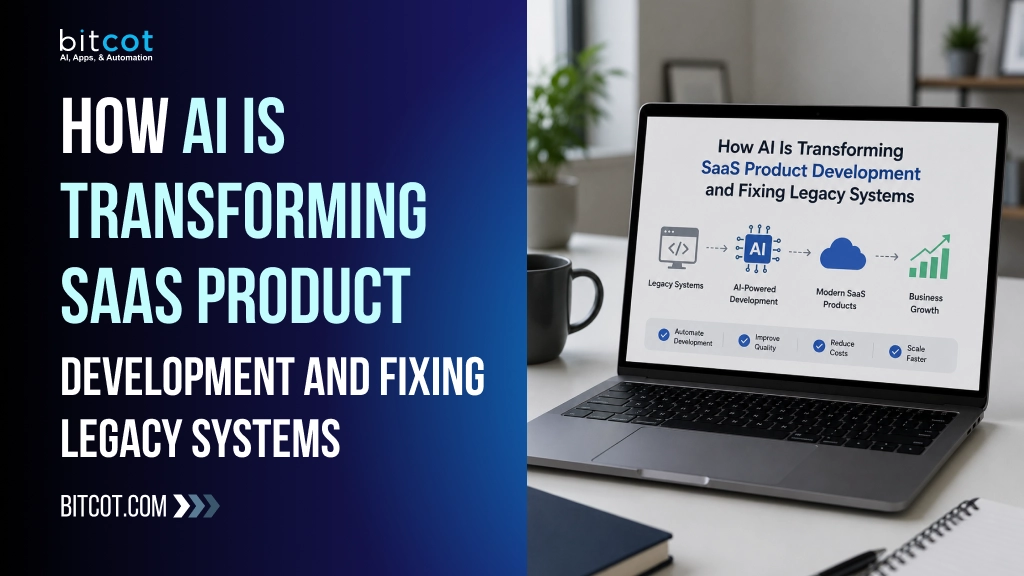
- AI coding assistants help developers complete tasks up to 55% faster, compressing SaaS product development cycles that once spanned quarters into weeks.
- According to Gartner research, legacy application maintenance consistently consumes the majority of enterprise IT budgets, leaving minimal capacity for product innovation without deliberate modernization.
- AI-powered code analysis tools can audit legacy codebases in days rather than months, surfacing undocumented dependency chains and migration risks that manual reviews routinely miss.
- SaaS companies in San Diego and across California are using AI not just to build new products faster, but to retire the legacy architectures that block their ability to scale.
- The teams making the fastest gains treat AI as a bridge: the same tooling used to decommission legacy systems becomes embedded in the SaaS product that replaces them, creating compounding returns across both workstreams.
Introduction
Software developers using AI coding assistants complete tasks significantly faster than peers working without AI support, with the largest gains in code generation, test writing, and documentation. For SaaS product teams, that productivity shift is already compressing release cycles that once spanned quarters into weeks.
The more consequential change is happening in a less visible part of the industry: AI is becoming the primary tool for diagnosing and rebuilding the legacy systems that quietly undermine many SaaS businesses’ ability to compete. Teams seeing the fastest iteration rates are often the same ones that used AI to map, audit, and retire their legacy infrastructure before building new, rather than building around it.
This pattern is particularly visible among software-driven companies in San Diego, where healthcare and fintech businesses face simultaneous pressure to ship competitive SaaS products while carrying the operational weight of systems built on decade-old architectures. This article examines both sides of that transformation: what AI in SaaS development actually changes in the product lifecycle, and what a realistic AI-driven legacy migration involves in practice.
What Is AI in SaaS Development and Why It Matters Now
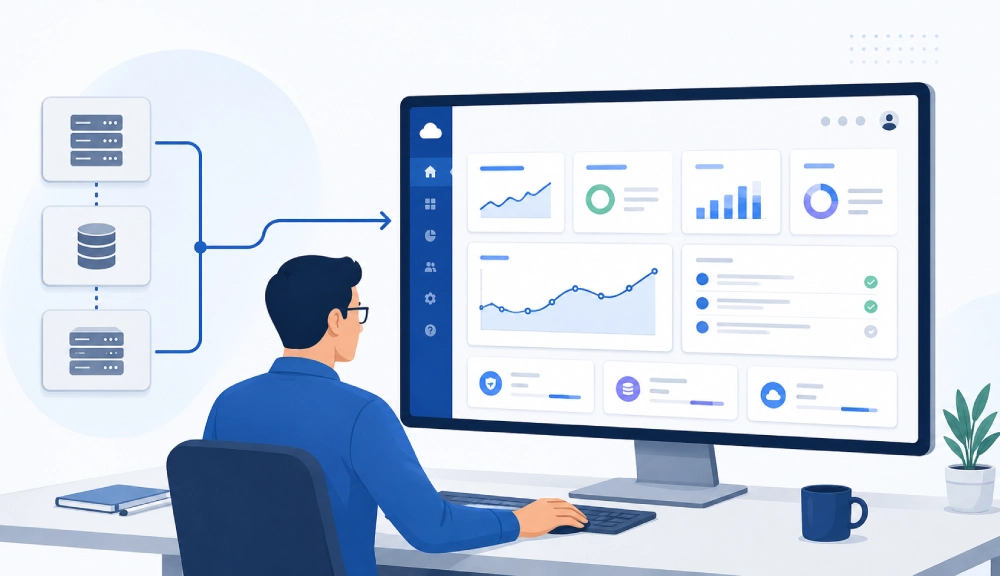
AI in SaaS development refers to the use of machine learning, large language models, and AI-assisted tooling across the software product lifecycle: from architecture decisions through code generation, automated testing, deployment, and monitoring. This is distinct from simply adding AI features to a SaaS product, such as a recommendation engine or intelligent search. The more significant application is using AI as a development accelerant that changes how engineers build, review, and maintain the product itself.
According to GitHub’s research on developer productivity, engineers using AI pair programmers spend less time on repetitive syntax and boilerplate tasks and more time on architecture and logic decisions. That reallocation matters in SaaS contexts, where product differentiation comes from business logic rather than infrastructure plumbing. Teams that embed AI/ML development tooling throughout their engineering workflow ship features faster and catch regressions earlier than teams that treat AI as a late-stage addition.
The reason this matters now specifically is that SaaS market density has increased sharply. According to IDC’s SaaS market research, the number of SaaS applications used by the average enterprise organization has grown substantially over the past five years. Differentiation through feature velocity, reliability, and adaptation speed has become the primary competitive lever. AI in SaaS development is the mechanism that makes higher velocity sustainable rather than chaotic.
How AI Is Reshaping SaaS Product Development Timelines
The most visible impact of AI on SaaS development timelines is in code generation and review. AI coding assistants suggest implementations in real time, flag potential issues before pull requests reach human reviewers, and generate unit tests that would otherwise represent hours of manual work per feature. These gains compound across sprints: a team shipping features 30% faster each two-week cycle is substantially ahead after six months, not just incrementally ahead.
Less discussed but equally significant is AI’s role in architectural decision-making. Tools that analyze patterns across a codebase can surface anti-patterns, performance bottlenecks, and scalability risks before they become production incidents. For SaaS products serving thousands of concurrent users, catching a database query problem during development rather than after a traffic spike is the difference between a routine fix and an emergency outage.
AI-assisted quality assurance is another compounding accelerant. Automated test generation tools analyze new code and produce regression tests covering common failure paths, reducing the bottleneck that manual QA creates near release dates. In SaaS product development, where continuous deployment is the target state, this matters more than in project-based software delivery because every failed deploy has downstream consequences for active users.
The SaaS product development trend worth tracking is the shift from AI as a code-completion tool to AI as a product intelligence layer. Teams are now using AI to analyze usage telemetry, prioritize backlogs based on user drop-off patterns, and identify which features drive retention versus which ones generate support volume. That closes the loop between shipping and learning faster than any manual product analytics workflow can manage.
The Legacy System Trap: Why Traditional Migration Approaches Break Down
According to Gartner’s research on IT portfolio optimization, legacy application maintenance consistently consumes the majority of enterprise IT budgets in organizations carrying significant technical debt, leaving limited capacity for new product development. For SaaS companies that grew through acquisition or rapid scaling, this problem is acute: the system that processed ten thousand transactions a day in 2015 was not built to handle the multi-tenant, API-first demands of a modern SaaS architecture.
The traditional response to legacy system debt has been the “big bang” rewrite: freeze the legacy system, build the new platform in parallel, then migrate users in a single cutover. According to Harvard Business Review’s coverage of large-scale IT transformation, this approach fails more often than it succeeds. The typical reason is that the new system underestimates the edge cases and integrations embedded in the legacy codebase that were never formally documented. Legacy systems accumulate business logic over the years; rewriting without first mapping that logic means rediscovering it through trial and error in production.
The alternative many teams attempt is incremental refactoring: extract one service at a time, gradually strangling the monolith. This works in principle but stalls in practice when the team lacks a comprehensive map of which legacy components have undocumented dependencies. Pulling one service and discovering it silently depends on three others loses weeks to debugging rather than migration progress. Generating that dependency map accurately and quickly is exactly the problem AI-powered code analysis was built to solve.
How to Modernize Legacy Systems with AI: A Practical Framework
A practical approach to AI for legacy system migration involves three phases that build on each other rather than running in isolation.
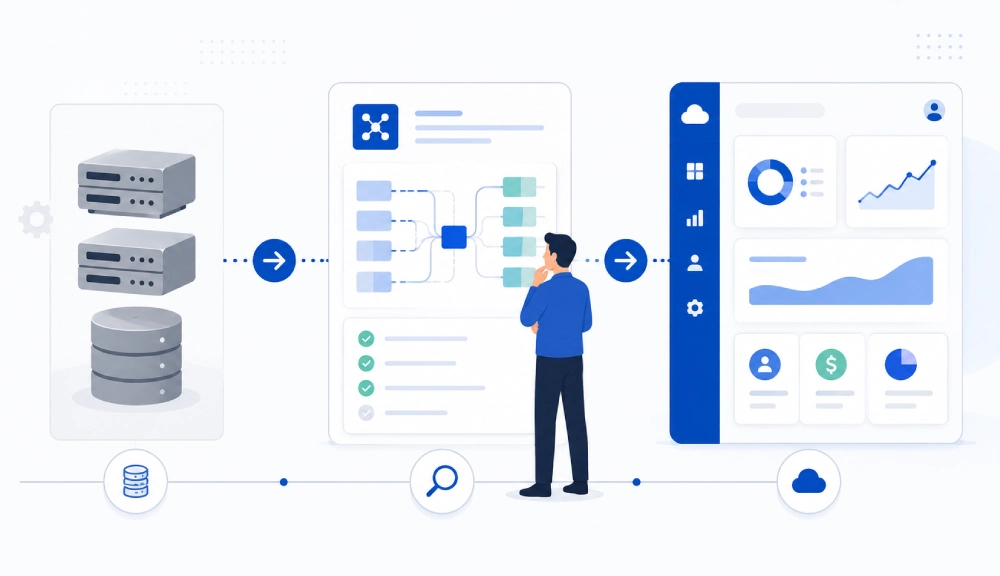
Phase 1: AI-Powered Codebase Audit. Before writing a line of new code, deploy static analysis tools augmented with large language model capabilities to map the entire legacy codebase. Modern AI code analysis tools can parse millions of lines of undocumented code, identify dependency graphs, flag dead code, detect data flow between modules, and generate readable summaries of what each component actually does. What previously required months of senior engineer time to reconstruct manually now takes days. The output is a modernization map: a prioritized view of what to migrate first, what to refactor in place, and what to retire entirely.
Phase 2: AI-Assisted Data Migration. Legacy systems almost always carry data schemas that do not translate directly to modern SaaS data models. AI tools can analyze source and target schemas, generate transformation logic, and flag records that will not migrate cleanly. Running the migration against a shadow copy of production data with AI validation before any live cutover catches the majority of data integrity issues before they affect users.
Phase 3: Parallel SaaS Development with AI Embedded. The third phase is where the unique value of this approach emerges. The AI tooling used to understand the legacy codebase in Phase 1 does not get discarded after migration. It becomes the foundation for custom software development of the new SaaS product: the same codebase intelligence that identified legacy anti-patterns now guides new architecture decisions, and the same automated testing infrastructure that validated data migration runs in the CI/CD pipeline for every new feature. Teams that approach legacy modernization this way consistently reach production-ready SaaS products faster than teams that treat migration and new development as separate projects.

What Does AI-Driven SaaS Development Look Like in Practice?
AI-driven SaaS development, in practice, looks like a development team with a substantially higher signal-to-noise ratio. Engineers spend less time writing boilerplate, chasing undocumented behavior, or manually constructing tests for known paths. They spend more time on the decisions that actually differentiate the product: the data model choices, the integration architecture, and the edge cases that determine reliability under real user conditions.
A concrete workflow pattern: a product team implementing a new billing module starts with an AI assistant generating a draft implementation based on the existing codebase context. The draft is not production-ready, but it handles roughly 70% of the logic correctly and surfaces the edge cases the team needs to resolve. Instead of starting from scratch and discovering those edge cases through testing failures, the team starts from a working skeleton and refines it. The total time to a production-ready billing module drops significantly.
For teams investing in generative AI integration within their SaaS products, the development loop tightens further. The AI layer that powers user-facing features such as intelligent search, automated summaries, or dynamic recommendations is built and iterated using the same AI-assisted development tooling, reducing the context-switching cost of maintaining two separate technology concerns within one product team.
What this does not look like is a team that automates everything and loses engineering judgment. The teams seeing the strongest results use AI to eliminate the work that does not require judgment, so that human judgment can focus where it creates the most value. That distinction matters for SaaS products, where architectural decisions made in year one compound in year three.
SaaS Modernization Trends Reshaping California’s Tech Ecosystem
California’s technology ecosystem is running a live experiment in SaaS modernization at scale. In San Francisco, healthcare SaaS companies are replacing scheduling and integration layers built in the early cloud era with AI-native architectures that can process unstructured clinical data at a scale their predecessors could not approach. In Los Angeles, fintech SaaS platforms are using AI-assisted development to compress the cycle between requirement changes and product updates, a process that once required months of coordination between engineering, legal, and product teams.
San Diego presents a particularly instructive case. The city’s intersection of healthcare, defense technology, and early-stage SaaS companies means that many local software teams build products requiring complex data relationships, strict uptime expectations, and user bases that have low tolerance for inconsistency. The adoption of AI in SaaS development among San Diego software teams has been driven less by trend-following and more by genuine engineering necessity: the products being built require a level of reliability and iteration speed that is difficult to achieve without AI tooling embedded throughout the development process.
For companies in this ecosystem, the competitive pressure is not abstract. Competing SaaS products in the same verticals are shipping faster. The response is not to hire more engineers but to make the existing engineering team more leveraged through AI-assisted workflows, a shift that compounds in value the longer it is in place.
Can AI Really Modernize a Legacy System, or Is That Overhyped?
AI cannot replace legacy systems on its own. That framing overstates what current tools can do and creates unrealistic expectations that lead to stalled projects. What AI can do is make the most painful parts of legacy migration, specifically the audit, dependency mapping, and documentation of undocumented business logic, substantially faster and more accurate. The engineering judgment about what to migrate versus what to rewrite versus what to retire still requires experienced engineers. AI accelerates the information-gathering that informs the judgment.
The pattern that works is using AI as an analysis layer, not as an autonomous migration engine. Feed the legacy codebase into an AI analysis tool to generate the dependency map and the technical debt inventory. Use that output to make informed decisions about migration sequencing. Then use AI coding tools to accelerate the implementation of the SaaS components that replace the legacy modules. At no stage does AI make the architectural decisions; it makes the humans making those decisions better-informed and faster-executing.
The teams for whom AI-driven modernization has not worked are typically the ones that expected AI to eliminate the need for experienced engineers rather than multiply their impact. Software modernization strategies that treat AI as a shortcut to skip the hard thinking fail at the same points that traditional modernization strategies fail: unclear scope, underestimated dependencies, and insufficient testing coverage. AI helps with all three, but it does not make any of them disappear.
What High-Performing SaaS Teams Do Differently with AI
Working with software teams in San Diego and across the healthcare and fintech sectors, we see a consistent pattern: the organizations making the fastest gains with AI in SaaS development are not the ones that adopted every available AI tool. They are the ones who identified specific bottlenecks in their development process and applied AI precisely where it reduced the highest-friction work. For most teams, that means AI-assisted code review, automated test generation, and AI-powered codebase analysis during legacy audits.
The teams that struggle typically conflate AI as a product feature with AI as a development tool. They invest in making the SaaS product AI-powered before the engineering process is AI-augmented, which means building a complex product with an unlevered team. Our recommendation, based on what we have observed across real project engagements: start with AI consulting focused on your development workflow before investing in AI as a user-facing feature layer. The internal leverage compounds faster than the external feature does.

Conclusion
The transformation AI is driving in SaaS product development is not a single capability or tool. It is a shift in how engineering teams relate to complexity: complex codebases become legible faster, complex migrations become less risky, and complex product logic gets implemented with fewer cycles wasted on boilerplate. For SaaS companies still carrying legacy systems, this matters because the same AI layer that accelerates new SaaS development also makes legacy migration more tractable. The two workstreams reinforce each other when approached together rather than sequenced separately.
The teams positioned to win in this environment are not necessarily the largest or best-funded. They are the teams that understand where AI reduces friction in their specific development process and apply it there first. If your team is evaluating how AI fits into your SaaS development or modernization strategy, start with an honest audit of where the highest-friction work actually lives.
Frequently Asked Questions
What is AI in SaaS development?
AI in SaaS development refers to the use of artificial intelligence and machine learning tools throughout the software product lifecycle, including code generation, automated testing, deployment monitoring, and codebase analysis. It is distinct from adding AI-powered features to a SaaS product: the focus is on using AI to make the engineering process itself faster, more accurate, and better-informed. As this article describes, these tools reduce repetitive coding work so that engineering teams can concentrate on architecture and business logic decisions that actually differentiate the product.
What is the difference between AI-driven SaaS development and traditional software modernization?
Traditional software modernization relies on manual code review, manual dependency documentation, and human-driven migration planning, which makes legacy audits slow and high-risk. AI-driven modernization uses machine learning tools to automate codebase analysis, generate dependency maps, and flag migration risks before the engineering team begins the actual migration work. The key difference described in this article is speed and completeness of the audit phase: AI can surface undocumented dependencies and embedded business logic in days that manual review would take months to find.
How does AI help modernize a legacy system?
AI helps modernize legacy systems primarily through automated code analysis, which maps existing dependencies and documents undocumented business logic faster than manual review can. Once the audit is complete, AI-assisted development tools accelerate the implementation of the SaaS components that replace the legacy modules, while automated test generation validates that the new system handles the same edge cases as the original. The three-phase framework in this article covers the AI-powered audit, data migration validation, and parallel SaaS development that together make the modernization process more reliable and less prone to mid-migration surprises.
How are SaaS companies in San Diego using AI for software modernization?
SaaS companies in San Diego are using AI modernization tools to address a specific challenge: competing in healthcare and fintech markets that require both high reliability and fast iteration speed, while carrying legacy systems that were not built for modern multi-tenant SaaS architectures. The adoption pattern has been practical rather than trend-driven, with teams applying AI-assisted code analysis to reduce the risk of legacy migrations and AI coding tools to compress the time to production for replacement SaaS modules. This article describes how that same pattern plays out across California’s broader technology ecosystem in San Francisco and Los Angeles as well.
Is AI-driven SaaS development worth the investment for teams still running legacy systems?
AI-driven SaaS development is worth the investment when the primary bottleneck is development speed or migration risk, which describes most teams running legacy systems that consume significant maintenance capacity. The practical return comes not from replacing engineers with AI, but from making existing engineers more leveraged: faster code review, automated test generation, and AI-powered legacy audits that reduce the risk of migrations failing due to undocumented dependencies. Teams that have stalled on legacy modernization efforts often find that AI-powered audit tooling removes the information barrier that was blocking meaningful progress.