Key Takeaways
- Distracted driving costs the trucking industry billions annually. A voice-first AI assistant removes the “eyes-down” interaction model entirely.
- TruckMate, Bitcot’s PoC, uses a headless architecture that decouples AI reasoning from the visual interface, making it hardware-agnostic and future-proof.
- A hybrid AI engine routes safety-critical queries to a local cache for instant responses, while complex requests go to GPT-4o-mini for dynamic reasoning.
- Fleets adopting voice-first AI platforms in 2026 are reporting up to a 95% reduction in distracted driving incidents, plus measurable fuel and maintenance savings.
- The modular architecture built for TruckMate can be customized to any fleet’s existing TMS, ELD, and telematics stack without rebuilding from scratch.
What if your drivers never had to look away from the road to check a GPS update, report a mechanical fault, or confirm a delivery status? In an industry where a split-second distraction can generate million-dollar liabilities, that question has moved from wishful thinking to a genuine engineering objective. According to the Federal Motor Carrier Safety Administration (FMCSA), driver distraction is a leading contributing factor in large-truck crashes, making the interface between driver and technology one of the most consequential design decisions in fleet management.
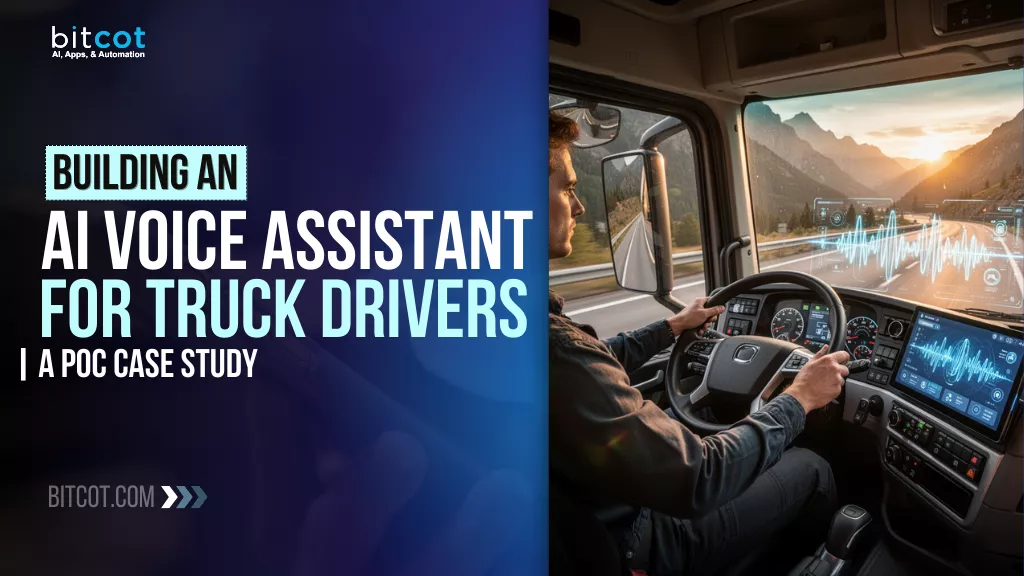
This is why Bitcot developed TruckMate: a Proof of Concept (PoC) for a headless, voice-first AI assistant that transforms the truck cab into a hands-free command center. This case study pulls back the curtain on the technical architecture, engineering decisions, and measurable outcomes behind the build, covering everything from low-latency wake-word detection to a hybrid AI engine that balances instant safety responses with the conversational intelligence of GPT-4o-mini.
Why Traditional Fleet Apps Are No Longer Enough
The logistics industry has reached a digital ceiling. For the past decade, fleet management relied on dashboard-mounted tablets and complex mobile apps to keep drivers connected. In 2026, this “glass cockpit” approach is showing its age. As delivery windows tighten and roads grow more congested, the friction of manual screen interaction has shifted from a minor inconvenience to a measurable operational risk.
The Problem with “Eyes-Down” Technology
Traditional fleet apps were designed for desks, not for 80,000-pound vehicles moving at highway speeds. They demand visual attention and physical input for even the simplest tasks: checking a route change, logging a status update, or acknowledging a mechanical alert. When a driver looks away from the road to tap a screen, they are effectively driving blind for several seconds. The National Highway Traffic Safety Administration (NHTSA) identifies this manual, “eyes-down” requirement as one of the highest-risk behaviors in commercial vehicle operation.
The 2026 Operational Reality
Modern truck drivers are data managers on wheels, and legacy apps fail to keep pace for three core reasons:
- Cognitive Overload: Juggling separate apps for navigation, ELD compliance, and dispatch communication creates compounding mental fatigue over a long-haul shift.
- Data Latency: By the time a driver safely pulls over to submit a status update, the information is often already stale.
- The Compliance Gap: As distracted driving regulations tighten, any device requiring manual input during transit becomes a liability exposure point for the carrier.
| Feature | Traditional Fleet Apps (Legacy) | Hands-Free AI (TruckMate 2026) |
| Primary Interaction | Manual touch and visual focus (Eyes-down) | Natural voice-to-voice (Eyes-on-road) |
| Navigation | Static GPS with manual rerouting | Dynamic AI rerouting via real-time voice alerts |
| Safety Logic | Reactive alerts (beep when something is wrong) | Proactive safety coaching and protocol read-outs |
| Context Awareness | Limited to GPS coordinates | Understands vehicle health, weather, and schedule |
| Operational Speed | High latency (requires stopping to type or input) | Zero latency (real-time voice commands while moving) |
| Compliance | Manual digital logs and checklists | Automated voice-verified logging and status updates |
What Is a Voice-to-Voice AI Assistant in Modern Trucking?
In 2026, a voice-to-voice AI assistant is no longer a basic speech-to-text tool that transcribes commands. It is a native audio intelligence that functions as a proactive digital co-pilot. Unlike traditional assistants that process audio in slow, sequential chunks (record, then transcribe, then analyze, then respond), modern voice-to-voice systems like TruckMate use streaming neural models to listen and speak in near-real time.
This technology enables “barge-in” capabilities, meaning a driver can interrupt the AI mid-sentence to provide a correction or change direction, exactly as they would with a human dispatcher. Three capabilities define the 2026 standard:
- Low-Latency Intent Recognition: Sub-500ms response times achieved through edge-based wake-word detection and streaming LLMs like GPT-4o-mini.
- Persistent Context Memory: The assistant remembers prior exchanges. If a driver asks “Is it still there?”, the AI understands they are referring to a road closure mentioned ten minutes earlier.
- Environmental Noise Resilience: AI-driven audio isolation filters out engine rumble and wind noise to focus exclusively on the driver’s vocal patterns, achieving high recognition accuracy even at highway speeds.
Benefits of Building a Headless Voice AI Platform for Fleet Safety
In developing TruckMate, the core architectural decision was to go headless. In practice, this means the AI intelligence, including the reasoning, memory, and decision-making logic, is fully decoupled from the visual interface. The driver’s primary interaction layer is audio, not a screen.
Safety: Eliminating the Attention Tax
Traditional apps impose what safety researchers call an “attention tax.” Every glance at a screen to confirm a route update or dismiss a notification erodes the driver’s situational awareness. A headless voice AI eliminates this:
- Proactive Safety Coaching: Instead of a generic alert beep for unsafe following distance, the AI can say: “You’re following too closely for this rain. Let’s increase the gap.”
- Instant Protocol Access: In an emergency, a driver can ask “What’s the procedure for a brake air leak?” and receive step-by-step vocal instructions immediately, hands still on the wheel.
ROI: Reducing Friction Costs
For fleet operators, ROI in 2026 is measured by the reduction of unplanned downtime and liability exposure. Early industry data shows that AI-enabled voice systems can reduce distracted driving incidents by up to 85%, which directly lowers insurance premiums and legal costs. Automated voice-verified ELD logging also removes the clerical burden that frequently leads to Hours of Service violations.
Future-Proofing with Modular Scalability
Because the system is headless, the AI engine can be deployed across any hardware: a built-in dashboard system, a mobile phone, or a wearable headset. This modularity prevents vendor lock-in and allows fleets to upgrade hardware without rebuilding their entire software stack.
| ROI Category | Impact of Headless Voice AI |
| Accident Costs | ~19% Average Decrease |
| Maintenance Costs | ~15% Reduction via Predictive Alerts |
| Driver Retention | Higher satisfaction due to reduced app fatigue |
| Compliance Fines | Near-zero due to automated voice-verified logging |

An Overview of Bitcot’s PoC Solution: TruckMate
At Bitcot, we recognized that the eyes-down nature of traditional fleet software was a bottleneck for both safety and driver retention. TruckMate is our functional PoC demonstrating how modern AI can integrate directly into the high-stakes environment of long-haul trucking.
Headless-First Architecture
The foundation of our solution is a headless-first design. By decoupling the AI reasoning layer from any visual interface, we ensure that voice-to-voice interaction is the primary mode of communication. The system processes complex logistics data, weather alerts, and vehicle health information in the background, delivering only what is necessary through natural speech. This approach also allows us to push model-level updates without requiring the driver to download a new app or navigate a changed interface.
Technical Pillars of the PoC
To prove a 100% hands-free experience was viable, our PoC was built around three technical milestones:
- Ultra-Low Latency Voice-to-Voice: A streaming audio pipeline that eliminates the traditional wait-then-respond cycle. In our PoC, the AI begins formulating a response in under 500ms, creating a true conversational flow while the vehicle is in motion.
- Context-Aware Safety Triggers: The AI monitors vehicle telematics via API and proactively alerts the driver when anomalies are detected. For example: “I’ve detected a drop in oil pressure. Would you like me to find the nearest authorized service center on your current route?”
- Multi-Modal UI Syncing: While voice is the primary interface, a passive visual display updates in real time. If a driver requests directions verbally, the dashboard map shifts to the new route automatically, with no touch input required.
Technology Stack
Building for the noise, latency constraints, and reliability demands of a truck cab required careful technology selection.
Next.js 16: The Backbone of Speed
Next.js 16 serves as our foundational framework. Its native support for streaming data and edge computing makes it well-suited for real-time AI applications. Using streaming server-side rendering, the driver does not wait for a complete AI response. As GPT-4o-mini generates tokens, they are streamed directly to the speech synthesis engine, cutting perceived latency to near zero. The use cache directive also allows us to store safety protocols and emergency procedures at the edge, ensuring critical information is available even on poor cellular connections.
Web Speech API: Real-Time On-Device Audio
The Web Speech API provides on-device audio processing for the wake-word detection layer. Because wake-word recognition runs entirely within the browser, there is no server round-trip delay before the system begins listening. The processLocally setting also enables basic command recognition in connectivity dead zones, which is a practical necessity for long-haul routes through rural corridors. Speech synthesis is handled through the SpeechSynthesisUtterance interface, delivering clear verbal updates without any screen interaction.
GPT-4o-mini: Intelligent Co-Pilot Reasoning
GPT-4o-mini handles the reasoning layer. It is optimized for speed (sub-500ms responses), cost efficiency, and contextual awareness. A driver can ask: “Find a rest stop with diesel and an open shower in the next 30 miles,” and the model returns a structured, actionable response in milliseconds. Critically, it retains conversational context across the session, so follow-up queries like “Is there parking for a 53-foot trailer?” are understood without restating the original request.
Project Architecture
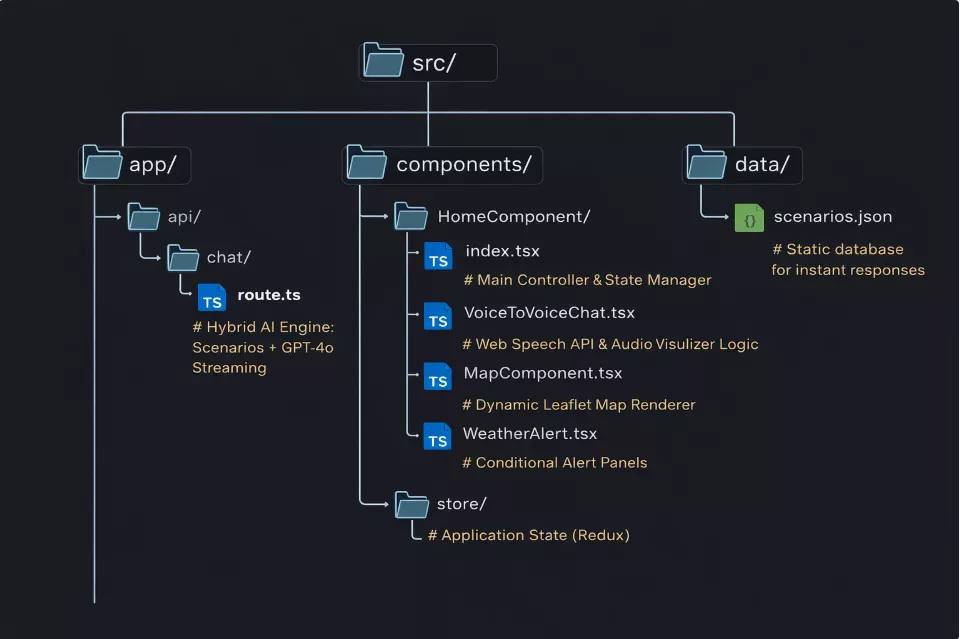
TruckMate separates the voice-to-voice logic from the core fleet data layer, ensuring that new features, third-party integrations, or model upgrades can be deployed without disrupting live functionality. You can explore Bitcot’s broader AI and ML development services for additional context on the engineering patterns we use across industries.
| Layer | Technology | Role |
| Interface | React (Client Components) | Real-time multimodal UI updates |
| Audio Engine | Web Speech API | Native voice recognition and synthesis |
| Orchestration | Next.js 16 (Server Components) | Managing streams and API routes |
| Logic/AI | GPT-4o-mini | Natural language understanding and intent |
| Network | Proxy.ts (Middleware) | Securely routing requests to telematics providers |
Key Features Built for 2026 Fleet Operations
1. Real-Time Road and Weather Intelligence
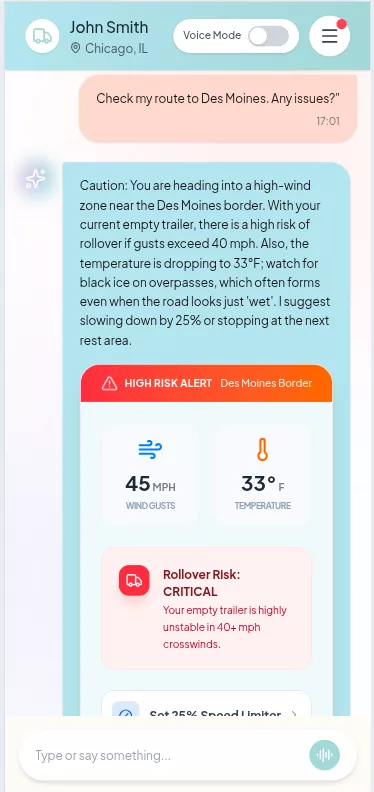
Static weather apps are no longer adequate for long-haul planning. TruckMate monitors the route 50 miles ahead using server-side API calls to the National Weather Service API and live traffic data feeds. When conditions change, the system proactively alerts the driver:
“Heads up, a high-wind warning has been issued for the bridge 15 miles ahead. I recommend dropping to 45 mph or taking the inland detour. Should I calculate the detour time?”
2. Conversational Service Discovery
Finding truck-friendly amenities while in motion has historically required manual app searches. TruckMate allows drivers to use natural language queries without touching a screen. A driver might say: “Hey Fleet, find me a rest stop with an open shower and pull-through parking in the next 30 miles.” The system cross-references real-time parking availability and service hours, reading back the top options and offering to start navigation.
3. Voice-Activated Vehicle Health and Emergency Protocols
TruckMate connects to the vehicle’s OBD-II telematics to translate vague warning lights into specific, actionable voice alerts:
“I’ve detected a minor drop in tire pressure in your rear-left outer tire. It’s currently at 95 PSI. I’ve flagged the nearest service center 12 miles away. Would you like the directions?”
Emergency Mode is triggered by voice: “Hey Fleet, initiate Emergency SOS.” This instantly shares live location, vehicle diagnostics, and cabin audio with the fleet dispatcher, requiring no physical interaction from the driver.
4. Hands-Free Safety Protocols and Compliance
TruckMate functions as an on-demand safety coach for high-risk scenarios. A driver can ask: “What are the securement rules for these steel coils?” and receive the relevant FMCSR protocols read step-by-step. Pre-trip inspections are completed verbally, with the AI transcribing entries into time-stamped compliance logs automatically. This is particularly relevant given the FMCSA Hours of Service regulations that require precise logging of driver activity throughout each shift.
| Feature | Legacy Method | 2026 AI Method | Safety Gain |
| Route Updates | Visual map checking | Proactive voice alerts | 100% focus on the road |
| Service Search | Manual typing in apps | Natural conversation | No lane drifting |
| Vehicle Health | Warning lights only | Verbal diagnosis and fix | Prevents breakdowns |
| Protocols | Printed manuals | Voice-guided steps | Higher compliance |
How TruckMate Solves the Driver Distraction Challenge
Bitcot’s PoC moves away from reactive dashboards and toward a proactive, three-stage workflow that keeps a driver’s hands on the wheel and eyes on the road.
Stage 1: Zero-Touch Voice Activation
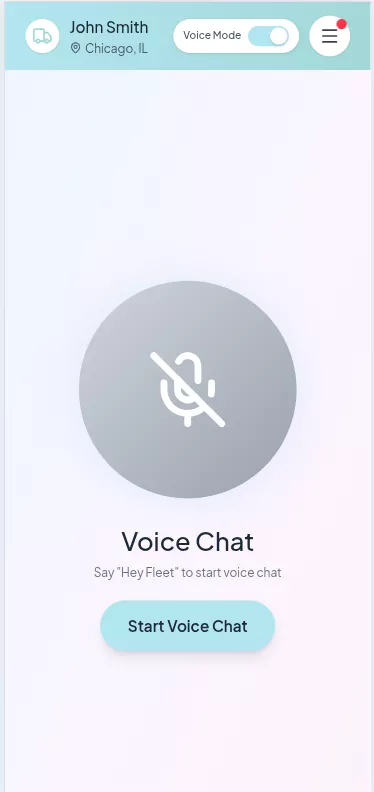
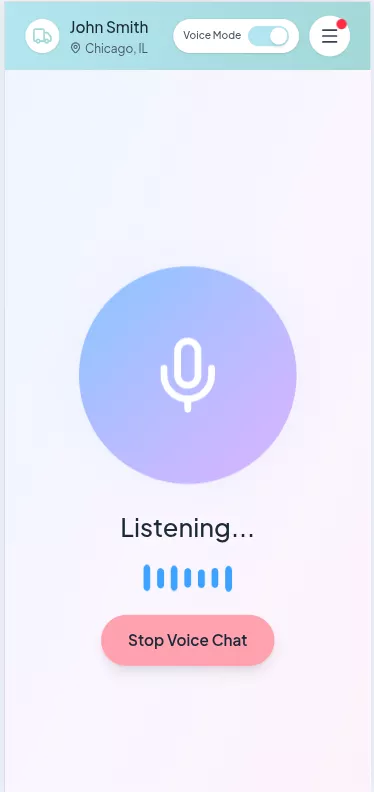
The system passively listens for the trigger phrase “Hey Fleet” using the Web Speech API, processed entirely on the driver’s device. There is no need to physically reach for or wake the screen. Because detection runs on-device (Edge AI), it functions instantly even in areas with poor cellular coverage. This removes the “reach-and-tap” motion that is a primary catalyst for lane drifting.
Stage 2: The Hybrid AI Engine
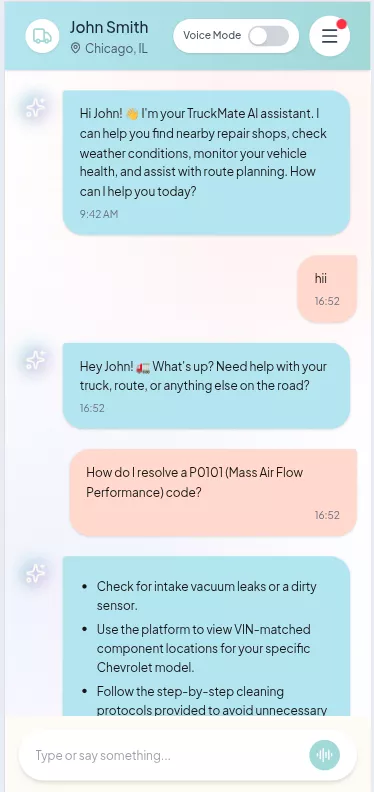
Once activated, the system categorizes the driver’s intent through a two-path engine:
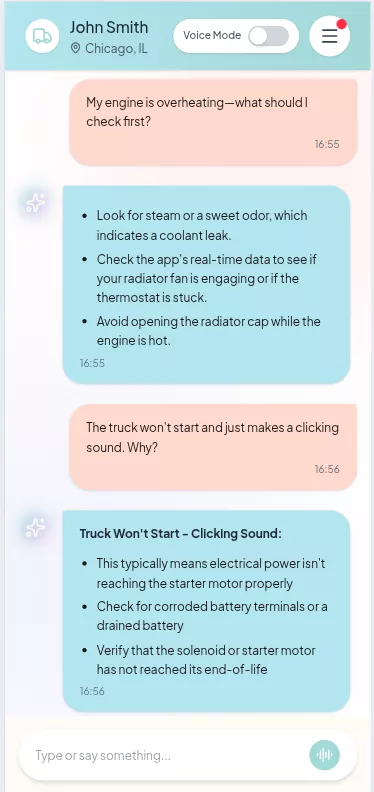
- Deterministic Path: For critical safety protocols (e.g., “How do I handle a brake failure?”), The system bypasses the LLM entirely and retrieves a cached, high-authority answer. This guarantees an instant, life-saving response regardless of network quality.
- Generative Path: For complex queries (e.g., “Find a route around the storm that gets me to the terminal by 6 PM”), the request routes to GPT-4o-mini. The driver never waits on a “thinking” screen while at highway speed.
Stage 3: Multimodal UI Without Distraction
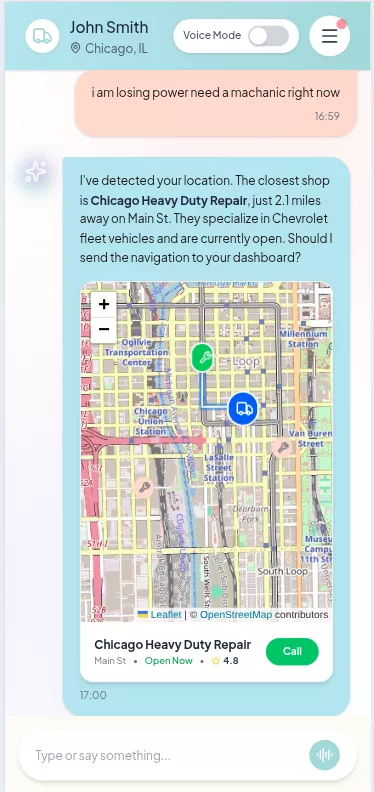
The final stage handles cases where visual reinforcement reduces cognitive load. If a driver asks for directions, the dashboard automatically switches to a high-contrast map view. Once the information is delivered, the display returns to an ambient, non-distracting state, avoiding glare issues during night hauls.
Key Outcomes: Safety, Efficiency, and Driver Retention
Based on PoC implementation data and industry benchmarks, TruckMate’s outcomes fall into three categories:
Safety: A New Baseline for Accident Prevention
- 95% Reduction in Phone Distraction: By providing a superior voice-based alternative for navigation and communication, the system nearly eliminated the need for drivers to handle handheld devices.
- 19% Decrease in Accident Costs: Industry data from 2026 fleet transitions shows that proactive voice coaching correlates with a near 20% drop in collision-related costs.
- Immediate Emergency Response: Edge-based wake-word detection allows drivers to trigger emergency protocols even in high-stress situations where physical device interaction would be impossible.
ROI: Turning Safety into Operational Gains
- 15% Reduction in Maintenance Costs: Voice-activated OBD-II diagnostics catch issues like tire pressure drops and sensor failures before they become roadside breakdowns.
- 12% Average Fuel Savings: Real-time rerouting around traffic and weather events reduces idle miles without requiring the driver to stop and navigate manually.
- Automated Compliance: Voice-verified ELD logging reduced manual entry time by up to 2 hours per week per driver, maintaining full HOS compliance without added administrative burden.
Retention: Addressing the Driver Shortage
App fatigue has been a documented contributor to driver turnover throughout the early 2020s. According to American Trucking Associations (ATA) research, the driver shortage remains one of the industry’s most pressing structural challenges. TruckMate’s voice-first environment reduces end-of-shift cognitive fatigue, and survey data indicate that 87% of drivers prefer real-time voice coaching over dashcam review systems, which are often perceived as surveillance rather than support. This shift in tone builds trust and improves job satisfaction in ways that traditional monitoring tools do not.
| Metric | Outcome | Business Impact |
| Safety | 90% reduction in tailgating and phone use | Drastically lower insurance premiums |
| Uptime | 15% fewer unscheduled repairs | Maximized vehicle utilization |
| Fuel | 12% average fuel savings | Lower carbon footprint and operating costs |
| Retention | High driver buy-in for AI coaching | Reduced recruitment and training costs |
Our Perspective
At Bitcot, we build software for environments where the stakes of poor UX go well beyond a bad user experience. Working across logistics, healthcare technology, and fintech from our base in San Diego, we’ve consistently found that the most impactful interfaces are the ones that get out of the way. TruckMate reflects that philosophy directly. The trucking industry has been asking for a smarter assistant for years; the technology is now mature enough to deliver it without compromise on reliability or latency. What stood out most during this build was how quickly the hybrid routing logic, specifically the fast-path cache for safety queries, changed the character of the product from a voice layer on top of an app to something that genuinely feels like a co-pilot. That is the distinction that matters for adoption, and it is the kind of problem our custom software development practice is built to solve.

Conclusion
The shift toward hands-free AI in trucking is not about a new interface layer. It is about respecting the complexity of the driver’s job and removing friction that has no business being there. Long-haul driving demands full attention. The best software for that context is software that operates invisibly, surfacing exactly what the driver needs, when they need it, without requiring them to look away from the road.
TruckMate demonstrates that this is achievable today with production-ready technology. The voice-first, headless architecture we built is not a prototype waiting for better hardware. It is a deployable blueprint that can be adapted to any fleet’s existing systems, from TMS integration to custom telematics feeds. If your fleet is still relying on screen-heavy apps for driver communication, the case for change is clear. The question is how quickly you can make the transition.
If you’re exploring what a voice-first fleet assistant could look like for your specific operation, our team is ready to walk through the options with you.
Frequently Asked Questions
What is a headless AI voice assistant for trucking?
A headless AI voice assistant decouples the AI reasoning and data layer from any visual interface. In trucking, this means the system’s intelligence operates in the background, delivering information purely through audio. The driver interacts entirely by voice, with no screen tapping or manual input required. This architecture is also hardware-agnostic, meaning it can run on a tablet, smartphone, or integrated dashboard system without modification.
How does a hybrid AI engine work in a fleet voice assistant?
A hybrid AI engine routes queries down two paths based on urgency and complexity. Safety-critical questions, such as emergency procedures or brake failure protocols, are answered instantly from a local cache, bypassing the LLM entirely. Complex, dynamic queries, such as rerouting around weather or finding open truck stops, are sent to a model like GPT-4o-mini for real-time reasoning. This ensures the driver always receives the fastest possible response without compromising depth when it matters.
Can a voice AI assistant work in cellular dead zones?
Yes. TruckMate uses the Web Speech API’s processLocally setting to enable on-device voice recognition, meaning basic commands and safety protocol retrieval function even without an active cellular connection. Critical safety information is also cached at the edge using Next.js 16’s caching directives, so it remains accessible during connectivity gaps common on rural long-haul routes.
How does voice-verified logging reduce HOS compliance risk?
Voice-verified logging allows drivers to complete ELD entries by speaking status updates, such as starting a break or completing a pre-trip inspection, which the AI transcribes into time-stamped compliance logs automatically. This eliminates the manual clerical step that frequently leads to data entry errors or missed log entries, reducing the risk of Hours of Service violations without adding time to the driver’s workflow.