
Key Takeaways
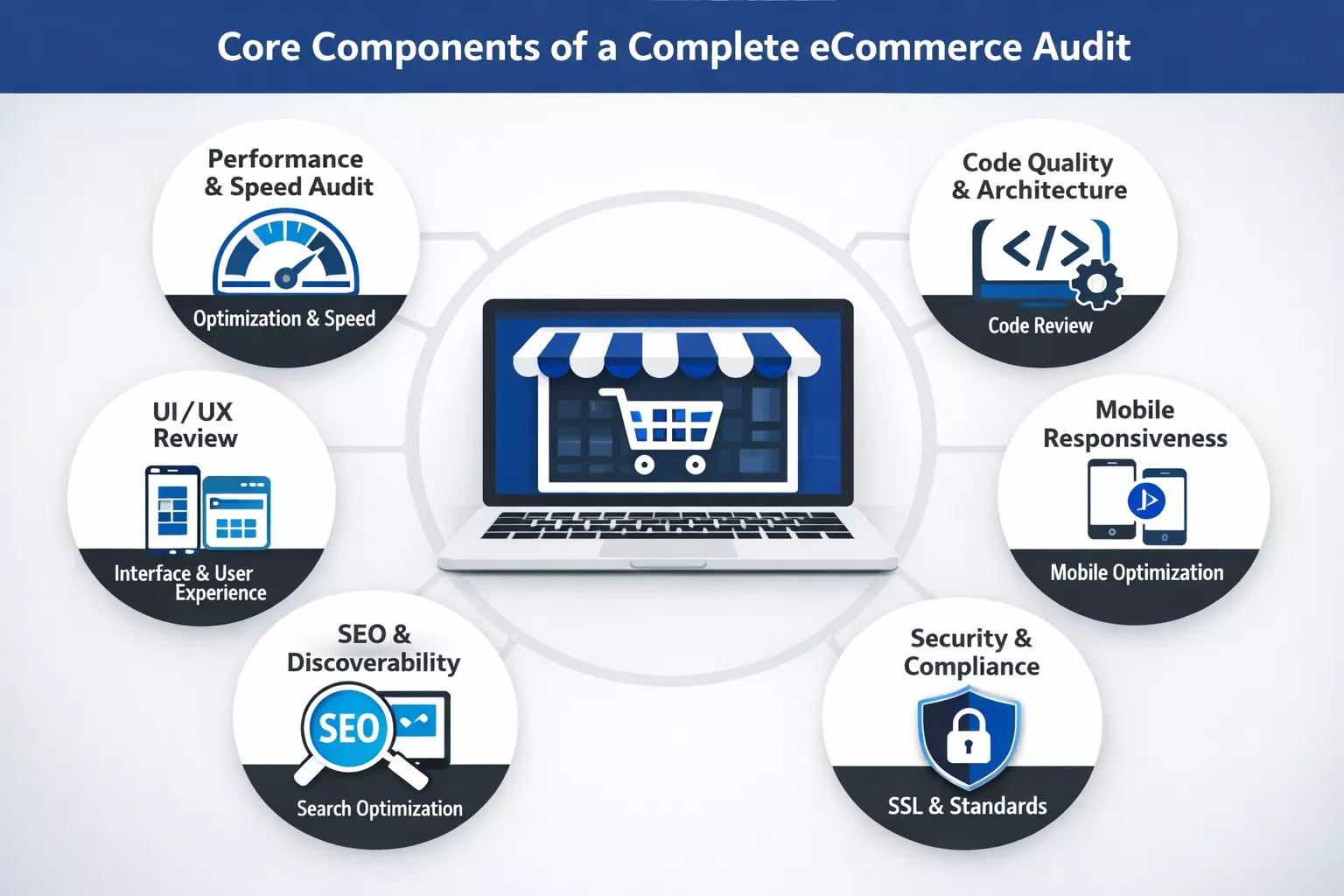
- A comprehensive eCommerce website audit covers code quality, page speed, UI/UX, mobile responsiveness, SEO, and security in a single review.
- A 1-second delay in page load time can reduce conversions by 7%, making performance audits directly tied to revenue.
- 69% of shopping carts are abandoned before checkout many of those losses are preventable with UX fixes identified in a proper audit.
- Stores in competitive markets like California and New York benefit most from regular audits, where even small conversion gains translate to significant revenue.
- Audit-driven improvements typically increase revenue 20–40% in the first year when fixes are prioritized by impact and implemented consistently.
Running an online store without regular audits is like driving with your eyes closed. You may feel fine right now traffic is coming in, orders are processing but hidden technical and UX problems are quietly costing you thousands in lost sales every single day. An eCommerce website audit gives you the full picture: what’s broken, what’s slowing you down, and exactly where customers are dropping off before they buy.
This guide walks through everything a complete eCommerce audit covers from server-side code and database queries to checkout flows and mobile responsiveness. Whether you’re running a WooCommerce store, a Shopify build, or a custom platform, the same principles apply. By the end, you’ll know what to look for, what issues matter most, and how to prioritize fixes that actually move the needle.
What Is an eCommerce Website Audit?
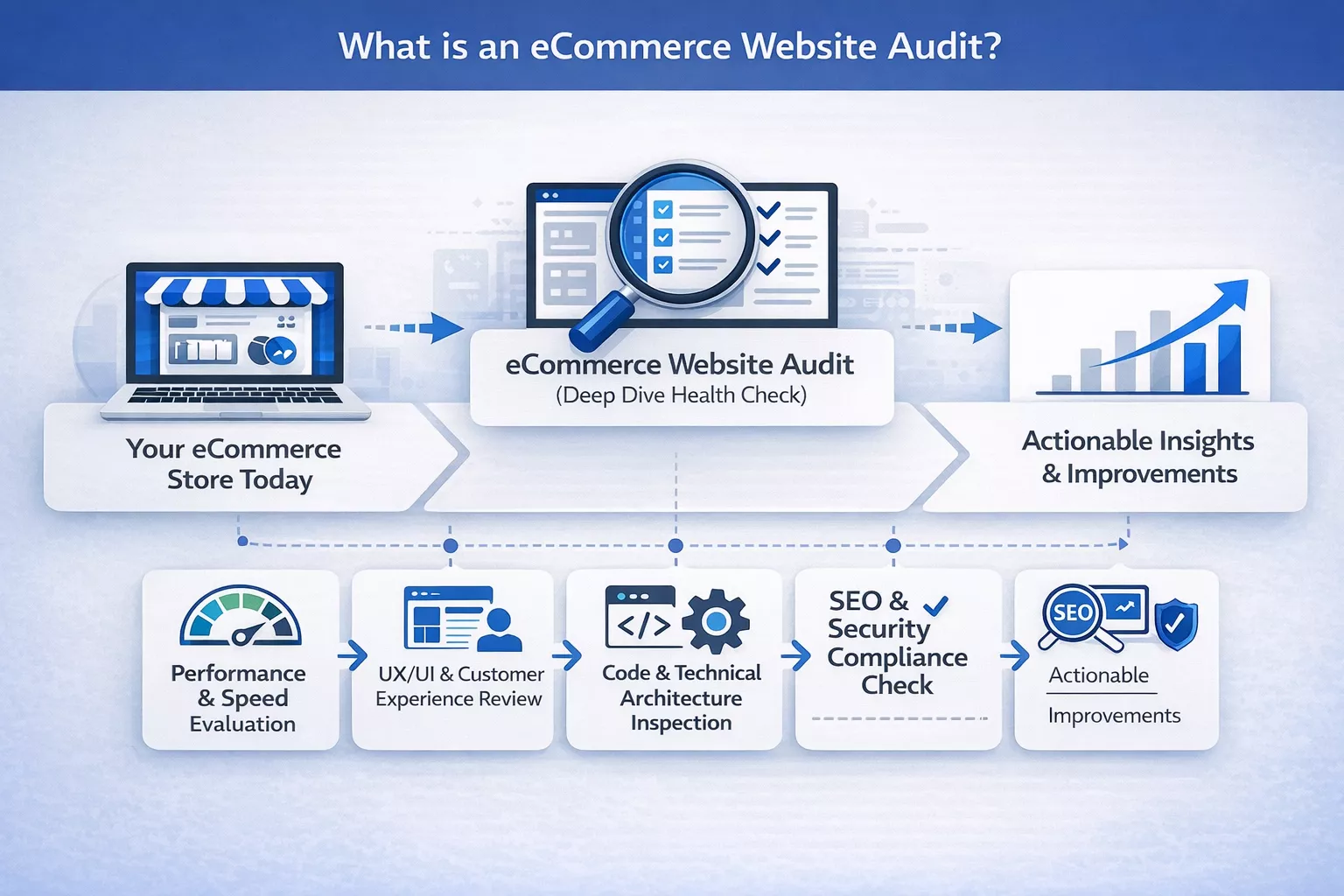
An eCommerce website audit is a structured, comprehensive review of every system that affects your store’s performance, usability, and visibility. Think of it as a health check that goes beyond surface-level symptoms to identify root causes.
Where basic monitoring tells you a page is slow, an audit tells you why it’s slow whether that’s an unoptimized database query, a render-blocking JavaScript file, or an improperly configured CDN. The goal is actionable insight, not just a list of problems.
A thorough audit examines:
- Code quality and technical architecture
- Page load times and site speed across devices
- User interface and customer journey mapping
- Mobile responsiveness and touch usability
- SEO implementation and crawlability
- Security vulnerabilities and patch status
- Checkout functionality and abandonment triggers
Why eCommerce Store Audits Matter for Business Growth
The data on this is clear. According to Portent’s eCommerce research, a 1-second page delay kills 7% of conversions. Speed up from 3 seconds to 1 second, and you can expect 20–30% more conversions. That’s not a minor optimization it’s a fundamental revenue driver.
On the security side, IBM’s Cost of a Data Breach Report shows retail breaches average over $4 million in damages, and research consistently shows the majority of affected customers don’t return after a breach. The reputational damage outlasts the financial one.
Beyond those headline numbers:
- UX improvements fix friction points that cause 15–25% conversion jumps within the first quarter.
- Technical SEO fixes boost organic traffic by 40% within 6 months, according to Backlinko’s eCommerce SEO study.
- Checkout simplification reduces cart abandonment rates, with each extra step increasing abandonment by roughly 10%.
Audits don’t just surface problems. They give you a prioritized roadmap so budget and development time go where the return is highest not toward the most vocal complaints or the shiniest new features.
Core Components of a Complete eCommerce Audit
Technical Performance Analysis
Over 60% of e-commerce traffic now comes from mobile devices, and mobile users have zero patience for slow loads. Sub-2-second load times are the standard, not the aspirational goal. A performance audit covers:
- Page speed testing across homepage, category pages, product pages, and checkout on both desktop and mobile, under real-user conditions, not just lab environments.
- Database optimization identifying slow queries, reviewing index structure, and flagging redundant calls that stack up during high-traffic periods.
- Image optimization unoptimized images are one of the most common conversion killers. The audit checks file sizes, compression, format choices (WebP vs. JPEG vs. PNG), and lazy loading implementation.
- Caching strategy proper browser caching, server-side caching (Redis, Memcached), and CDN configuration can reduce server load by 70–80%.
- Infrastructure review hosting environment, CDN setup, and scalability headroom for traffic spikes.
Code Quality and Architecture Review
Your code is either making you money or costing you money. Clean, well-structured code directly affects page speed, reliability, and the ability to ship new features without breaking existing ones.
A code audit examines:
- Custom code for deprecated functions, inefficiencies, and plugin conflicts
- Platform-specific architecture patterns (WooCommerce hooks, Shopify theme structure, Magento modules)
- Third-party integrations payment gateways, shipping calculators, email tools for bottlenecks and error handling gaps
- API performance slow external API calls delay page loads and frustrate users, who never know why the page feels sluggish
- Render-blocking JavaScript and CSS that delays time-to-interactive
For teams using custom software development, this review also covers build pipeline efficiency, deployment practices, and code maintainability over time.
User Experience and Interface Design
Customer experience drives conversions full stop. The audit maps the entire customer journey and identifies where confusion, friction, or distrust causes drop-off.
Navigation analysis covers menu structure and labeling, search functionality and filters, product categorization logic, breadcrumb navigation, and mobile menu usability. Poor navigation sends customers to competitors.
Shopping cart functionality is audited for add-to-cart button visibility, cart summary clarity, quantity adjustment ease, price transparency, and upsell placement. According to Baymard Institute, 69% of shopping carts are abandoned and many of those are preventable.
Checkout process mapping examines form field complexity, payment option variety, trust signal placement, error message clarity, and mobile checkout optimization. Every unnecessary step increases abandonment by approximately 10%.
Product page design covers image quality and zoom functionality, description completeness, review display, pricing visibility, stock indicators, and related product recommendations all the elements where buying decisions actually happen.

Mobile Responsiveness Testing
Mobile shoppers are unforgiving. Any friction loses the sale immediately. A mobile audit tests touch target sizes, form field usability on small screens, image scaling and quality, horizontal scrolling problems, mobile checkout flow, and mobile payment options. It’s not enough for the site to be technically “responsive” every interaction needs to feel native on a phone.
Security and Compliance Assessment
One security breach can destroy years of customer trust overnight. The security portion of the audit covers:
- SSL certificate validity and configuration
- PCI DSS compliance status for payment processing
- Outdated software versions and unpatched plugins
- Backdoor and malicious code injection scanning
- Data encryption standards for stored and transmitted customer data
- Cookie consent implementation and privacy policy accessibility
For stores built on platforms like WooCommerce, plugin sprawl is a particularly common vulnerability outdated or abandoned plugins are responsible for a significant share of eCommerce security incidents.
Marketing and Conversion Optimization
Traffic without conversions is a vanity metric. The audit examines the full sales funnel traffic source performance, landing page effectiveness, cart abandonment patterns, and post-purchase engagement. Conversion rate optimization (CRO) checks cover CTA placement, value proposition clarity, trust signals and social proof, urgency tactics, and email capture strategies.
Analytics configuration is reviewed in parallel Google Analytics setup accuracy, eCommerce tracking implementation, goal configuration, and attribution model setup. Garbage data leads to garbage decisions.
Search Engine Optimization Audit
Organic traffic is the most cost-efficient acquisition channel available to eCommerce stores but only if the technical foundation supports ranking. The SEO component covers:
Technical SEO: XML sitemap accuracy, robots.txt configuration, canonical tag implementation, structured data markup, site architecture and internal linking, and 404 error identification.
On-page SEO: Title tag optimization, meta description effectiveness, header hierarchy, image alt text, content quality, and keyword targeting strategy.
Content strategy: Product description quality, category page optimization, content gap analysis, and duplicate content issues a surprisingly common problem on stores with large catalogs.
For stores looking to build long-term organic visibility, AI-powered tools are increasingly being used to identify content gaps and automate structured data generation at scale.
Common Issues Found in eCommerce Website Audits
Across hundreds of store audits, the same categories of problems appear again and again. Here’s a practical overview of what typically surfaces and the business impact each carries:
| Issue Category | Common Problem | Business Impact | Priority |
|---|---|---|---|
| Performance | No image optimization | Slow loads, high bounce rate | High |
| Performance | No CDN implementation | Slow international loads | Low |
| Performance | Inefficient caching | Server overload, slow response | Medium |
| UX | Complex checkout (5+ steps) | Up to 68% cart abandonment | Critical |
| UX | Missing mobile optimization | Up to 60% mobile traffic lost | Critical |
| Security | Missing or expired SSL | Trust loss, SEO penalty | Critical |
| Security | Outdated plugins/platform | Up to 95% attack vulnerability | High |
| SEO | Missing meta descriptions | Lower CTR from search | Medium |
| SEO | Duplicate content | Up to 50% ranking penalty | High |
| Code | Render-blocking JavaScript | Slow initial page load | High |
Business impact percentages represent typical ranges observed across multiple audits. Actual results vary by store.
How to Choose the Right eCommerce Audit Provider
Not all audits are equal. A marketing agency audit and a developer-led technical audit produce very different outputs. Here’s what to look for when choosing who conducts yours.
What technical expertise should an audit provider have?
The provider should have hands-on experience with eCommerce platforms not just websites in general. Shopify experts don’t automatically understand WooCommerce architecture, and vice versa. Look for platform-specific credentials and an actual development background. Marketing teams can spot UX issues, but they miss the code-level problems that cause them.
Tools matter too. Industry-standard audit tools include Google Lighthouse for performance analysis, Screaming Frog for comprehensive SEO crawls, GTmetrix for speed testing, and platform-specific debuggers for code-level issues. Providers who don’t mention their toolset are likely doing surface-level work.
What should a quality audit deliverable include?
A solid audit delivers more than a list of problems. Expect a documented process, findings organized by priority and business impact, specific recommendations with implementation guidance, and projected outcomes for key fixes. Vague reports without prioritization leave you no better off than before the audit.
Post-audit support is also worth evaluating. Finding problems is easy fixing them requires development resources. Providers who offer implementation support can help you move from insights to results faster.
Taking Action After Your eCommerce Website Audit
The audit is worthless if it sits in a folder. Prioritization is everything.
Not all issues carry equal weight. When prioritizing, consider three factors: impact (how significantly it affects conversions or revenue), effort (how much time and resources the fix requires), and dependencies (whether other fixes need to happen first). Start with quick wins high impact, low effort improvements to build momentum and demonstrate value early.
For implementation, a sprint-based approach works well for most teams. Two-week development cycles with continuous testing allow quick wins to ship first while longer architectural changes move through a proper QA process. Rushed implementations create new problems. Better to implement fixes correctly than quickly.
Continuous monitoring matters just as much as the initial audit. Key metrics should be tracked monthly, with deeper quarterly reviews and a full annual audit. Technology changes, customer expectations rise, and competition intensifies your store needs to evolve with all of it. Teams working with experienced eCommerce developers can build this kind of ongoing optimization cadence into their product roadmap.
Industry-Specific eCommerce Audit Considerations
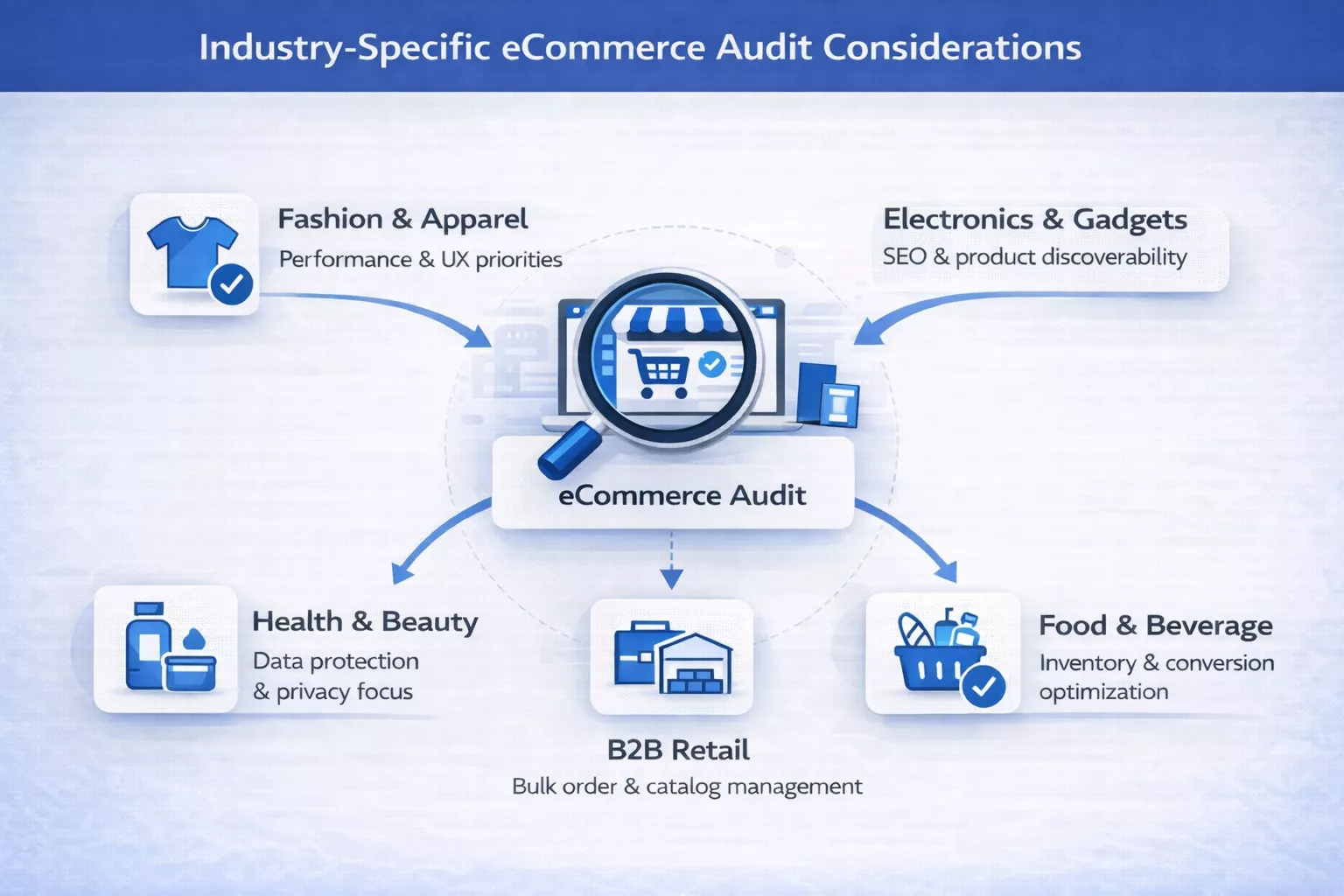
Different product categories have unique requirements that a generic audit may miss. A few examples:
- Fashion and apparel: Size chart accuracy, color variation display, virtual try-on readiness, and return policy clarity are critical audit areas.
- Electronics and tech: Technical specification accuracy, comparison tool functionality, warranty clarity, and review authenticity matter most.
- B2B eCommerce: Quote request workflows, bulk ordering capabilities, custom pricing by account, and ERP integration reliability need specialized focus.
- Health and beauty: Ingredient disclosure, subscription management functionality, and bundle configuration are key audit touchpoints.
- Food and grocery: Freshness tracking, dietary restriction filtering, and delivery time slot management are unique to this category.
Our Perspective
Working with eCommerce teams across industries, the pattern we see most often is this: stores invest heavily in traffic acquisition while under-investing in the technical foundation that turns that traffic into revenue. A paid campaign can bring thousands of visitors to a product page that loads in 4 seconds on mobile, has a confusing add-to-cart flow, and no visible trust signals. That’s an expensive way to generate zero return.
The stores that grow consistently are the ones that treat their technical stack as a product something that gets reviewed, improved, and optimized on a regular cycle. In competitive markets like California and New York, where acquisition costs are high and customer expectations are even higher, even marginal improvements in conversion rate or checkout completion have outsized revenue impact. An audit is the fastest way to find those improvements without guessing.

Conclusion
An eCommerce website audit isn’t a one-time project it’s the foundation of a continuous improvement process. The stores that win long-term are the ones that understand exactly what’s working, fix what’s broken, and make data-driven decisions about where to invest next.
Whether your store is losing customers to slow load times, a confusing checkout, security vulnerabilities, or a poor mobile experience, an audit surfaces the real problems and gives you a prioritized path to fix them. The competitive gap between stores that audit regularly and those that don’t widens every year.
If you’re ready to stop guessing about what’s costing you sales and start making improvements with measurable impact, a comprehensive audit is the right first step. Talk to a specialist to find out what your store’s specific gaps are and what fixing them could mean for your bottom line.
Frequently Asked Questions
What is an eCommerce website audit and what does it include?
An eCommerce website audit is a comprehensive technical and strategic review of your online store. It covers code quality, page speed, database performance, mobile responsiveness, UX and checkout flow, SEO implementation, and security vulnerabilities. The goal is to identify root causes of poor performance or low conversions not just surface symptoms and provide a prioritized list of actionable fixes.
How often should an eCommerce store be audited?
Most eCommerce stores benefit from monthly monitoring of key performance metrics, quarterly deep-dive reviews, and a comprehensive annual audit. Stores that launch major updates, migrate platforms, or experience sudden drops in traffic or conversion rates should conduct an audit immediately outside of that regular schedule. Technology and customer expectations change fast enough that annual reviews alone are rarely sufficient for growing stores.
What are the most common issues found in eCommerce audits?
The most frequently found issues are unoptimized images causing slow load times, overly complex checkout flows with too many steps, missing or expired SSL certificates, outdated plugins with known security vulnerabilities, and duplicate content causing SEO ranking penalties. Mobile UX problems particularly on checkout and product pages are also consistently among the highest-impact issues found across stores of all sizes.
Can an eCommerce audit improve my Google rankings?
Yes. Technical SEO fixes identified in a proper audit such as correcting canonical tags, resolving duplicate content, improving page speed, fixing broken internal links, and implementing structured data markup can meaningfully improve organic search rankings. Research suggests technical SEO improvements can boost organic traffic by 40% or more within six months of implementation.