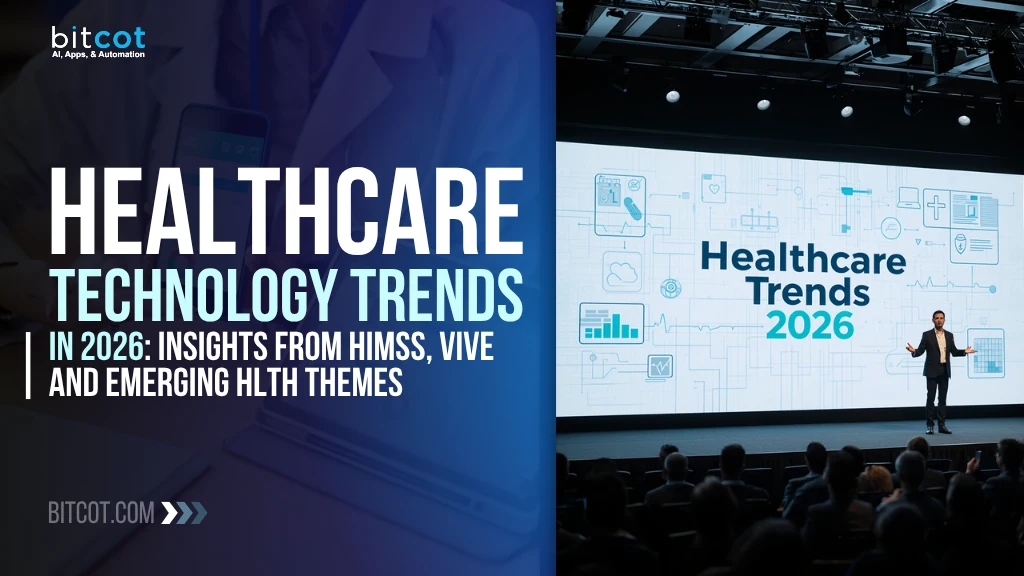
The U.S. healthcare industry is entering a major transformation phase in 2026 – and if you’ve been paying attention to the conversations happening at the industry’s biggest conferences, you already know this shift feels different from previous years.
Across leading healthcare conferences including HIMSS Global Health Conference & Exhibition and ViVE 2026, one message became impossible to ignore: healthcare organizations are moving beyond experimentation and focusing on operational healthcare transformation. What we are witnessing today is actively shaping the future of healthcare technology for years to come.
Hospitals, provider organizations, payers, and healthcare technology leaders are no longer investing in digital tools simply because they are innovative. Healthcare executives are prioritizing technologies that improve operational efficiency, reduce clinician burnout, strengthen interoperability, support compliance, and deliver measurable ROI.
Healthcare AI, workflow automation, interoperability modernization, and enterprise healthcare integrations dominated conversations across healthcare CIO panels, startup showcases, and enterprise technology discussions.
At the same time, rising labor shortages, reimbursement pressures, cybersecurity threats, and growing patient expectations are forcing healthcare systems to modernize faster than ever before.
This shift is reshaping how US healthcare organizations evaluate software vendors, healthcare AI platforms, cloud infrastructure, and digital transformation initiatives.
According to healthcare leadership discussions highlighted throughout 2026 industry events, many provider organizations continue struggling with implementation readiness, interoperability complexity, governance concerns, and operational integration challenges even as healthcare AI investment accelerates.
This growing gap between healthcare AI adoption and enterprise execution readiness became one of the strongest themes across major healthcare conferences in the United States.
In this article, we explore the top healthcare technology trends in 2026 emerging from HIMSS, ViVE, and conversations shaping HLTH 2026 – and what they mean for healthcare organizations navigating digital transformation.

Why 2026 Is a Turning Point for Healthcare Technology
Healthcare organizations spent the past several years testing digital health innovation. Pilot programs launched. Point solutions multiplied. And somewhere along the way, the technology stack got complicated without getting more effective.
In 2026, the focus has changed.
The technology trends in healthcare that are gaining the most traction are not the flashiest – they are the ones solving real operational problems at scale. Understanding the digital health trends 2026 is bringing to the surface helps explain why healthcare organizations are finally moving from strategy decks to actual deployment.
Healthcare leaders are now asking how AI can reduce administrative burden, how hospitals can improve operational efficiency, and which technologies integrate with existing EHR systems. They want to know how organizations can adopt AI securely, which platforms scale across enterprise environments, how providers can reduce clinician burnout, and what technologies genuinely improve patient engagement.
This operational shift was visible across every major healthcare conference in the United States.
Instead of showcasing disconnected innovation pilots, healthcare vendors increasingly focused on workflow automation, AI governance, interoperability, enterprise integrations, AI built with HIPAA guidelines in mind, revenue cycle optimization, cloud modernization, and secure healthcare data infrastructure.
Healthcare CIOs are becoming more selective about technology investments. And honestly, that selectivity is long overdue.
Every piece of new technology in healthcare is now being evaluated against one core question: does it make our operations measurably better? Enterprise buyers now expect faster implementation timelines, measurable ROI, EHR compatibility, scalable cloud infrastructure, secure AI deployment, compliance-ready software, and seamless interoperability.
This is creating new opportunities for healthcare software development partners that understand both healthcare operations and enterprise technology modernization.
Key Conference Signals from HIMSS, ViVE & Emerging HLTH Themes
Across HIMSS, ViVE, and emerging HLTH themes, a common direction is clear: healthcare organizations are moving from AI experimentation to enterprise-wide adoption. As this shift accelerates, priorities like governance, interoperability, security, and operational efficiency are becoming essential foundations rather than optional considerations.
How HIMSS 2026 Put AI Governance and Interoperability Front and Center
According to discussions highlighted at the HIMSS Global Health Conference & Exhibition, enterprise healthcare AI adoption, interoperability modernization, and cybersecurity resilience remain central priorities for healthcare systems in 2026.
The healthcare IT trends surfacing at HIMSS this year made one thing clear: governance and compliance are no longer afterthoughts – they are the foundation that enterprise AI adoption is being built on. Official HIMSS conference themes strongly emphasized AI governance and responsible AI adoption, healthcare cybersecurity, interoperability modernization, digital health transformation, enterprise healthcare infrastructure, and workforce efficiency and clinician experience.
Healthcare organizations are rapidly adopting AI, but CIOs remain concerned about governance, compliance, security, and workflow disruption. That tension – between moving fast and moving safely – defined much of the HIMSS conversation this year.
One of the strongest themes across HIMSS was the growing demand for AI solutions built with HIPAA guidelines in mind that integrate directly into existing clinical and operational systems. Clinical decision support systems, in particular, emerged as a category where governance expectations are highest – because the stakes of a poorly governed AI recommendation in a clinical setting are simply too high.
Healthcare executives increasingly want AI systems that integrate with EHR workflows, support auditability, reduce administrative burden, improve operational efficiency, maintain compliance standards, and protect patient data.
Interoperability also remained one of the most urgent healthcare infrastructure priorities. Healthcare organizations continue to struggle with fragmented systems, disconnected data environments, and legacy healthcare platforms that slow operational efficiency. FHIR APIs, enterprise healthcare integrations, and healthcare data modernization were heavily discussed throughout the conference.
Why Ambient AI and Operational Efficiency Dominated ViVE 2026
Healthcare leaders attending ViVE 2026 focused heavily on operational AI, clinician workflow optimization, and healthcare automation strategies designed to reduce administrative burden and improve enterprise efficiency.
If HIMSS was the governance conversation, ViVE was where the tech innovations in healthcare got put to work. One of the most discussed healthcare technology trends was ambient AI – and for good reason.
Healthcare systems are increasingly deploying AI-powered clinical documentation tools designed to reduce physician burnout and administrative workload. These solutions use natural language processing in healthcare, voice recognition, real-time transcription, AI-generated clinical notes, automated documentation workflows, and EHR-connected AI systems to get there.
The goal is simple: reduce the amount of time physicians spend on documentation and administrative tasks so they can focus on what they trained for – patient care.
Healthcare workforce pressure remains one of the biggest operational concerns across the US healthcare industry. Healthcare organizations continue facing rising administrative burden, staffing shortages, and increasing documentation complexity – all of which are accelerating interest in AI-powered clinical workflows.
Healthcare systems are evaluating ambient AI based on documentation accuracy, EHR integration capabilities, ease of physician adoption, security and compliance standards, and overall workflow compatibility.
Recent healthcare research involving clinicians using ambient AI systems found strong improvements in documentation efficiency and reduced cognitive workload, further accelerating enterprise healthcare interest in AI-powered clinical documentation platforms.
Another important trend from ViVE was the growing demand for healthcare workflow automation. Hospitals and provider organizations are increasingly seeking automation solutions for patient scheduling, prior authorization, revenue cycle management, contact center operations, care coordination technology, patient communication, and administrative workflows.
This signals strong enterprise demand for healthcare automation platforms and AI-powered healthcare operations.
Emerging HLTH 2026 Themes Centered Around ROI, Consolidation, and Enterprise Scalability
As healthcare leaders prepare for HLTH 2026 later this year in Las Vegas, several healthcare tech trends are already shaping enterprise conversations across the industry before the event even opens its doors.
Healthcare executives continue facing growing financial and operational pressure as hospitals modernize infrastructure, improve margins, and scale digital transformation initiatives.
Emerging healthcare investment priorities include enterprise healthcare AI adoption, healthcare workflow automation, revenue cycle optimization, healthcare SaaS scalability, digital health consolidation, patient engagement innovation, healthcare infrastructure modernization, and AI governance and compliance.
Healthcare buyers are becoming more cautious about technology investments. The days of signing a contract based on a slick demo are largely over.
One of the biggest themes emerging ahead of HLTH 2026 is platform consolidation. Healthcare organizations increasingly want fewer vendors that can deliver integrated healthcare ecosystems, enterprise scalability, interoperability support, AI-enabled workflows, secure cloud infrastructure, and end-to-end operational visibility – all under one roof.
This represents a major shift away from disconnected point solutions.
Healthcare executives increasingly prefer technology partners that understand enterprise integrations, healthcare compliance, operational workflows, data interoperability, and healthcare infrastructure modernization.
Investor conversations across the healthcare industry also continue showing strong momentum around AI workflow automation, revenue cycle AI, healthcare analytics platforms, remote patient monitoring, healthcare infrastructure software, provider operations technology, and healthcare SaaS platforms.
Digital health investors are increasingly prioritizing scalable healthcare infrastructure companies over experimental digital health applications. This pivot signals a clear maturity in how the emerging technologies in healthcare industry are being evaluated and funded.
Top Healthcare Technology Trends in 2026
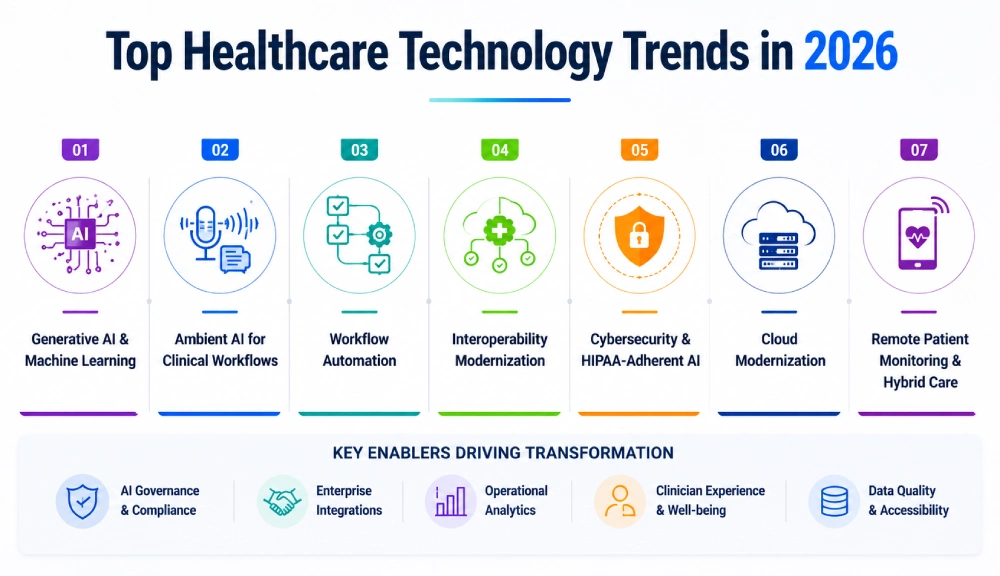
1. Generative AI and Machine Learning in Healthcare Are Moving Into Enterprise Deployment
Generative AI continues to reshape healthcare operations. But the conversation has matured. Healthcare organizations are no longer asking whether to adopt AI – they are asking how to deploy it responsibly at scale.
AI in healthcare 2026 looks very different from the proof-of-concept era. Instead of experimenting with isolated AI pilots, healthcare leaders are focusing on enterprise-wide operational use cases. The most common applications include clinical documentation automation, revenue cycle automation, AI-powered patient communication, prior authorization automation, healthcare contact center AI, predictive analytics in healthcare, clinical AI copilots, and workflow optimization.
Healthcare organizations care about generative AI because it helps reduce operational friction.
Hospitals continue to struggle with staffing shortages, administrative overload, clinician burnout, rising operational costs, and manual workflows. Machine learning in healthcare is increasingly viewed as a way to surface meaningful patterns from complex patient data – improving both clinical decision-making and operational efficiency without adding workforce pressure.
However, healthcare leaders remain cautious about hallucination risk, HIPAA adherence, AI governance, clinical trust, data privacy, and security vulnerabilities. These concerns are not obstacles to adoption – they are the conditions for adoption done right.
Healthcare AI adoption accelerated significantly entering 2026 as hospitals searched for ways to improve operational efficiency. Industry research shows healthcare AI investment continues growing rapidly across revenue cycle management, workflow automation, patient communication, and administrative operations.
Healthcare executives increasingly expect AI initiatives to produce measurable operational ROI rather than isolated innovation outcomes.
This creates strong demand for AI-powered healthcare solutions built by implementation partners who understand both the clinical environment and the compliance requirements. Bitcot builds exactly that – secure, governance-ready healthcare AI solutions that plug into enterprise operations from day one.
2. Ambient AI Is Reducing Clinician Burnout Across US Health Systems
Ambient AI became one of the most discussed emerging healthcare trends in 2026 – and the enthusiasm is backed by real operational pain.
Clinicians continue to spend large portions of their day on documentation and EHR navigation. Studies have shown that physicians spend nearly two hours on administrative tasks for every one hour of direct patient care. That imbalance contributes significantly to physician burnout.
Healthcare organizations are now investing in ambient AI solutions that automate clinical note creation, voice transcription, SOAP notes, EHR documentation, and patient summaries. The goal is to allow clinicians to focus more on patient care and less on administrative work.
Healthcare systems are evaluating ambient AI based on documentation accuracy, EHR integration capabilities, ease of physician adoption, security and compliance, and workflow compatibility.
The rapid growth of ambient AI also creates demand for healthcare integrations, AI workflow implementation, healthcare API development, and enterprise AI deployment.
Bitcot helps healthcare organizations implement ambient AI workflows that connect directly to existing EHR environments – reducing documentation burden while keeping data governance intact.
3. Healthcare Workflow Automation Is Accelerating Across Provider Organizations
Operational efficiency became one of the strongest healthcare technology priorities in 2026. And when you look at what hospitals are actually dealing with every day, it is easy to understand why.
Hospitals and provider organizations continue to face labor shortages, staffing constraints, and administrative inefficiencies. Manual processes that once worked at smaller scale are now breaking under the weight of modern healthcare volume.
As a result, healthcare organizations are rapidly investing in workflow automation technologies. Key use cases include revenue cycle automation, appointment scheduling automation, AI-powered patient intake, claims processing automation, prior authorization automation, care coordination workflows, automated patient engagement, and healthcare contact center automation.
Healthcare executives increasingly want technologies that reduce manual work across enterprise healthcare operations.
This trend is accelerating demand for healthcare workflow automation solutions, intelligent healthcare operations platforms, healthcare SaaS applications, AI-powered healthcare automation, and enterprise healthcare integrations.
Bitcot builds workflow automation solutions tailored to the operational realities of hospitals, provider groups, and payer organizations across America.
4. Healthcare Interoperability Remains a Critical Infrastructure Challenge
Interoperability remains one of the biggest infrastructure challenges in US healthcare – and it has been on the priority list for years without being fully solved.
Many healthcare systems still operate across fragmented technology environments. This creates operational inefficiencies, data silos, and poor patient data management across care teams and facilities.
Healthcare organizations are increasingly investing in FHIR APIs, healthcare API development, EHR integrations, enterprise data platforms, real-time healthcare data exchange, and cloud-based interoperability infrastructure.
Healthcare leaders understand that AI adoption depends heavily on accessible and interoperable healthcare data. You cannot build intelligent workflows on top of disconnected systems.
Despite years of healthcare digitization efforts, many provider organizations still struggle with fragmented healthcare systems, disconnected patient records, and outdated data exchange workflows. Interoperability modernization continues to be one of the highest healthcare infrastructure investment priorities in 2026.
Without modern interoperability infrastructure, healthcare organizations struggle to share patient information efficiently, enable enterprise analytics, scale AI initiatives, improve care coordination, and modernize workflows.
Bitcot helps healthcare organizations modernize interoperability through FHIR-based APIs, EHR integration engineering, and enterprise data infrastructure built for scale.
5. Healthcare Cybersecurity and HIPAA-Adherent AI Are Becoming Mandatory
Healthcare cybersecurity remained a major concern across HIMSS, ViVE, and emerging HLTH discussions. As AI and cloud adoption accelerate, the attack surface for healthcare organizations is growing with it.
Healthcare organizations are especially concerned about ransomware attacks, PHI exposure, AI data leakage, third-party vendor risk, cloud vulnerabilities, shadow AI usage, and identity access management.
Healthcare executives increasingly expect vendors to provide infrastructure built with HIPAA guidelines in mind, secure healthcare cloud architecture, encryption and access controls, AI governance frameworks, audit logs and monitoring, and enterprise-grade security practices.
Security is no longer a secondary requirement. It is now a core healthcare buying priority – and rightfully so.
Healthcare organizations are increasingly cautious about deploying AI systems without proper governance frameworks, auditability, compliance oversight, and enterprise security controls.
Bitcot builds healthcare technology that adheres strictly to HIPAA regulations – with security, access controls, and audit infrastructure built into the architecture from the start.
6. Healthcare Cloud Modernization Continues to Grow
Many healthcare organizations still rely on outdated legacy systems. These systems often limit scalability, interoperability, analytics capabilities, AI adoption, and operational agility – essentially creating a ceiling on how far digital transformation can go.
Healthcare organizations are increasingly modernizing infrastructure through cloud migration, hybrid cloud strategies, healthcare data modernization, API-driven architecture, and enterprise platform modernization.
Cloud modernization supports better interoperability, faster innovation, scalable healthcare applications, AI integration, improved disaster recovery, and enterprise analytics.
The rise of emerging healthcare technology in cloud environments is pushing CIOs to rethink their infrastructure strategies entirely – not just upgrade what they have, but rebuild with future scalability in mind.
Healthcare CIOs increasingly prioritize cloud-ready healthcare technology partners that understand compliance, scalability, and integration complexity. Bitcot’s cloud solutions practice is built specifically around these requirements.
7. Remote Patient Monitoring, Telehealth, and Hybrid Care Models Are Expanding
Remote patient monitoring continues to gain momentum across US healthcare. What started as a pandemic-era workaround has become a genuine care delivery strategy, and the new emerging technology in healthcare powering it is becoming increasingly sophisticated.
Telehealth trends 2026 reflect a broader shift toward hybrid care models that combine virtual and in-person delivery – with population health management technology playing a growing role in keeping at-risk patients connected between visits.
Healthcare organizations are increasingly investing in RPM technologies to support chronic disease management, post-acute care, population health initiatives, hospital-at-home programs, and preventive care strategies.
Healthcare systems are also focusing on hybrid care delivery models that combine virtual and in-person care.
This creates growing demand for healthcare mobile app development, patient engagement platforms, healthcare IoT integrations, wearable health technology integrations, remote monitoring infrastructure, and secure healthcare communication systems.
Healthcare organizations increasingly want patient-facing digital experiences that improve accessibility and engagement. Bitcot builds RPM and hybrid care platforms designed for clinical usability and enterprise security.
What Healthcare CIOs Are Prioritizing in 2026
Healthcare CIO priorities became much clearer across major healthcare conferences. The focus is no longer on innovation alone – it is on innovation that actually solves operational problems.
Understanding the medical technology trends driving procurement decisions helps explain exactly why CIO buying behavior has shifted so dramatically this year. Value-based care technology is a strong example of this – as reimbursement models continue shifting toward outcomes over volume, CIOs are investing in platforms that can demonstrate patient impact and financial performance simultaneously.
Here is how those priorities break down:
| Priority | Why It Matters |
| Clinician burnout reduction | Workforce retention and efficiency |
| Workflow automation | Operational productivity |
| AI governance | Risk and compliance management |
| Healthcare cybersecurity | Data protection and resilience |
| Interoperability | Data accessibility and care coordination |
| Cloud modernization | Infrastructure scalability |
| Revenue cycle optimization | Financial performance |
| Enterprise integrations | Platform consolidation |
| Compliance readiness | Regulatory alignment |
| Operational analytics | Better decision-making |
Healthcare organizations increasingly evaluate technology vendors based on integration capabilities, security standards, healthcare expertise, implementation speed, scalability, operational ROI, and long-term partnership potential.
This creates strong opportunities for healthcare technology companies that understand enterprise healthcare operations – not just the technology side, but the clinical and operational realities that come with it.
Enterprise Healthcare Buying Signals in 2026
Several important healthcare buying signals emerged from HIMSS, ViVE, and industry conversations leading into HLTH 2026. Taken together, they paint a clear picture of where enterprise healthcare procurement is heading.
Healthcare Buyers Want Fewer Vendors
Hospitals increasingly prefer integrated healthcare ecosystems over disconnected point solutions.
Healthcare organizations want technology partners capable of supporting enterprise integrations, AI implementation, workflow modernization, cloud migration, interoperability, and long-term scalability – all under one roof. The era of managing twelve different vendors for twelve different problems is losing its appeal fast.
Operational ROI Is Driving Procurement
Healthcare executives increasingly expect measurable outcomes from technology investments.
Healthcare organizations want solutions that reduce manual work, improve productivity, lower operational costs, accelerate workflows, and improve patient experiences. Pilot-stage promises no longer move procurement committees.
Security and Compliance Are Mandatory
Healthcare organizations are becoming more selective about technology vendors.
Vendors without strong healthcare compliance and security expertise may struggle to win enterprise healthcare contracts. This is not a differentiator anymore – it is table stakes.
EHR Compatibility Is Critical
Healthcare systems increasingly prefer technologies that integrate directly with existing EHR workflows.
Integration complexity remains one of the largest barriers to healthcare technology adoption. The best solution on paper fails in practice if it cannot connect to the systems already in use.

What These Trends Mean for Healthcare Organizations
Healthcare organizations entering 2026 face increasing operational pressure. There is no clean way to say it – hospitals and provider systems must modernize technology infrastructure while balancing financial constraints, workforce shortages, compliance requirements, cybersecurity risks, and patient expectations simultaneously.
For those trying to make sense of the best healthcare technology trends and innovations this year, the signal is consistent across every major conference and every major buyer conversation: operational transformation is the priority, and the window to act strategically is now.
Understanding healthcare digital transformation trends at this level of depth matters because the organizations investing thoughtfully today are setting the foundation for how care gets delivered over the next decade – not just the next budget cycle.
The healthcare organizations that succeed will likely focus on workflow automation, secure AI adoption, interoperability modernization, enterprise integrations, cloud modernization, and patient engagement technologies.
Healthcare technology decisions are increasingly tied to long-term operational transformation. A bad technology decision today does not just create a short-term problem – it creates technical debt that compounds over time.
This means healthcare organizations need strategic technology partners that understand healthcare operations, enterprise infrastructure, compliance requirements, integration complexity, AI implementation, and scalability challenges.
Modernize Healthcare Operations with Secure Digital Transformation
Healthcare organizations need technology partners that understand interoperability, compliance, AI governance, workflow automation, and enterprise healthcare integrations.
As a healthcare software development company with senior-only engineers and an architecture-first delivery model, Bitcot helps healthcare providers modernize operations through secure, scalable, and HIPAA-adherent healthcare technology solutions.
Bitcot helps healthcare organizations build and modernize:
- HIPAA-adherent healthcare applications and AI solutions
- Enterprise healthcare software and SaaS platforms
- FHIR interoperability solutions and healthcare cloud infrastructure
- Healthcare mobile applications and patient engagement tools
- Workflow automation systems and enterprise integrations
By combining healthcare software development expertise with enterprise integration and AI implementation capabilities, healthcare organizations can modernize operations while maintaining security and compliance.
Talk to our team to explore what secure healthcare digital transformation looks like for your organization.
Final Thoughts
Healthcare AI adoption is shifting from isolated innovation pilots toward enterprise workflow transformation. That shift is not happening in the future – it is happening now, and the organizations moving deliberately are already pulling ahead.
The healthcare organizations that succeed in 2026 will likely prioritize operational AI, interoperability modernization, secure cloud infrastructure, and workflow automation over disconnected experimental technologies.
Enterprise healthcare buyers increasingly want scalable healthcare ecosystems capable of improving operational efficiency while maintaining compliance, security, and long-term flexibility.
The healthcare technology trends emerging from HIMSS, ViVE, and conversations shaping HLTH 2026 reveal a major shift in healthcare digital transformation priorities. Healthcare organizations are moving beyond innovation hype and focusing on technologies that improve operational performance. The latest healthcare innovations making the biggest impact are not always the newest – they are the ones that integrate cleanly, scale reliably, and deliver measurable outcomes.
The strongest healthcare technology investments in 2026 are centered around AI-powered workflow automation, interoperability modernization, AI built adhering strictly to HIPAA regulations, enterprise healthcare integrations, cloud modernization, operational efficiency, patient engagement, and healthcare cybersecurity.
Healthcare executives increasingly expect technology partners to deliver operational ROI, enterprise scalability, security and compliance, workflow integration, and long-term modernization support.
As healthcare systems continue modernizing infrastructure and adopting AI-powered operations, the future of healthcare technology will be defined not by the sophistication of the tools – but by how well those tools integrate into the people, processes, and workflows that healthcare runs on every day.
Organizations that invest strategically in healthcare digital transformation today will be better positioned to improve efficiency, enhance patient experiences, and navigate the evolving healthcare landscape in 2026 and beyond.
Frequently Asked Questions (FAQs)
What are the top healthcare technology trends in 2026?
The top healthcare technology trends in 2026 include generative AI in healthcare, ambient AI, healthcare workflow automation, interoperability modernization, HIPAA-adherent AI, healthcare cybersecurity, cloud modernization, remote patient monitoring, and enterprise healthcare integrations.
Why are hospitals investing in healthcare AI?
Hospitals are investing in healthcare AI to reduce clinician burnout, improve operational efficiency, automate administrative tasks, optimize revenue cycle management, and enhance patient engagement.
What is ambient AI in healthcare?
Ambient AI in healthcare refers to AI-powered systems that automate clinical documentation using natural language processing, voice recognition, transcription, and real-time note generation integrated with EHR workflows.
Why is interoperability important in healthcare?
Healthcare interoperability allows different healthcare systems and applications to securely exchange patient information, improve care coordination, support analytics, and enable scalable AI implementation.
What do healthcare CIOs prioritize in 2026?
Healthcare CIOs are prioritizing workflow automation, AI governance, interoperability, cybersecurity, cloud modernization, clinician burnout reduction, enterprise integrations, and operational efficiency.
What challenges exist in healthcare AI adoption?
Major healthcare AI challenges include HIPAA compliance, hallucination risk, physician trust, workflow integration complexity, security concerns, and governance requirements.
How does healthcare cloud modernization help providers?
Healthcare cloud modernization improves scalability, interoperability, analytics capabilities, disaster recovery, AI readiness, and operational flexibility for healthcare organizations.
What should healthcare organizations look for in a healthcare technology partner?
Healthcare organizations should look for healthcare expertise, compliance knowledge, interoperability capabilities, enterprise integration experience, secure AI implementation, and scalable software development services.
How is machine learning being used in healthcare in 2026?
Machine learning in healthcare is being applied to predictive analytics, revenue cycle optimization, clinical decision support, patient risk stratification, and operational workflow automation – helping providers improve both clinical outcomes and financial performance.
What is the role of telehealth in 2026 healthcare delivery?
Telehealth trends in 2026 reflect a shift toward permanent hybrid care models that combine remote monitoring, virtual visits, and in-person care – supported by wearable health technology, mobile apps, and secure communication infrastructure.