Key Takeaways
- AI-native architecture: Next-gen healthcare apps build validation, audit, and security around AI from day one, not as an afterthought bolted on before launch.
- 3 new security requirements: PHI output filtering, prompt injection blocking, and immutable versioning of AI-generated clinical content are non-negotiable in 2026 builds.
- 93% physician adoption: Up from 31% in 2016 (AMA, 2022), AI infrastructure is now a clinical expectation, meaning the architecture that supports it must be production-grade from the first sprint.
- California leads in 2026: San Diego, LA, and SF are at the forefront of ambient AI documentation and agentic clinical workflows, setting the engineering bar for the rest of the country.
- HIPAA as the baseline: The Security Rule’s four Technical Safeguard categories access, audit, integrity, and transmission security map directly onto the architecture decisions every AI-native healthcare application must get right.
Introduction
Early AI in healthcare was additive: a decision support widget here, a risk flag there, a chatbot grafted onto the patient portal. The architecture was an afterthought, and clinicians noticed. The tools worked in demos but not in practice.
Next-gen AI healthcare applications are built differently. The data model, access controls, and security architecture are designed around AI from day one, not bolted on later. According to the American Medical Association’s Digital Health Research, physician adoption of digital health tools jumped from 31% to 93% between 2016 and 2022, making seamless AI integration the baseline clinical expectation in San Diego, Los Angeles, and across the country.
This guide breaks down what separates next-gen AI healthcare apps from their predecessors and how generative AI is reshaping clinical workflows in 2026. It covers what HIPAA-guided architecture actually requires, built for teams ready to move beyond the first generation.
How Is AI Transforming Healthcare Mobile Apps in 2026?
AI is transforming healthcare mobile applications in 2026 by shifting them from passive record interfaces to active clinical participants. The previous generation presented data: lab results, medication lists, and appointment schedules. The current generation acts on data, surfacing predictions, drafting documentation, flagging anomalies, and recommending pathways before a clinician has to ask.
This shift changes not just what the app does but how the entire system must be built, validated, and secured. Development teams that treat these capabilities as dashboard features rather than inference pipelines with their own security perimeters are making a category error that produces clinical risk rather than clinical value.
From Displaying Data to Generating Insights at the Point of Care
Clinical decision support delivered through mobile applications has matured from static rule-based alerts to dynamic, context-sensitive AI recommendations. A mobile app integrated with a hospital’s EHR can now surface a sepsis risk score for every patient on the unit, updated continuously as new vitals arrive, ranked by urgency, and linked to the clinical evidence that generated the recommendation.
This is not a display feature. It is an AI inference pipeline running against live patient data, requiring its own validation, its own audit trail, and its own security perimeter within the application.
Ambient AI Reducing Documentation Burden
Ambient AI documentation is the highest-adoption AI category in clinical settings in 2026. These systems listen to patient-physician conversations and generate structured clinical notes automatically. According to research published in the Journal of the American Medical Informatics Association, administrative documentation consumes close to two hours of after-hours work per physician per day, making it the most targeted workflow for AI-assisted relief.
The development challenge is significant: ambient AI processes the most sensitive clinical conversation that exists, the in-room encounter between a patient and their physician. It must do so with session isolation that prevents one patient’s conversation from influencing another’s generated notes, and with output filtering that catches any PHI from a previous session that a language model might surface through context bleed.
Remote Patient Monitoring with Predictive Intelligence
Remote patient monitoring applications in 2026 are not threshold alert systems. They are continuous inference engines that analyze trend patterns in biometric streams, including heart rate variability, blood oxygen, activity patterns, sleep cycles, and medication adherence signals, to predict deterioration before it becomes an acute event.
For high-risk chronic disease patients managed by health systems in San Diego, Los Angeles, and Sacramento, these applications reduce emergency admissions by catching deterioration signals days before the patient would have presented to urgent care. The mobile application layer carries the clinical interface and alert delivery; the AI layer runs server-side against a continuous stream of encrypted device data.
AI-Powered Patient Engagement That Personalizes to the Individual
Patient engagement applications in 2026 use AI to move beyond generic health education toward personalized care plan coaching calibrated to the individual patient’s condition, history, and behavior patterns. A patient with Type 2 diabetes and documented medication non-adherence receives different nudges, different educational content, and different appointment reminders than a patient with the same diagnosis who is adherent.
The AI layer builds a behavioral model for each patient and adjusts the communication strategy continuously. This capability is a significant differentiator for healthcare organizations in San Francisco and Irvine competing for patient engagement in a market where patients have multiple care options and digital expectations shaped by consumer technology.
What Makes a Healthcare App “Next-Gen”? The AI-Native Architecture Difference
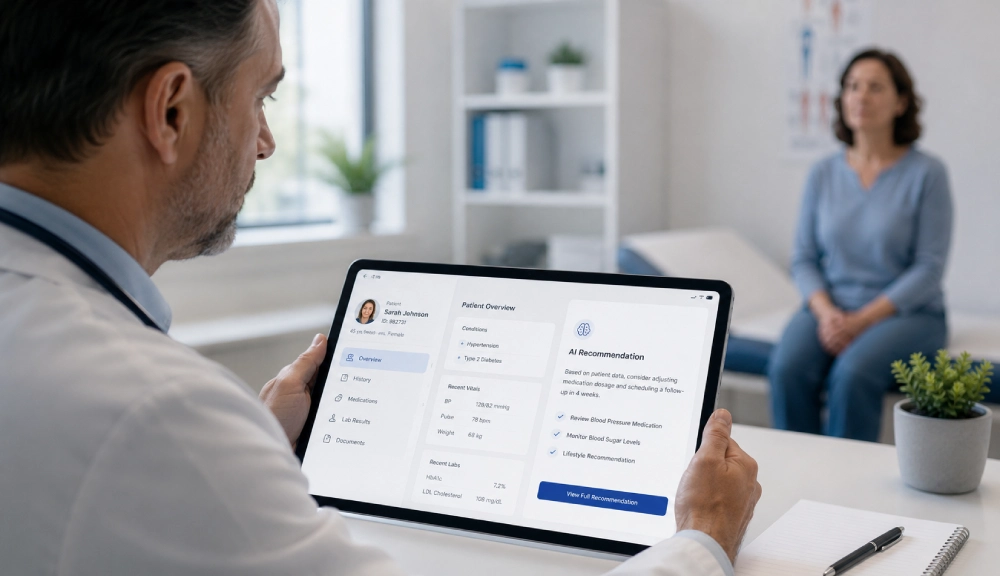
The concrete distinction that actually separates next-gen AI healthcare applications from retrofitted first-gen ones is architectural: was the application designed with AI as a foundational system component, or was AI added to an application that was built without it?
AI-Added vs. AI-Native: The Practical Difference
An AI-added healthcare application has a traditional software architecture with an AI feature integrated through an SDK or API call. The database schema was not designed with AI training in mind, the audit logging was not designed to capture model inference events, and the access control system was not designed around AI-specific data flows.
The result is an application where the AI feature works functionally but creates gaps: patient data that should be inaccessible to the AI model is accessible through the integration layer, and audit logs capture user interactions but not model behavior. The application cannot demonstrate after the fact what the AI produced and on what data.
An AI-native healthcare application is designed from the first sprint with AI as a first-class component. The database schema includes partition boundaries optimized for AI training data isolation, the audit logging system captures model inference requests and outputs as first-class audit events, and the access control matrix explicitly defines which AI components can access which patient data categories and under what conditions. HIPAA-guided security design, applied from day one, produces this architecture naturally because the four Technical Safeguards that the Security Rule defines map directly onto the architecture decisions that AI-native development requires.
Model Governance as a Core Application Function
Next-gen AI healthcare applications treat model governance as a core application function, not as an operational afterthought. Every model deployed to a production clinical environment has a documented validation dataset, performance benchmarks against defined clinical outcomes, a rollback mechanism, and continuous drift monitoring.
When a sepsis prediction model’s performance drops below a defined threshold because the patient population has shifted, the application detects it and alerts the responsible clinical team. The development process includes a defined path for retraining and revalidating the model before its predictions continue to influence clinical decisions. First-gen applications with AI modules do not have this; next-gen AI healthcare applications treat it as a standard operational requirement.
Generative AI in Healthcare Apps: What It Does and What It Demands from Security Design
Generative AI in healthcare apps represents the most significant capability expansion in healthcare technology since EHR digitization, and the most significant security design challenge since the shift to cloud infrastructure. Large language models integrated into clinical workflows can draft documentation, synthesize records, automate administrative processes, and support diagnostic reasoning in ways that were not technically feasible three years ago.
Each of these capabilities introduces specific security requirements that applications without generative AI do not face.
Clinical Note Generation and Documentation Automation
Generative AI clinical note generation extracts structured clinical information from unstructured sources including physician dictation, ambient conversation transcripts, and prior notes, then produces SOAP-format documentation suitable for EHR entry. The development challenge specific to this feature: the language model’s context window can retain fragments of previous inputs, and a poorly isolated implementation can surface details from a prior patient’s encounter in the current patient’s generated note.
Session isolation at the model serving layer, combined with input sanitization and output review before EHR write, is the minimum architecture for this feature. Building ambient documentation features confirms that the session isolation layer consistently requires more careful design than the note generation model itself.
Prior Authorization Automation
Generative AI can analyze a patient’s clinical record, match it against payer coverage criteria, and draft a prior authorization submission automatically, reducing a workflow that previously took days of back-and-forth to hours. The security requirement specific to this feature: the AI system is making API calls to external payer systems that carry protected health information.
Each payer integration requires its own access control scope, its own audit configuration, and its own output review to confirm that the AI-generated submission does not include clinical details outside the scope of the specific authorization request. The generative AI integration architecture for prior authorization is not a general LLM call. It is a scoped, audited, output-filtered workflow with strict data minimization at every step.
Diagnostic Reasoning Support
Multimodal generative AI systems that synthesize findings from medical imaging, clinical notes, lab results, and vital sign trends to support diagnostic reasoning are moving from research settings into production clinical applications in 2026. These systems do not diagnose: they surface evidence and pattern matches that a physician evaluates and acts upon.
The development requirement specific to this feature: the AI’s output must be clearly attributed as AI-generated reasoning support, not as a clinical conclusion. That attribution must be preserved in the audit record alongside the model version and the data sources that informed the output. This is a patient safety requirement and a record integrity requirement that HIPAA-guided integrity controls are designed to enforce.
Conversational Patient Interfaces
Healthcare chatbots and AI assistants that handle appointment scheduling, symptom triage, medication questions, and care plan guidance are in active deployment across health systems in San Jose, Irvine, and Long Beach. The security challenge unique to conversational interfaces is prompt injection: a patient input that embeds instructions designed to override the model’s intended behavior can cause it to retrieve or summarize records it was not authorized to access.
This vulnerability does not exist in traditional healthcare software because there is no language model to manipulate. HIPAA-guided access controls, applied to the AI layer specifically, combined with input validation that detects and blocks injection patterns before they reach the model, is the required security architecture for any patient-facing conversational AI feature.

Advanced Healthcare App Development Trends Shaping 2026
The advanced healthcare app development trends that matter in 2026 are not incremental feature additions to existing categories. They are architectural shifts that change what a healthcare application is and how it must be built. Development teams and healthcare organizations that treat these trends as optional upgrades rather than foundational transitions will find themselves building to a prior generation’s standard.
Federated Learning for Privacy-Preserving AI Training
Federated learning allows AI models to be trained across multiple healthcare organizations or facilities without centralizing patient data. Each facility trains the model on its local data, shares only the model weight updates rather than the patient records, and the central system aggregates the updates into an improved shared model.
For AI/ML development in healthcare, federated learning addresses the single most consistent obstacle to building high-performing clinical AI: the tension between needing diverse training data and the legal and ethical constraints that prevent centralizing patient records across organizations. Health systems in San Francisco and Sacramento are participating in federated learning consortia for rare disease modeling and population health prediction that would be impossible under centralized data architectures.
Agentic AI in Clinical and Administrative Workflows
Agentic AI systems that can navigate multi-step workflows autonomously, querying EHR records, generating documentation, submitting to external systems, and updating care plans without a human initiating each step, are entering clinical and administrative use in 2026. The security design requirement for agentic AI is significantly more demanding than for single-inference AI features.
An agentic system that has write access to EHR records and can submit to external payer systems must have every action logged, attributed to a specific task session, and reversible within a defined window. The access control model for an agentic AI component must be scoped to the minimum permissions required for the specific workflow it executes, re-evaluated for each task initiation, and revoked automatically when the task completes. Building this correctly requires treating the AI agent as a distinct principal in the access control model, not as an extension of the human user who initiated the workflow.
Multimodal Clinical AI Models
Multimodal AI models that process and reason across multiple data types simultaneously, including medical imaging, clinical notes, lab results, genomic data, and vital sign streams, are moving from academic research into production healthcare applications. A cardiologist reviewing a patient can receive an AI-synthesized summary that combines echocardiogram findings, recent troponin trends, current medication list interactions, and comparable patient outcomes, presented as a structured clinical brief rather than a series of separate data views.
The telemedicine software development platforms being built for remote cardiology consultations in 2026 are integrating multimodal AI precisely because asynchronous remote review requires the AI to surface what a specialist would look for in person, before the synchronous consultation happens.
AI-to-AI Workflows and Interoperability
The most advanced healthcare organizations in 2026 are building workflows where AI features trigger other AI features without human intervention at each step. An ambient documentation model generates a clinical note draft, which triggers a coding AI that assigns ICD-10 codes, which triggers a prior authorization AI that matches codes against payer criteria and drafts a submission, all within seconds of the patient encounter ending.
Each handoff in this pipeline carries patient data between AI components, and each handoff requires its own access scope, its own audit event, and its own output validation. Building these pipelines correctly requires the same architectural discipline as building any distributed system with strict data isolation requirements: define the data contract at each interface before building either side of it. The healthcare automation solutions built on this pattern are where the most meaningful efficiency gains are concentrated in 2026.

How HIPAA-Guided Security Design Shapes AI-Native Healthcare Applications
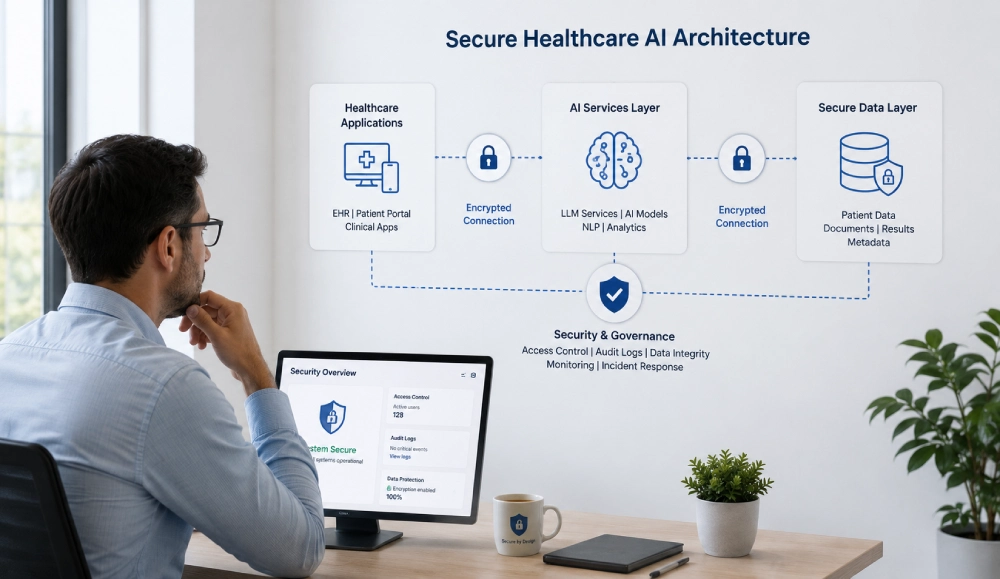
HIPAA-guided security design is not a certification path. It is a set of four technical requirements defined in the HIPAA Security Rule’s Technical Safeguards standard that represent the responsible minimum architecture for any application handling patient health information. For next-gen AI healthcare applications, these four requirements map directly onto the security challenges that AI-native architectures introduce. Building with HIPAA-guided design as the baseline produces an application whose security architecture is grounded in the most widely recognized technical standard for healthcare data protection.
Access Controls Built for AI Components, Not Just Human Users
Traditional access control systems were designed for human users with defined roles. Next-gen AI healthcare applications require access controls extended to AI components as distinct principals. A generative AI feature that drafts prior authorization submissions needs read access to the patient’s diagnosis codes and procedure history, but not to their mental health records, substance use history, or social determinants data.
Defining that scope at the AI component level, enforcing it at the API layer, and logging every access event with model identity and task context is what HIPAA-guided access control requires when the subject making the access request is an AI agent, not a human clinician. According to HHS guidance on the HIPAA Security Rule, unique user identification and minimum necessary access apply to all entities accessing electronic protected health information, a category that explicitly includes AI components in any production healthcare application.
Audit Controls That Capture AI Behavior, Not Just User Actions
HIPAA-guided audit controls in an AI healthcare application must capture more than who accessed what record and when. They must capture what the AI produced, from what input, using which model version, and at what timestamp. This level of audit granularity is not optional for clinical AI.
When a physician acts on an AI-generated risk score or accepts an AI-drafted clinical note, the audit record must reconstruct exactly what the AI produced so that the basis for the clinical decision can be reviewed if the outcome is questioned later. Append-only audit storage with cryptographic integrity verification, covering AI inference events as first-class audit records, is what this requirement produces in a production system. The AI agents for EHR systems that perform best in production are those where this audit layer was architected before the first model was integrated.
Integrity Controls for AI-Generated Clinical Content
The HIPAA Security Rule’s integrity requirement protects electronic protected health information from improper alteration or destruction. Applied to AI-generated content, this requirement works in a way the original regulation did not anticipate. A clinical note drafted by an ambient AI system and then edited by the attending physician must preserve both the original AI-generated version and the physician-modified version as distinct, immutable records.
The final note in the EHR should carry attribution to both the AI generation event and the physician review. This is a patient safety requirement as much as a security one: if a clinical outcome is questioned, the ability to reconstruct what the AI produced versus what the physician decided is essential to understanding the decision chain. According to NIST SP 800-53 Rev. 5, information integrity controls in systems handling sensitive data should include mechanisms for detecting and documenting alterations, a standard that next-gen AI healthcare applications must apply to AI-generated clinical content specifically.
Transmission Security Across AI Inference Pipelines
The HIPAA Security Rule’s transmission security requirement covers every channel over which electronic protected health information travels, and in 2026 AI healthcare applications that channel extends far beyond the user-facing API. Patient data moves between multiple AI components, external model inference endpoints, and third-party payer or reference data systems. Every transmission in this pipeline requires TLS 1.3 encryption regardless of whether it is user-facing.
An internal API call from a clinical decision support service to a model inference endpoint carries patient context in the request body and must be encrypted and authenticated as rigorously as the user-facing API. For mobile healthcare applications serving patients in San Diego and Los Angeles on consumer internet connections, certificate pinning prevents interception even when the patient’s network is outside any infrastructure the development team controls.
What We’ve Seen Across AI Healthcare Builds in California
The shift from first-gen to next-gen AI healthcare applications is visible in the discovery conversation before a single line of code is written. First-gen projects start with a feature list: “We want AI-powered clinical decision support, an ambient documentation tool, and a patient engagement chatbot.” Next-gen projects start with a different set of questions: “What patient data does each AI feature need access to, and can we scope that access without compromising clinical usefulness? How do we version-control model outputs that become part of the patient record?”
Across software development in San Diego and Los Angeles healthcare engagements, the consistent pattern in next-gen builds that succeed is this: teams that adopt HIPAA-guided security design as an architecture input rather than a compliance checkpoint build faster in the development phase. The access control matrix is designed before the API. The audit logging schema is designed before the database. The AI component scope is defined before the model is trained.
That sequence produces a system where the AI and the security architecture reinforce each other, rather than a system where the engineering team spends the final sprints trying to constrain AI behavior that was built without constraints in mind. The AI-native app development approach is not more complicated than the alternative. It is more deliberately designed.

Conclusion
AI-powered healthcare solutions in 2026 are not defined by which AI features they include. They are defined by how the application was architected to support, validate, and secure AI behavior at every layer. Generative AI in healthcare apps, ambient documentation, agentic clinical workflows, and multimodal diagnostic models are all technically accessible. The differentiating question is whether the organization building the application treats AI as a first-class architectural component from day one, with HIPAA-guided security design as the baseline that structures every data model, API scope, and audit requirement around it.
For healthcare organizations in California and across the United States evaluating or building next-gen AI healthcare applications, the decision that matters most is not which AI features to include. It is whether the development partner builds an AI-native application from the foundation or adds AI on top of an existing structure. That distinction separates applications that deliver sustained clinical value from applications that require expensive remediation before they can operate reliably in a production clinical environment.
Frequently Asked Questions
What are AI healthcare applications?
AI healthcare applications are software systems that use machine learning, generative AI, and agentic AI to support clinical decision-making, automate administrative workflows, and surface insights from healthcare data. Next-gen versions are built AI-native, meaning the data model, access controls, and security architecture are designed around AI from day one, not added as an afterthought.
What is the difference between first-gen and next-gen AI in healthcare apps?
First-gen AI was bolted onto existing application architecture, creating gaps in access control, audit coverage, and model validation. Next-gen AI healthcare applications are built AI-native from the first sprint, with integrity controls for AI-generated content, AI components treated as distinct access control principals, and continuous drift monitoring built into the architecture.
How is generative AI transforming healthcare mobile apps in 2026?
Generative AI is reshaping four core workflows: ambient clinical documentation, prior authorization automation, diagnostic reasoning support, and patient-facing conversational interfaces. Each introduces security requirements beyond standard healthcare software, including session isolation, PHI output filtering, prompt injection blocking, and immutable versioning of AI-generated clinical content.
How do next-gen healthcare technology solutions use HIPAA-guided security design in California?
Health systems in San Diego, Los Angeles, and San Francisco use HIPAA-guided security design as the architectural baseline for access control, audit logging, transmission security, and AI-generated content integrity. California organizations also layer state-level data privacy obligations on top, designing both into the data model from the first sprint rather than as a pre-launch compliance review.
Are AI-powered healthcare solutions worth the investment compared to standard clinical software?
Yes, when the target workflow involves pattern recognition, documentation, or decision support at a scale clinician time alone cannot sustain. Ambient documentation, predictive monitoring, and prior authorization AI are delivering measurable outcomes in 2026. The investment holds when the application is built AI-native with proper validation and HIPAA-guided security design, since first-gen implementations without these foundations typically require costly remediation.