Key Takeaways
- Static AWS access keys create serious, long-lived exposure risks in hybrid and multi-cloud environments: a single compromised key grants permanent, unrestricted access until manually revoked.
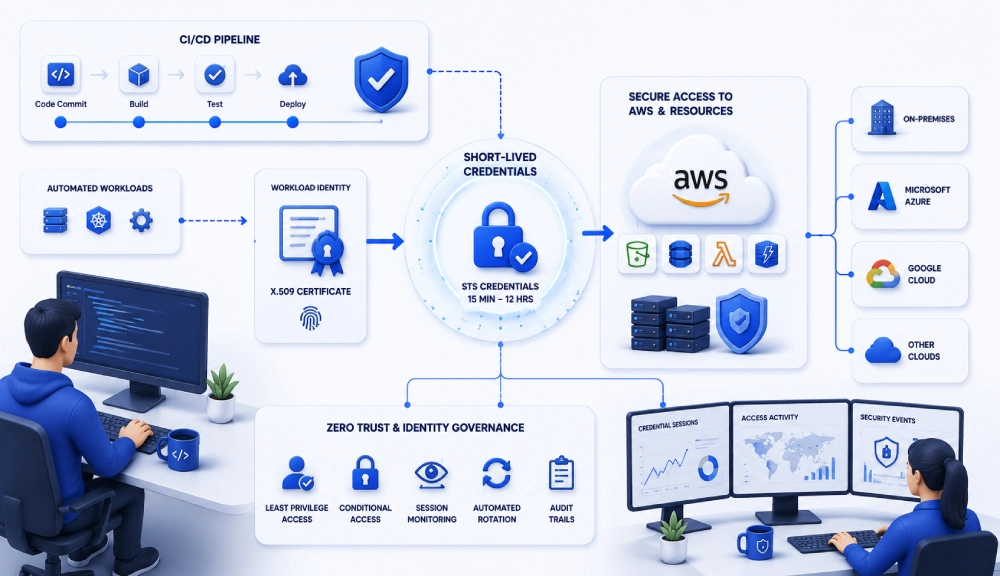
- AWS IAM Roles Anywhere eliminates static keys by issuing short-lived STS session tokens (valid 15 minutes to 12 hours) to external workloads that authenticate via X.509 certificates.
- The service is built on three components: a Trust Anchor (your Certificate Authority), an IAM Role (defining permissions), and a Profile (linking them together).
- Organizations in regulated industries, including healthcare and fintech firms across California and New York, benefit from the built-in audit trail IAM Roles Anywhere creates in AWS CloudTrail.
- Adopting IAM Roles Anywhere directly supports a zero-trust architecture, where every workload, whether on-premises, in Azure, or in GCP, must prove its cryptographic identity before receiving access.
Introduction
According to the Verizon Data Breach Investigations Report, stolen or misused credentials are the leading cause of data breaches year after year. In hybrid and multi-cloud architectures, where applications routinely run outside AWS while still depending on AWS-managed services such as S3, DynamoDB, and Secrets Manager, the default solution has historically been the same problematic one: long-lived static access keys stored on external servers. That approach works, but it creates a persistent security liability that grows with every server added to your infrastructure.
AWS IAM Roles Anywhere was introduced specifically to close this gap. It extends the IAM role model, already used natively inside AWS, to any external environment: on-premises data centers, virtual machines on Azure or GCP, bare-metal servers, and CI/CD pipelines. Instead of storing a static key, external workloads present a cryptographic certificate to receive short-lived, automatically expiring credentials. This post breaks down how the service works, why static keys remain a significant risk, and what your team gains by making the switch.
Why Are Static AWS Access Keys a Security Risk in Hybrid Environments?
Static AWS access keys are a liability by design. Once issued, they remain valid indefinitely until someone manually revokes them, and that permanence is exactly what makes them dangerous outside of AWS’s controlled infrastructure.
Permanent Exposure After a Server Compromise
If an on-premises server, a VM on a third-party cloud, or a CI/CD runner is compromised, any static AWS access key stored on that machine is immediately available to the attacker. Unlike credentials tied to an AWS instance profile, a static key carries no context: AWS cannot distinguish between a request from your legitimate Jenkins server and the same request issued from an attacker’s laptop in another country. The key works from anywhere, at any time, with the full set of permissions it was granted.
Manual Rotation Is Error-Prone and Often Skipped
Security standards, including guidance from the NIST Special Publication 800-63B and the Center for Internet Security, recommend rotating credentials frequently. In practice, environments with dozens or hundreds of external servers relying on the same static keys make rotation an intensive, coordination-heavy process. A missed update on even one application during a rotation cycle can cause unexpected outages. The operational burden means rotations are deferred, and deferred rotations mean exposure windows that stretch from weeks to years.
No Machine Identity Verification
Inside AWS, IAM instance profiles cryptographically tie temporary credentials to a specific EC2 instance. AWS verifies the requesting resource’s identity before issuing tokens. With static keys on external servers, no such binding exists. AWS sees only the key, not who or what is presenting it. The absence of contextual validation eliminates a critical layer of the zero-trust model that modern security frameworks require.
Compliance Friction Across Regulated Industries
Security frameworks such as SOC 2, PCI-DSS, and those governed by guidance from the U.S. Department of Health and Human Services require demonstrable use of strong authentication, frequent credential rotation, and least-privilege access. Long-lived static keys fail on all three counts, creating audit exposure and complicating the compliance process for engineering and security teams.
What Is AWS IAM Roles Anywhere?
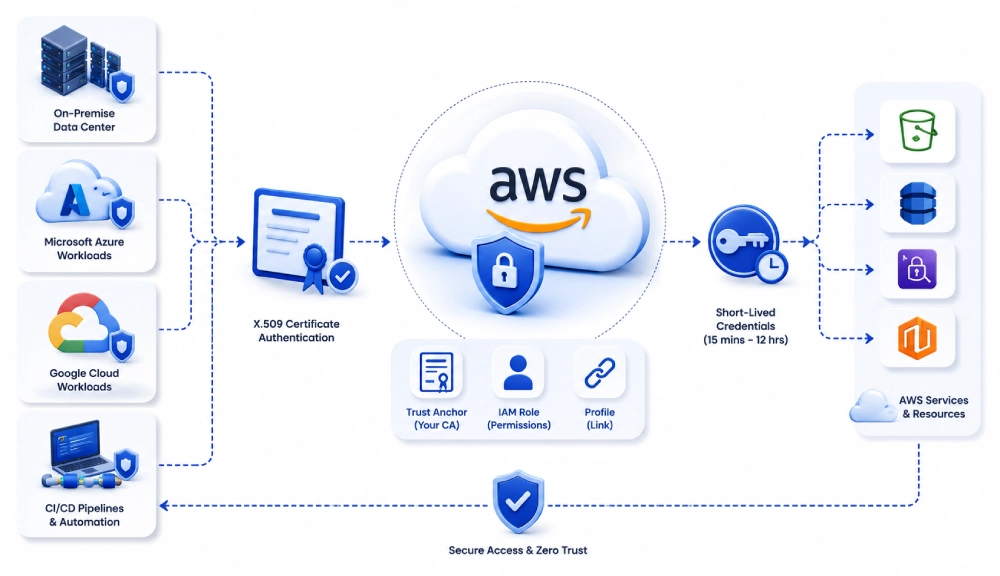
AWS IAM Roles Anywhere is a service that extends the IAM role model to workloads running outside of AWS. It enables any external machine that holds a valid X.509 certificate, issued by a Certificate Authority (CA) your organization controls, to request temporary AWS credentials from the AWS Security Token Service (STS). The result is the same kind of short-lived, automatically expiring access that EC2 instances have used for years, now available to any server regardless of where it runs.
The service replaces the need to distribute, store, and rotate static access keys across external infrastructure. Instead, your team manages certificates through your existing PKI, and AWS handles the rest.
The Three Core Components
IAM Roles Anywhere requires three configuration objects to establish a trust relationship between your external environment and AWS:
- Trust Anchor: Registers a Certificate Authority with AWS. This can be your existing enterprise PKI or an AWS Private Certificate Authority. Any certificate issued by this CA will be trusted by IAM Roles Anywhere when verifying incoming requests.
- IAM Role: A standard IAM role that defines exactly what permissions the external workload is allowed to use, for example, read-only access to a specific S3 bucket. The role’s trust policy must explicitly allow the
rolesanywhere.amazonaws.comservice principal to assume it. - Profile: Links a Trust Anchor to one or more IAM Roles. The Profile also lets you apply session policies to further restrict the permissions available within any given credential session.
How the Authentication Flow Works
The full workflow from credential request to AWS API call follows six steps:
- The external server (for example, an on-premises automation host) makes a
rolesanywhere:CreateSessionrequest to the IAM Roles Anywhere endpoint, signed using the private key corresponding to its X.509 certificate. - IAM Roles Anywhere validates the request signature using the certificate’s public key, confirming the server holds the private key and therefore controls the identity it claims.
- The service checks that the certificate was issued by the CA registered in the Trust Anchor, confirming organizational trust.
- Upon successful verification, IAM Roles Anywhere calls AWS STS to assume the IAM role defined in the linked Profile.
- STS issues temporary credentials (Access Key ID, Secret Access Key, and Session Token) with a configurable TTL, typically one hour.
- The external server uses those credentials to call AWS APIs. When the credentials expire, the server requests a new set, maintaining continuous access without manual intervention.

How Does IAM Roles Anywhere Improve Security Compared to Static Keys?
IAM Roles Anywhere improves security in five specific, measurable ways. Each addresses a direct weakness of the static key model.
| Security Dimension | Static Access Keys | IAM Roles Anywhere |
|---|---|---|
| Credential Lifespan | Permanent until manually revoked | 15 minutes to 12 hours, automatically expires |
| Identity Verification | None: any holder of the key is trusted | Cryptographic: server must prove it holds the private key |
| Rotation Burden | Manual, error-prone, and frequently delayed | Automatic: new tokens requested on expiry |
| Blast Radius if Compromised | Full, persistent access until revocation | Limited to the TTL window of the current token |
| Audit Trail | Key-based: no identity binding | Certificate-bound: logged in AWS CloudTrail with host identity |
According to AWS documentation, IAM Roles Anywhere also supports fine-grained role assumption conditions based on certificate attributes such as Common Name and Organization Unit. This means you can issue different certificates to different server groups, each mapping to a role with precisely scoped permissions, rather than sharing a single broad key across your entire fleet.
Benefits for DevOps Teams in Hybrid and Multi-Cloud Architectures
The operational benefits of IAM Roles Anywhere extend well beyond security. Engineering and DevOps teams that have managed key distribution across large server fleets understand the coordination cost that static keys impose at scale.
Elimination of Secret Sprawl
Secret sprawl, the distribution of credentials across configuration files, environment variables, CI/CD secrets stores, and deployment scripts, is one of the most common sources of accidental credential exposure. IAM Roles Anywhere removes the need to place AWS credentials anywhere in the external environment. The only long-lived secret is the certificate itself, managed through your PKI infrastructure, not scattered across application configs.
Consistent Security Governance Across Environments
Organizations running workloads across AWS, Azure, GCP, and on-premises data centers typically end up managing different authentication models for each environment. IAM Roles Anywhere allows your team to apply a single, unified IAM policy model to all external workloads, regardless of where they run. This consistency reduces the chance of policy drift and simplifies security reviews.
Alignment with Zero-Trust Principles
The NIST Zero Trust Architecture (SP 800-207) defines zero trust as a model where no implicit trust is granted to any resource based solely on its network location. IAM Roles Anywhere operationalizes this principle for external AWS access: every credential request requires a cryptographic proof of identity, regardless of where the request originates. This is a direct implementation of the zero-trust “verify explicitly” principle at the infrastructure layer.
Support for Existing PKI Infrastructure
Most enterprise organizations already operate a PKI for TLS certificates and internal identity management. IAM Roles Anywhere integrates directly with that existing infrastructure: your CA becomes the Trust Anchor, and the certificates you already issue to servers become the authentication mechanism for AWS access. There is no requirement to adopt an entirely new identity system.
Practical Value for CI/CD Pipelines
CI/CD runners on platforms such as Jenkins, GitLab, and self-hosted GitHub Actions are common consumers of AWS credentials for deployment and infrastructure automation. These runners are also frequent targets for credential theft. IAM Roles Anywhere allows each runner to authenticate using a certificate tied to that specific runner’s identity, and the resulting credentials expire automatically at the end of the session, eliminating the risk of a long-lived key persisting in a build artifact or log file.
Our Perspective
Working with software teams in healthcare and fintech across San Diego and beyond, a consistent pattern emerges when organizations begin moving workloads to hybrid environments: the authentication model does not keep pace with the infrastructure change. Teams stand up external servers to run automation, reporting pipelines, or integration services that need AWS access, and they reach for static keys because it is the fastest path to a working system. The operational debt accumulates quietly.
The shift to IAM Roles Anywhere requires two things that teams sometimes underestimate: a clear picture of every external workload currently using static keys, and a PKI capable of issuing certificates to those workloads in a repeatable, auditable way. The second part, in particular, surfaces gaps in certificate management practices that existed long before AWS access was in scope. Addressing those gaps early in the migration makes the transition substantially smoother and produces lasting improvements to the broader identity posture.

Conclusion
Static AWS access keys were a pragmatic solution for a simpler era of infrastructure. In hybrid and multi-cloud environments, where external servers, CI/CD runners, and cross-cloud workloads all require AWS access, they represent an exposure risk that compounds with scale. AWS IAM Roles Anywhere addresses this directly, replacing permanent credentials with short-lived, certificate-backed tokens that expire automatically and leave a clear audit trail in CloudTrail.
The architecture is well-suited to organizations that already operate a PKI and want to extend their existing identity model to cover AWS access without building a new system from scratch. For teams still distributing static keys across their infrastructure, the transition to IAM Roles Anywhere is one of the highest-leverage security improvements available with the current AWS toolset. If your team is evaluating that transition and wants a clear-eyed assessment of the steps involved, the right people to speak with are already familiar with your environment.
Frequently Asked Questions
What is AWS IAM Roles Anywhere?
AWS IAM Roles Anywhere is a service that allows workloads running outside of AWS, such as on-premises servers, VMs on other cloud providers, and CI/CD pipelines, to obtain temporary AWS credentials using X.509 certificates instead of static access keys. It extends the IAM role model to external environments by requiring each workload to authenticate with a certificate issued by a trusted Certificate Authority before AWS issues short-lived STS tokens.
How is IAM Roles Anywhere different from using static AWS access keys?
Static access keys are permanent credentials that remain valid until manually revoked, carry no identity context, and create a significant exposure risk if compromised. IAM Roles Anywhere issues short-lived session tokens (valid 15 minutes to 12 hours) that expire automatically, and each credential request is authenticated using a cryptographic certificate that binds the request to a specific machine identity. An attacker who obtains a session token from an IAM Roles Anywhere session has a narrow window of exposure; an attacker who obtains a static key has indefinite access.
How do you set up AWS IAM Roles Anywhere?
Setup requires three steps: first, register a Trust Anchor by connecting a Certificate Authority (your existing enterprise PKI or AWS Private CA) to IAM Roles Anywhere; second, create or configure an IAM Role with a trust policy that allows the rolesanywhere.amazonaws.com service principal to assume it; third, create a Profile that links the Trust Anchor to the IAM Role and optionally applies session-level permission restrictions. Once configured, external workloads use the AWS credential helper tool or SDK to exchange a signed certificate for temporary credentials.
Is AWS IAM Roles Anywhere suitable for CI/CD pipelines in fintech or healthcare software teams?
Yes, and it is particularly well-suited to those environments. CI/CD runners that deploy or manage AWS infrastructure are high-value targets for credential theft. IAM Roles Anywhere allows each runner to authenticate with a certificate unique to that runner, receive credentials scoped to the minimum permissions needed for the deployment task, and have those credentials expire automatically at the end of the session. For fintech software development teams and healthcare engineering organizations managing sensitive infrastructure, this model produces a significantly stronger access control posture than storing static keys in a CI/CD secrets manager.
Does IAM Roles Anywhere work with non-AWS cloud providers like Azure or GCP?
Yes. IAM Roles Anywhere is designed for any environment outside of AWS, including virtual machines running on Azure, GCP, or Oracle Cloud. As long as the external host holds a valid X.509 certificate issued by the Certificate Authority registered as the Trust Anchor, it can request temporary AWS credentials. This makes it a practical solution for organizations operating in genuinely multi-cloud architectures who need a unified method for granting external workloads access to AWS services.
Is AWS IAM Roles Anywhere worth implementing if we already use a secrets manager for our static keys?
A secrets manager reduces the risk of keys being hardcoded in source code, but it does not change the fundamental properties of the credential itself: the key is still permanent, still requires manual rotation, and still provides unrestricted access to anyone who retrieves it from the secrets store. IAM Roles Anywhere eliminates the static key entirely, replacing it with a credential that expires automatically and is tied to a verified machine identity. For organizations in regulated industries or those operating large external server fleets, the security improvement from removing static keys is substantially greater than the improvement from storing them more securely. Teams considering DevOps consulting to modernize their access model will typically find IAM Roles Anywhere is a recommended first step in any hybrid security review.