- Nearly two-thirds of enterprises are still stuck in the experimentation or piloting phase. The bottleneck is infrastructure readiness, not the technology itself
- The highest-ROI AI automation use cases are already deployed across SaaS, fintech, healthcare, and manufacturing
- Data readiness and architecture validation must come before any AI deployment decision
- Hyperautomation and agentic AI are active competitive advantages in 2026, not emerging trends
- Every quarter without AI-augmented operations widens the performance gap against competitors who are already running these systems
Introduction
AI automation ideas are everywhere in 2026, but execution remains the gap separating organizations that generate measurable returns from those running expensive pilots that stall in year one. According to McKinsey’s 2025 State of AI report, only 39% of organizations report any measurable enterprise-level business impact from AI, despite widespread investment. The bottleneck is rarely the technology. It is the infrastructure, data, and sequencing surrounding it.
This guide is written for technical leaders and enterprise decision-makers who need more than a list of buzzwords. Whether your organization operates in San Diego, New York, or anywhere across the United States, the use cases below are drawn from real production deployments in SaaS, healthcare, fintech, and manufacturing. Each one includes concrete examples and the infrastructure context that determines whether it succeeds or stalls.
If your goal is to identify where AI automation creates the fastest ROI within your current data maturity level and how to avoid deploying before your architecture is ready this is where to start.
Why Do Most Enterprise AI Automation Initiatives Stall in Year One?
Most enterprise AI initiatives stall because organizations skip the readiness work and jump straight to deployment. The failure is not a model problem it is a foundation problem.
According to McKinsey’s 2025 State of AI research, nearly two-thirds of organizations remain in the experimentation or piloting phase, unable to convert early wins into enterprise-level impact. The blockers look remarkably consistent across industries:
- Data living in siloed ERP, CRM, and legacy systems with no unified schema
- Engineering teams are stretched thin between product delivery and ongoing maintenance
- No ML Ops foundation to monitor, retrain, or govern deployed models
- Security frameworks that were never designed with AI pipelines in mind
- Vendor solutions that solve one narrow problem and create five new integration dependencies
- Hyperautomation strategies launched without the process maturity to support them
Organizations that treat digital transformation as the frame for AI adoption, not a standalone IT project, consistently outperform those that do not. The practical starting point is identifying where your data is cleanest, your processes are most documented, and your ROI potential is highest, then building outward from there.
The organizations winning with AI in 2026 are not the ones who deployed the most tools. They are the ones who identified the right use cases for their current data maturity, built modular architectures, and created feedback loops that improve over time.
15+ AI Automation Ideas That Drive Real Operational ROI
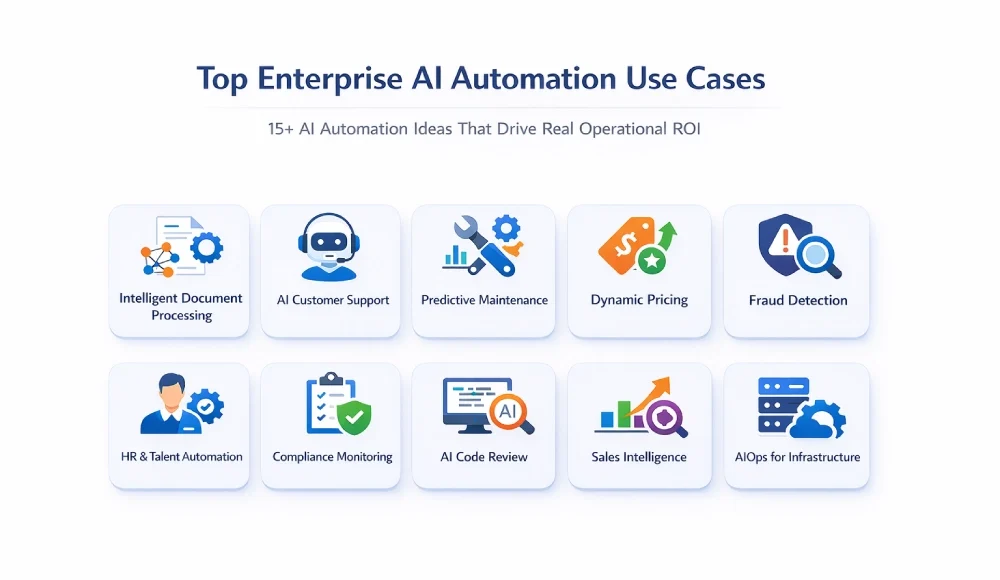
Each use case below has been implemented across enterprise environments. Complexity varies, and that context matters. Before evaluating any of these, audit which use cases align with your current data maturity. The ones that do will deliver returns the fastest.
1. Intelligent Document Processing and Data Extraction
Manual document handling is one of the highest-cost, lowest-value activities in any operation-heavy organization. AI-powered document processing combines optical character recognition (OCR) with large language models to extract, classify, and route data from invoices, contracts, intake forms, and insurance claims with accuracy rates exceeding 95% on structured documents.
Real use case: A fintech lending platform reduced loan processing time from four days to under six hours by automating document intake, identity verification, cross-referencing, and underwriting data extraction using a custom LLM pipeline integrated into their Salesforce workflow.
2. AI-Powered Customer Support and Triage
Modern AI triage systems classify incoming tickets by urgency, route them to the right team, suggest resolution paths based on historical data, and handle Tier 1 queries fully autonomously. The most advanced implementations use agentic AI architectures where autonomous agents manage multi-step resolution workflows, escalate based on sentiment signals, and learn continuously from resolved cases.
Real use case: A B2B SaaS platform deployed an AI triage layer that resolved 42% of support tickets without human escalation. Average handle time on escalated tickets dropped by 31% because agents received pre-populated resolution suggestions before reading the ticket.
3. Predictive Maintenance for Manufacturing and Infrastructure
Reactive maintenance is budget destruction at scale. AI models trained on IoT sensor data, equipment logs, and historical failure patterns can predict component failure windows with enough lead time to schedule maintenance before production disruption occurs. Edge AI processes sensor data directly on-device, reducing latency and enabling real-time decisions without cloud round-trips.
Real use case: A mid-sized manufacturer reduced unplanned downtime by 27% in the first year after deploying predictive maintenance AI across three production lines. The model was retrained quarterly as new sensor data accumulated, improving accuracy over time.
4. Dynamic Pricing and Revenue Optimization
AI-driven dynamic pricing models analyze demand signals, competitor pricing, inventory levels, customer segment behavior, and seasonality in real time, then adjust pricing to maximize margin without sacrificing conversion. This is not exclusive to eCommerce. SaaS platforms use it for seat-based pricing optimization. Marketplaces use it to balance supply and demand economics.
Real use case: A direct-to-consumer eCommerce brand deployed a dynamic pricing engine that increased gross margin by 18% in a single quarter without any additional marketing spend.
5. AI-Augmented Fraud Detection and Risk Scoring
Traditional rules-based fraud detection is brittle. Machine learning fraud models learn continuously from transaction data, flagging anomalies in real time across millions of signals, device fingerprints, behavioral biometrics, velocity patterns, and network graphs. According to Gartner, AI-driven fraud systems consistently outperform legacy rule engines on both detection rates and false positive reduction.
Real use case: A fintech payments platform replaced its legacy rules engine with an ML fraud detection system. False positive rates dropped by 40%, reducing manual review costs and customer churn from declined legitimate transactions.
6. Automated Financial Close and Reconciliation
Robotic process automation combined with AI handles transaction matching, anomaly detection, variance explanation, and reconciliation across ERP systems, bank feeds, and subsidiary ledgers, compressing close cycles from 10 days to 3. The most effective implementations use RPA for high-volume transactional processing and AI for exception detection and variance analysis.
Real use case: A PE-backed SaaS company with operations across four business units automated 78% of its reconciliation workflow. The finance team redirected capacity toward forecasting and investor reporting instead of manual data validation.

7. Intelligent HR and Talent Operations
From resume screening to onboarding workflows to attrition prediction, AI is restructuring how talent organizations operate. Attrition prediction models analyze engagement signals, performance patterns, tenure milestones, and compensation benchmarking to flag flight-risk employees before they resign, giving HR and managers a window to act.
Real use case: A healthcare network with 12,000 employees deployed an attrition prediction model that identified high-risk nursing staff with 74% accuracy 90 days before resignation. Proactive retention interventions reduced nursing turnover by 19% over 12 months.
8. Supply Chain Demand Forecasting
AI demand forecasting ingests point-of-sale data, macroeconomic indicators, social sentiment, weather patterns, and supplier lead time variability to produce probabilistic demand curves, not single-point forecasts. According to AI-augmented supply chain planning reduces forecasting errors by 20–50% compared to legacy ERP-native models.
Real use case: A consumer goods manufacturer reduced inventory carrying costs by 22% and stockout events by 34% after replacing their ERP-native forecasting module with an AI demand planning layer that updated forecasts daily.
9. Automated Compliance Monitoring and Reporting
AI compliance systems monitor system logs, access patterns, data flows, and policy adherence in real time, generating audit-ready reports and flagging violations before they become regulatory events. The most mature implementations operate under a defined AI governance framework built into pipeline design from day one, rather than retrofitted after deployment.
Real use case: A health-tech SaaS platform reduced compliance audit preparation time from six weeks to under five days by deploying an automated compliance monitoring tool that maintained continuous evidence collection across cloud infrastructure.
10. AI-Powered Code Review and Developer Productivity
AI code review tools analyze pull requests for security vulnerabilities, logic errors, style inconsistencies, and test coverage gaps at a fraction of the time a senior engineer review requires. According to GitHub’s 2025 Octoverse research, generative AI integration into development workflows is reducing time-to-feature for experienced engineering teams by 20–35%.
Real use case: A Series B SaaS company integrated AI-assisted code review and documentation generation into their CI/CD pipeline. Senior engineers reported spending 40% less time on review cycles and more time on architecture decisions.
11. Marketing Personalization at Scale
AI personalization engines analyze behavioral data, purchase history, content engagement, and CRM attributes to deliver individualized content, product recommendations, and email sequences at a scale no human team can replicate manually. This is where generative AI integration creates compounding returns: each interaction improves the model’s next recommendation.
Real use case: A fitness platform with 800,000 active users deployed an AI personalization layer across email, in-app messaging, and push notifications. Engagement rates increased by 47%. Monthly recurring revenue from personalized upsell sequences grew by 22% in two quarters.
12. Conversational AI for Internal Knowledge Management
Enterprise knowledge is trapped in documentation, email threads, and the institutional memory of people who might leave next quarter. RAG-powered (Retrieval-Augmented Generation) internal AI assistants trained on company documentation, product specs, and standard operating procedures give employees instant, accurate answers without context-switching or waiting for a colleague.
Real use case: A 600-person logistics company deployed an internal AI assistant connected to their operations wiki, HR policies, and compliance documentation. New employee ramp time decreased by 38%. Internal IT and HR support requests dropped by 29%.
13. Automated Sales Intelligence and Lead Scoring
AI lead scoring models synthesize CRM data, firmographic signals, behavioral intent data, and historical win/loss patterns to rank leads by conversion probability allowing sales teams to focus on accounts that are actually ready to buy. According to Salesforce’s State of Sales report, high-performing sales teams are nearly three times more likely to use AI-guided selling tools than underperforming teams.
Real use case: A B2B marketplace integrated AI lead scoring into their Salesforce instance. Sales cycle length decreased by 24%. Win rates on accounts in the top two scoring tiers increased by 31%.
14. AI-Driven Quality Assurance in Production Environments
AI-powered QA systems generate test cases, identify regression risks from code differences, and prioritize test execution based on change impact analysis. For manufacturers, computer vision QA systems inspect products on the line faster and more consistently than human inspectors, with defect detection rates exceeding 99% in controlled environments.
Real use case: An electronics manufacturer deployed computer vision QA across two production lines, replacing manual visual inspection for circuit board defects. Defect escape rate dropped by 91%. Cost per inspection decreased by 67%.
15. AI Operations (AIOps) for Infrastructure Management
AIOps platforms correlate telemetry data across logs, metrics, traces, and events to detect anomalies, predict outages, and automate remediation, often before users are impacted. By the end of 2026, 40% of enterprise applications will incorporate task-specific AI agents, up from less than 5% in 2025.
Real use case: A SaaS platform processing 50 million or more daily transactions, deployed AIOps tooling across their cloud infrastructure. Mean time to detect dropped from 47 minutes to under 4 minutes. Mean time to resolve decreased by 58%.
16. AI-Assisted Customer Onboarding and Lifecycle Management
AI onboarding systems personalize the activation journey based on role, company size, use case, and behavioral signals, triggering contextual nudges, in-app guidance, and customer success alerts when customers fall off the activation path. For vertical SaaS businesses, especially, time-to-value is a direct driver of 90-day retention.
Real use case: A vertical SaaS company for the healthcare market reduced time-to-value from 45 days to 18 days after deploying an AI-driven onboarding orchestration layer. 90-day retention improved by 26%.
What Separates AI Automation That Delivers ROI From Expensive Experiments?
The difference between AI automation that delivers measurable results and an expensive experiment comes down to infrastructure discipline applied before deployment.
According to PwC’s 2025 US Responsible AI Survey of 310 US business leaders, nearly 60% of executives say responsible AI practices directly improve ROI and operational efficiency. The organizations generating the strongest returns are not the ones with the largest AI budgets. They are the ones who built the right foundation first.
| Dimension | AI-Hype Implementation | AI-Ready Implementation |
| Data foundation | Fragmented, siloed, inconsistent | Unified data pipelines, schema-consistent |
| Architecture | Point solutions bolted onto legacy systems | Modular, API-first, cloud-native |
| Governance | Reactive, handled after deployment | Built into the architecture design from day one |
| Vendor strategy | Single-vendor lock-in | Composite AI with best-of-breed integration |
| ML Ops | None or ad-hoc | Monitoring, retraining, and drift detection in place |
| ROI measurement | Vague and qualitative | Defined KPIs measured against documented baselines |
| Team alignment | IT-driven, business teams excluded | Cross-functional ownership from the start |
Run this table as an internal audit. Score your current state honestly against each row the gaps will tell you exactly where architecture investment is most urgent before your next AI automation initiative.
How to Choose the Right AI Automation Ideas for Your Organization
Not every use case on this list belongs in your next planning cycle. Choosing the right starting point depends on three factors: where your data is already clean and accessible, which processes are documented well enough to automate, and where the ROI is both meaningful and measurable.
For most organizations, intelligent document processing and AI-powered support triage are strong first deployments. They are high-volume, have clear input/output structures, and generate measurable results quickly. Supply chain forecasting and AIOps tend to follow once the data infrastructure is more mature.
For teams building or evaluating the underlying AI/ML development layer, architecture decisions made at the start, model selection, vector database strategy, and pipeline orchestration have an outsized influence on long-term performance and maintainability. Those decisions deserve as much attention as the use case selection itself.
The practical approach is to identify one or two use cases where your data is already clean, scope tightly, and build a proof point that earns internal momentum for broader investment. That sequencing discipline is what separates organizations generating real returns from those stuck in perpetual experimentation.
Our Perspective
Across the projects our team in San Diego has built, spanning healthcare software, fintech platforms, and SaaS applications, one pattern repeats consistently: the organizations that extract the most value from AI automation are the ones that invested in data architecture before they invested in AI models.
In practice, this means we spend a significant portion of early engagement time on pipeline design, API integration strategy, and how data flows between systems, not on model selection. The model is rarely the bottleneck. The connective tissue between data sources is.
For healthcare clients in particular, we have observed that the highest-impact automation wins tend to live at the intersection of scheduling, intake, and care coordination, not in the more visible patient-facing features. The back-office workflows that nobody talks about are often where the compounding returns are hiding. That is the starting point we recommend most teams evaluate first.

Conclusion
AI automation ideas are only as valuable as the infrastructure prepared to support them. The 16 use cases in this guide represent proven deployment patterns each generating measurable returns when implemented with the right data foundation, architecture discipline, and sequencing. The McKinsey finding that only 39% of organizations are generating measurable AI business impact is not a technology problem. It is a foundation and sequencing problem.
The path forward is consistent regardless of industry: assess your data readiness, identify the highest-ROI use cases within your current state, validate your architecture, and build with governance integrated from the start. Organizations across the United States that take that approach in 2026 are the ones that will look back on this period as when they pulled ahead.
If you are evaluating where to start or where your current infrastructure stands, the most valuable first step is an honest assessment of your data and architecture readiness before any vendor conversation begins.
Frequently Asked Questions
What is AI automation in an enterprise context?
AI automation in an enterprise context refers to the use of machine learning models, large language models, and intelligent process automation to handle business workflows that previously required manual human effort. Unlike traditional rule-based automation, AI automation adapts to variable inputs, learns from historical data, and can manage unstructured content such as documents, emails, and support tickets. As outlined in this article, enterprise AI automation spans use cases from document processing and fraud detection to supply chain forecasting and AIOps.
What is the difference between AI automation and robotic process automation (RPA)?
RPA handles repetitive, rule-based tasks by mimicking user interactions with software interfaces, while AI automation applies machine learning to handle tasks that involve judgment, pattern recognition, or unstructured data. The most effective enterprise implementations use both in combination: RPA for high-volume transactional processing and AI for exception handling, anomaly detection, and predictive analysis. The automated financial close use case covered in this article is a strong example of both working in tandem.
How does an organization identify the right AI automation ideas to start with?
The right starting point is determined by three factors: where your data is already clean and accessible, which processes are well-documented, and where the ROI is both meaningful and measurable within a short time horizon. Intelligent document processing and AI-powered support triage are consistently strong first deployments because they are high-volume, structurally clear, and produce measurable results quickly. The internal audit table in this article scoring your organization against data foundation, architecture, governance, and ML Ops dimensions is a practical first step before selecting any use case.
How are San Diego and California-based enterprises applying AI automation in 2026?
Scaling companies and enterprise teams in San Diego, Los Angeles, and across California are applying AI automation most actively in three areas: healthcare software workflows including scheduling and care coordination, fintech operations such as fraud detection and document processing, and SaaS product development velocity through AI-assisted code review and QA. The pattern our team observes most consistently is that back-office automation the workflows that are less visible but high-volume tends to generate the fastest measurable returns for California-based organizations early in their AI adoption journey.
Is investing in AI automation ideas worth it for mid-market companies, not just large enterprises?
Yes, AI automation is viable and often faster to implement at mid-market scale because there is less organizational complexity slowing down deployment decisions. The most important qualifier is data readiness, not company size. Mid-market organizations with clean CRM data, documented support workflows, or structured financial data are often better positioned than large enterprises with fragmented legacy systems. The use cases in this article particularly support triage, lead scoring, and document processing were drawn from mid-market and scaling company deployments, not only Fortune 500 environments.