Key Takeaways
- The right healthcare AI development company brings clinical workflow knowledge, not just coding skills; these two things are not the same.
- EHR integration experience, including HL7 and FHIR standards, is one of the most practical ways to separate credible vendors from generalists.
- Data security should be an architectural decision made at the start of a project, not a feature added at the end.
- Always ask for references from comparable healthcare organizations and request a scoped pilot before committing to a full build.
- Post-launch model monitoring matters as much as the initial build. AI performance changes over time as clinical data and workflows evolve.
Introduction
Picking the wrong AI development partner in healthcare is an expensive mistake, and not just financially. A system that mishandles patient data, breaks an EHR integration, or makes unreliable predictions in a clinical workflow carries real consequences for care teams and patients alike.
That’s the core reason why evaluating a healthcare AI development company is a different process from hiring a general software team. Technical skill matters, of course. But healthcare also demands clinical knowledge, familiarity with interoperability standards, a disciplined approach to data privacy, and the ability to build systems that fit into the way hospitals and clinics actually operate.
This guide lays out ten practical criteria to help healthcare organizations, digital health startups, and clinical decision-makers cut through vendor marketing and identify partners who can genuinely deliver. Whether you’re building a patient engagement tool, a clinical documentation system, or a predictive analytics platform, these are the questions worth asking before you sign anything.
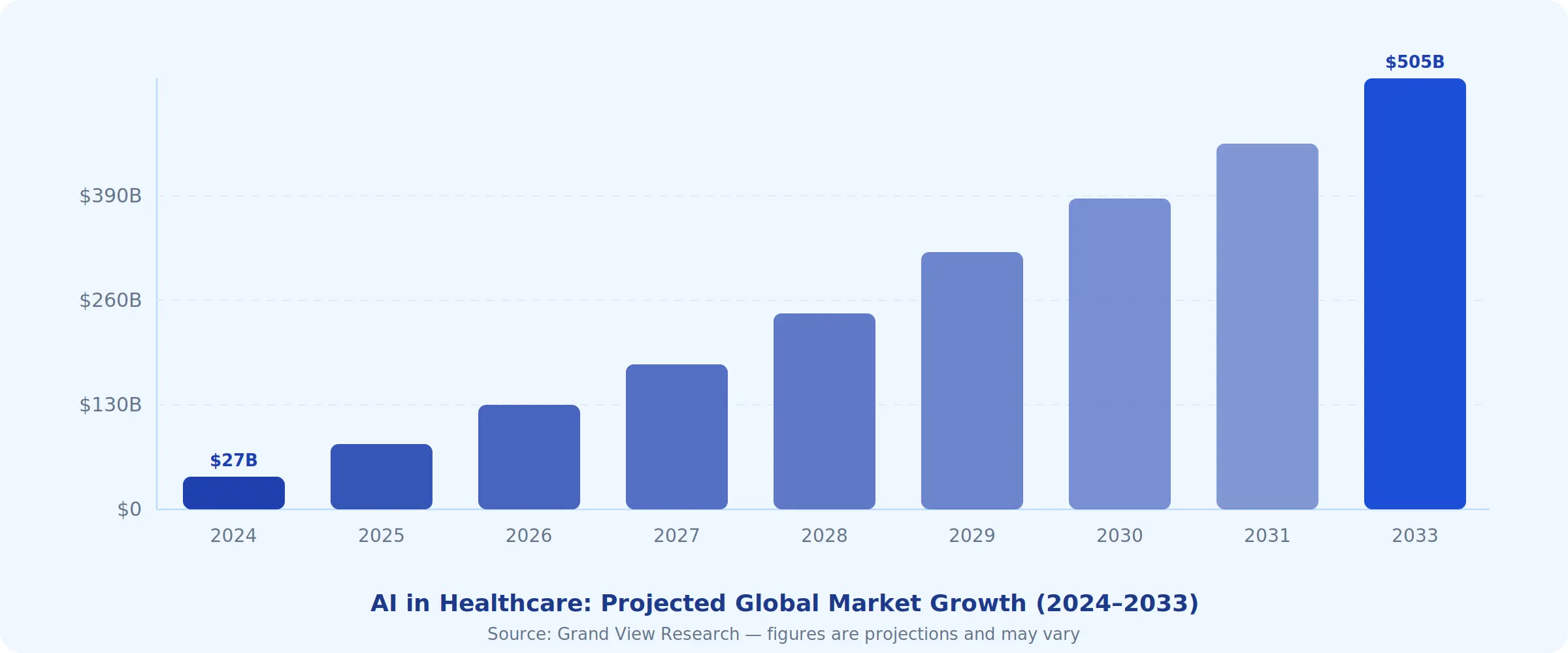
Source: Grand View Research AI in Healthcare Market Size & Share Report, 2024–2033. Figures are projections and may vary.
Healthcare Domain Experience That Goes Beyond a Services Page
Most software agencies will list healthcare somewhere on their website. Very few have genuinely worked inside its constraints: tight workflows, legacy systems, regulatory sensitivities, and the kind of clinical detail that only comes from actually building in this space.
When evaluating a potential healthcare AI software development partner, push past their marketing materials. Ask to see detailed case studies from healthcare clients, not just logos that explain the actual problem, what was built, how it connected to existing systems, and what the measurable result was. “We built a patient portal” is very different from “we reduced missed appointments by 30% for a 200-bed hospital by connecting a scheduling AI to their Epic instance.”
Other signs of genuine domain depth: working knowledge of HL7 and FHIR standards, experience with EHR platforms like Epic, Cerner, and Athenahealth, and involving clinical advisors or domain experts during the build process rather than treating clinical requirements as a checklist item.
Technical AI/ML Depth in Healthcare-Specific Areas
Healthcare AI isn’t one thing. It spans computer vision for medical imaging, NLP for automating clinical documentation, machine learning models that predict patient risk, and agentic AI systems that manage multi-step workflows autonomously. A development partner who is strong in one area may be a poor fit for another.
Before engaging any vendor, map your specific use case to the AI capabilities it actually requires, then test whether the partner has done real work in that area.
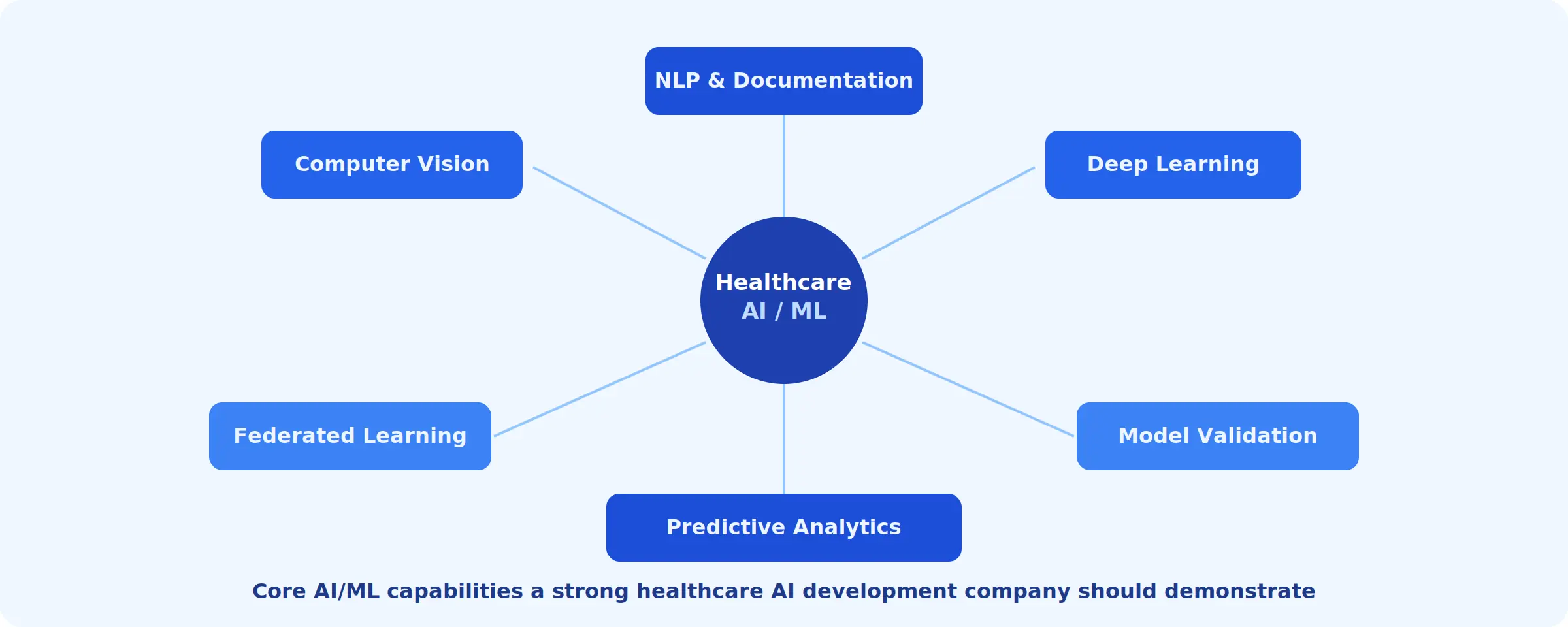 Core AI/ML capabilities a strong healthcare AI development company should be able to demonstrate with real project experience
- ML model development, testing & deployment
- NLP for clinical notes & documentation
- Deep learning for diagnostic imaging
- Predictive patient outcome modeling
- Privacy-preserving & federated AI training
- Clinical decision support integration
A Serious, Structured Approach to Data Security
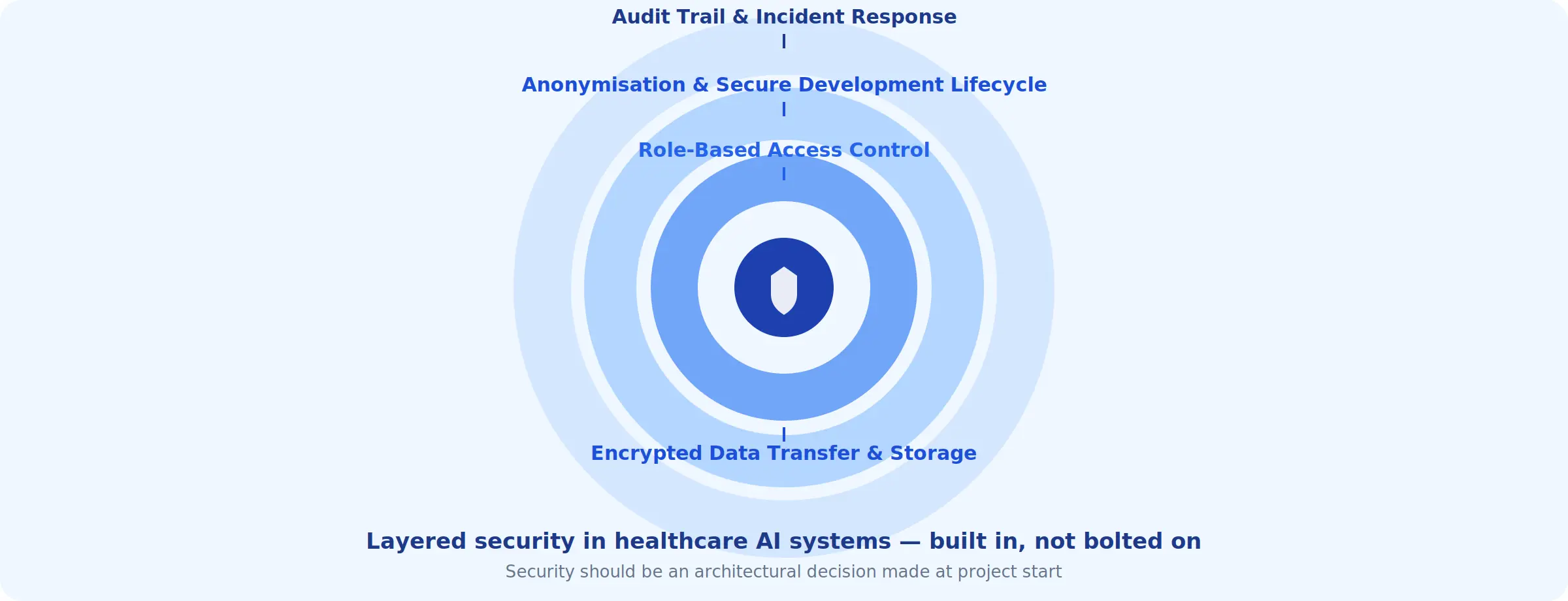
Patient data is among the most sensitive information handled in any industry. Any AI development for healthcare that doesn’t treat security as a core architectural concern, not a feature to be added later, is a risk before the first line of code ships.
What a well-structured security approach actually looks like in practice:
- Encryption at rest and in transit: all data stored and transferred should be encrypted by default
- Role-based access control: only authorized users and systems can access specific data sets or functions
- Data anonymization during model training: raw patient identifiers should not be needed to train AI models
- Routine security audits and penetration testing are ideally part of the standard delivery cycle, not a one-off exercise
- Defined incident response procedures, a clear process for detecting, containing, and reporting data issues
A practical signal: if a vendor only raises security topics after you ask, that’s a red flag. A partner with genuine healthcare experience will address data handling in the first scoping conversation.
Real EHR Integration Experience
One of the most common ways healthcare AI projects fail is that the AI works perfectly in isolation but can’t connect to the clinical environment it’s supposed to serve. Healthcare systems are fragmented by nature, with different EHR vendors, legacy databases, departmental tools, and custom APIs all coexisting. A good EHR integration AI partner knows how to navigate this.
The standards that underpin interoperability in healthcare are specific:
- The current standard for structured clinical data exchange is essential for any system that reads from or writes to an EHR
- The broader messaging framework underlying most clinical data communication between systems
- Direct integration experience with platforms like Epic, Cerner, and Athenahealth reduces implementation friction considerably
Ask any candidate vendor to describe a real integration challenge they’ve solved, not their general capability, but a specific instance. What was the EHR, what was the obstacle, and how did they resolve it? Vague answers here are informative. For healthcare organizations looking at the broader picture, the current healthcare technology landscape makes interoperability a non-negotiable priority, not a nice-to-have.
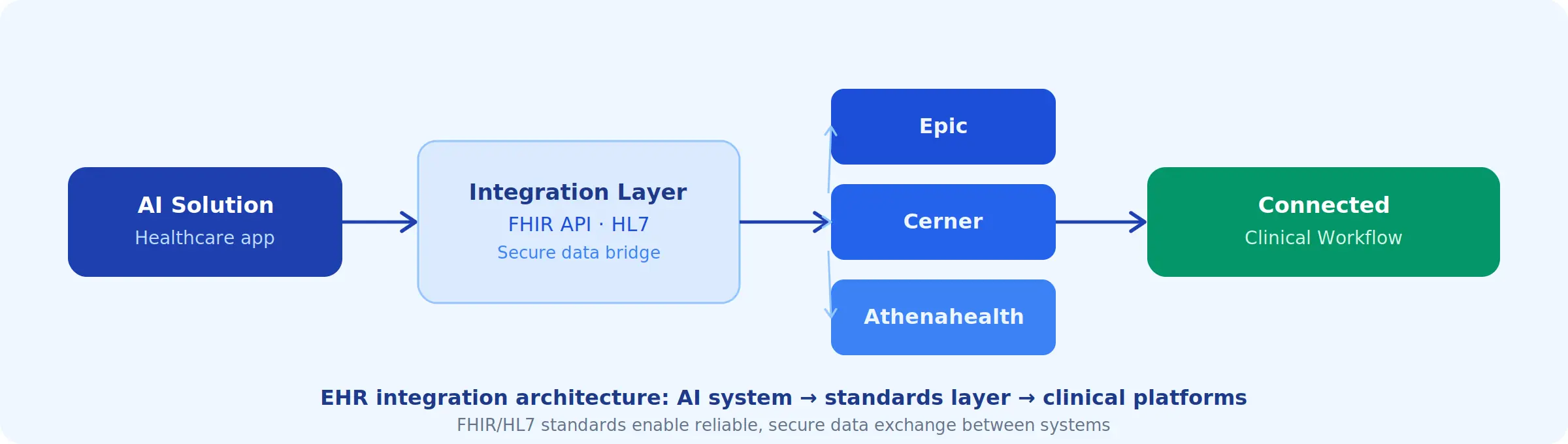 Effective EHR integration routes data through a FHIR/HL7 standards layer before connecting to clinical systems. This avoids brittle, point-to-point connections
Clear Development Process and Honest Post-Launch Support
Healthcare AI doesn’t end at go-live. Patient populations change, clinical workflows evolve, and AI models can quietly degrade in accuracy over time if nobody is watching. A development partner worth working with will have a clear answer for what happens after deployment, not just during it.
Questions worth asking every candidate vendor:
- How do you monitor model performance after launch? What metrics do you track?
- What triggers a model review or retraining cycle?
- How are AI decisions logged for auditability and traceability?
- What does your team structure look like six months after go-live?
Partners who give vague answers about post-launch support are often signaling that the relationship ends at delivery. In healthcare AI, that’s a structural problem.
Documented, Verifiable Outcomes from Real Projects
Almost every vendor will tell you their AI improves patient outcomes or reduces administrative burden. What separates credible partners from aspirational ones is whether they can show you specific numbers from actual deployments, not estimates or projections.
When reviewing a vendor’s case studies, look for concrete figures tied to real clients: processing time reduced by a specific percentage, appointment no-show rates cut by a measured amount, staff hours saved per week. Then ask for a reference contact who can confirm the results.
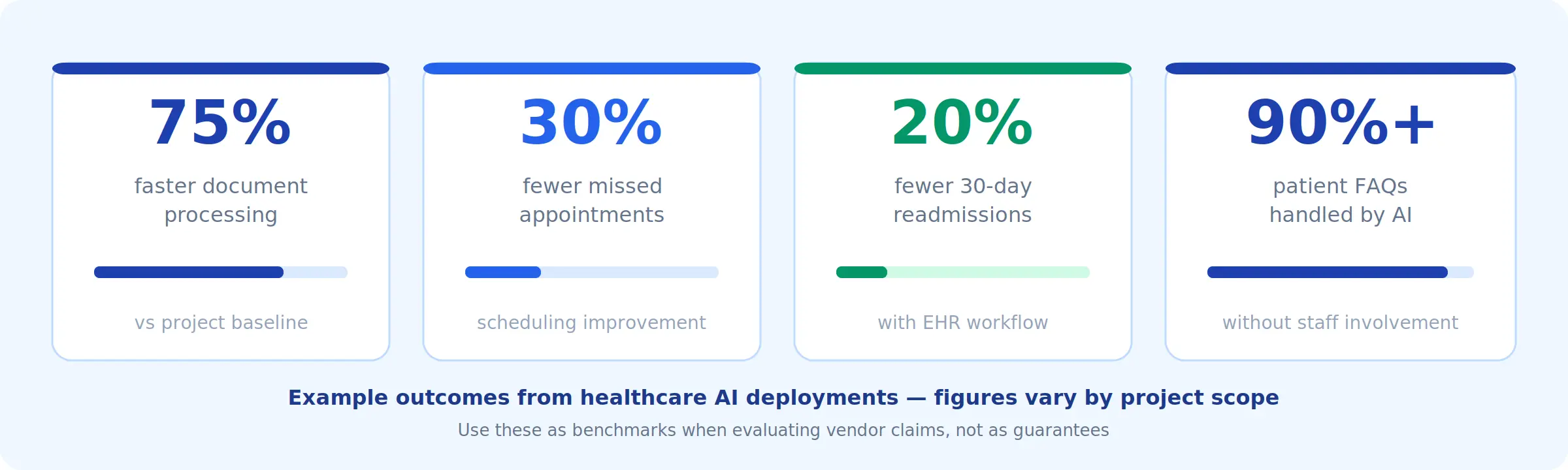 Outcome figures vary by project. Use these as benchmarks to calibrate what realistic results look like and to test whether vendor claims are in the right range
Architecture Built to Scale
A system that handles one clinic’s patient volume today needs to stay stable as you add facilities, users, and data streams. Many AI systems are initially scoped as pilots, but end up being asked to carry much more load within a year of launch. If the architecture wasn’t designed for scale from the start, that expansion becomes a rebuild.
Key things to discuss with any development candidate: which cloud infrastructure they work with (AWS, Azure, or GCP are the main options in enterprise healthcare), how they handle containerization and service isolation, and whether they’ve stress-tested systems under realistic clinical data volumes. The growth of AI automation in healthcare means the bar for scalable, maintainable architecture is only going up.
Communication Quality and Organizational Fit
Healthcare AI projects involve a wider set of stakeholders than most software builds: clinical staff, IT teams, administrators, compliance officers, and often external partners. A development team that communicates clearly with engineers but confuses clinical users, or one that delivers technically but misreads organizational dynamics, will struggle to produce something that actually gets used.
One of the most reliable ways to test communication quality before committing: ask to run a small-scoped pilot or proof of concept first. This surfaces how the vendor handles ambiguity, how they respond when something unexpected comes up, and whether their working style is compatible with your team’s. A development partner who is confident in their work will welcome this.
Regulatory Awareness Appropriate to Your Project Type
Not every healthcare AI system carries the same regulatory burden. An administrative automation tool has different requirements than an AI system that influences a clinical decision. Part of evaluating a development partner is understanding whether they know the difference and can build accordingly.
A credible development partner will raise regulatory classification as a scoping question early, not wait for you to ask. Architecture decisions made later to accommodate regulatory requirements are significantly more expensive than those made at the start.

Why Leading Healthcare Organizations Choose Bitcot for AI Development
Healthcare organizations do not have the luxury of learning from a failed AI implementation. That is why the organizations that take AI seriously choose their development partner with the same rigor they apply to clinical decisions.
We start with a POC, not a pitch. Every Bitcot healthcare AI engagement begins with a structured proof of concept before a full build is scoped or a development contract is signed. We build something real inside your actual environment using your EHR data, your clinical workflows, and your infrastructure to answer the questions no proposal can answer: Does the AI output fit your clinical team’s workflow? Is your data ready? Where are the integration gaps that will slow the full build if we do not address them now?
We build for the clinical team, not just the IT team. A system the IT team loves, but the clinical team ignores, is a failed project regardless of what the technical specs say. Bitcot involves care team stakeholders from the POC phase, not just at testing, because clinical adoption is an engineering requirement, not an afterthought.
We stay accountable after go-live. The first 90 days after launch are when the most important learning happens. Model behavior in a real clinical environment is always different from a controlled test environment. Our post-launch model includes ongoing performance monitoring, retraining cycles, and a direct escalation path when something behaves unexpectedly.
If you are evaluating healthcare AI development partners and a vendor is not willing to start with a POC, that hesitation is itself an answer.
Portfolio Alignment With Your Specific Use Case
A team with strong expertise in diagnostic imaging AI is not automatically well-suited to build a patient scheduling agent. Use case experience matters at a granular level. When reviewing a vendor’s portfolio, look for work that is close to your actual project, not just work that is vaguely “in healthcare.”
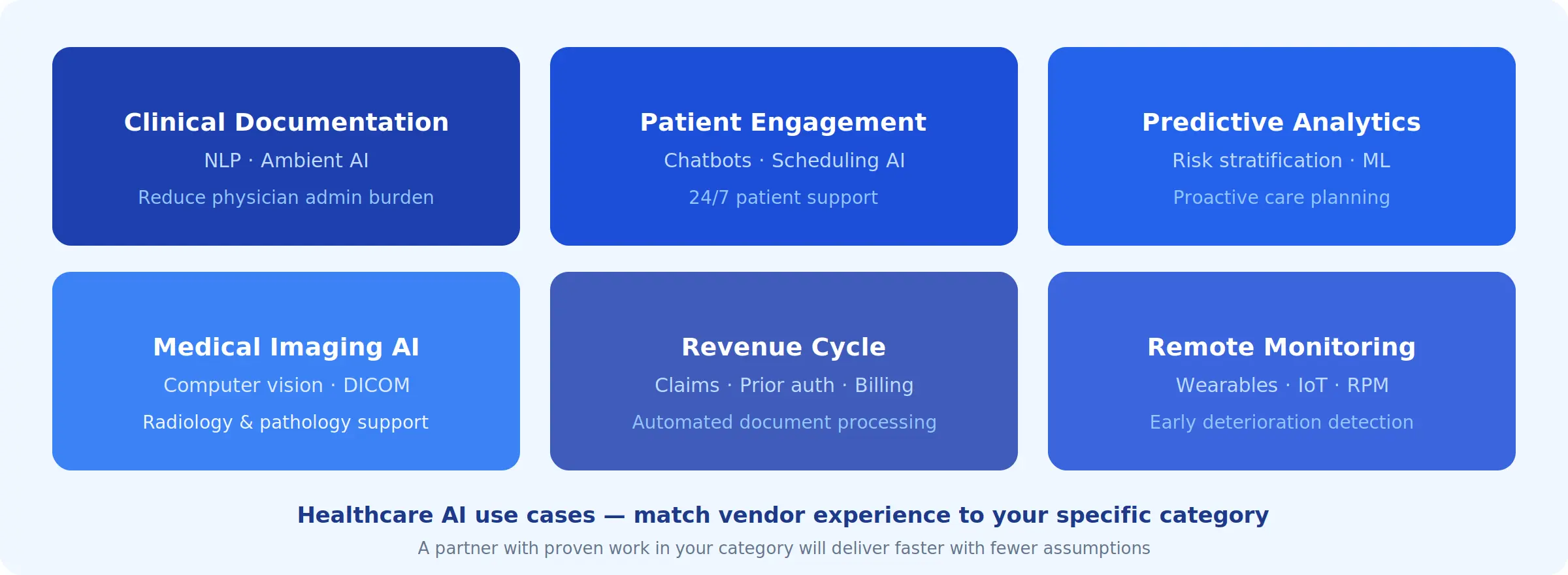 Healthcare AI spans several distinct specializations. A partner with proven work in your category will move faster and make fewer costly assumptions.
Organizations building conversational or agentic systems should look specifically at whether the vendor has experience with multi-step AI agents for healthcare not just single-function chatbots or static prediction models.
How to Run a Practical Vendor Evaluation
Once you know what to look for, structure your evaluation so you’re comparing vendors on the same basis rather than reacting to whoever has the best sales presentation.
Write a clear brief before you speak to anyone
Define your use case, your current system environment, your timeline, and your success criteria. Vendors who receive a clear brief give you better proposals and reveal their thinking faster.
Ask for case studies, not capability statements.
Request two or three relevant project examples with specifics: what was built, how it connected to existing systems, and what the measured outcome was.
Run a structured technical conversation.
Ask about their approach to EHR integration, data handling, model validation, and post-launch monitoring. Weak or evasive answers here are a reliable signal.
Speak to a reference client.
Ask the vendor for a contact at a comparable healthcare organization. Focus your conversation on communication quality, delivery reliability, and how they handled problems.
Commission a scoped pilot before committing.
A small, bounded proof of concept, an integration test, a prototype workflow, and a model validation run tell you far more than any proposal or reference call.

Conclusion
Choosing a healthcare AI development company is not the same as choosing a software vendor. The stakes are different, the constraints are different, and the technical requirements are more specific. Getting this decision right means asking the right questions before a contract is signed about domain experience, integration capabilities, data handling, post-launch support, and alignment between the vendor’s portfolio and your actual use case.
The companies that deliver the best healthcare AI systems are the ones that treat clinical context as a design input, not an afterthought. They build systems that fit the way healthcare actually operates, and they stay engaged long enough to ensure those systems continue to perform.
If you’re in the process of evaluating partners for a healthcare AI application, use the criteria in this guide as your starting framework and treat any vendor who can’t answer these questions clearly as a risk rather than an opportunity.
Frequently Asked Questions
What is a healthcare AI development company?
A healthcare AI development company specializes in building artificial intelligence and machine learning systems for the healthcare industry. Unlike general software agencies, these companies have working knowledge of clinical workflows, healthcare data standards like HL7 and FHIR, EHR integration patterns, and the privacy and regulatory requirements that govern how patient data can be used. Common products they build include clinical documentation automation, patient engagement tools, predictive analytics platforms, diagnostic support systems, and revenue cycle automation.
How is choosing a healthcare AI company different from hiring a general software agency?
The core difference is domain depth and the consequences of errors. A general software agency builds applications; a healthcare-specialized team also understands the clinical environment those applications operate within. In healthcare, a misconfigured AI model, a broken data integration, or an incorrect prediction doesn’t just cause a bad user experience it can affect clinical decision-making. That raises the bar on validation, auditability, security practices, and how the system is monitored after go-live.
Should I hire a healthcare-specialized AI company or a general software firm?
A healthcare-specialized company is the right choice. Healthcare AI is not simply software with medical data attached it operates in a complex and sensitive environment, directly influences patient care decisions, and demands in-depth knowledge of clinical workflows, interoperability standards, and data governance. A general software firm will typically underestimate these requirements. The best company for healthcare AI development brings proven healthcare projects, clinicians on staff, and deep FHIR/EHR integration knowledge. Ramp-up time for generalist firms adds cost and delays that specialized partners avoid.
How should I evaluate a healthcare AI vendor's portfolio?
Go deeper than logos and testimonials. Ask for case studies that answer: what was the clinical or operational problem, what was built and how did it connect to existing systems, and what measurable result was achieved? Then ask to speak with a reference client who can verify those claims. Also check whether the work is close to your use case a portfolio strong in diagnostic imaging AI is not automatically strong in patient scheduling or revenue cycle work.
What data security practices should a healthcare AI development company follow?
A well-structured healthcare AI security approach includes: encryption of data at rest and in transit, role-based access controls that limit exposure of sensitive records, data anonymization or de-identification during model training, regular security audits and penetration testing as part of the standard development cycle, and clearly documented incident response procedures. A key signal is whether the vendor raises these topics proactively during your first scoping conversation or only when you ask.