Key Takeaways
- Scalable AI engagement systems enable healthcare organizations to automate patient communication, triage, and follow-up at volumes that manual workflows cannot sustain.
- An API-first, modular architecture is the foundation for AI engagement tools that integrate with EHR platforms and grow alongside patient volume.
- Starting with a high-frequency, low-complexity use case, such as appointment reminders or post-discharge check-ins, accelerates adoption and builds internal confidence.
- Health systems in California and New York are deploying AI engagement layers to handle rising patient volume across outpatient and specialty care settings.
- Measuring engagement quality, not just delivery volume, is the defining factor in whether an AI engagement system creates lasting clinical value.
Introduction
Patient volume is climbing. Care teams are stretched thin. And the communication gap between providers and patients, between appointments, after discharge, and across chronic condition management programs, is widening every year. Scalable AI engagement systems for healthcare are emerging as one of the most practical ways to close that gap without adding headcount proportional to patient growth.
According to analysis from McKinsey & Company, AI applications in clinical and administrative workflows are increasingly focused on patient-facing engagement, where the opportunity to reduce care gaps and improve follow-through is greatest. Healthcare organizations across California, New York, and nationally are asking the same question: how do we build an AI engagement infrastructure that works at scale, integrates with what we already have, and actually gets used by patients?
This article covers the core architecture, the right use cases to prioritize first, the integration challenges worth planning for in advance, and the critical design decisions that separate an AI engagement system that scales gracefully from one that stalls after the pilot phase.
What Is a Scalable AI Engagement System in Healthcare?
A scalable AI engagement system is a software platform that uses artificial intelligence, conversational interfaces, automation, and real-time clinical data to communicate with patients across multiple touchpoints: before an appointment, after a procedure, throughout a chronic care program, or when a care gap is identified in a patient’s record.
Unlike a single chatbot or a basic SMS reminder tool, a scalable system is designed to handle growing patient populations, multiple care programs, and diverse communication channels from a unified architecture. The defining characteristic is adaptability. The system adjusts messaging based on patient data, responds dynamically to patient inputs, routes escalations to the right clinical team member, and generates engagement data that operational teams can act on.
These platforms typically support voice, SMS, web chat, patient portal integration, and mobile app channels from a single backend, eliminating the fragmentation that plagues many early-stage healthcare AI deployments. The goal is not to replace human care. It is to give care teams intelligent, automated support for the routine, high-volume interactions that consume significant staff time and often fall through the cracks in busy clinical environments.
The Core Building Blocks of a Healthcare AI Engagement Platform
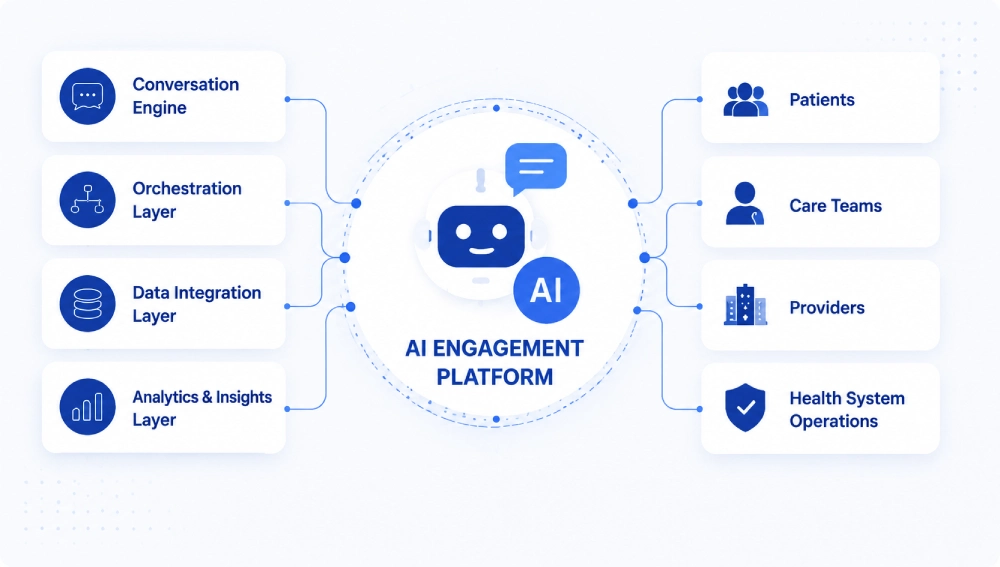
Building a scalable AI engagement system from the ground up, or extending an existing patient communication platform with AI capabilities, requires attention to four foundational layers. Each layer serves a distinct function, and weakness in any one of them limits the system’s overall effectiveness.
Conversation Engine
This is the natural language processing and dialogue management layer. It interprets patient inputs, maintains context across a conversation, and generates responses that are accurate, empathetic, and clinically appropriate. Large language models are increasingly used here, but they require healthcare-specific fine-tuning and carefully designed guardrails to prevent off-protocol responses or inaccurate clinical information reaching patients.
Orchestration Layer
The orchestration layer connects the conversation engine to clinical workflows. It determines when to escalate a conversation to a human, when to trigger an automated action such as scheduling an appointment or sending a lab result summary, and when to route a query to a specialist team versus a general care coordinator. This layer is where the clinical logic lives, and it requires close collaboration between software engineers and clinical operations teams to design correctly.
Data Integration Layer
A healthcare AI engagement system is only as intelligent as the data it can access. FHIR-based APIs are now the standard for connecting AI platforms to electronic health record systems, enabling the system to personalize communication based on a patient’s care history, upcoming appointments, and active care programs. This integration layer also handles bidirectional data flow, writing engagement outcomes back into the EHR or population health platform so that care teams can see the full picture of a patient’s engagement status.
Analytics and Feedback Layer
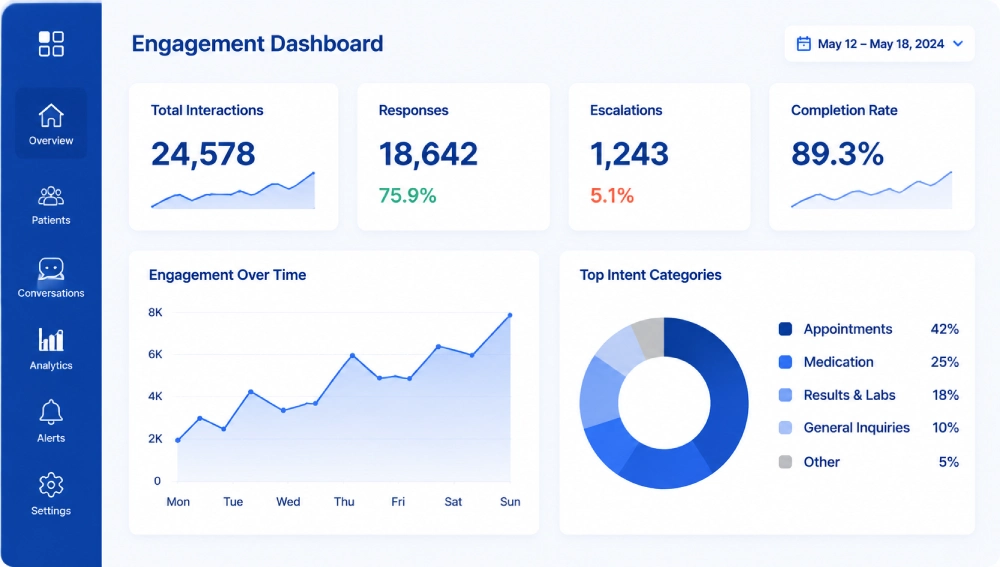
Scalability requires continuous learning. The analytics layer tracks engagement rates, response quality, escalation frequency, and outcome correlations. This data feeds back into model tuning and workflow optimization, allowing the system to improve over time rather than stagnate at its initial performance level. Research published in JAMA Network Open has shown that patient engagement programs with integrated feedback loops and adaptive messaging demonstrate measurably better adherence outcomes compared to static outreach models.
Which Use Cases Should Healthcare Organizations Prioritize First?
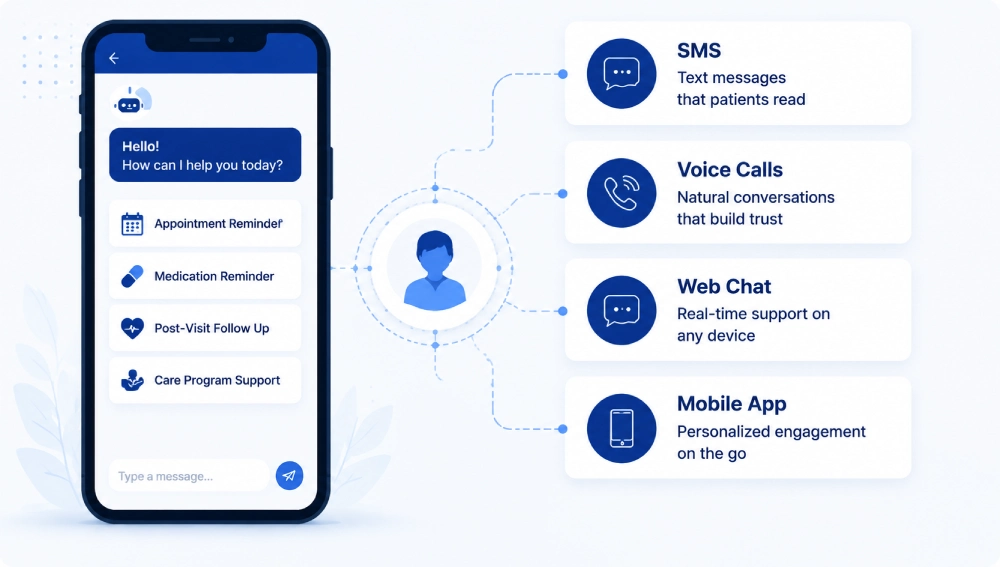
The most common implementation mistake is trying to build everything at once. Healthcare organizations that succeed with AI engagement consistently start with a single, high-frequency use case that has a clear outcome metric and an existing workflow to attach to. These are the use cases that deliver measurable results during the first deployment cycle:
- Appointment reminders and confirmations: High volume, low clinical risk, and measurable impact on no-show rates. Ideal for establishing AI infrastructure and demonstrating value to stakeholders quickly.
- Post-discharge follow-up: Structured check-ins after inpatient or outpatient procedures can identify early warning signs, improve patient confidence, and reduce preventable returns to care.
- Chronic disease program outreach: Patients managing diabetes, hypertension, or heart disease benefit from consistent, personalized check-ins that reinforce care plan adherence between provider visits.
- Preventive care gap closure: AI-driven outreach for overdue screenings, vaccinations, and annual wellness visits helps health systems proactively manage population health at a scale that manual outreach cannot match.
- Pre-procedure preparation: Automated instruction delivery, dietary reminders, and consent confirmation workflows reduce day-of complications and administrative burden for care teams.
According to Rock Health’s digital health research, AI-enabled patient engagement tools deployed in outpatient settings consistently show stronger retention and follow-through compared to traditional phone-based outreach, particularly when the system personalizes the timing and content of communication to each patient’s specific care history and preferences.

What Makes an AI Engagement System Truly Scalable?
Many healthcare organizations deploy an AI engagement pilot that works well for 500 patients and then discover it cannot function effectively at 50,000. Scalability is not automatic. It is designed from the beginning. Several architectural and operational decisions determine whether a system scales gracefully or breaks under load.
Cloud-Native, Event-Driven Architecture
Scalable healthcare AI platforms are built on cloud-native infrastructure with event-driven processing. This allows the system to handle thousands of simultaneous patient conversations, trigger engagement workflows in response to real-time clinical events, and distribute compute load without manual intervention. Stateless microservices and message queues are the standard patterns for this kind of architecture, and they are what allow a system to handle a 10x increase in patient volume without requiring a platform rebuild.
Multi-Tenant, Multi-Program Support
A truly scalable system supports multiple care programs, departments, and patient populations from a single platform instance. This allows a health system to run a post-discharge program for cardiology, a chronic care program for endocrinology, and a preventive care campaign for primary care simultaneously, without managing separate systems for each program or duplicating infrastructure.
Configurable Conversation Flows Without Engineering Dependency
Clinical and operational teams need the ability to update conversation scripts, add new programs, and adjust escalation rules without requiring engineering involvement for every change. Low-code configuration tools that give non-technical staff meaningful control over engagement content are a critical scalability enabler. When every content update requires a developer, the system becomes a bottleneck rather than an asset.
Robust Testing and Clinical Safety Guardrails
As patient volume grows, the risk surface of an AI engagement system grows with it. Scalable platforms include automated conversation testing, edge case detection, and hard boundaries on what the AI can and cannot say. Clinical teams must be able to review AI responses, flag problematic outputs, and adjust guardrails without disrupting live patient interactions. A study overview from Health Affairs found that health systems achieving the highest patient satisfaction with AI-powered communication consistently prioritize transparency features: patients are clearly informed when they are interacting with an AI system, and escalation to a human care team member is always accessible.
Integrating AI Engagement with EHR and Telehealth Platforms
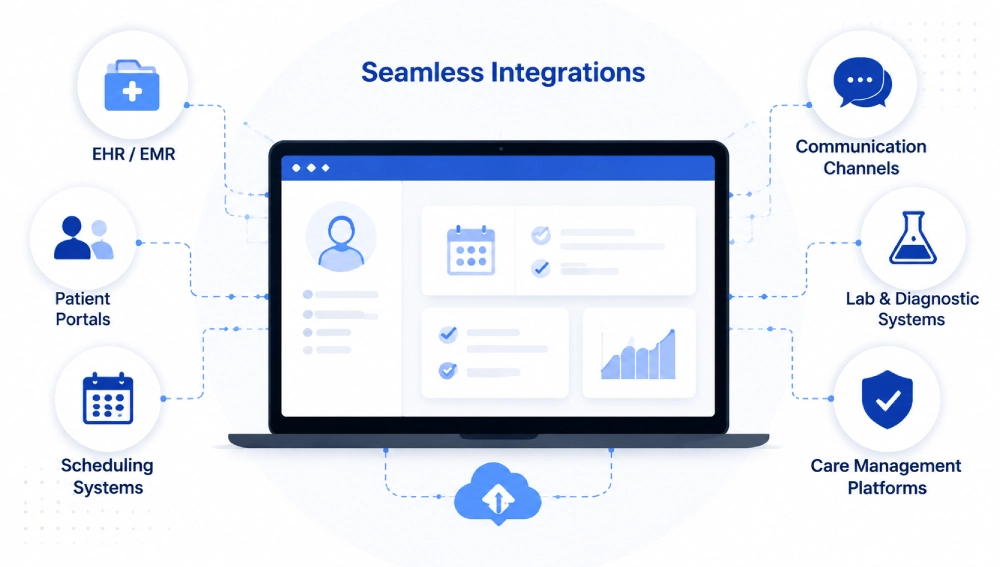
AI engagement systems do not exist in isolation. Their clinical value depends on how well they connect to the rest of a healthcare organization’s technology stack. The most important integration points include:
- EHR systems (Epic, Cerner, Athenahealth): Patient demographics, appointment data, care plans, and clinical notes flow into the engagement engine via HL7 FHIR APIs. Bidirectional integration also allows engagement outcomes, such as a patient’s response to a post-discharge survey, to update the patient’s record in real time.
- Patient portal and mobile applications: Engagement interactions that begin in an SMS or voice channel can be handed off to a patient portal or mobile app for richer interactions, document exchange, or secure messaging with a care team member.
- Telehealth platforms: AI engagement systems increasingly serve as the pre-visit preparation and post-visit follow-up layer for telehealth encounters, automating the communication touchpoints that surround the virtual care visit.
- Population health management tools: Integration with population health platforms allows AI engagement to be driven by risk stratification models, ensuring that the highest-need patients receive the most intensive and timely outreach.
Teams working on healthcare software development consistently find that FHIR adoption across major EHR platforms has significantly reduced integration complexity compared to five years ago, though meaningful interoperability still requires careful API design and ongoing maintenance as EHR vendors continue updating their interfaces.
Avoiding Common Pitfalls When Deploying Healthcare AI Engagement Systems
Even well-designed AI engagement systems encounter predictable failure points during deployment. Understanding these pitfalls allows engineering and clinical teams to design around them from the start.
Treating AI Engagement as a One-Time Implementation
AI engagement systems require continuous tuning. Patient language, care protocols, and organizational workflows change over time. Systems that are not actively maintained degrade in quality and patient trust. Assign ownership for ongoing model maintenance and content updates before the system goes live, not after the first performance drop.
Measuring Only Delivery Metrics
Sending a message and engaging a patient are not the same thing. Organizations that measure only message delivery volume miss the signal entirely. Response rates, escalation rates, care plan adherence, and downstream clinical outcomes such as reduced readmissions or improved chronic disease management indicators are the metrics that reveal whether an AI engagement system is actually working.
Underestimating Content Complexity
Healthcare AI engagement content must be medically accurate, readable at an appropriate literacy level, available in multiple languages for diverse patient populations, and updated whenever clinical guidelines or care protocols change. This is a significant content management burden that many organizations underestimate when scoping their initial deployment.
Skipping the Change Management Process
Care teams that are not involved in designing and testing AI engagement workflows will not trust or support the system after launch. Involving nurses, care coordinators, and frontline staff in defining escalation logic and reviewing conversation scripts dramatically improves adoption. Research from Accenture’s healthcare AI practice consistently identifies staff preparation and change management as the strongest predictors of successful healthcare AI deployment outcomes, ahead of both technology selection and budget allocation.
Our Perspective
In San Diego, and across the California and New York health system landscape we work with, the organizations making the most meaningful progress with AI engagement are not always the ones with the most complex infrastructure or the largest engineering teams. They are the ones that started with a specific clinical problem, built a focused solution with a tight feedback loop, and then expanded deliberately from there.
The teams at Bitcot who work on AI and machine learning development for healthcare clients see this pattern consistently. A well-scoped post-discharge follow-up system that demonstrably reduces preventable returns to care creates far more organizational momentum than a comprehensive engagement platform that takes years to build and launches with lukewarm adoption from the clinical staff it was designed to support.
The goal is to build custom software that fits how care teams already work, then make it smarter and broader over time. Scalability is not about building big on day one. It is about building on a foundation that can grow without being rebuilt.

Conclusion
Healthcare organizations that build scalable AI engagement systems gain a durable operational advantage: the ability to reach more patients, more consistently, with communication personalized to their care journey, without growing staff at the same rate as patient volume.
The path there starts with use case clarity, not platform selection. Define the patient interaction problem worth solving first. Design a modular architecture that can expand as care programs grow. Integrate with existing clinical infrastructure from the beginning so the system is informed by real patient data. Measure what matters clinically, not just what is easy to count. And invest in change management so the care teams working alongside the system trust it and help it improve over time.
If your organization is ready to take the next step toward building or refining a patient engagement platform, the right technical partner can accelerate both the design phase and the path to meaningful outcomes. Reach out to explore what is possible for your care setting.
Frequently Asked Questions
What is a scalable AI engagement system in healthcare?
A scalable AI engagement system is a software platform that uses AI, natural language processing, and automation to communicate with patients across multiple channels including SMS, voice, patient portals, and mobile apps. It connects to clinical data sources to personalize messages, routes escalations to care team members, and generates analytics that help organizations improve outreach quality over time. Unlike a single chatbot, a scalable system is designed to support multiple care programs and large patient populations from a unified architecture.
How long does it take to build a healthcare AI engagement platform?
A focused initial deployment such as an AI-driven appointment reminder or post-discharge follow-up program can typically be built and launched within three to six months when the technical architecture is clearly defined and EHR integration is scoped in advance. More comprehensive platforms supporting multiple care programs, multilingual communication, and advanced analytics require a phased approach with a longer overall timeline. Starting with a single high-value use case and expanding incrementally is consistently the fastest path to organizational adoption and measurable clinical outcomes.
What data integrations are required for AI patient engagement systems?
At minimum, an AI engagement system needs integration with the organization’s EHR platform to access appointment schedules, patient demographics, and care plans. FHIR-based APIs are the current standard for this connection and are supported by all major EHR vendors. Additional integrations with population health management tools, telehealth platforms, and patient portal systems expand the system’s ability to personalize communication. Bidirectional integration, where engagement outcomes write back into the EHR, is essential for the system to create clinical value rather than simply delivering messages.
How do you measure the success of a healthcare AI engagement program?
The most meaningful metrics go beyond message delivery volume. Response rates, escalation rates, appointment adherence, care plan completion, and downstream clinical outcomes such as reduced readmissions or improved chronic disease management indicators provide a clearer picture of engagement effectiveness. Organizations should also track patient satisfaction with AI-driven communication and monitor escalation data for patterns that reveal gaps in the AI system’s ability to handle specific interaction types, using those patterns to guide ongoing model improvements.