Key Takeaways
- The ROI of remote patient monitoring systems is measured across three dimensions: clinical outcomes, operational efficiency, and performance in value-based care arrangements.
- AI transforms RPM from a data collection tool into a clinical decision-support system by replacing static threshold alerts with personalized, predictive risk scoring.
- Evidence consistently shows that RPM programs targeting high-risk populations such as heart failure and COPD patients reduce 30-day readmissions when AI triage and care coordination are in place.
- Health systems in California and New York are deploying AI-powered RPM to extend specialist oversight to underserved communities and manage post-discharge transitions at scale.
- EHR integration, configurable clinical workflows, and care team change management are the factors most responsible for whether an RPM deployment achieves its intended outcomes.
Introduction
A patient is discharged after a hospitalization for heart failure. Their care team sends them home with a follow-up appointment scheduled in two weeks. Within ten days, fluid retention has progressed, symptoms have worsened, and the patient calls 911. By the time they reach the emergency department, what could have been a brief medication adjustment has become a multi-day readmission.
This scenario plays out across US hospitals at a scale that strains clinical capacity and challenges every organization trying to improve the ROI of remote patient monitoring systems. RPM technology was designed to interrupt this cycle. Connected devices and continuous data streams give care teams real-time visibility into patients between visits. But data alone does not prevent readmissions. The difference between an RPM program that generates clinical value and one that generates dashboard clutter comes down to a single question: What does the system do with the data once it is collected?
For hospitals in California, New York, and across the country, the answer increasingly involves AI. This article breaks down where AI in remote patient monitoring actually creates measurable value, what the evidence says about readmission reduction, and what hospital technology teams need to know to build RPM solutions that work at scale.
What Does ROI Actually Mean for RPM Healthcare Systems?
ROI for remote patient monitoring is not a single metric. It is a composite of clinical performance, operational efficiency, and strategic positioning, each of which contributes to the overall value a health system captures from its RPM investment.
Clinical ROI
Clinical ROI is the foundation of the entire value case for RPM. It includes measurable improvements in patient outcomes: reduced readmissions, earlier detection of clinical deterioration, higher chronic disease management adherence, and fewer preventable emergency department visits. Without demonstrable clinical ROI, operational and strategic benefits are difficult to sustain or justify at the board level.
Operational ROI
Operational ROI reflects the efficiency gains that AI-powered RPM delivers to care teams. A well-designed RPM system with intelligent alert prioritization allows a smaller team of nurses and care coordinators to effectively manage a larger monitored population. Instead of reviewing every data point manually or responding to a flood of low-priority alerts, clinical staff receive filtered, ranked notifications that direct attention to the patients who need it most, right now.
Strategic ROI
As CMS and private payers continue shifting reimbursement toward value-based care models, health systems that demonstrate lower readmission rates and better chronic disease management through RPM are better positioned in risk-sharing contracts. RPM data also supports quality metric documentation, population health program reporting, and the kind of longitudinal patient data that informs clinical program development. According to analysis from McKinsey & Company, healthcare organizations that integrate AI into patient monitoring workflows are accelerating their ability to perform under value-based care arrangements, where outcome quality directly drives program sustainability.
How AI Changes What RPM Systems Can Actually Deliver
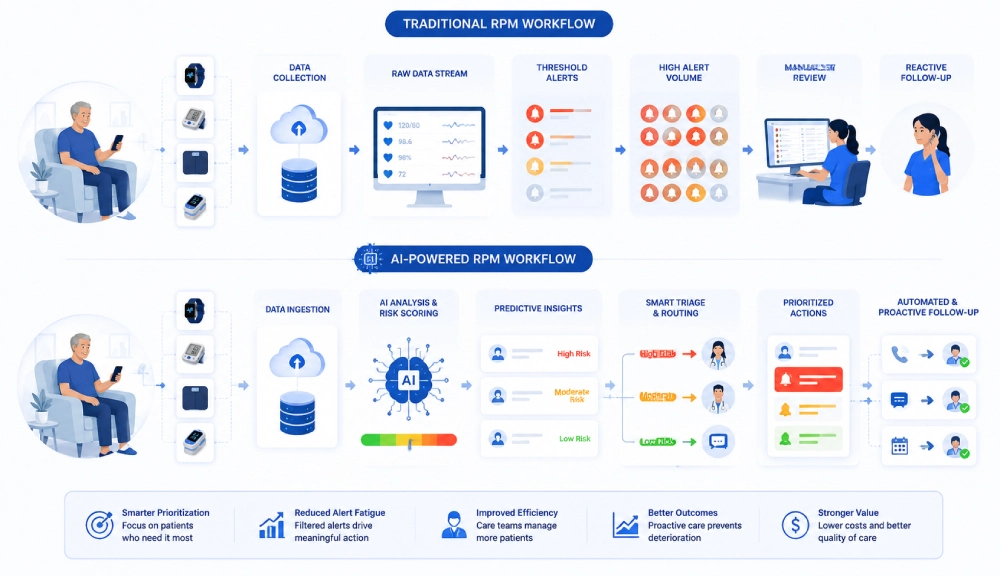
Understanding the benefits of AI in patient monitoring systems requires a direct comparison between what traditional RPM platforms offer and what AI-powered platforms make possible. The difference is not incremental. It is architectural.
Without AI, RPM systems collect and display data. Care coordinators review dashboards and manually flag outliers. Threshold-based alerts fire whenever a patient’s reading crosses a static population-level limit. Alert volume becomes unmanageable at scale, and alarm fatigue sets in: clinicians begin ignoring or delaying responses to notifications, including real warnings embedded in the noise.
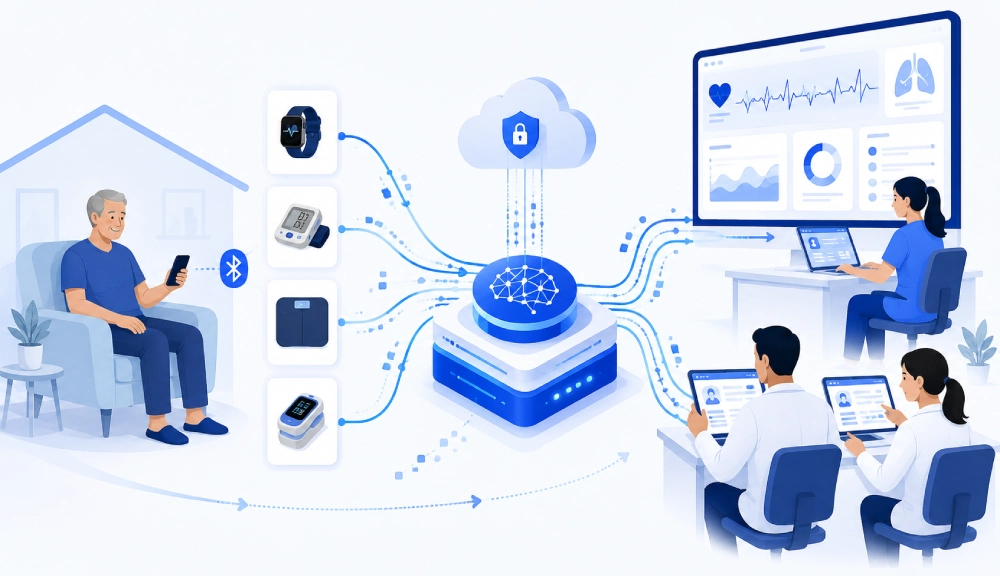
With AI, the system interprets data rather than simply displaying it. Machine learning models learn each patient’s individual physiological baseline and flag deviations that are meaningful for that specific patient, not just statistically unusual for the population. Predictive algorithms identify patients moving toward deterioration before they cross a clinical threshold, enabling proactive outreach rather than reactive intervention. Automated triage routes high-priority alerts to the right care team member immediately, low-priority signals to asynchronous review queues, and routine check-ins to automated follow-up workflows.
The Agency for Healthcare Research and Quality (AHRQ) has identified alarm fatigue as a persistent patient safety concern in both inpatient and remote monitoring contexts. AI-driven prioritization directly addresses this risk by raising the signal-to-noise ratio in alert streams, which is one of the primary barriers to clinical adoption of RPM at scale.
The practical result of this architecture is that care teams using AI-powered RPM spend less time on data management and more time on clinical decision-making. That reallocation of cognitive effort is where the operational ROI of AI in remote patient monitoring is generated.
Does Remote Patient Monitoring Reduce Hospital Readmissions?
This is the most consequential question for hospital administrators evaluating RPM programs, and the published evidence is clear: yes, RPM reduces hospital readmissions when it is implemented with adequate clinical follow-up infrastructure and AI-driven alert management.
The strongest evidence comes from high-risk chronic condition cohorts. Patients with heart failure, chronic obstructive pulmonary disease (COPD), and uncontrolled hypertension represent some of the highest 30-day readmission risk groups in US hospital systems. Studies reviewed in JAMA Internal Medicine have consistently found that RPM programs targeting these populations, particularly those combining connected device monitoring with automated patient outreach and structured care team escalation protocols, demonstrate meaningful reductions in readmissions compared to standard post-discharge follow-up.
The factors that determine whether a given RPM program achieves readmission reduction are predictable:
- Alert responsiveness: How quickly the care team responds to deterioration signals. AI triage that eliminates noise and surfaces real risk drives faster, more confident response times.
- Patient engagement: Whether patients consistently use their monitoring devices and respond to care team outreach. AI-powered engagement tools, including automated check-in messages and personalized reminders, sustain device usage over the life of the program, particularly for elderly and chronically ill populations.
- Data integration: Whether RPM data flows into the EHR and is visible to the full care team. Isolated RPM data silos prevent the coordinated response that prevents readmissions.
- Protocol design: Whether escalation logic is designed by clinicians based on the specific patient population, not copied from generic vendor templates that were built for a different care setting.
Health Affairs research has noted that RPM programs combining strong care team coordination with AI-assisted triage show the most consistent readmission reduction results across diverse patient populations, including Medicaid beneficiaries and rural patients who face structural barriers to traditional follow-up care.
The Core ROI Drivers of AI-Powered RPM Solutions for Hospitals
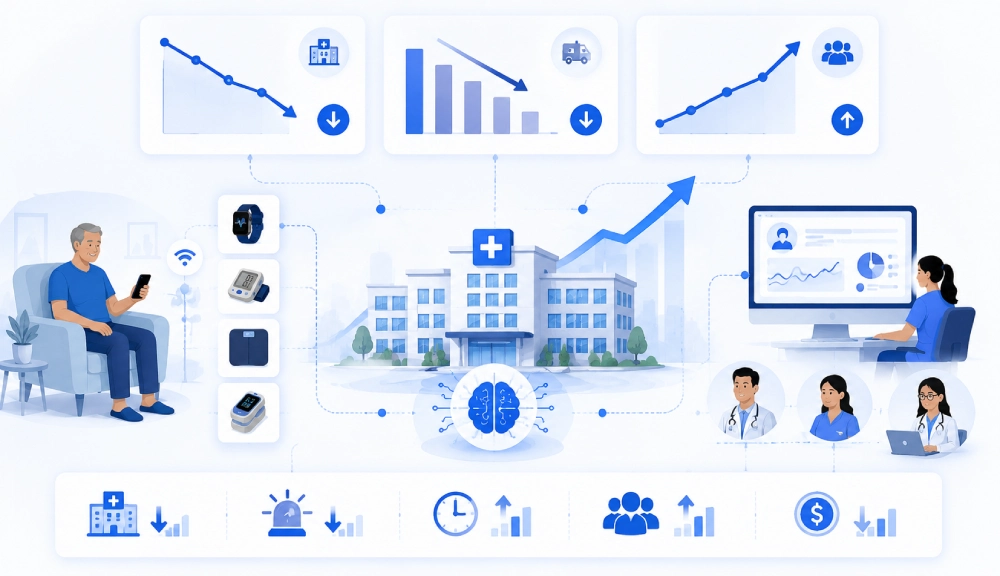
Breaking down the ROI of RPM healthcare systems requires identifying the specific clinical and operational outcomes that AI makes possible. The following are the most consistently documented value drivers across hospital RPM deployments:
Readmission Reduction
AI-powered RPM enables earlier intervention by detecting deterioration before it becomes a clinical emergency. For heart failure, COPD, post-surgical, and high-risk obstetric populations, this benefit is most pronounced and most clearly linked to the AI alert layer rather than monitoring volume alone.
Reduced Emergency Department Utilization
Patients enrolled in active RPM programs with AI-driven proactive outreach are significantly more likely to contact their care team when symptoms begin than to wait until they require emergency care. This shift from reactive to proactive care is one of the most impactful operational changes an RPM program delivers.
Care Team Efficiency and Scalability
AI triage and automated workflow routing allow a clinical team to manage a larger monitored population without sacrificing response quality or increasing staff burnout. This operational leverage is a primary driver of the long-term sustainability of hospital RPM programs.
Chronic Disease Management Improvement
Continuous monitoring paired with AI-generated care plan recommendations supports better management of conditions like diabetes, hypertension, and atrial fibrillation between provider visits. Preventing condition progression reduces the frequency and severity of acute interventions that drive high-acuity utilization.
Patient Satisfaction and Retention
Patients who feel actively monitored and supported between visits report higher satisfaction scores and stronger trust in their care team. This has measurable downstream effects on patient retention and referral volume in competitive healthcare markets like Los Angeles, San Diego, and New York City.

What Should Hospitals Look for in an RPM Solution?
Not all RPM solutions for hospitals deliver equal clinical value. When evaluating platforms, clinical and technology leaders should assess these criteria carefully before committing to a vendor or building internally:
AI Capability Depth
Evaluate whether the platform uses machine learning for personalized patient baselines, predictive risk scoring, and intelligent alert prioritization, or simply applies static thresholds across all patients. The difference in clinical signal quality between these two approaches is significant and directly affects care team adoption.
EHR Integration Quality
The RPM platform must connect to your EHR via FHIR-compliant APIs and support bidirectional data exchange. Platforms that require manual data transfer or generate isolated datasets do not deliver the care coordination benefits that drive measurable ROI. Integration capability should be validated in a technical proof of concept before procurement, not assumed from vendor documentation.
Device Ecosystem Flexibility
Hospitals serve diverse patient populations with varied connectivity options and device literacy levels. Effective RPM solutions support a broad range of Bluetooth and cellular-enabled monitoring devices and accommodate patients who have limited prior experience with connected health technology.
Configurable Clinical Workflows
Every hospital has different care team structures, escalation protocols, and patient populations. The platform should allow clinical teams to configure alert logic, escalation pathways, and engagement workflows without requiring vendor involvement for routine adjustments. When every protocol change requires a support ticket, clinical adoption stalls.
Validated Outcomes Evidence
Ask vendors for published outcomes data from comparable health system deployments. The platform’s AI models should be validated on patient populations that resemble your own. A solution with strong evidence in commercial insurance populations may perform very differently in a Medicaid-heavy or rural patient mix.
According to the American Heart Association, heart failure patients enrolled in structured remote monitoring programs with proactive care team follow-up show stronger adherence to care plans and lower rates of preventable deterioration than those managed through standard in-person follow-up schedules alone.
Integrating AI-Powered RPM with Hospital Infrastructure
The integration architecture of an RPM solution determines how deeply it can support clinical decision-making across a hospital’s care continuum. Key integration points for hospital technology teams include:
- EHR integration: Patient enrollment data, care plans, and diagnostic history flow from the EHR into the RPM platform, enabling AI models to contextualize monitoring data against each patient’s clinical baseline. Alert responses and engagement outcomes write back to the EHR in real time, keeping the full care team informed.
- Clinical alert management systems: High-priority RPM alerts should flow directly into the hospital’s existing notification infrastructure so care team members receive them through familiar channels without switching between platforms.
- Population health platforms: RPM data integrated with population health tools enables risk stratification at the program level, identifying which patients need monitoring intensity adjustments and which can safely transition to lower-touch follow-up protocols.
- Telehealth platforms: RPM programs paired with telehealth capabilities create a complete remote care continuum. Monitoring data informs the agenda of virtual visits, and care plan changes made during those visits are reflected immediately in the monitoring protocol.
Teams experienced in healthcare software development consistently emphasize that integration planning must begin during the vendor evaluation process, not after contract signature. Assumptions about API compatibility and data mapping that go unvalidated at the start are the most common cause of deployment delays and scope creep in RPM program launches.
How California and New York Health Systems Are Approaching RPM
Health systems in California and New York are deploying AI-powered RPM at scale, driven by large Medicaid and Medicare Advantage populations, high chronic disease burden, and telehealth infrastructure expanded significantly during the COVID-19 pandemic.
In California, health systems across San Diego, Los Angeles, and the Central Valley are using RPM to extend specialist oversight to patients in communities underserved by in-person specialty care. AI-powered alert management enables a cardiologist or pulmonologist based in a major medical center to effectively monitor patients in communities hours away, with intelligent filtering ensuring that only genuinely concerning changes require direct physician attention.
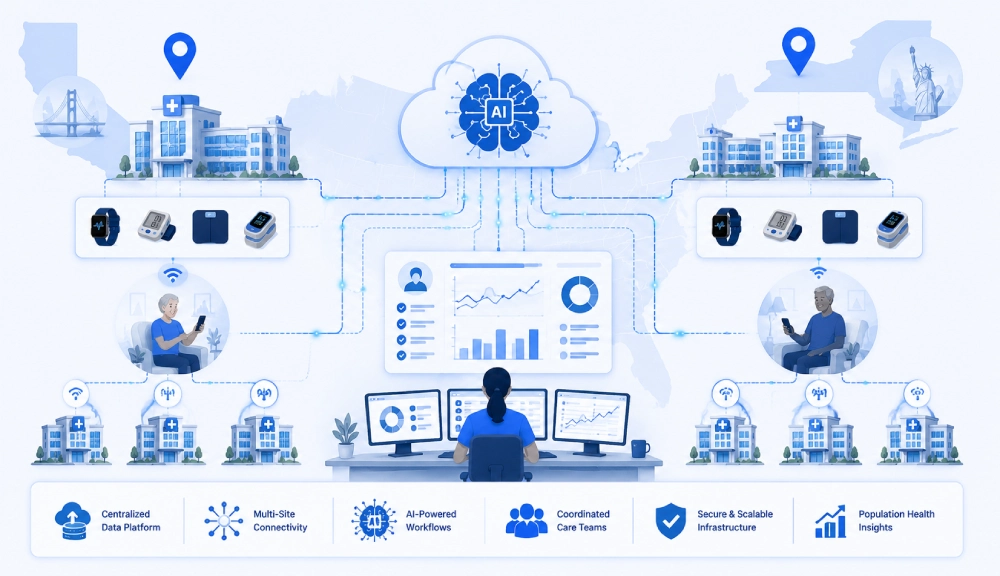
In New York, dense urban hospital systems are deploying RPM to manage post-discharge transitions for high-risk patients who are difficult to reach through traditional follow-up protocols. AI-driven engagement tools sustain device usage and care team communication in these populations, where social determinants of health, such as transportation barriers and competing caregiving responsibilities, frequently interrupt standard follow-up schedules.
Bitcot’s AI and machine learning development teams have worked with healthcare clients in these markets to design RPM data pipelines, alert management architectures, and patient engagement layers that fit the specific clinical workflows and population characteristics of each deployment environment.

Our Perspective
In our work building healthcare software in San Diego and for health system clients across California and New York, the RPM deployments that achieve the strongest and most durable outcomes share one defining characteristic: they treat the AI layer as a clinical tool, not a technology feature.
The Bitcot team’s experience with custom healthcare software across outpatient chronic care, post-acute recovery, and population health programs consistently shows that AI adds its most significant value not at the monitoring layer but at the decision layer. The question that drives real outcomes is: which patient needs attention right now, what is the right response, and who on the care team should act?
RPM infrastructure designed with that decision-support architecture at its center performs measurably and consistently better than platforms where AI is added as an afterthought to basic monitoring tools. That design philosophy is what separates RPM programs that achieve lasting clinical impact from those that stall after the pilot phase.
Conclusion
The ROI of remote patient monitoring systems is not found in the devices or the data streams. It is found in what care teams can do with that data when AI is doing the work of filtering, predicting, and prioritizing on their behalf.
For hospitals evaluating or expanding their RPM programs, the differentiating factor is architectural: build systems where AI is embedded in the clinical workflow from the beginning, not layered on top after deployment. Start with the patient populations where readmission risk is highest, and monitoring benefit is best documented. Integrate with your EHR and care team infrastructure before going live. Measure outcomes at the clinical level, not just the operational one.
When the AI layer is designed correctly, remote patient monitoring becomes one of the most effective tools in a health system’s portfolio for improving patient outcomes and managing population health at scale. Reach out to a technical team that understands both the clinical context and the engineering requirements to get there.
Frequently Asked Questions
What is the ROI of remote patient monitoring for hospitals?
The ROI of remote patient monitoring systems spans three categories: clinical ROI (reduced readmissions, earlier detection of deterioration, better chronic disease management), operational ROI (care team efficiency and the ability to monitor larger patient populations without proportional staff increases), and strategic ROI (stronger performance in value-based care contracts where outcomes drive reimbursement). The combined impact across these three areas is what makes RPM one of the highest-value technology investments available to health systems managing chronic and high-risk patient populations.
Does remote patient monitoring reduce hospital readmissions?
Yes, published evidence consistently shows that RPM programs targeting high-risk populations, particularly patients with heart failure, COPD, and uncontrolled hypertension, reduce 30-day readmissions when implemented with AI-driven alert management and structured care team follow-up. The key factors are alert responsiveness, patient engagement with monitoring devices, EHR data integration, and clinical escalation protocols that are designed for the specific patient population rather than based on generic vendor templates.
How does AI improve RPM systems compared to traditional monitoring tools?
Traditional RPM platforms collect and display data, relying on care coordinators to manually review dashboards and respond to static threshold-based alerts. AI-powered RPM systems learn each patient’s individual baseline and generate predictive risk scores that flag deterioration before it crosses a clinical threshold. AI triage also filters irrelevant alerts, routing only high-priority signals to clinical staff and dramatically reducing the alarm fatigue that prevents care teams from adopting RPM at scale. The result is faster response times, higher clinical confidence, and better patient outcomes per monitored patient.
What should hospitals look for when evaluating RPM solutions?
Hospitals evaluating RPM solutions should prioritize AI capability depth, FHIR-compliant EHR integration, device ecosystem flexibility, and the ability for clinical teams to configure workflows without vendor dependency. Equally important is asking vendors for published outcomes data from comparable health system deployments, validating that the platform’s AI models perform well on patient populations similar to your own. Change management readiness within the care team is as important as the technology selection itself in determining whether a deployment achieves its intended clinical results.
What clinical populations benefit most from AI-powered remote patient monitoring?
Heart failure, COPD, hypertension, diabetes, and post-surgical recovery patients represent the populations with the strongest evidence base for RPM benefit. These groups share high readmission risk, frequent between-visit deterioration events, and chronic condition trajectories that respond well to continuous monitoring and proactive outreach. High-risk obstetric patients and those managing atrial fibrillation are also strong candidates for AI-powered RPM based on published outcomes data from hospital deployments across the United States.